Cognitive Coaching with Mary Bouley, ep. 282
Most instructional coaches are dropped into their roles without training or any real guidance. This month, we’re exploring different universal models of instructional coaching so you can draw from them and build your own approach that supports your teachers!
Last week, we talked about Student-Centered Coaching with Diane Sweeney. This week, Mary Bouley joins me to discuss Cognitive Coaching.
During the episode, Mary provides an introduction to Cognitive Coaching, including how it differs from other approaches. She explains why Cognitive Coaching is more relevant than ever in today’s high-pressure school systems. You’ll discover how it fosters teacher independence, helping them become more self-reliant. Plus, learn the first steps for getting started with Cognitive Coaching!
Instead of focusing on “fixing” teachers, Cognitive Coaching builds trust and supports self-directed growth. Listen to the full episode now. For the highlights, keep reading below!
What Is Cognitive Coaching?
To start the conversation, Mary gives us a brief introduction to Cognitive Coaching. She explains that Cognitive Coaching is more than an approach; it’s a way of being rooted in trust, nonjudgment, and genuine care.
Developed by Arthur Costa and Robert Garmston, it centers on the idea that the biggest impact a coach can make comes from supporting a teacher’s thinking and energy. The mission of the work is to produce self-directed people with the cognitive capacity for excellence both independently and in community.
Unlike a more behaviorist approach, Cognitive Coaching asks coaches to trust the process and allows teachers to sort out their challenges in their own time. It aims for lasting transformation by cultivating reflection, problem-solving, and intrinsic motivation. Coaches create a space where teachers can process their feelings and energy, explore their beliefs, and develop their own solutions.
In today’s education landscape, with its sense of urgency, instructional coaches may struggle to embrace this type of coaching due to time constraints and competing priorities. There’s often pressure to step in and fix things. But as Mary explains, people don’t change on a dime. True transformation takes time, relationships, and community. She believes that most capable administrators know in their hearts that lasting change can’t be rushed, but they are under constant pressure from the demands of the system.

Starting out as an instructional coach can be so overwhelming! It can feel like there are too many things to do, and you just don’t know where to start. This resource includes a guide, printables, and fillable forms (PDFS) to build relationships, have a dialogue with your administrator, review data and make a plan, visit classrooms, and more! Get the First 20 Days of Instructional Coaching Start Up Kit and Forms today!
How Does Cognitive Coaching Differ from Other Coaching Approaches?
Mary and I discussed how cognitive coaching differs from other models. She says one thing that sets Cognitive Coaching apart is that it is “who you are choosing to be”.
Cognitive Coaching helps teachers become aware of their thinking and capacity, giving them space to process both their thoughts and emotional state. The coach’s role is to ask questions that build the teacher’s sense of efficacy and mastery.
Mary explains that a measure of a Cognitive Coaching conversation is the shift in energy. Coaches lean into five states of mind (which are energy sources): consciousness, flexibility, interdependence, efficacy, and craftsmanship. The coach reflects on whether the teacher is leaving the conversation feeling more empowered, rather than weighed down or dependent.
To hear Mary describe what a Cognitive Coaching conversation with a teacher sounds like, be sure to listen to the full episode using the player below!
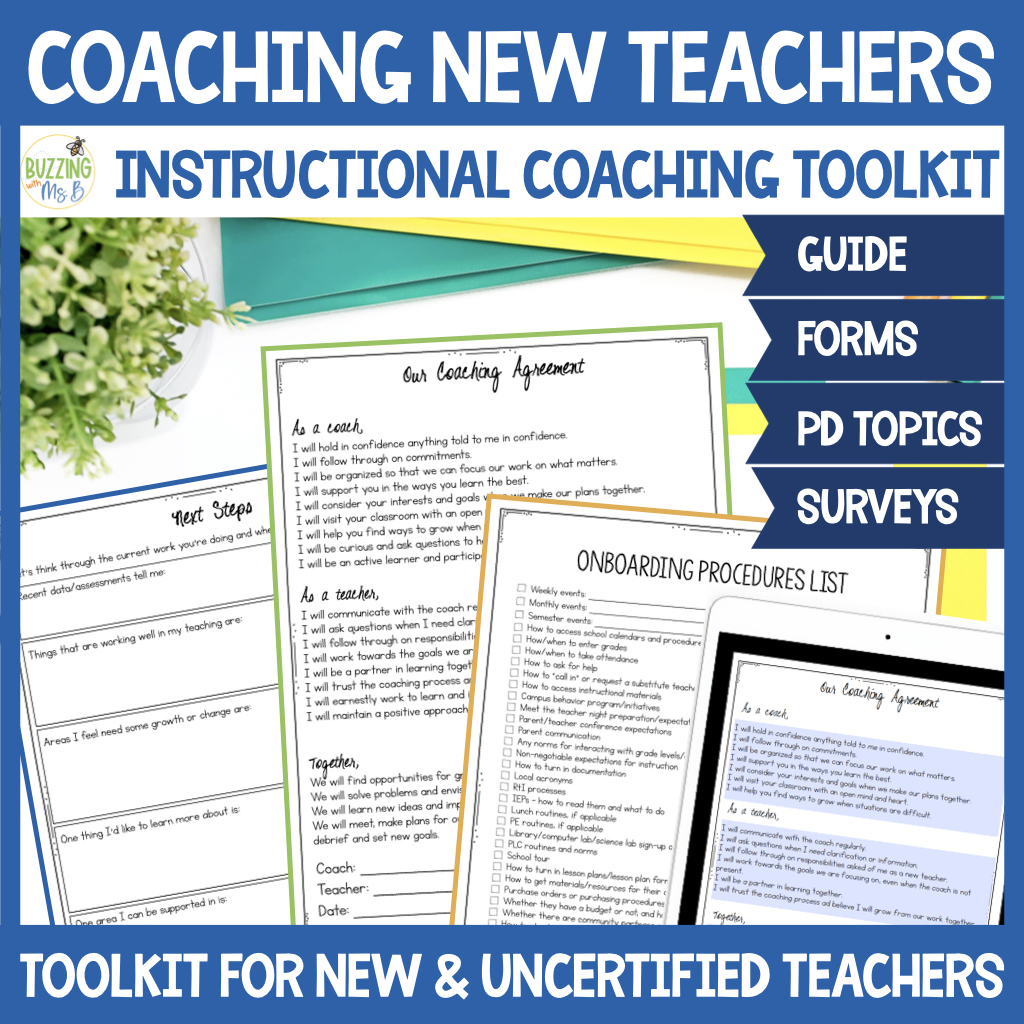
Have a plan for working with new and uncertified teachers with the Coaching New Teachers Toolkit!
It includes forms, templates, and everything you need to help your new and uncertified teachers! Figure out what support the need and provide PD and coaching with these resources. Grab the Coaching New Teachers Toolkit in my TpT Store!
⭐⭐⭐⭐⭐ “I support & coach new teachers and this resource is so valuable. I purchased it several months ago and often use tips you suggested when working with teachers. It is an essential section of my “Teacher Support Provider Binder” that I carry around with me everywhere.”
How Cognitive Coaching Supports Teacher Independence
So, how does Cognitive Coaching support teacher independence over time?
Mary tells us that the gold standard in Cognitive Coaching is self-directedness. The goal is to help teachers self-monitor, self-modify, and self-manage so they can reflect on their practice and solve problems independently long after the coach is gone. This shift is crucial in an education culture that pushes compliance and quick fixes.
As we all know, some teachers aren’t aware of their own blind spots or how their actions influence student behavior in the classroom. Over time, teachers who take part in Cognitive Coaching develop more self-awareness. Building this self-awareness takes patience, reflection, and a willingness to bring patterns to light in a caring environment.
We also talk about judgment, which is something I’ve had to work on myself. Mary explains that we’re wired to judge, so it’s natural. What she does is set aside judgment in the moment and trusts that the person is doing their best. She acknowledges this can be difficult when you walk into a classroom and see children affected by a struggling teacher. But ultimately, she returns to the belief that teachers are doing their best, and as instructional coaches, our role is to support them and help them grow.

Be ready for anything with the Instructional Coaching Editable Binder Megapack!
It includes forms, templates, and everything you need to get organized for instructional coaching! Coach teachers and document your coaching work with these printable and editable tools. Grab the Instructional Coach Binder Megapack in my TpT Store!
Getting Started with Cognitive Coaching
For anyone interested in exploring Cognitive Coaching, Mary suggests several practical first steps:
- Visit thinkingcollaborative.com to learn more about trainings, articles, and resources.
- Attend a Cognitive Coaching Training (often offered by districts, but sometimes open to other individuals in the community).
- Share Cognitive Coaching with your leadership team and ask them to bring it to your school or district.
- Read more about it, including the Cognitive Coaching textbook and related articles.
Cognitive Coaching for Teachers
I hope this episode piqued your interest in Cognitive Coaching. I really enjoyed my conversation with Mary, and I know you will too.
Ready to dig into Cognitive Coaching? Listen to the episode now!
Topics and Questions Discussed in Episode 282 – Cognitive Coaching with Mary Bouley
- An introduction to Cognitive Coaching
- How Cognitive Coaching differs from other coaching approaches
- Examples of Cognitive Coaching conversations
- The five states of mind: consciousness, flexibility, interdependence, efficacy, and craftsmanship
- How Cognitive Coaching supports teacher independence and self-direction
- Supporting teachers without judgment
- Practical first steps for getting started with Cognitive Coaching
About Mary Bouley
Mary Bouley is an educator with 40 years of experience from Pre-K to higher education. She first encountered Cognitive Coaching in 2006 and has been a Cognitive CoachingSM Training Associate for Thinking Collaborative since 2015.
Turning Insight Into Action: Practical Steps You Can Take After Listening
Here are simple actions you can take today:
1️⃣ Grab the FREE First 20 Days of School Checklist
If you are feeling nervous about back to school and unsure how to set yourself up for a successful year, grab the FREE First 20 Days of School Checklist. It’s perfect for coaches who are new or trying to have a do-over at the beginning of the school year.
2️⃣ Join the Instructional Coaching Club
The Instructional Coaching Club is an online membership designed to help instructional coaches improve instruction at their schools. It gives coaches the tools to go out and do it.
3️⃣ Share this episode about Cognitive Coaching
If this episode inspired you, share it with a fellow coach or administrator. Start a conversation about how you could use Cognitive Coaching on your campus.
Ready to listen?
This post contains links to products from one or more of our advertisers. This means I may receive commissions for purchases made through links in this post when you click on links to those products. Thank you for your support!
Learn more
- Episode 139 – Better Coaching Conversations with Arthur Aguirre, Ph.D.
- Episode 281 – Student-Centered Coaching with Diane Sweeney
- Buzzing with Ms. B on Instagram
- Join My Facebook Group: Instructional Coaching with Ms. B
- FREE First 20 Days of School Checklist
- Mary Bouley (Thinking Collaborative)
- Email MaryBouley@cox.net
Helpful Resources
- Join the Instructional Coaching Club
- First 20 Days of Instructional Coaching Start Up Kit and Forms
- First 20 Days of Instructional Coaching Start Up Kit and Forms on TpT
- Instructional Coach Binder Megapack – Editable Forms, Calendars, Planning Tools
- Instructional Coaching Binder Megapack – Editable Forms, Documents & Tools on TpT
- Buzzing with Ms. B TpT Store
- The Confident Literacy Coach
- Simply Coaching Summit
- Book – Cognitive Coaching: Developing Self-Directed Leaders and Learners
Listen on: Apple Podcasts, Spotify, or your favorite listening app

Thank you for listening to Buzzing with Ms. B: the Coaching Podcast. Want more coaching ideas
Check me out at buzzingwithmsb.com and on Instagram @buzzingwithmsb.
If you love the show, share it with a coach who would love it too, or leave me a review on iTunes! It’s free and it helps others find this show, too. Happy coaching!
Podcast produced by Fernie Ceniceros