| | |

The Foundational Principles of Instructional Coaching, ep. 285

Instructional coach writing in a book on a desk. These words are at the bottom "The Foundational Principles of Instructional Coaching".

Coaching doesn’t come with a handy little manual! 

One minute you’re planning a coaching cycle, the next you’re facilitating a PLC, analyzing data, putting out fires, and trying to build relationships with teachers, all before the end of first period. It’s no wonder instructional coaching can feel so overwhelming.

While there isn’t a playbook for every situation, there are several principles that govern our work as coaches. 

In this episode, I share the six foundational principles of instructional coaching and explain how they can strengthen your coaching practice. This podcast is part of the Get Focused on Instructional Coaching! series, which will help you make some decisions about the big picture of your instructional coaching work this year.

Listen to the full episode! Here are the highlights!

Starting out as an instructional coach can be so overwhelming! It can feel like there are too many things to do, and you just don’t know where to start. This resource includes a guide, printables, and fillable forms (PDFS) to build relationships, have a dialogue with your administrator, review data and make a plan, visit classrooms, and more! Get the First 20 Days of Instructional Coaching Start Up Kit and Forms today!

How Jurassic World Inspired the 6 Foundational Principles of Instructional Coaching

Ever watch the movie Jurassic Park? It’s my youngest brother’s favorite movie, and collectively, we’ve probably watched it 700 times.

One Saturday, while watching the Jurassic World series, we talked about how the filmmakers created rules that governed the dinosaurs’ behavior, helping the story feel more believable. For example, the dinosaurs were treated as animals, not monsters like Godzilla.

I thought that was really interesting! Then, I thought instructional coaches need a set of foundational principles to guide us too. My coaching principles grew out of this Jurassic Park revelation.

Let’s dig in and break down each of the six foundational principles I rely on to anchor my coaching. To hear the full story about how I came up with these principles, be sure to listen to the full episode!

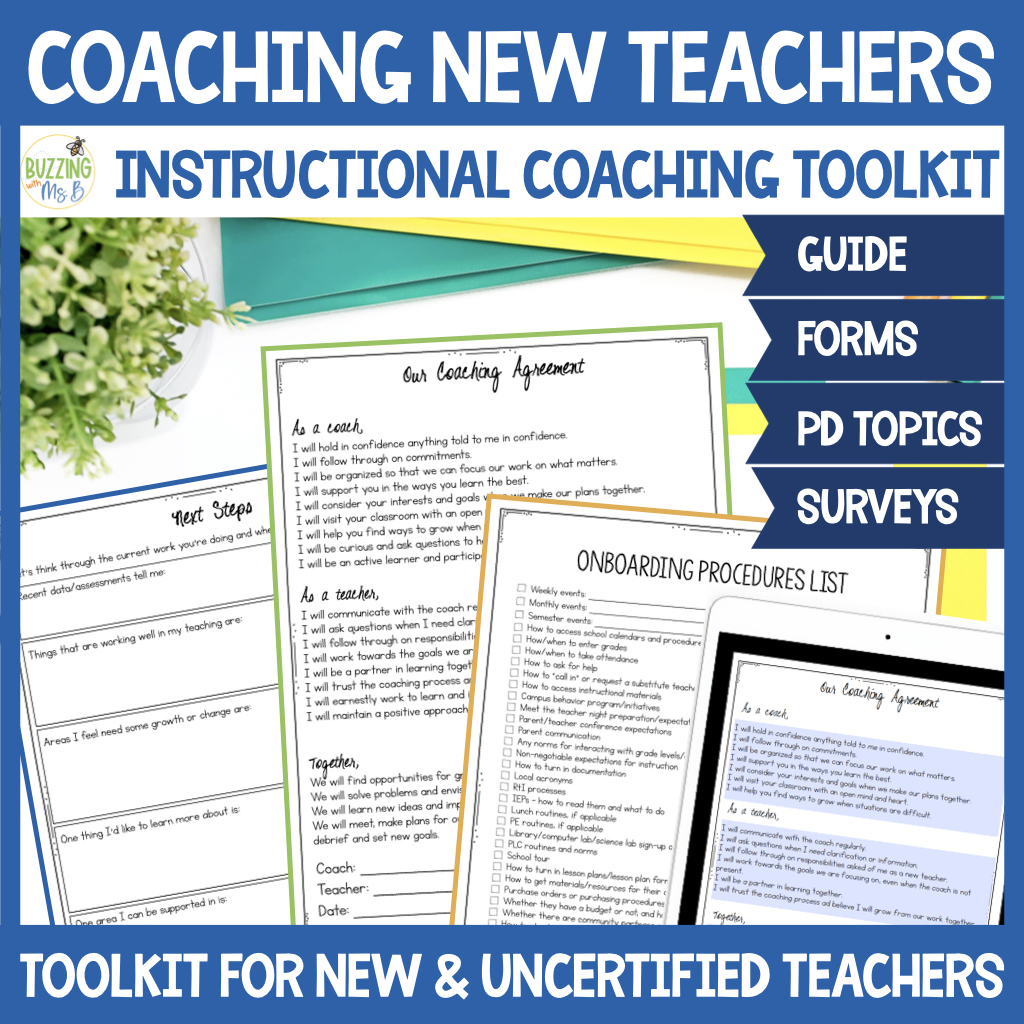
Have a plan for working with new and uncertified teachers with the Coaching New Teachers Toolkit!

It includes forms, templates, and everything you need to help your new and uncertified teachers! Figure out what support the need and provide PD and coaching with these resources. Grab the Coaching New Teachers Toolkit in my TpT Store!

⭐⭐⭐⭐⭐ “I support & coach new teachers and this resource is so valuable. I purchased it several months ago and often use tips you suggested when working with teachers. It is an essential section of my “Teacher Support Provider Binder” that I carry around with me everywhere.”
The 6 Foundational Principles of Instructional Coaching

Here are 6 foundational principles for instructional coaching!

1️⃣ Coaches support teacher growth and learning for all teachers

Too often, instructional coaches are designated to work with “struggling teachers”. I feel like this really limits our capacity to provide support to ALL teachers and to truly develop coaching relationships that can change the whole school. As I always say, every teacher deserves a coach!

2️⃣ A clearly defined role, understood by all stakeholders, is necessary for the success of coaching

If you can start with a clearly defined role, you’re way ahead of the game! When teachers, administrators, and other stakeholders know what you do (and what you don’t do), it builds trust, clarifies expectations, and makes it easier to develop strong coaching partnerships.

3️⃣ Coaches serve their schools at different levels in different ways

Coaching isn’t one-size-fits-all! We have to be thoughtful about our teachers’ different needs. In episode 284, we dig into the COACH framework and how you can use it to support teachers at various levels. We also need to support them in different ways, and that’s where The Coaching Strategy Toolbox comes in. Having flexible strategies lets us differentiate our coaching support to meet teachers where they are in the moment and move them forward.

4️⃣ Teachers learn best when they choose the types of support they receive

Teachers are more willing to learn, experiment, and engage in the coaching process when we give them agency. Whenever possible, let teachers pick from a “menu” of coaching options.

5️⃣ Focusing on student learning and behaviors helps coaches and teachers improve their practice

The ultimate goal of coaching is not just to help teachers; it’s to support student learning. Shift the focus from what the teacher does and says to how kids learn and behave, and what instructional strategies could improve outcomes.

6️⃣ Every teacher interaction is an opportunity

Coaching is a long game. Every teacher interaction is an opportunity to build trust, strengthen relationships, and lay the foundation for future coaching work. By being intentional with each conversation, we create opportunities for deeper coaching over time and better support every teacher in the school.

If you want more support, join the Instructional Coaching Club. Every month you’ll get coaching resources and fun bonuses that keep the joy in coaching and save you a whole lot of time. You’ll also get access to a video about the foundational principles of instructional coaching that can help you implement these practices.

Be ready for anything with the Instructional Coaching Editable Binder Megapack!

It includes forms, templates, and everything you need to get organized for instructional coaching! Coach teachers and document your coaching work with these printable and editable tools. Grab the Instructional Coach Binder Megapack in my TpT Store!

The Foundational Principles of Instructional Coaching

Coaching is tough, but when you ground yourself in these six principles, you start to find your own path forward. I hope these principles support you as you build your coaching program and support meaningful growth in your school.

Grab your coffee and listen to the full episode to hear about these six foundational principles of instructional coaching!

Topics and Questions Discussed in Episode 285 – The Foundational Principles of Instructional Coaching

  • The 6 foundational principles of instructional coaching
  • How the Jurassic World series inspired my coaching principles
  • Coaching ALL teachers, not just “struggling” ones
  • Getting clear on your coaching role
  • Differentiating your coaching support
  • The importance of agency in the coaching process
  • Focusing coaching on student learning and outcomes
  • Treating every teacher interaction as an opportunity

Turning Insight Into Action: Practical Steps You Can Take After Listening

Here are simple actions you can take today:

1️⃣ Join the Instructional Coaching Club

If you’re looking for ongoing coaching support, I would love to see you in the Instructional Coaching Club! You get access to a video about the foundational principles of instructional coaching that can help you implement these principles.

2️⃣ Download the FREE First 20 Days of School Checklist

If you’re gearing up for a new year or need a reset, grab the FREE First 20 Days of School Checklist to set yourself up for a successful, impactful year of coaching!

3️⃣ Build Your Coaching Menu

Brainstorm the different ways you can support teachers this year. Create your coaching menu and invite teachers to pick what works best for them.

Want a resource that includes a coaching menu, slide show, invitations for a special “Meet the Coach” event, and a guide to teach you how to do it? Grab the “Meet the Coach Slide Show & Coaching Menu for Instructional Coaches” here!

Ready to listen?

  • Ready to listen? You can listen below with the media player, or search for Buzzing with MS. B: The Coaching Podcast anywhere you listen to podcasts!

This post contains links to products from one or more of our advertisers. This means I may receive commissions for purchases made through links in this post when you click on links to those products. Thank you for your support!

Learn more

Helpful Resources


Listen on: Apple Podcasts, Spotify, or your favorite listening app


Thank you for listening to Buzzing with Ms. B: the Coaching Podcast. Want more coaching ideas

Check me out at buzzingwithmsb.com and on Instagram @buzzingwithmsb.

If you love the show, share it with a coach who would love it too, or leave me a review on iTunes! It’s free and it helps others find this show, too. Happy coaching!

Podcast produced by Fernie Ceniceros

The Foundational Principles of Instructional Coaching, ep. 285, Instructional Coaching with Ms. B Podcast

Chrissy Beltran (00:01.4)

Hey coach, and welcome to Instructional Coaching with Miss B. Today we are talking about the foundational principles of instructional coaching. This is part of the Focus on Instructional Coaching series where we help get your brain ready for all of the coaching work that you’re gonna do this year by making some decisions about the big picture of instructional coaching.

If you’re feeling overwhelmed, you’re not alone and I have a great checklist that can help you out. It’s gonna help you narrow down the millions of things you could be working on into the very specific tasks you do need to work on in the first 20 days of school. And this will help you set yourself up for a successful, impactful year of coaching. Grab the handy first 20 days of coaching checklist at buzzingwithmissb.com slash first 20, that’s first two zero, and be ready to coach your teachers this school year with intention.

Okay, so here’s how I came about creating these foundational principles of instructional coaching. And I know I’m not the first person to create these, okay? I know that I’ve seen other people who have their own, but I didn’t really think about it until one day I was talking to my brother and my youngest brother, Matthew, he comes over once a week on Saturdays. He is 16 years younger than me. And so I’m essentially an old lady. And so I really…

love that he still comes over to visit, even if it’s just to use my washer and dryer, because he lives in an apartment and, you know, doesn’t want to do a laundromat. So he comes to visit me once a week on Saturday and we watch series movies. So we’ve been doing this since about 2019. We had to take a little hiatus for the pandemic lockdown. And then we jumped back in. We started out with Marvel movies. And the reason we did this, which is unrelated to the foundational principles of coaching, is that we were

watching, he was like, I’ll come do my laundry, I’ll hang out. That’s when he moved out and got his own place. And he was like, I’ll come over on Saturday to use your washer. And I said, OK, cool, we can watch a movie. And he came on Saturday and we flicked around choosing a movie for probably about 45 minutes. I don’t know if we ever settled on anything. We probably ended up watching some TV show or some crummy movie we didn’t really pick. It just kind of like we didn’t know what else to do. And so it is instead of like enjoying that time, we were like this was this was dumb, right?

Chrissy Beltran (02:10.882)

And then I said, you know what, what if we watched series movies? And so every day we watch another, or every Saturday that you come over, we watch another installment of that series. So for example, Jurassic Park, first we watched Jurassic Park and then the next time we watched, you know, the, is, what’s the second one? my gosh, Lost World. And then we just keep moving, you know, in that way.

And he was like, oh, that makes sense. We only have to choose a movie once every so often. So we started out with Marvel movies because there are like dozens of Marvel movies and it probably took us about a year and a half to finish all those Marvel movies. And I also had a baby in that time. So I was a little out of commission for a while. So that was that was how it originated that we watched series movies. So Jurassic Park is his favorite favorite series or really his favorite movie of all time. And and so.

My whole family is obsessed with this movie. We have probably watched it about 700 times collectively because he was obsessed with it for years and then we watched it every day. Well, we started to watch the Jurassic World movies and he was like, these are awful movies. And he’s very into like film and structure and you know, like storytelling and how these things should work and what good writing is.

And so I was like, well, what’s wrong with them? So he’s telling me all the problems of Jurassic World, right? And he says they start out badly and they just get worse. I don’t completely disagree. I completely agree that they are not as good as the first three movies. But I mean, as far as the popcorn flick goes, I like me some dinosaurs, so I’m fine with it. Anyway, he said, you know, it’s interesting because whenever these people were creating these movies, they had this, they created this list of rules to abide by that the dinosaurs had to abide by.

And I was like, well, what does that mean? He’s like, well, whenever they started making the movies, they were like, okay, the rules that they created were supposed to govern the way dinosaurs acted in the movie. And so they were supposed to like make sure that these rules were going to be sort of a guideline. So they didn’t start just writing crazy stuff or doing crazy things in the movie that didn’t keep.

Chrissy Beltran (04:25.772)

with what the dinosaurs actually do. So there were certain things like they needed to be treated like animals, not monsters. Dinosaurs are wild animals, right? So they’re not movie monsters and they have to be treated with respect that you would teach, treat dangerous wildlife. Like if you had a lion in a cage, how would you treat it versus how would you treat like, you know, I don’t know, Godzilla. They had to, they insured for something like a…

ensure proper habitat management, right? Like we have seen that in the first few movies that they actually really work on the habitat and they talk about that their environments were appropriately designed, that they were, they did allow for observation, but the observation was at angled vantage points or like it was a safe distance. It just was really interesting. So I thought that’s so interesting. You know, I love that they have these rules to govern. Now, according to him, it didn’t make it a good movie, but that was an interesting premise, right? So then I thought, okay.

As an instructional coach, there are rules that we use to govern our work. And different people will tell you different rules, right? And rules are not necessarily the right word, but certainly foundational principles that we build our work on, I think is a good phrase. And so that’s what this episode is all about. I’m gonna share with you the six foundational principles to abide by that guide my coaching work and could guide your coaching work as well, if you agree, and really help you to establish yourself as a coach at your school. Now, if you’re looking for ongoing coaching support,

I would love to see you in the Instructional Coaching Club. It’s a monthly installment of coaching how to PD, PD kits to build teacher toolboxes for instruction, and fun bonuses that will help you keep the joy in your coaching work and also save you whole lot of time in creating your own stuff. So head to instructionalcoachingclub.com and you’ll get access to the video all about the foundational principles of instructional coaching that can help you implement these practices. So here are my foundational principles for instructional coaching and you can actually

see this on the site and grab like a little download. Coaches, the first one is coaches support teacher growth and learning for all teachers. That is so important to me because how many times do we see coaches who are designated to work with struggling teachers and then other teachers are like, I don’t want to ever have to work with them because that means I’m a struggling teacher. And I feel like that really limits your capacity to provide support to teachers and to like really truly develop coaching relationships that can change the whole school.

Chrissy Beltran (06:50.594)

The second principle is a clearly defined role understood by all stakeholders is necessary for the success of coaching. Sometimes, especially if you are new to coaching or you’ve never had a coach at your school or your administrator is new, you might jump right into coaching without really having an idea of what your job is. And I know I certainly did. And not having that clearly defined role impacted me over time. It certainly impacted me at the beginning where teachers were like, and you do what now?

And I was introduced as an expert, which meant that teachers were like, how lovely, you do everything. That’s so nice for you. And so it was not a good place to start. It was a real challenge. And I had to develop that relationship first with teachers who were excited to work with me, and then over time with teachers who were not so excited to work with me. So if you can start with a clearly defined role, you are way ahead of the game. The third principle is that coaches serve their schools at different levels in different ways. Now these are specifically

principles that apply to coaching in a school. And so many of the things that we see online are really helpful, but it doesn’t always help you facilitate yourself as a coach, like really plug yourself into a school system. I’ve been a coach at a school and I know how challenging it is because as one of the district personnel put it for me the first year of school as my coaching, when we were having a data meeting, she was like, I will lead this data meeting because you have to live here. When you’re a coach and you live in the school,

and it has nothing to do with how much time you spend there. It’s about, that is where your home is, your coaching home. You’re building those relationships every single day and you’re not coming in from the outside to say, hey, I’m here to help you with this or whatever, just pop in. You’re there every single day and you’re guiding teachers and working with teachers and everything you do is adding or detracting from that coaching relationship. So as a coach who serves their teachers in different levels, in different ways,

we have to be thoughtful about the needs of teachers in different levels. Now I talk about that in the last episode. We dig into the coach framework and how you can really use that framework to think about supporting your teachers at different levels.

Chrissy Beltran (09:00.002)

But we also support them in different ways, and that’s where the coaching strategy toolbox comes in. The idea is that not every teacher needs the same thing from you at the same time, and we really have to differentiate our coaching support in order to meet their needs in that moment and to move them forward to create future support. Number four is that teachers learn best when they choose the types of support they receive. Now, I do not believe that it’s realistic that you never help a teacher who didn’t ask for your help. That’s gonna happen.

If you work in a school, sometimes the principal’s gonna say, you gotta find a way to get in this classroom or I’m assigning you to work in this classroom. I don’t disagree with that necessarily. I think sometimes in the interest of kids, it’s just what’s gotta happen. However, if you can give that teacher agency, when you work with them and say, these are some of the supports that I can provide, which one looks good to you, they are much more likely to learn more and actually engage with you. The fifth principle is that focusing on student learning and behaviors help coaches and teachers improve their practice.

So if you can take your work and instead of zeroing in on everything the teacher does and says, and really focus on how students learn and behave in that classroom and what the teacher can do to change that, that can help you have conversations that will improve teaching practice. The whole point of everything that we do is not just to help teachers, it’s to help teachers so that we can help kids. And so if we can focus on what’s happening with the kids, we can make adjustments to the teacher actions that are kind of creating those responses.

The last six foundational principle is that every teacher interaction is an opportunity. You pass on the hallway, it’s an opportunity to build a coaching relationship, to leverage that conversation into future coaching work, or it’s also an opportunity to nail another nail in the coffin of that relationship, right? So we need to make sure that we are being thoughtful about every interaction that we have with teachers, how we can take it, leverage it into future coaching work, because coaching is a long.

game. It is not a short game. This is about making decisions now that will affect the work that we do with that teacher three months from now. If we can take every interaction and leverage it into an opportunity down the road, we can truly support all teachers at our school. I hope that’s helpful to you when you’re thinking about your coaching program and how you can use it to really support your school and grow your school one day at a time. Next week we’re going to talk about a coaching practice that is very common.

Chrissy Beltran (11:20.35)

that many of us use and we’re gonna take it and use it to create coaching conversations. So coaching newsletters are often distributed by coaches monthly or even weekly, but do they give you a return on that investment of time? How can we leverage them? You know I love to leverage. So next week we’re gonna talk with Jeffrey Bradbury about turning your instructional coaching newsletter into coaching conversations. And until then, happy coaching!

Share:

Similar Posts

Leave a Reply

Your email address will not be published. Required fields are marked *