| | | | |

Turning Your Instructional Coaching Newsletter into Coaching Conversations with Jeffrey Bradbury, ep. 286
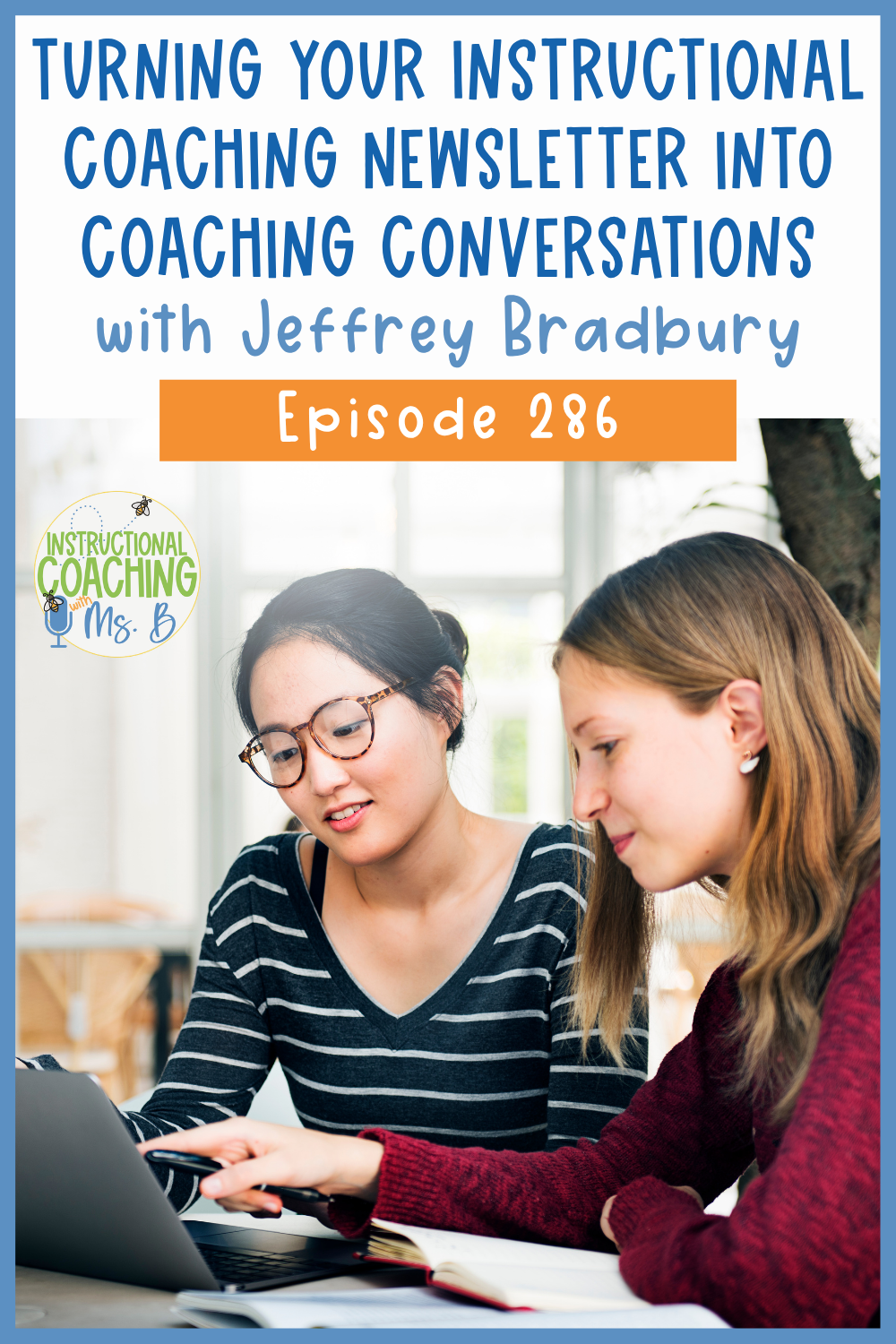
A teacher and a coach looking at a computer screen together. These words are at the top "Turning Your Instructional Coaching Newsletter into Coaching Conversations with Jeffrey Bradbury Episode 286".

Coaching newsletters are often distributed monthly or weekly, but do they actually lead to meaningful conversations and coaching cycles?

In this episode, author and educator Jeffrey Bradbury joins me to talk about turning your instructional coaching newsletter into coaching conversations with teachers. The discussion focuses on the importance of using your newsletter to gain entry into classrooms and build awareness of your role.

If you’re tired of putting energy into a newsletter that ends up in the recycling bin and never turns into coaching work, you’re definitely not alone! This episode is all about how to make your newsletter a tool for coaching cycles, not just a pretty PDF.

Here are the highlights! To hear all of Jeffrey’s insights, be sure to listen to the entire episode!

Why Create a Coaching Newsletter?

Coaches often spend a lot of time creating newsletters, websites, and other resources for teachers. But if those resources feel like one more thing on an already full plate, they’re likely to be ignored, no matter how valuable the content.

Jeffrey tells us that when created purposefully, a coaching newsletter becomes more than information about tools and trends. We can use newsletters to spark coaching conversations, highlight classroom practices, and reinforce school-wide goals.

By being intentional with our newsletters, we can create something teachers want to come back to again and again. We can build archivable, searchable resources that teachers can use when they’re ready.

One idea Jeffrey discussed was viewing newsletters as a marketing tool that answers the questions of who we are and what our purpose is on campus. Newsletters, emails, and digital resources are the vehicles that get you into classrooms and create excitement around your coaching support.

Starting out as an instructional coach can be so overwhelming! It can feel like there are too many things to do, and you just don’t know where to start. This resource includes a guide, printables, and fillable forms (PDFS) to build relationships, have a dialogue with your administrator, review data and make a plan, visit classrooms, and more! Get the First 20 Days of Instructional Coaching Start Up Kit and Forms today!

Creating Newsletters That Drive Coaching Cycles

During the conversation, Jeffrey explains that coaching newsletters should be a teaching opportunity and a conversation starter. Your newsletter can serve as a scaffold for ongoing coaching cycles.

Jeffrey suggests including these sections in your instructional coaching newsletter:

1️⃣ What’s Going on in the District: Connect newsletters to school goals, showing how coaching supports school- and district-wide goals.

2️⃣ Teacher Feature: Share practical examples of how teachers are trying new strategies or meeting goals.

3️⃣ Coaching Corner: Introduce coaching opportunities connected to the newsletter’s theme.

4️⃣ Applications/Goals: Feature practical uses of tech/tools already used by the school. Give teachers ideas for how to use them.

Here are a few things to keep in mind when writing your newsletter:

Keep It Relevant: Teachers have a lot on their plates. Jeffrey recommends focusing on the tools and resources teachers already use at the school.

Offer Bite-Sized, Actionable Tips: Highlight one how-to that teachers can use right away.

Personalize It: Instead of sending a one-size-fits-all format, create subject- or grade-level versions. Jeffrey keeps 80% of the message consistent across all versions but customizes the remaining 20% to make each newsletter feel personalized. To hear how this type of newsletter can fit into a vertical coaching cycle, be sure to listen to the entire episode.

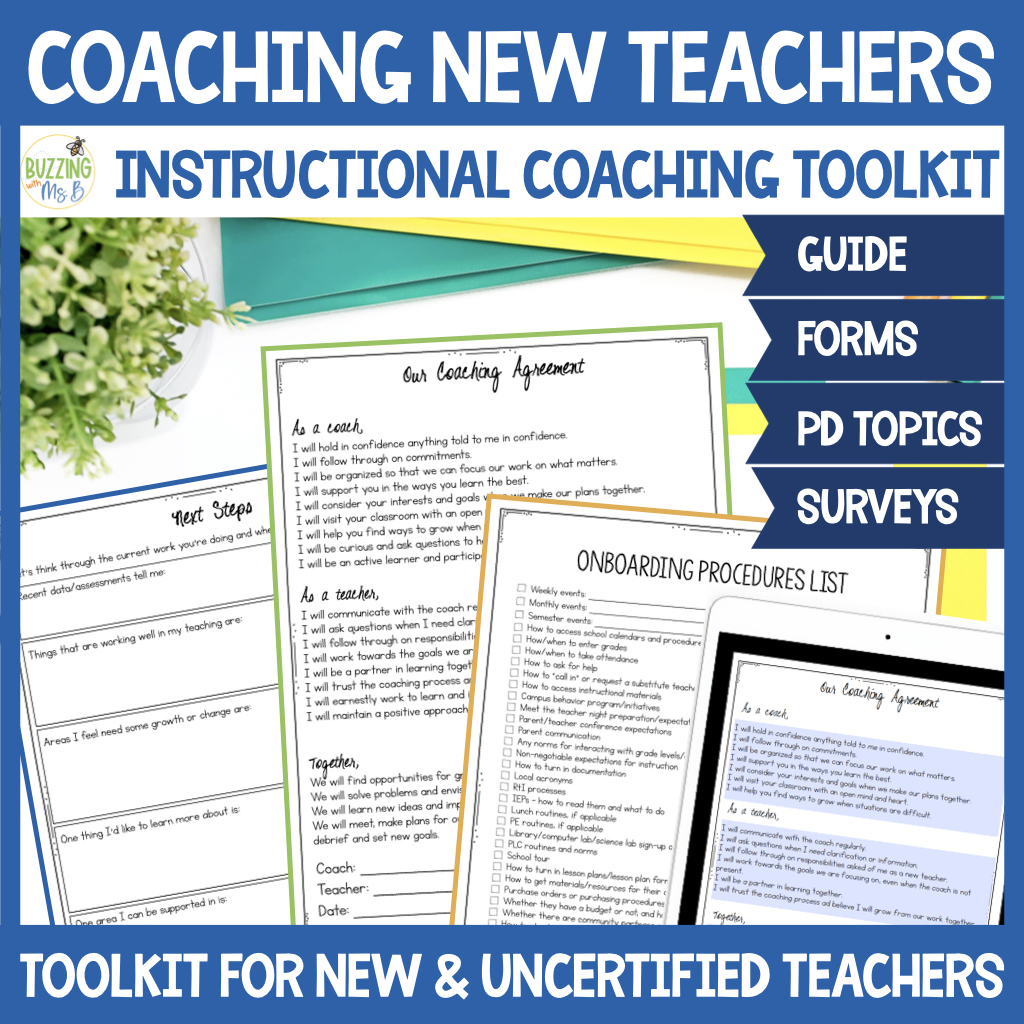
Have a plan for working with new and uncertified teachers with the Coaching New Teachers Toolkit!

It includes forms, templates, and everything you need to help your new and uncertified teachers! Figure out what support the need and provide PD and coaching with these resources. Grab the Coaching New Teachers Toolkit in my TpT Store!

⭐⭐⭐⭐⭐ “I support & coach new teachers and this resource is so valuable. I purchased it several months ago and often use tips you suggested when working with teachers. It is an essential section of my “Teacher Support Provider Binder” that I carry around with me everywhere.”
Vertical Coaching Cycles: Moving from All-Staff to Targeted Support

How do we get people to think about coaching cycles not as horizontal events, but as vertical strategic opportunities?

Jeffrey suggests that instead of starting with individual classroom visits, try a coaching cycle that goes from whole staff to small groups, to individualized support. He says this is usually a four- or five-week series. The newsletter acts as the opener for each stage: introducing goals, providing targeted examples, and prepping teachers for one-on-one support.

Here’s a sample of the vertical model Jeffrey described in our discussion. During the episode, he also shares an example of what this could look like in action!

Week 1 – Faculty

The principal introduces what everyone will be working on and has the coach give an overview. The first coaching newsletter is made for everyone.

Week 2 – Grade Level/Department

This week you customize the newsletters by grade, content, or department. Keep most of the content the same but tailor it to specific curriculum needs.

Week 3 – Personalized Support

You’re not writing a typical newsletter this week. Instead, you’re sending a personal email to three or four teachers that explains how this new thing we’re working on can fit in their classroom. This is where you get into classrooms.

Week 4- Celebration & Spotlight

Send a newsletter to all staff highlighting classroom success stories to celebrate progress and reinforce the value of the coaching cycle.

Approaching coaching cycles in this way means teachers are never caught off guard. They’ve seen the topic multiple times and know what supports are available. This progression warms teachers up and reduces friction, which leads to less time spent convincing them to let you in the door.

Be ready for anything with the Instructional Coaching Editable Binder Megapack!

It includes forms, templates, and everything you need to get organized for instructional coaching! Coach teachers and document your coaching work with these printable and editable tools. Grab the Instructional Coach Binder Megapack in my TpT Store!

Newsletters as Archivable Resources

With vertical coaching, you’re in classrooms every day. You’re meeting with groups and individual teachers. You end up in a cycle that keeps going and going. From all the different communications, you basically have your website built, emails written, and coaching cycles lined up.

Newsletters can become a resource over time if they’re useful and easy to find. Here are three tips Jeffrey shared during the episode:

1️⃣ Archive Your Newsletters: The newsletter, if done right, is something that can be archived for future use. Save your newsletter in Google Drive or another searchable platform. Start the year by showing staff how to make resource folders and search by key terms.

2️⃣ Make It Searchable: Use easy-to-search file and folder names so teachers can easily find what they need. This way, even if their inbox is a black hole, they can still find information.

3️⃣ Model What You Want to See: Use the same tools and platforms teachers are expected to use. This will help you become more proficient and inspire teachers to try it in their classrooms.

Turning Your Instructional Coaching Newsletter into Coaching Conversations 

I hope this episode encourages you to see your instructional coaching newsletter as a cohesive tool. When thoughtfully designed, it can connect school initiatives with the day-to-day coaching work you’re doing alongside teachers.

Listen now to hear all of this engaging conversation!

Topics and Questions Discussed in Episode 286 – Turning Your Instructional Coaching Newsletter into Coaching Conversations with Jeffrey Bradbury

  • Turning your instructional coaching newsletter into coaching conversations
  • Why create a coaching newsletter
  • Using newsletters as marketing and relationship-building tools that are aligned to school/district goals
  • Writing newsletters that spark conversations and drive coaching cycles
  • What goes in a coaching newsletter: Structuring it for maximum teacher engagement
  • Vertical coaching cycles: Moving from all-staff to targeted support
  • Differentiating communication to make every teacher feel seen and supported
  • Building easy-to-search, archive-friendly newsletter libraries
  • Aligning every newsletter to campus and district goals for maximum impact

About Jeffrey Bradbury
Jeffrey Bradbury is an ISTE award-winning digital learning strategist, educational broadcaster, public speaker, and the author of Impact Standards. As a founder of the TeacherCast Educational Network, he is passionately dedicated to empowering teachers, coaches, and school districts looking to make an impact in the classroom.

Turning Insight Into Action: Practical Steps You Can Take After Listening

Here are simple actions you can take today:

1️⃣ Join the Instructional Coaching Club

If you’re looking for ongoing coaching support, I would love to see you in the Instructional Coaching Club!

2️⃣ Download the FREE First 20 Days of School Checklist

If you’re gearing up for a new year or need a reset, grab the FREE First 20 Days of School Checklist to set yourself up for a successful, impactful year of coaching!

3️⃣ Grab the Editable Newsletters for Coaches & Administrators

Keep your faculty up-to-date with information about upcoming dates, reminders, best practices, professional development resources, teacher features, and more! This bundle includes 17 newsletters for coaches and administrators to send to their faculty. Get the Editable Newsletters for Coaches & Administrators here!

Ready to listen?

  • Ready to listen? You can listen below with the media player, or search for Buzzing with MS. B: The Coaching Podcast anywhere you listen to podcasts!

This post contains links to products from one or more of our advertisers. This means I may receive commissions for purchases made through links in this post when you click on links to those products. Thank you for your support!

Learn more

Helpful Resources


Listen on: Apple Podcasts, Spotify, or your favorite listening app


Thank you for listening to Buzzing with Ms. B: the Coaching Podcast. Want more coaching ideas

Check me out at buzzingwithmsb.com and on Instagram @buzzingwithmsb.

If you love the show, share it with a coach who would love it too, or leave me a review on iTunes! It’s free and it helps others find this show, too. Happy coaching!

Podcast produced by Fernie Ceniceros

Turning Your Instructional Coaching Newsletter into Coaching Conversations with Jeffrey Bradbury, ep. 286, Instructional Coaching with Ms. B Podcast

Chrissy Beltran [00:00:00]:

Hey, coach, and welcome to episode two eighty six of instructional coaching with Ms. B. Today, we are talking about how to use your instructional coaching newsletter to create more coaching conversations and coaching cycle work with my guest, Jeffrey Bradbury. This is the, series all about getting focused on instructional coaching that’s gonna help get you set up for this school year, and I am inviting you to join the instructional coaching club. Instructional coaching club is the cool place to be for coaches. It is full of resources for PD and PLC meetings, coaching forms, PD videos for you to learn from, and so many print and go resources for you to use with teachers. You can go to instructionalcoachingclub.com. Please join me there. I think you’re gonna love it. Now let me introduce my guest. Jeffrey Radbury is an ISTE award winning digital learning strategist, educational broadcaster, public speaker, and the author of Impact Standards. As a founder of the TeacherCast Educational Network, he is passionately dedicated to empowering teachers, coaches, and school districts looking to make an impact in the classroom. So let’s go ahead and dig into this topic and welcome my guest. So let’s welcome Jeffrey to the podcast. Welcome and thanks for being here today.

Jeffrey Bradbury [00:01:07]:

How are you today?

Chrissy Beltran [00:01:09]:

I’m doing great. And, oh, well, I’m getting over a cough, so I’m hoping that that doesn’t make its way into the podcast. But other than that, we’re doing great. How about you?

Jeffrey Bradbury [00:01:15]:

I’m doing fantastic. It has been a wonderful summer.

Chrissy Beltran [00:01:18]:

Awesome. It’s it’s been a quick we’re all we’ve only been out for two weeks, so we’re we’re just getting started. And today, I would love to get into the topic of coaching newsletters and how coaches can use their newsletter really purposefully and meaningfully to develop coaching conversations with teachers. We sometimes spend a lot of time creating newsletters and, you know, and all these kind of, like, behind the scenes tasks that happen in our office, and then they don’t turn into anything in our actual coaching work. We don’t get enough mileage out of them. So can you talk a little bit about the purpose of sharing a regular newsletter with teachers?

Jeffrey Bradbury [00:01:51]:

Sure. And, yes, this is such an important topic. You know, I was as an as an instructional coach for more than fifteen years, I have gone through all of the stages of communication. Right? You blast everything out at the beginning of the year. You create the website that has, everything on it that turns out nobody wants to listen to. You send something to somebody, and then they go, oh, I didn’t read it. All of these different things, we have all been through. Right? And as people are listening to this at the beginning of the school year, it really does comes down to, okay, how do we become effective communicators? And what we need to realize is that as an instructional coach, we’re not just wearing that educator hat. We need to be wearing that entrepreneur hat. Our communication tools are the vehicle from which we are gonna be getting ourselves into the classroom. And I look at our the way that we create newsletters and emails and and even our websites. This is a marketing tool that stems from really the question of who we are in our buildings, what our function is, and what the purpose is.

Chrissy Beltran [00:02:59]:

Mhmm. And

Jeffrey Bradbury [00:03:00]:

what we find is that a lot of instructional coaches just find the latest tchotchke, and then they send it around. It happens a lot over the summertime. Right? I was just at this ISTE conference. I saw this thing. I can’t wait to put it in my newsletter, or I saw it on Facebook, or this is new thing was on Twitter. I can’t wait to share it. And the bottom line is your teachers aren’t living in that same world that you are. So how can we create something that’s going to not only speak to them, but also support the district goals and initiatives that we are there to then support?

Chrissy Beltran [00:03:35]:

That is such a good point because I think that there’s so many times we see that kind of, like, trainer of trainers model where the coach goes to something, gets super excited, wants to turn it around. Teachers are not as excited whenever they just see a snippet about it, you know, in an email or something. And that’s because they didn’t benefit from all of the carefully structured experience that that coach had to get them excited about that thing.

Jeffrey Bradbury [00:03:57]:

Absolutely. And it’s not about you, the coach. It’s about them as the student, right, or the student teacher. Right? And I look at my newsletters. I’ve always built them on platforms that I would love to emulate for my teachers. I like to use Google Sites an awful lot for these things, mostly because I wanna see my my I keep seeing my students, but, really, my teachers utilize Google Sites in a different way.

Chrissy Beltran [00:04:23]:

Mhmm.

Jeffrey Bradbury [00:04:23]:

I know the popular thing is to use a Sway or a s’more or, you name the thing. Right? But we’re not really expecting our teachers to use that stuff. We’re using or we’re looking for our teachers to use these, like, Google Sites as an example. So I look at that newsletter as an as a teaching opportunity. I want somebody to come to me and go, hey. How’d you do that on your newsletter? I saw that you embedded this, or I saw this, or you put a video, or how did how did you get there? Every single conversation, every single communication point is a is a is a collaboration waiting to happen. And I usually try to format my newsletters in three or four, maybe even five parts. There’s always a, you know, what’s going on in the district, and how can this be supportive. There’s always a teacher feature. Like, look at what’s happening in missus Brown’s class. And I always try to get those into the here’s what’s happening in missus Brown’s class, and they’re using Google Slides or they’re meeting their reading standards. There’s always some kind of a coaching tie in, although that’s not the headline of the deal. So it’s always like, you know, what’s going on in the classrooms, what is new in the world. I always make that really small because you always have those two percenters that are they’re they’re curious. But I also have, you know, what are the applications or goals of the school? For instance, I’ll always have a, hey. Did you know Google Classroom can do this? Right? Did you know in PowerSchool you can do this? Meaning, whatever the applications that the district is support is supporting for the teachers, your newsletter should really be featuring that rather than, hey. This latest and greatest AI thing or, hey. Here’s a thing I just saw online. Teachers have a lot on their plates. Teachers are not looking for a million new different ed tech tools. Teachers are being told they have to use classroom teams, doc sheets, slides, etcetera. Let’s just use the the concept here for focusing on that. Right? Did you know that you can now do this in slides? Done. Simple. Like, here’s how you insert a video in slides. Here’s how you create a template in slides. Those are, like, the instructional videos that we should be focusing on, not, hey. There’s this new tool that I saw. Right? So I always like to focus things on exactly where the teachers are knowing that if I do that kind of an approach, I’ll always find others that I’ll we can have, you know, expanded conversations on.

Chrissy Beltran [00:07:03]:

I like that. It’s it’s a lot like thinking about your professional development and practicing what you preach in professional development. So if teachers are required to have learning targets, then you use learning targets during PD, things like that. So whatever the teachers are expected to use in their classrooms, you want to use that same those same resources and then help them get really really good at seeing those things in action so that they can try it out themselves.

Jeffrey Bradbury [00:07:23]:

And that’s exactly it. And I don’t make just one newsletter. If I’m gonna do this right, I’m gonna make up three or four. One that’s math focused, one that’s English focused, one that’s social studies science focused. You know? And and that doesn’t mean that you have to be completely different. That just means, you know, 80% is the same. Mhmm. But then you have that that curricular focus on one of them. And so if I was gonna send you an email, that says, here’s the three things that we’re working on, you know, two of them might be the same thing I’m sending your neighbor, but the one thing might be specialized towards you, your your grade level, your department, whatever. Mhmm. Yeah. One of the best ways to look at using this is really to to support our coaching cycles. And this is something that I talked a lot about over the summertime at ISTE is how do we get people to think about coaching cycles not as horizontal events, but think of them as vertical strategic, opportunities here. And if you give me thirty seconds here, when I look at a vertical coaching cycle, I look at it as like a four or five week series where in week one, you get up in front of the entire faculty, and the principal says, okay. Today, we’re gonna do this thing. Here’s Jeff, your instructional coach. He’s gonna give an overview. And then the next week, it’s gonna be Jeff is gonna be meeting with group, you know, department levels or grade levels. The next week, it’s gonna be individual teachers. And then finally, we’re gonna get into classrooms, and there’s a cycle that kinda revolves around that. So you’re basically thinking of an inverted pyramid.

Chrissy Beltran [00:08:55]:

Okay.

Jeffrey Bradbury [00:08:56]:

Everybody, small groups, smaller, smaller, and then finally you get those one to ones. If you look at this from your communication point of view, the first week of your newsletter should be made for everybody. Hey. In a couple days, I’m gonna go over this Google Classroom thing. Next week, your newsletter is gonna be, here’s how Google Classroom works for science or for math or for English. And then finally, by the time you get to the third week, you’re not writing a newsletter. You’re sending a personal email to three or four teachers that says, hey, Chrissy. How’s you know, we’ve already talked twice. Here’s how classroom can work for you. Mhmm. And then finally at the end, you know, it’s, hey. Here’s a newsletter for everybody. Here’s how Chrissy is using it, and here’s how Dave’s using it, and here’s how Matt’s using it. And that way, you really do get that cycle of a conversation where everybody is getting hit, and I don’t have to worry about needing to go into everybody’s classroom because the principal got up at the beginning of the of the the month and said, this is our goal. This is important. Here’s the coach. This is how we’re gonna get there. You now are automatically the rock star, and your communications is just the tool from which you’re going to spark conversations once you do walk into a meeting or a classroom or conversation. Mhmm. Everything revolves on, in my world, just getting those vertical coaching cycles together and figuring out how your your newsletters and your emails are communicating that message. If something like that can happen, then you as the coach are meeting the goals of the building. You as the coach are now invaluable, and you as the coach have all the opportunities to collect data points to share and say, look. This is the goal. This is what I’ve done. This is how I’ve done doing it. These are the teachers I’ve worked with, and here’s the results. Now you, principal, walk into the to the classrooms with your little checkbox and go, oh, okay. This is how it works. And then by the time you get into that December, January area, you’ve done three or four of these.

Chrissy Beltran [00:10:55]:

Mhmm.

Jeffrey Bradbury [00:10:55]:

So every day you’re in classrooms. Every day you’re meeting with groups. Every day you’re meeting with departments. Every and, you know, you you just get on this cycle that just keeps going and going. And now you basically have your website built from all of the different communications. You have your emails built. You have your coaching cycles already lined out for the next couple months. And you’re the most valuable person in the school district all because you’ve set up a system that’s gonna meet the needs of your building and and school goals.

Chrissy Beltran [00:11:25]:

So then can you talk a little bit, like, an example of a time that you’ve used the structure to like, it’s like a topic that you were doing is is because what I’m hearing is kind of, like, more like a instead of a instead of this coaching cycle, like you said, something that’s really focused on individual teacher, we’re talking about, like, moving the school through trying something out is what it sounds like. So can you talk a little bit about that?

Jeffrey Bradbury [00:11:44]:

Yeah. And when I say that, you are focused on on individual teachers. You’re just getting to the individual teachers after you’ve dealt with

Chrissy Beltran [00:11:51]:

Right.

Jeffrey Bradbury [00:11:52]:

The entire staff, which is different than walking into room one and making a relationship, walking into room two and making a relationship. Right? You’re you’re doing it from the top down versus the bottom up. And when you meet with your principals ahead of time, you’re saying, look. This is our goal. Every I’ll just let’s talk in general. Everybody’s gonna use Google Classroom. Okay? But not just, hey. I use it. I really wanna see Google Classroom being used for classroom discussions.

Chrissy Beltran [00:12:20]:

Mhmm.

Jeffrey Bradbury [00:12:20]:

Well, how does that work? Well, in classroom, you’ve got an assignment that’s called, questions or whatever it’s called. What if we did something where at the beginning, our entry ticket and our exit ticket were, you know, one of them is an open ended question and one of them is a multiple choice. What if our we have a school goal? That way, all teachers are using Google Classroom with those multiple to do this. Right? Mhmm. To start student discourse, to get discussion, to ask a quick poll question, and now it’s up on the board and they can comment on it, all of those different things. And meeting with my principal, I know I really wanna focus on second and third grade because those students, according to my tests last year and whatever, they need to focus on communication. They need to focus on those kinds of topics.

Chrissy Beltran [00:13:13]:

Mhmm.

Jeffrey Bradbury [00:13:14]:

So, again, week one, I’m gonna get up and do my song and dance. Hey. I know everybody’s using Google Classroom. It’s one of our favorite applications, but did you know that this thing is here? Now before I get to the faculty meeting, I’m sending out an email to everybody going, hey. Don’t forget to show up on Monday. I’m gonna show off this wonderful thing. I’ve primed the pump a little bit. Right? Now after I do my faculty meeting, it’s, okay. Now I’m gonna meet with all the third grade teachers, the fourth grade teachers, and that I’m gonna actually have their curriculum ahead of time and say Mhmm. Alright. While I’m meeting with these five teachers at a time, here are some lessons that you’re already working on. Right? We’re gonna talk about rock cycles, and we’re gonna talk about westward expansion or whatever they do. And and here’s how you can bring this up in your second grade lesson, in your third grade lesson. And and this doesn’t have to be students on devices. You could have teacher on the board, and and a student can come up on the board. Whatever it happens to be. Right? And then, of course, I already know that I’m trying to get Chrissy because Chrissy is a little shy, and she’s not quite there. Maybe Chrissy is a news a news, Whatever it is. Mhmm. We’ve already identified Chrissy back when I was meeting with the principal. Because the principal, of course, knows Chrissy and does the walk throughs, like you know? So, really, I’m but by the time I meet with Chrissy, she’s already seen this in action twice. So she’s no longer shy of me as a coach. She actually might have some questions. And because I’ve already seen Chrissy twice and I’ve kind of I don’t wanna say targeted, but, you know, for the last two weeks when I’ve been doing my larger demos, I’m kind of doing my demos for Chrissy even though there’s 50 other people in the room. So by the time we actually get to do a one to one meeting, there is no, hey. I’m busy. There is no, I I’ve gotcha. There’s no, you know, here’s the hand. Come back later. It’s we already have a good rapport. And so, hey. Maybe a meeting is only ten minutes, Not this let’s take an hour thing, but I’m on a prep, but I don’t have time. But did you really schedule? But I got grading to no. No. No. Ten minutes. Because you’ve already seen it a couple times. And the only point for that meeting is, what do you need and when can I come back to help you see it in

Chrissy Beltran [00:15:28]:

action? Mhmm.

Jeffrey Bradbury [00:15:29]:

You’re cutting out a lot of stuff that has to do with the traditional coaching cycle. Coaching cycle should not be an hour long meeting that’s gonna take up somebody’s prep. My opinion. Right? By the time you actually get to sitting with somebody, they’ve seen the song. They’ve seen the dance. They know how the rabbit comes out. They just need to know how to get it to support them. Mhmm. Whereas another teacher is just be like, hey. I got it. Thanks. Right? Don’t need you know, I might I might spend a lot of time with that other teacher, that high flyer, but I it’s on other things. It’s on the level two, level three of Google Classroom.

Chrissy Beltran [00:16:06]:

Mhmm. Yeah. I think what’s interesting about is the idea that because you’re aligning everything around this main topic that you’re doing, you’re able to differentiate within, your teachers.

Jeffrey Bradbury [00:16:18]:

Yeah. It’s it’s it’s but it but think about it from the point of view of a teacher. Right? You’re gonna introduce a new chapter. You’re going broad, And then you’re gonna teach the chapter, and then you’re gonna you’re gonna you know, I always like go to the lima bean chairs. Now you’ve got a smaller group of it’s the same concept.

Chrissy Beltran [00:16:34]:

Mhmm.

Jeffrey Bradbury [00:16:34]:

Right? Your newsletter is essentially the homework in this assignment. Hey. The first is what do you know? The second one is we’re gonna do this part of this chapter and this part of this chapter. By the time it’s three, it’s alright. Here’s a here’s a written multiple like and then finally, I’m here’s the assessment. And then in our world, the assessment is I’m coming in to see it in action.

Chrissy Beltran [00:16:54]:

Mhmm.

Jeffrey Bradbury [00:16:54]:

And I and and the because the following week, the principal’s gonna come in and see it in action. But there’s no reason for a principal to walk into Chrissy’s classroom if she doesn’t know what she’s doing. And if she doesn’t know what she’s doing, then that’s my fault as an instructional coach. We’re not setting up the system the right way. But I can’t do that alone. I need the principal. So if the principal wants to meet his goals, I need to be working with that principal lockstep here, and we need to have an entire month worth of systems where we can have double checks. And now when I sit down with the with the principal, I actually have something to talk about, and he’s interested. Because in order for him to meet hit him or her to meet his or her goals, I need to be set up correctly.

Chrissy Beltran [00:17:39]:

Mhmm.

Jeffrey Bradbury [00:17:39]:

And this all goes back to the fact that look. It’s the beginning of the year. When a coach gets in introduced, they’re gonna say, this is Chrissy, your coach, or is this gonna say, this is Chrissy. Her job is to boom boom boom boom boom boom. And I’m gonna make sure that we’re like, and this is how the world is working. If not, Chrissy walks into a class and goes, I’m the coach, and and teachers go, thanks. And you become a volunteer. So all of this is coming down to, as the beginning of the year starts, what’s your job? What’s your role? And we should always remember that a coach’s job is not to meet with teachers. A coach’s job is to help support the the the the goals and and and, you know, the the goals of the school district. You’re doing that through working with teachers, through Mhmm. Coaching cycles, through your newsletter. Your newsletter is a tool. The coaching cycle is also a tool Mhmm.

Chrissy Beltran [00:18:32]:

For you

Jeffrey Bradbury [00:18:32]:

to do your job. The coaching cycle is not your job. It’s how you do your job.

Chrissy Beltran [00:18:37]:

Right. It’s one of the many ways in which you can do your job. Yeah.

Jeffrey Bradbury [00:18:41]:

I can teach you about Google Classroom in the hallway, and I can sit there for four weeks and show you everything. Or I can make a video tutorial,

Chrissy Beltran [00:18:48]:

or

Jeffrey Bradbury [00:18:48]:

I could tell you to go to teacher cast and look at one of my like, all those different things. The bottom line is the building has a goal, and it doesn’t have to be a tech goal. Right? The goal for this week could be improving students’ reading scores, improving long division, improving, the way that science teachers organize their labs because there might be five or six science teachers, and they’re all doing things to maybe we just start it with all science teachers get together and we have a you know, the administrator gets up and says, our goal for the next two months is to revolutionize the way we’re organizing science labs.

Chrissy Beltran [00:19:25]:

Mhmm.

Jeffrey Bradbury [00:19:25]:

Next week, Jeff’s gonna meet with every single department. Go. Right? And suddenly, that is your newsletter.

Chrissy Beltran [00:19:32]:

Mhmm.

Jeffrey Bradbury [00:19:32]:

You’re talking organizational strategies. You’re talking naming of of documents. You’re all of these different things. So everything is hand in hand, and it all comes down to what’s your job and how are you gonna do it. And you’re gonna do it through your newsletters, through your coaching cycles, through all of that.

Chrissy Beltran [00:19:53]:

Right. It’s one of your tools in your toolbox. And I love the idea of making sure that everything is super aligned on the goals that you have for your school because regardless of what those look like. For example, you know, two months on a goal is is probably not enough for a lot of for a lot of the goals that schools work towards. Right? But you can structure it in terms of, okay. I’m going to we’re going to introduce this because you have multiple things that you’re working on throughout the school year. Right?

Jeffrey Bradbury [00:20:18]:

Always.

Chrissy Beltran [00:20:19]:

And so then you’re like, okay. Logically, we would start here. This is where we’re gonna start, and we’re gonna build as we move throughout the year. You can have, like, a theme or a focus for each of your newsletters that’s helping you move through the goals that you’re working with teachers on across the school year and developing you know, like, kind of building on itself.

Jeffrey Bradbury [00:20:35]:

And because teachers are all over the place in their development

Chrissy Beltran [00:20:39]:

Right.

Jeffrey Bradbury [00:20:40]:

My my goal for you might be Google Classroom. For another teacher, Google Classroom might be the way that I’m gonna get into your room to do other things.

Chrissy Beltran [00:20:50]:

Mhmm. Mhmm.

Jeffrey Bradbury [00:20:50]:

Because you’re a high flyer or maybe you’re all the way on the other side of the innovation curve. The bottom line is we’re gonna find one thing. So maybe in a year, there’s ten months. Maybe we identify five things that we’re gonna just level set.

Chrissy Beltran [00:21:05]:

Mhmm.

Jeffrey Bradbury [00:21:06]:

And if you’ve got it in two minutes, great. What else can we do? Mhmm. And if it takes you three months and I gotta come in four different times, okay. That’s great.

Chrissy Beltran [00:21:16]:

Right. But the the newsletter is like your introduction. It’s part of your introductory phase to that topic for Dean

Jeffrey Bradbury [00:21:21]:

The newsletter, if done right, is the thing that that that they can archive.

Chrissy Beltran [00:21:25]:

I see so many people. No.

Jeffrey Bradbury [00:21:27]:

No. No. No. No. You need to create your newsletters as an archivable thing in their Google Drive. So the first thing I put on my newsletters is hit the archive button.

Chrissy Beltran [00:21:37]:

Mhmm.

Jeffrey Bradbury [00:21:37]:

My my first tech tip every single year is how do you create folders and put this in it?

Chrissy Beltran [00:21:43]:

Mhmm. And

Jeffrey Bradbury [00:21:44]:

that’s just a video that I give out because I don’t want you deleting this. I want you to think about this and go, you know what? I I don’t need this now.

Chrissy Beltran [00:21:51]:

Mhmm.

Jeffrey Bradbury [00:21:52]:

I don’t need this now, but but maybe tomorrow I will.

Chrissy Beltran [00:21:55]:

That’s right. Yes. I remember one time I was talking with a teacher, and she was like, look. This is my resources folder in my email. This was a long time ago. Okay? This is my resources folder in my email, and she opened up. She goes, they’re all from you. And I was like, oh my gosh. Am I sending too much stuff? She goes, no. You’re the you’re you’re sending things that I actually wanna go back to at some point, so I save everything in my folder so I can dig back into it when I need it.

Jeffrey Bradbury [00:22:15]:

Teaching them how to use that search button in Gmail?

Chrissy Beltran [00:22:19]:

Yeah.

Jeffrey Bradbury [00:22:20]:

But then but but none of that works if you’re not creating

Chrissy Beltran [00:22:24]:

Mhmm.

Jeffrey Bradbury [00:22:25]:

Newsletters that are that. It’s okay Right. To make a nice looking Google site as your newsletter. But if you send me an email that just links to it and there’s nothing else, then you’ve done yourself wrong.

Chrissy Beltran [00:22:38]:

Mhmm.

Jeffrey Bradbury [00:22:39]:

So how do you create the email that has those searchable terms that then they all link to the same the world I don’t know if you realize this. The world works in search.

Chrissy Beltran [00:22:49]:

For sure. Oh, I’ve I’ve my boss used to say, how can you find anything on your laptop? I was like, I you will not you would not believe the length of the names of some of my files because I’m gonna name it anything I might think to look for later. You know?

Jeffrey Bradbury [00:23:04]:

But that’s where we are. If you and I are both math teachers and I name it c h one and you go

Chrissy Beltran [00:23:09]:

CHAPTERSpaceONE

Jeffrey Bradbury [00:23:11]:

Right. I still can’t find it because I’m going chapter the number one. That’s where some of these things are. There’s no shame in a principle getting up and going, guys, or the curriculum director. Guys, when we are writing everything

Chrissy Beltran [00:23:26]:

Mhmm.

Jeffrey Bradbury [00:23:27]:

This is the one sentence is all it takes from central admin. This is how we’re naming things.

Chrissy Beltran [00:23:32]:

Our convention. Our naming convention. Yeah. And and

Jeffrey Bradbury [00:23:35]:

if that means that I’m a silly person for thinking about it, I’m a silly person, but it’s all about search. Nobody knows what folder Chrissy keeps stuff in.

Chrissy Beltran [00:23:45]:

Mhmm.

Jeffrey Bradbury [00:23:45]:

And because I’m not Chrissy, I don’t care what folder that’s in, but I do know how to search for science. Right?

Chrissy Beltran [00:23:53]:

Mhmm.

Jeffrey Bradbury [00:23:55]:

And that’s how you spend more time teaching and less time organizing.

Chrissy Beltran [00:23:59]:

Mhmm. Awesome. Well, thank you so much, for being here today, Jeffrey. How can people keep learning from you if they’re interested?

Jeffrey Bradbury [00:24:05]:

You know what? If you’re looking for a great way to improve your instructional coaching program this year, I have all of my resources over at yourdigitallearningcoach.com. You can check out all of my resources. I’ve got, oh, probably 10 or 12 different downloadable freebies from job hunting to what do you do with your first ninety days, your last ninety days. We’ve got coaching trackers. We’ve got notion templates for for coaching. Everything that you’re looking for is there. And, of course, you can always check out my brand new book, Impact Standards, over at teachercast.net/standards. It’s all there. And if you’re looking to put together a standards based way to to support your school district, head on over to your digitallearningcoach.com.

Chrissy Beltran [00:24:46]:

Awesome. Thank you so much. Alright, coach. I hope that helps you think a little bit about how your instructional coaching newsletter can be a cohesive tool in terms of your school initiatives, the work that you’re doing with teachers, and supporting them along their journey so they can go back and access that resource every single day as you work together. Next week, we are digging into a topic that I love to talk about. It’s all about coffee with a coach, how to introduce yourself as an instructional coach. It’s the next episode in our series all about getting focused on instructional coaching. And until then, happy coaching!

Share:

Similar Posts

Leave a Reply

Your email address will not be published. Required fields are marked *