| | |

Formative Assessments: Quick and Easy Check-Ins with Glen Pearsall, ep. 279

Student in classroom writing into test booklet on desk. These words are on th eimage, "Formative Assessments: Quick and Easy Check-Ins with Glen Pearsall".

Hey Coach!

What if assessment wasn’t just another task for teachers to get through, but one of the most powerful learning levers in the classroom?

Better yet, what if it could be done quickly and required zero extra work for your teachers?

Sounds too good to be true? That’s exactly what we’re discussing this week on Instructional Coaching with Ms. B!

Today, teacher coach and best-selling author Glen Pearsall is here to talk about formative assessments: quick and easy check-ins. He offers assessment strategies that are fast and easy for teachers to use with students.

This episode is part of the Better Assessments, Better Data series, and it’s going to help you think about opportunities to improve assessment so you can gather more useful information to support instruction.

During the episode, Glen unpacks some of the most persistent misconceptions about formative assessment and explains what distinguishes it from other types of assessments. He shares how to use effective questioning to gauge student progress and provide instant feedback during a lesson. We look at how to use fast, formative assessments for quick feedback and explore creative ways to adapt summative assessments for formative feedback. You’ll walk away with new tools and strategies to use with your team.

This episode is full of actionable ideas that don’t require more paperwork or special resources. Listen now to get all the details! Here are the highlights!

Digging into data form, pencils and markers on a desk. The words "Data forms: for coaches and admin is at the bottom"

Understanding your school data is so important to school leaders and instructional coaches! These 18 different data forms will help you collect, organize, and analyze your data. Then you’ll use your data and analysis to reflect and make a plan for next steps!

What Distinguishes Formative Assessment from Other Types of Assessments? (And Common Misconceptions)

We begin the conversation by exploring the difference between formative and summative assessments. Glen emphasizes that formative assessment is not defined by a specific format or tool but by its timing and purpose within the learning process. While summative assessment is something teachers give at the end of learning to assess student achievement.

During the episode, he highlights common misconceptions around formative assessments, including:

Misconception 1: Formative assessment is a type of assessment

Glen tells us that formative assessment is not a type of assessment, but it’s a time of assessment. Formative feedback is gathered while students are still learning, not after. It feeds straight back into the student’s performance, so immediate adjustments can be made in the moment.

Misconception 2: Formative assessment must always take a written form

There is this false idea that formative feedback has to take written form. In fact, formative assessment is embedded in classroom practices, including questioning and real-time feedback.

I love that Glen focused on when the assessments happen. I think that’s a really easy way for coaches to present this to teachers and help them be thoughtful about the kinds of data they’re getting in the moment. Formative assessment is about influencing learning as it happens and providing immediate feedback that students can use to improve their learning in real time, not when it’s too late to make a difference.

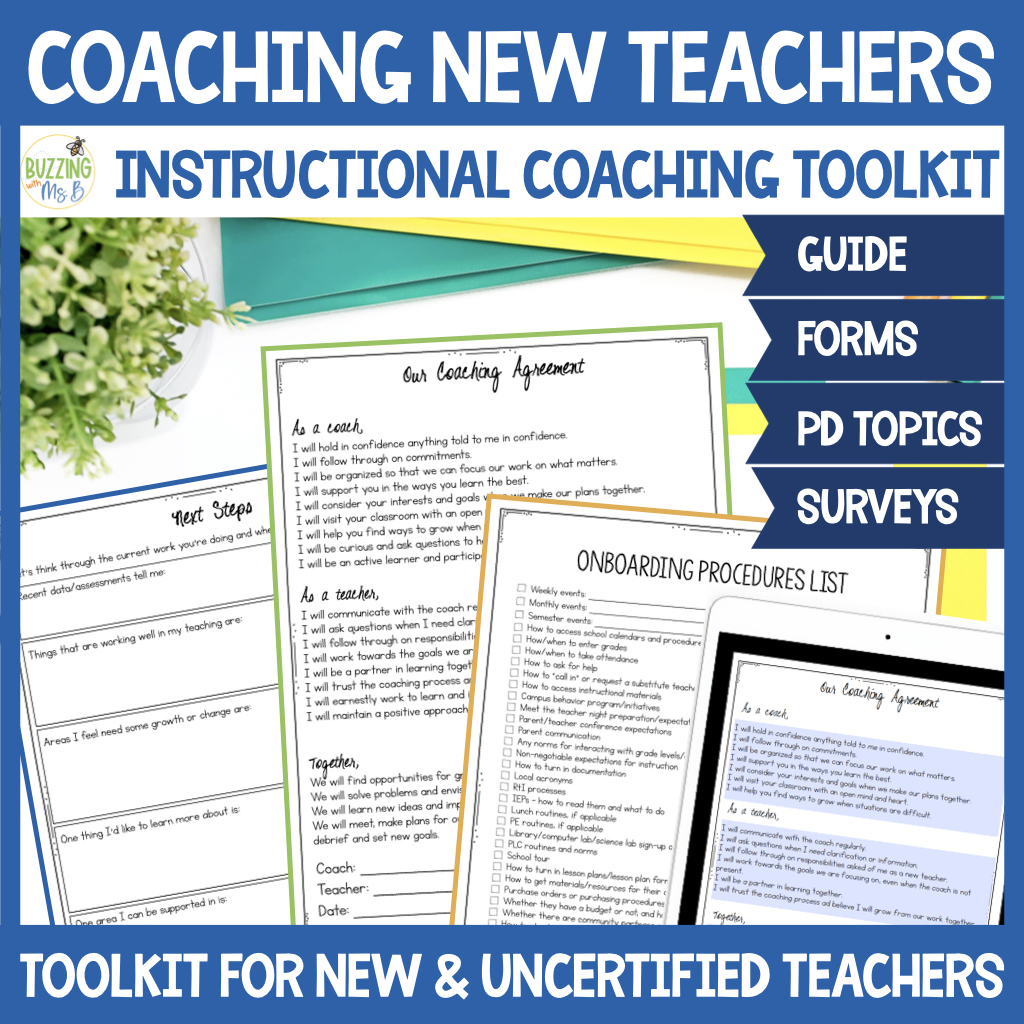
Have a plan for working with new and uncertified teachers with the Coaching New Teachers Toolkit!

It includes forms, templates, and everything you need to help your new and uncertified teachers! Figure out what support the need and provide PD and coaching with these resources. Grab the Coaching New Teachers Toolkit in my TpT Store!

⭐⭐⭐⭐⭐ “I support & coach new teachers and this resource is so valuable. I purchased it several months ago and often use tips you suggested when working with teachers. It is an essential section of my “Teacher Support Provider Binder” that I carry around with me everywhere.”
Using Effective Questioning to Check on Student Progress and Provide Feedback During a Lesson

Some studies say that teachers ask and answer between 200 and 300 questions per day! Being able to influence that can have a really profound impact.

So how can teachers use those questioning opportunities to actually check on student progress during a lesson and provide them with feedback? Glen says that one of the things about questioning techniques is that it’s so subtle that even small adjustments can really improve student learning.

In Australia, the average teacher wait time after a question is about 1.1 seconds. That leads to six or seven kids answering 93% of the answers in the class in his studies. If a teacher bumps up the wait time to three seconds, it can triple the average number of responses in class. Waiting just a little longer means you can hear many more voices and get a clearer sense of what everyone is thinking in the room.

A technique Glen highlighted is pre-cueing a question (“In five minutes, I’m going to ask you this question…”). He says he loves to use pre-questioning as an adjustment for students who might be struggling.  It gives them time to formulate an answer and helps them have a voice in the classroom.

One of Glen’s favorite forms of questions is called an inverted question in Australia; some American teachers refer to it as a contextual situation. Essentially, instead of giving kids a question and expecting an answer, you give them an answer and get them to comment. You’ll  get much richer answers.

Here are two examples:

  1. Instead of asking students, “Is 19 a prime number?”, ask, “19 is a prime number. Why?”
  2. Instead of asking, “Is this a fiction or non-fiction book?”, ask, “This is a nonfiction book. How do we know it’s a non-fiction book?”

Inverted questions are really powerful because they signal to students that we’re interested not so much in the answer but the reasoning behind the answer. Teachers are able to present a higher-order question to students and get them to tell us what they’re thinking.

In Glen’s work, he has seen that kids respond more to this type of question than to traditionally framed ones. He thinks it’s because students feel safe, they have been given the answer, and they’re just commenting.

He says what he really likes about this is that you get more sophisticated answers, and an instructional coach can help teachers make that adjustment. Asking these types of questions does not involve more preparation or correction of materials afterwards. It’s a really subtle shift that makes a big impact.

I love this because having kids express their reasoning is so important! It encourages longer answers instead of a single-word response. Turns out the real trick isn’t how many questions you ask in the classroom; it’s how you ask and how long you wait for a reply.

Fast, Formative Assessments for Quick Feedback

Glen’s amazing book, Fast and Effective Assessment, has lots of ideas for using quick feedback in the moment. During the episode, he shares two that are emblematic examples. Both strategies are quick, require no extra prep, and make feedback visible and actionable to all students in the classroom.

Traffic Lights

One of Glen’s go-to strategies is the Traffic Light System. After explaining a new concept to students, ask them to show with their fingers if they’re green (understood it), amber (sort of but would like to go over it again), or red (didn’t get it).

When kids were interviewed after, it was apparent that half of the kids who put up amber were actually red because they didn’t want to say they didn’t understand. When Glen flipped the script and asked students to rate how well the teacher explained the content, students were much more candid with their feedback.

Fist to Five

Another strategy Glen discussed was Fist to Five. When I was a new teacher, we were a big Kagan school, and this was a good one from them. Teachers ask students to rate their understanding on a 0–5 scale with their fingers. It allows you to quickly spot gaps and see where everyone is in the class. It’s a super simple but powerful tool.

Be ready for anything with the Instructional Coaching Editable Binder Megapack!

It includes forms, templates, and everything you need to get organized for instructional coaching! Coach teachers and document your coaching work with these printable and editable tools. Grab the Instructional Coach Binder Megapack in my TpT Store!

How Can Teachers Make Modifications to Summative Testing Strategies That Would Help Them Monitor Students’ Progress Formatively?

In Glen’s book, Fast and Effective Assessment, he argues that it’s really useful to bring tests back into the middle phase of learning. He says to do that and make them effective, there are adjustments teachers can make in the classroom. During the conversation, we explore creative ways to adapt summative tests for formative use.

Here are two ideas you can try out!

Red-Blue Test

You give students a standard closed-book test and have students answer in blue pen first. Then, switch to a red pen and give them an open-book test to fix or finish their answers using available resources.

This gives you a lot of information: blue answers show what students can do without assistance, red reveals what students can do with support, and errors expose misconceptions. That’s incredible data for a teacher to review because it helps them target the remaining learning precisely where students need it. I love this strategy because it requires nothing new for teachers to create.

Instant Indicative Test

Another method is the Instant Indicative Test. Glen says this one is so powerful, and I completely agree!

Students are given criteria for successful work (i.e., writing in paragraphs), and they self-score in real time. The trick is to make the criteria indicative and give extra points for things students don’t often do. As students actively review and revise their own work, they get ongoing feedback about their performance.

Formative Assessments: Quick and Easy Check-Ins

This episode is so good! I seriously took multiple little notepads of notes!

There’s something so exciting about hearing that quick and easy formative assessments don’t have to mean more work or more stress. All we need is a shift in when and how we gather information on student learning.

You don’t want to miss this actionable episode, Formative Assessments: Quick and Easy Check-Ins. Listen now!

Topics and Questions Discussed in Episode 279 – Formative Assessments: Quick and Easy Check-Ins with Glen Pearsall

  • Formative assessments: quick and easy check-ins
  • What distinguishes formative assessment from other assessment types, and common misconceptions
  • How to use effective questioning to check on student progress and provide instant student feedback during a lesson
  • Fast, formative assessment ideas for immediate feedback: Traffic Lights and Fist to Five
  • Flipping the script: having students rate the teacher’s explanation
  • Creative ways to adapt summative assessments for formative feedback
  • The Red-Blue Test and Instant Indicative Test methods
  • Student self-assessment and checklists to drive learning

About Glen Pearsall
Glen Pearsall is Australia’s leading Teacher Coach and a best-selling author. He specialises in instructional technique, student behaviour, and reducing teacher workload.

Turning Insight Into Action: Practical Steps You Can Take After Listening

Here are simple actions you can take today:

1️⃣ Try One of the Strategies Glen Mentioned

During the episode, Glen shared many practical ways to help students get feedback in the moment. Try out one of the strategies he suggested: wait time, pre-cueing questions, inverted questioning, Traffic Lights, Fist to Five, Red-Blue Test, or Instant Indicative Test. Let me know how it goes in the Instructional Coaching with Ms. B Facebook group or on Instagram @buzzingwithmsb!

2️⃣ Join the Instructional Coaching Club

The Instructional Coaching Club is an online membership designed to help instructional coaches improve instruction at their schools. It gives coaches the tools to go out and do it.

3️⃣ Get the FREE Data Bookmark & Data Analysis Forms

Get the tools you need to analyze data through different lenses, such as subpopulations, standards, and more. The Data Bookmark and Data Analysis Forms are free and perfect for digging into data any time of year! Head to buzzingwithmsb.com/dataplc to grab the free download!

Ready to listen?

  • Ready to listen? You can listen below with the media player, or search for Buzzing with MS. B: The Coaching Podcast anywhere you listen to podcasts!

This post contains links to products from one or more of our advertisers. This means I may receive commissions for purchases made through links in this post when you click on links to those products. Thank you for your support!

Learn more

Helpful Resources


Listen on: Apple Podcasts, Spotify, or your favorite listening app


Thank you for listening to Buzzing with Ms. B: the Coaching Podcast. Want more coaching ideas

Check me out at buzzingwithmsb.com and on Instagram @buzzingwithmsb.

If you love the show, share it with a coach who would love it too, or leave me a review on iTunes! It’s free and it helps others find this show, too. Happy coaching!

Podcast produced by Fernie Ceniceros

Formative Assessments: Quick and Easy Check-Ins with Glen Pearsall, ep. 279, Instructional Coaching with Ms. B Podcast

Chrissy Beltran [00:00:01]:

Hey, coach, and welcome to Instructional Coaching with Ms. B. Today, we have a wonderful guest. Glenn Pearsall is here to talk about assessment strategies that are actually easy for teachers to use. This is part of the better assessments, better data series that I’m running this month, and it’s going to help you think about opportunities that you have to grow assessment in your school so that you actually have better information that is supportive of instruction. If you are struggling to help teachers look at maybe formal data, summative, or common assessment data through different lenses, such as subpopulations, standards, or any other lens, I have a free download that I think will be helpful to you. If you go to buzzingwithmissb.com/dataplc,c, you can grab the free download of the data bookmark and the data analysis forms that you can use to structure a very simple data meeting and actually walk away with some thoughts on what you can do to adjust based on that data. So let me introduce my guest. Glenn Pearsall is Australia’s leading teacher coach and a best selling author. He specializes in instructional technique, student behavior, and reducing teacher workload. And wouldn’t it be fantastic if we could actually reduce teacher workload while improving instruction at the same time with quick formative assessments that give you immediate data? I mean, this is really actionable stuff in this episode, so I cannot wait to share it with you. Let’s dig right in. Let’s welcome Glenn to the podcast. Thank you for being here today, Glenn.

Glen Pearsall [00:01:25]:

Good day. Thanks for having me.

Chrissy Beltran [00:01:27]:

Okay. I would love to dig into formative assessment with you because you literally wrote the book on formative assessment. So what distinguishes a formative assessment from other assessment types, and what are some of the misconceptions that you see most commonly around formative assessment?

Glen Pearsall [00:01:42]:

Yeah. I think one of the the big misconceptions about formative assessment is that it’s a type of assessment, but really it’s a time of assessment. Mhmm. Summative assessment is something that, you know, teachers give at the end of learning to, assess a student’s general achievement. Formative feedback is actually seeking out, feedback while learning is in progress to influence the level of that achievement. And so really good formative assessment actually feeds straight back into the student’s performance. I think the other big kind of misnomer about formative assessment is that it always has to take a written form. But so much of what we do in the classroom, the culture of the classroom is dictated by actually what we do around questioning and snapshot feedback. For many students, they get a very clear signal that this teacher is not just about I wanna be right or wrong, but they’re interested in my learning and how much it can improve through questioning. We ask and answer about 200 questions, a day as a teacher, and so being able to influence that can have a really profound impact. When I first started, I used to, sometimes teach kids both literacy and sport. And, you know, if a kid was shooting a basketball the wrong way, I might get them to straighten their elbow and turn their hips a little bit. But, if that same kid wrote an essay, I might collect up the essay. I might correct it with a whole pile of all other that work I’m gonna do, and then I might give it back to them in six days’ time. That just wouldn’t fly on a basketball court. I couldn’t say to her you know, I couldn’t say, hey, Chrissy. With your free throw, I’ve got some changes I’d love for you to make. I’ll give you some written feedback about that in six days’ time, and then you can apply it at an unspecified later date. Real time feedback in the classroom at the time is really efficient. It does involve more work for the teacher, and it’s really effective because kids can make real time changes.

Chrissy Beltran [00:03:32]:

I love that distinguishing characteristic that you’re really focusing on when the assessment happens. I think that’s a really easy way for coaches to present that to teachers and, you know, help them be thoughtful about the kinds of data they’re getting in the moment to respond immediately. My brother is a, a baseball coach, and so we talk about this kind of work a lot. It’s crazy, the connections that are so clearly made. Right? We’re teaching kids how to do things, both of us. And he talks a lot about how to provide immediate feedback and what kinds of data he collects in the moment that he can use to immediately turn back around and help kids make adjustments to do better. And, and, yeah, the the the the just power that that has in the classroom of giving kids quick feedback on something instead of waiting till the end. You know, I can remember whenever I taught writing, and it was one of my favorite things to teach. I felt like by the time we got to the end of the writing piece that the kids were working on, I already knew it. I had seen it so many times because I I had interacted with them about it so many times throughout the process because the point wasn’t to score it at the end of the day or the end of the unit. The point was for them to get better at it as they were writing and make adjustments. So I just I really love that, that intro the analogy you made. So you mentioned using effective questioning to check on student progress, you know, to really because we apparently ask 200 ask and answer 200 questions a day, which seems I mean, almost seems minimal to me. Seems some days even or even crazier than that.

Glen Pearsall [00:04:58]:

Yeah. But the figure is between two and three hundred a day. But sometimes if you’re working around the literacy space, sometimes language teachers, you might even get up to 300, educational support staff who work one on one with kids. It’s higher as well.

Chrissy Beltran [00:05:11]:

Wow. That’s that makes sense. So how can teachers use those questioning opportunities to actually check on student progress during a lesson and provide them with that feedback?

Glen Pearsall [00:05:20]:

Yeah. Well, one of the things about questioning technique is that it’s so subtle that even small adjustments can really improve student learning. In Australia, the average wait time, the time, that a teacher waits for from a question to when the student answers is about 1.1. It’s a tiny fraction of time. And that generates about six or seven kids answer roughly 93% of the the answers in class in my video studies. Alright? If a teacher is prepared to wait three seconds, just an extra couple of beats, that triples the average number of responses in class. It goes from six and a half to 18. So even just waiting a bit longer can mean you hear many more voices and get a much clearer sense of not just who the the first responders are, but what everyone is thinking in the room. And so for instance, a little adjustment I love to make because I love to pre quest cue questions for kids who struggle. So when you pre cue a question, it might just be, hey, Chrissy. In five minutes’ time, I’m gonna ask you what’s the capital of Papua New Guinea. And then I start the q and a in five minutes’ time, and I’m asking kids around the class for their answers. And then I ask, what might be the capital of Burkina Faso? Chrissy, what’s the capital of Papua New Guinea? And just doing it that way means that that student has got five minutes of thinking time to formulate an answer. Now it might be that you still say, I don’t know, but you won’t say, I don’t know, because you your low processing speed processing speed means you haven’t even Right. Considered the question. And for kids, that’s a really simple way of getting students who might be struggling, to actually have a voice in the classroom. If you’ve experienced trauma, if you don’t speak English at home, if you’re someone who has, like, those processing issues, just that little bit of pre queuing is the difference between being an active class member who can give a real sense of where they’re up to and a student who just says, and moves on.

Chrissy Beltran [00:07:17]:

I love that. And it gives you a better impression accurate impression of what they actually know and can do.

Glen Pearsall [00:07:22]:

Yep. One of my favorite forms of question is what we call an inverted question in Australia. It’s got different names. Some American school teachers call it a contextual solicitation, which is a slightly awkward phrase to me. But but, essentially, what it is is that instead of giving kids a question and expecting an answer, you give them an answer and get them to comment. Alright? There’s a big difference between Chrissy. Is 19 a prime number? And, you know, your options are yes or no. And to reframe it as an inverted question, I might say, Chrissy, 19 is a prime number. Why? And suddenly I get a much richer response, Oh, because it’s only divisible by itself and one. Then I can bounce that around to other kids. John, what about 11? Is it a prime number? Is it divisible by only itself and one? And that inversion is really powerful because it signals to kids that I’m not interested so much on the answer, but in the reasoning behind your answer. Mhmm. And I I love that because so many teachers and that your your audience is full of teacher coaches. They would know that so many teachers find themselves playing guess what I’m thinking.

Chrissy Beltran [00:08:26]:

Yeah.

Glen Pearsall [00:08:27]:

You know, you’re sitting in a classroom, a teacher’s got a passage of writing on the board. Hey, guys. There’s a keyword here, and, we’ve been doing it all week as our theme. What’s what’s the keyword, Chrissy? No. Aaron, what do you no. Sydney. Yeah. Guys, it’s in the bottom half of the board. Yeah. And that’s not it. No. It’s on this line here. It starts with s.

Chrissy Beltran [00:08:46]:

Yeah. And there’s just no purpose to that. Let’s just guess it. There’s no point.

Glen Pearsall [00:08:50]:

There’s no point.

Chrissy Beltran [00:08:50]:

Kids are, like, scrambling, trying to figure out what you’re thinking. Yeah.

Glen Pearsall [00:08:54]:

That kind of end stop answering where I’m answering a question to see if I can get it right, is something we see from kids all the time. But with this inverted form, what you’re able to do is you’re able to present a question to a kid that’s quite sophisticated and get them to really tell us what they’re thinking. What I love about it is, in our work at least, that’s a higher order question, but more kids respond to that question than a traditionally framed question. And I think it’s because they feel safer. They’ve been given the answer. They’re just commenting on it.

Chrissy Beltran [00:09:24]:

Yeah. I’m gonna pause us here for just one second. I realized my laptop is running low on power, and I’ve been recording a lot today. So I’m gonna grab my charger before I lose it. I usually just have the cord right here, but I, went I worked at a coffee shop yesterday, and I had it in my bag, of course. So okay. Okay. Now we’re good. That’s better. Now we won’t fall out in the middle of the episode. Okay. Okay. Yeah. I really love that as well because having kids express their reasoning is so important. I mean, it encourages longer answers, you know, kids retrieving that information rather than just, like, a single word. That’s right. And, I’ve I’ve seen that so many times of fill in the blank questions. Yep. I I used to work with a teacher, and she’d say, so a prime number is what? And then the kids would have to guess the words, you know, that she wanted them to say, and it had to be like an exact match. And that isn’t that’s more like recitation

Glen Pearsall [00:10:42]:

It is.

Chrissy Beltran [00:10:43]:

Really Yeah. Than actual explanation.

Glen Pearsall [00:10:45]:

I often, see teachers of very young kids doing it. You know, I was watching a teacher once, asking kids, is this a fiction or a nonfiction book? And for a five year old, the standard answer is, it’s a fiction, nonfiction, fiction, nonfiction, fiction. You know, they’re gonna guess all the learning, all the answers. Right? And in that instance, it’s just much more powerful to say, this is a nonfiction book. How do we know it’s a nonfiction book?

Chrissy Beltran [00:11:09]:

I love that.

Glen Pearsall [00:11:09]:

And straight away, you’re getting those more much more sophisticated answers. And what I love about that is a teacher coach can help a teacher make that adjustment. It doesn’t require significantly more preparation. It doesn’t involve more marking up or correction of material afterwards. It’s a very subtle adjustment, but it has a really big impact.

Chrissy Beltran [00:11:27]:

Yeah. That is such a big difference. So then you have you actually have a book about this, and you have several books about assessment. But, one of your books is about, fast formative assessments. So which fast formative assessments do you recommend that teachers could use for quick feedback in the moment?

Glen Pearsall [00:11:42]:

Yeah. Obviously, my book Fast and Effective Assessment has lots and lots of these. I’ll try and pick a couple of them emblematic examples. One of my favorites is traffic lights. I love, to come into a classroom, and we first did this work around, maths in the middle of the year. So for in Australia, that falls from kind of, year fives right up to, year nine, so right between, you know, elementary all the way up to high school. And we would go into class and we’d say, alright, guys. Can you just give me a signal? I’ve explained this work to you. If you’re comfortable with proceeding and you understand, can you just put up one finger? That indicates you’re a green.

Chrissy Beltran [00:12:15]:

Mhmm.

Glen Pearsall [00:12:16]:

Okay? If you’re an amber, that’s two fingers, that means that you’ve actually understood what I’ve said, but you wouldn’t mind me going over it one more time or get one more example. And if you don’t understand, indicate to me that you’re a red by putting up three fingers. Right? Now that worked pretty solidly. And, oh, you know, for instance, teachers could say, can the ambers and greens go over this together? That would clarify those ambers who are a little in between me. Can the red stay here and I’ll go over this material again? But I always interview the kids’ perspective on this. I like to know what kids feel about it. And what was apparent when we interviewed the kids was that the kids who were putting up amber, about half of them were actually reds. They just didn’t feel like they could take a special risk and say they didn’t understand. So I had a colleague who uses this work all the time, and I said, is there a little adjustment I need to make here? And she said, Glenn, it’s not a little adjustment. It’s everything. You’re doing it backwards. It’s not about them. It’s about you. So we went back to the groups we were trialing it with, and we said, okay, guys. Can you just give me a traffic light for how well I’ve explained Mhmm. Work to you? Can you give me a green if I’ve explained it well enough for you to understand? Can you give me an amber if I’ve done okay, but I probably need to clarify a little bit with some more examples. And you can you give me a read if you didn’t explain it well enough? If I did not explain it well enough for you to understand at all. And boy, were the kids generous in their feedback then. They were more than happy to tell us exactly where they

Chrissy Beltran [00:13:37]:

were.

Glen Pearsall [00:13:38]:

Yeah.

Chrissy Beltran [00:13:39]:

Yeah. I actually made a note whenever I whenever you were talking about, you know, one finger, two finger, three fingers, I wrote two fingers are probably not understanding, but they’re embarrassed to say that they didn’t really get it. So it’s like, well, you can tell me a little bit more about it. If it’ll make you feel better, that’s fine. And it’s like

Glen Pearsall [00:13:58]:

so often when you then make it about yourself, kids are really quick to say, oh, you could have done this. And I just couldn’t explain that element correctly. But as a teacher, and particularly as a teacher coach helping teachers, that’s a really safe way to get lots of data, and it helps teachers who might be struggling really see what’s working and what is just leading to sort of compliant reactions that don’t actually tell us at all about where students are up to.

Chrissy Beltran [00:14:20]:

Right. And you know what? How powerful to give kids the evaluative, you know, position and say, like, you’re supposed to be learning here. So if I’m not it’s not just about what I’m teaching, it’s about what you’re learning. So if you’re not able to learn from what I’m doing, then, you know, maybe we need some adjusting. Yeah. So I just I really like that.

Glen Pearsall [00:14:38]:

We often talk in Australia about the difference between the intended curriculum and the attained curriculum. Mhmm. Mhmm. You know, the measure of a lesson is not how well you prepared for it. It’s not how well even you delivered the material. It’s what kids take from it. And sometimes I might have taught it, but they might not have caught it. And so it’s our job to actually use feedback to find that that difference, to find that unevenness of learning, and then address it in real time. Mhmm. Another kind of good example of this is I really like fist to fage. Again, it’s a common one to use in Australia. When I first started teaching, I used to ask kids questions like this. Chrissy, did you understand what I just said? Chrissy, did you do the reading? Did you do the homework? At least in my classes, I would hear this, yeah. You hear the complexity in that answer? I wasn’t just accessing that complexity. And then one day, I had a teacher caller came in, and I’d just been asking about some work we were doing for an excursion, what you guys call a field trip. Mhmm. And, you know, whether or not the kids had done the reading. And, they came in and they I remember they said to the first kid, how well did you read that material? And the kid who I just asked, did you read it? And he said, yeah. They got a very different, much more detailed response. And I just remember thinking, oh, I’m not asking about the extent of learning. So asking about the extent of learning can be really powerful and Pfister five does that really well. You know, if if, I’m asking people about parallel parking, I can give them a six point scale and get them get them to tell me how well they do it. And it’s really good because there’s a rigor to it. You need to actually give on that six point scale. You need to be able to explain what each of those points is, and that helps kids find out where they’re up to. So, you know, a fist might mean you’re not currently entitled to drive a car in The United States, or it might be one might be, oh, look. I I can parallel park a car, Glenn. It’s just I choose never to do it. Or two might be, yeah. I can parallel park a car as long as there’s three empty car spaces in a row. Right? Three, I can do it in familiar circumstances. Four, in unfamiliar circumstances. Or five, if I can parallel park a car so well, we could go out to the curb now and watch you do it. And what I love about doing that is you never have to say to kids, after you’ve given your answer, turn and justify it to the person next to you. They just do it. Or I kinda think it’s a four. I’m not sure he explained it that well, but what I can do is they actually give you that material. And I just I love that about something like Pfister five. You get a really quick sense of where everyone’s up to. You can see gaps in learning. Mhmm. If you’ve never done this in class, kids often come up with their own signal. I once had a boy, it give me a very complex array of fingers half crooked, open and closed. And I was like, what’s that about? And he

Glen Pearsall [00:17:20]:

said, oh, that’s 3.75. Yeah. And I just love that. I’d give it him a six point scale. He’s like, no. No. We need finer gradations. Let’s put it on a 2.5. And his teacher was good. She was just like, I’m just glad to use these decimals. I love Fist of Five. It’s such a simple tool, but it can be so really effective.

Chrissy Beltran [00:17:39]:

Yeah. That’s a good one. I I think, that’s an that’s a Kagan strategy. I remember from back in the day when I was a new teacher. We were a big Kagan school, and, that was a good one. And they do. They cut they’re, like, they’re bending their, like, heaviness meant and I’m, like, two and a half, two and yeah. They do. They’re, like, kind of in between this and that. So, you know, they definitely are very thoughtful about the degree whenever they are they’re using their fist to five. That’s a

Glen Pearsall [00:18:05]:

good one. Perfect way to put it. And, you know, sometimes people say, well, won’t kids, you know, have some gaps in in the difference between what they think and others think? The way we improve their feedback is we don’t use it less. We use it more. The more of these strategies you use, the better kids get at them, and they start to give finer and finer gradiations response, and you get a a much more precise sense of where kids are up to.

Chrissy Beltran [00:18:28]:

Yeah. That makes sense. Yeah. If we just avoid asking them how well they’re doing because they don’t always have a good handle on it, when do they get the practice on it, on on identifying how well they’re doing.

Glen Pearsall [00:18:37]:

Yeah. And and kids just get better at it, the more they do it like anything else.

Chrissy Beltran [00:18:41]:

Mhmm. Yeah. So okay. You mentioned earlier, like, that one of the ways to think about formative assessment is when you give the assessment. Right? Summative assessment is usually something we think about, like, you know, end of unit or end of week or end of whatever. Right? So how can teachers make modifications to the summative testing strategies that would help them actually monitor student progress formatively?

Glen Pearsall [00:19:04]:

Yeah. So, there’s a chapter about this in fast and a formative, assessment. And, essentially, what we argue is that it’s really useful to bring tests back into the middle phase of the learning. And to do that, to make them effective, there’s some adjustments you can make. Again, there’s lots of examples you can do, but I’ll I’ll I’ll name a couple. One of my favorite ones is what the strains call a red blue test. Essentially, I take end of week, end of sequence, end of topic test, and I pull it back in the learning during perhaps a revision phase. And what I do is I give it to the kids, with a slightly tighter timeline sometimes, and we ask students to complete it with a blue pen. Alright? Standard test conditions, closed book, they answer the question. Then we enter the red phase. We say, okay, guys. Now I need you to switch pens now. Now it’s red pen. Now it’s an open book test. You can use any of the resources you’ve developed in class. You can use this reference material. Maybe you can even use the textbook, what whatever it is that they use. That gives you astonishing feedback because I can then see a whole lot of things. If it’s your test, Chrissy, I can see the answers in blue are the things you can do without assistance. Alright? The answers in red are the things that you recognize you need to do, but you actually need some support with that’s in that zone of, proximal development. Mhmm. And the things that are still wrong that you haven’t corrected in red are actually examples of misconceptions, things that you don’t know that you don’t know.

Chrissy Beltran [00:20:26]:

Yeah.

Glen Pearsall [00:20:27]:

And that’s incredible data for a teacher to look over because you can really target for the remaining learning in that sequence precisely where the need is for kids.

Chrissy Beltran [00:20:37]:

That is I’m just picturing that. That is a great one. I love that strategy because it’s nothing different that teachers have to create or start from scratch with. They already have it, but it’s going to help teachers and kids be aware of where they are in that moment. Yeah. They can completely kind of revise the rest of their unit based on on what they see on that.

Glen Pearsall [00:21:00]:

Yeah. It’s almost as though then the text of the learning becomes much more precise for everyone. Teachers know where to target. Kids know what they need to work on next. Yeah. And it kind of demystifies the idea that you’re just trying to perform getting it right. Instead, just look, what do I work on next? Which is always the question Right. In learning. Another strategy I love is what we call the instant test. I know some American teachers I was working in Boston a while ago and teachers were calling it an instant indicative test, but it’s a bit of a niche activity in America. And I think it’s one that and when I work with American schools, I always think it’s so powerful. With something like an instant indicative test, what you can do is you can, get students to get some work. Maybe it’s a provisional work that they haven’t yet finished or it’s a draft answer. And then you simply give them a whole series of criteria, and then they mark their work according to that criteria. Now I was actually just doing this in Australia recently. I was watching a teacher and she said to a group of kids, alright. Give yourself two marks if you’ve, cohesively structured your essay. Now these were middle school kids. They were more than happy to go, yep. Definitely. I’ve got two marks. Definitely. Right? But I’ve read their essays beforehand, and I knew that they actually weren’t cohesively structured. Trap or the trick to this kind of work is making sure that you actually give indicative features. So it would have been much better for that teacher not to say, were you successful? Because that’s what effectively she was asking. But to actually say, do you have these signs of success?

Chrissy Beltran [00:22:27]:

Yes.

Glen Pearsall [00:22:27]:

So a question like, give yourself two marks if your answer’s in paragraphs is indicative of a

Chrissy Beltran [00:22:34]:

Yes.

Glen Pearsall [00:22:34]:

A carefully structured answer. It’s not necessarily the the case, but it might be indicative of it. In a math classroom, in upper elementary school, give yourself five marks if you’ve shown you’re working out to each problem. That’s indicative of a better answer. It’s not whether or not the answer’s right, but that’s much easier for a kid to correct in a class. Yes. So what we try and do is we try and do that. Now the second aspect to this is we just rig it. Whatever it is our kids don’t do, we just give that more points. I should say for junior kids, we ask them just to give ticks. Sometimes in workshops, people say junior kids can’t do this. So then I show lots of junior examples, and with a tick, a kid can do that quite successfully or a little check mark. Sometimes people refer to it as in mistakes. Mhmm. And you just rig it. Alright. I want you to give yourself two marks if you’ve got your name on the work. Right? That that’s a really low level thing, but it might be indicative of a a bigger performance. I was watching this teacher teaching a a, a business study subject, a commerce subject in a high school recently, and they said, give yourself 70 marks out of 20 if you’ve referred to the case study in the answer. And in that subject, that’s that’s a common misconception. Right? The kids were outraged. One boy yelled out, that’s too much. And another kid had this great cadence. He said, you didn’t tell us. You did not tell us. You did not tell us. The outrage. Yeah. Actually, she did tell them. It was in bold on their worksheet. Right? But, using this style of activity means they’re much more likely to internalize, those questions and put them in. And what I love for a teacher is that you can see so quickly where everyone’s up to in the class. One of the most common things about this if people haven’t done an instant test before is kids routinely change their answers during the marking phase. Mhmm. Alright, guys. Give yourself two marks if you’ve, remembered to, start with the author rather than a character in your topic sentence. Right? And you see kids actually making changes in real time and and sometimes they’ll do it kind of like sneakily like they’re cheating. But in fact, that’s exactly what we wanna generate. We wanna get kids with that fast feedback loop. When you design a game, for kids who are age five to 17, the conventional advice is they need feedback on their performance Wow.

Chrissy Beltran [00:24:51]:

It’s

Glen Pearsall [00:24:51]:

really motivating the kids to have that ongoing feedback about their performance. And we can’t possibly do that in the classroom, but we can certainly ramp up the amount of feedback that kids are getting and reflecting on by using strategies like the instant test.

Chrissy Beltran [00:25:06]:

Yeah. Absolutely. Little kids can do this. I used to use this in my third and fourth grade classrooms as a teacher. I didn’t know it’s called an instant test. Yep. And, I would just have them take out a colored pencil, and I’d say, if you can underline a main idea statement in your paragraph, you underline it, and I’d require them to, like, mark the evidence, and then they could give themselves 10 points or whatever. And, yeah, it was it was great. And the I I would circle transition words. If you can circle a transition word, give yourself two points. If you can circle another one, give yourself two points. And it was it’s it’s all about making it accessible to the kids you have. It’s not that they can’t do it. You just have to use the kinds of things that would be on a rubric that would be appropriate for that grade level. Yeah.

Glen Pearsall [00:25:44]:

And and why why that’s so powerful? Why all these strategies with, formative assessment are so powerful is because it doesn’t require a lot of effort from the teacher Mhmm. To actually shift the emphasis on the students. You know, there’s a a quote that sometimes I use in my work that that a lot of schools, kids come to watch their teacher work really hard.

Chrissy Beltran [00:26:03]:

Yeah.

Glen Pearsall [00:26:03]:

I really like when you can use formative assessment to put the onus on students to do that cognitive thinking.

Chrissy Beltran [00:26:10]:

Yes. Oh, I love this. This is such a good way to wrap up this episode. So many actionable strategies that I know people can turn around with their teachers, like, this week. So how can people keep learning from you if they wanna discover more?

Glen Pearsall [00:26:22]:

Yeah. So, my book on assessment fast and formative assessment, which looks at all these feedbacks and has, I think, a 120 of these strategies, that’s available, through ASCD, and we’ll put the link in the show notes. For the teacher coaches out there, I’ve written a book on teacher coaching with Natasha Harris. It’s called Tilting Your Teaching. It’s about those small modifications of practice that have really big, changes of outcome for the teachers in terms of their performance. That’s tilting your teaching. That’s available from, from McCrail in The States. And then finally, if people wanna contact me, they can do so through critical agendas. And, again, we’ll put the link in the show notes.

Chrissy Beltran [00:26:59]:

Yes. For sure. Alright. Thank you so much for being here today. This is great.

Glen Pearsall [00:27:02]:

Thanks to you, Tom. I really appreciate it.

Chrissy Beltran [00:27:07]:

That was so good. I love an actionable episode. I seriously took multiple little notepads of notes. It was such good stuff, good things that we can turn around, strategies that I can use with coaches in instructional coaching club and with coaches, you know, everywhere that I work with coaches. So I hope that you found some good ideas to use with your teachers. I think it’s gonna be so helpful. Next week, we’re gonna continue our series about better data better better assessments, better data. And I know that you’re going to love the episode where we dig into using data effectively, different type of assessments, and how they can actually be purposeful in our schools. Until then, happy coaching!

Share:

Similar Posts

Leave a Reply

Your email address will not be published. Required fields are marked *