An Introduction to Different Types of Assessments with Steve Ventura, ep. 278
Better assessments give us better data, and better data leads to better instruction.
When teachers have quick access to information about how students are doing in the moment, they can make instructional shifts that have an immediate impact on learning. That’s why formative assessment is a critical, often missing, piece of instruction. If we wait for something like a summative assessment, the learning time has often passed, and we miss the in-the-moment feedback that can help us adjust instruction right there in the lesson.
We’re continuing our mini-series with an introduction to different types of assessments with the G.O.A.T. of assessment, Steve Ventura! We talk about all things data, evidence, and assessments.
An Introduction to Different Types of Assessments
Steve offers an introduction to the different types of assessments we can use in the classroom and explains a little about each one. He says the goal is to get teachers to actually give assessments and then match the instructional needs with the students’ needs.
Formative Assessments: This is something we do “during instruction” to gather evidence on student learning in real time. This allows teachers and students to start making good, immediate adjustments that improve their learning outcomes.
Benchmark Assessments: These assessments are somewhere in the middle. They provide a checkpoint for the end of the quarter/semester for trying to gather additional information after instruction.
Summative Assessment: According to Steve, this is the “autopsy report”. There are no more chances to intervene after that.

Understanding your school data is so important to school leaders and instructional coaches! These 18 different data forms will help you collect, organize, and analyze your data. Then you’ll use your data and analysis to reflect and make a plan for next steps!
How Instructional Coaches Can Support Teachers in the Creation of Assessments
As instructional coaches, we want to help teachers create assessments that improve instruction and student outcomes. During our conversation, I asked Steve to discuss some ways we can support teachers in the creation of the different types of assessments.
When it comes to formative evaluation, Steve recommends learning the process of assessments first. Teachers need to learn what a good question stem is, what good distractors are, and make answers plausible. When working with his clients across the country, he gives them a little cheat sheet that is a menu with types of questions to ask for different Depth of Knowledge (DOK) levels.
Steve says the design of the assessment has to be based on the current level of rigor. What he’s seeing in the field is that teachers are creating assessments, but they cannot determine if it’s the true level of rigor based on the standard they’re assessing. These teachers are giving assessments to students who already know information, and the students come back 90 to 100% proficient. What’s missing is the rigor and challenge. He explains that people don’t really understand what kind of items go with what kind of rigor.
He goes on to say that the more the assessments are aligned with the standard, the more teachers are able to easily identify the need. That’s when things really get moving! He explains that teachers are struggling to figure out where their students are, so they tend to go a bit lower, because they’re not quite sure how rigorous those items should be.
Finally, he tells us assessments are really a measure of our practice. The result we get from the assessments should be more of the instructional effort than the students.
The Difference Between Data and Evidence
Steve says he’s been spending a lot of time helping teachers understand the difference between data and evidence.
Data is just information: attendance records, behavior, and testing.
Evidence is about the “why”. It’s the story behind the numbers that lets you identify root causes and make targeted decisions.
What we see with the evidence piece is more about a root cause, like can we identify the antecedents that took place before we actually got it? We have the data, but the evidence is what we’re looking for. It’s the “why” and where we can identify what took place before those results, and that’s when the conversation came alive. I refer to this as the context around data.
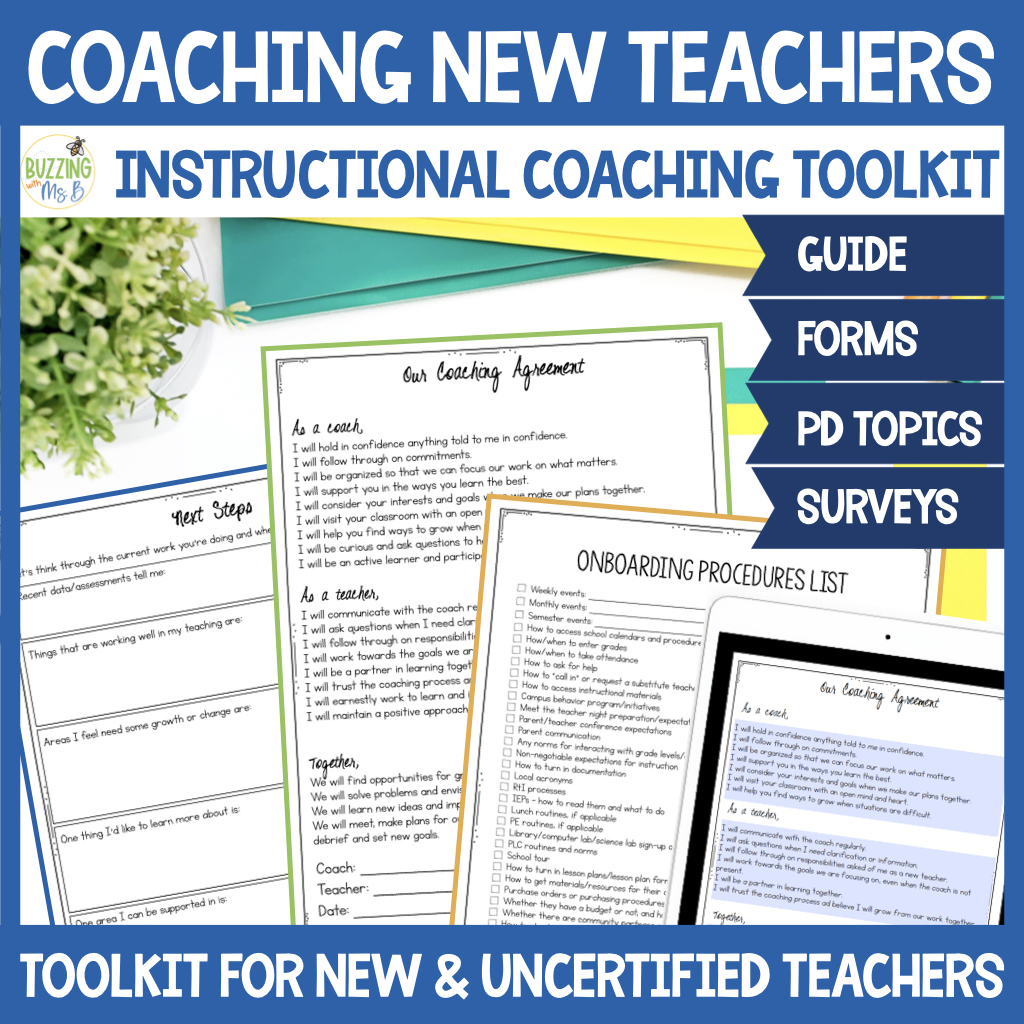
Have a plan for working with new and uncertified teachers with the Coaching New Teachers Toolkit!
It includes forms, templates, and everything you need to help your new and uncertified teachers! Figure out what support the need and provide PD and coaching with these resources. Grab the Coaching New Teachers Toolkit in my TpT Store!
⭐⭐⭐⭐⭐ “I support & coach new teachers and this resource is so valuable. I purchased it several months ago and often use tips you suggested when working with teachers. It is an essential section of my “Teacher Support Provider Binder” that I carry around with me everywhere.”
5 Key Buckets of Student Understanding
Steve says you can’t teach kids surface all year long. Based on assessment results, some of the issues could be conceptual or procedural.
He has a new book coming out with ASED, in which he identified 50 plus strategies into five key areas: surface, procedural, conceptual, reasoning, and transfer.
- Surface builds foundational knowledge with new material and content.
- Procedural addresses the steps students follow, like in math operations.
- Conceptual means to be able to describe your procedural works.
- Reasoning is where we use those reasoning skills to determine next steps and solve problems.
- Transfer is having kids learn something in one context and apply it to a new and novel situation.
I think that such a great way to categorize the results that teachers are looking at. Sorting errors into these categories makes it much easier to figure out what the student needs in the moment.
When I work with teachers looking at assessments, we actually look at student work because I want to see where it went wrong. Just because they circle B or C doesn’t tell you anything about their thinking. I can envision people scoring or looking at data together and then sorting questions into those different buckets so they can make decisions about their future next steps.
Benchmark Assessments
During our conversation, Steve and I discuss what makes a really good benchmark assessment and some of the limitations. Benchmarks are commonly administered at the end of instructional units or quarters to gauge student progress. They’re great for determining how well the teaching went and where the kids were proficient or not proficient.
Steve says the only issue with benchmarks is that there may not be another opportunity to go back after instruction for reteaching. He says benchmarks are more summative than formative.
One thing we touched on was the idea of building “buffer days” after benchmarks. On my campus, we gave teachers a few days after the assessments to respond quickly to the data, provide enrichment, or offer interventions.

Be ready for anything with the Instructional Coaching Editable Binder Megapack!
It includes forms, templates, and everything you need to get organized for instructional coaching! Coach teachers and document your coaching work with these printable and editable tools. Grab the Instructional Coach Binder Megapack in my TpT Store!
Looking at Data Through Different Lenses
I asked Steve to tell us about some other lenses that we can look at data through that are really supportive of teachers making decisions. He says it doesn’t have to be an assessment all the time. It could be data on the room environment, how the kids work with each other, or the way they exchange ideas. Steve says he likes to listen to the strategies the kids use to work a problem out, not just listen for their answers.
Steve highlights authentic performance assessments, where students perform, as they do in music or art. Assessments don’t have to be paper and pencil; they can be through a project or creation.
He says that assessments are the definition of equity. Every kid should be able to take an assessment, even if you have to read it to them or they need to take it orally.
An Introduction to Different Types of Assessments
I loved chatting with Steve! If I were to walk away with one thing from this conversation, it would be those five buckets that he talked about. We can use them to identify the way that students are responding to questions and what their next learning needs are. I think that could be so beneficial for you in your instructional coaching work. That’s absolutely the language that I would take and run with from this episode. I’m so glad that Steve was able to join us today.
Listen to the full episode now to learn more.
Topics and Questions Discussed in Episode 278 – An Introduction to Different Types of Assessments with Steve Ventura
- An introduction to different types of assessments
- How instructional coaches can support teachers in the creation of assessments
- The difference between data and evidence
- Five categories of student understanding
- Benchmark assessments
- Looking at data through different lenses
About Steve Ventura
Steve Ventura is the founder and president of Advanced Collaborative Solutions, ACS. A movement dedicated to empowering educators and students through collaboration, innovation, and impactful professional learning. With a vision of ensuring every child, regardless of background, has access to highly effective teachers and leaders, Steve provides practical, research-based strategies to drive meaningful changes in education.
Turning Insight Into Action: Practical Steps You Can Take After Listening
Here are simple actions you can take today:
1️⃣ Grab the Data Forms for Instructional Coaches and Admins
Understanding your school data is so important to school leaders and instructional coaches! These 18 different data forms will help you collect, organize, and analyze your data. Then you’ll use your data and analysis to reflect and make a plan for next steps!
2️⃣ Join the Instructional Coaching Club
The Instructional Coaching Club is an online membership designed to help instructional coaches improve instruction at their schools. It gives coaches the tools to go out and do it.
Ready to listen?
This post contains links to products from one or more of our advertisers. This means I may receive commissions for purchases made through links in this post when you click on links to those products. Thank you for your support!
Learn more
- Episode 277 – How Required Lesson Plans Can Support Checks for Understanding with Dr. Jana Lee
- Buzzing with Ms. B on Instagram
- Join My Facebook Group: Instructional Coaching with Ms. B
- Data Bookmark & Analysis Forms
- Steve Ventura Website
Helpful Resources
- Join the Instructional Coaching Club
- Data Forms for Coaches and Admin
- Instructional Coach Binder Megapack – Editable Forms, Calendars, Planning Tools
- Instructional Coaching Binder Megapack – Editable Forms, Documents & Tools on TpT
- Buzzing with Ms. B TpT Store
- The Confident Literacy Coach
- Simply Coaching Summit
Listen on: Apple Podcasts, Spotify, or your favorite listening app

Thank you for listening to Buzzing with Ms. B: the Coaching Podcast. Want more coaching ideas
Check me out at buzzingwithmsb.com and on Instagram @buzzingwithmsb.
If you love the show, share it with a coach who would love it too, or leave me a review on iTunes! It’s free and it helps others find this show, too. Happy coaching!
Podcast produced by Fernie Ceniceros