
Formative Assessments: Quick and Easy Check-Ins with Glen Pearsall, ep. 279

Hey Coach!
What if assessment wasn’t just another task for teachers to get through, but one of the most powerful learning levers in the classroom?
Better yet, what if it could be done quickly and required zero extra work for your teachers?
Sounds too good to be true? That’s exactly what we’re discussing this week on Instructional Coaching with Ms. B!
Today, teacher coach and best-selling author Glen Pearsall is here to talk about formative assessments: quick and easy check-ins. He offers assessment strategies that are fast and easy for teachers to use with students.
This episode is part of the Better Assessments, Better Data series, and it’s going to help you think about opportunities to improve assessment so you can gather more useful information to support instruction.
During the episode, Glen unpacks some of the most persistent misconceptions about formative assessment and explains what distinguishes it from other types of assessments. He shares how to use effective questioning to gauge student progress and provide instant feedback during a lesson. We look at how to use fast, formative assessments for quick feedback and explore creative ways to adapt summative assessments for formative feedback. You’ll walk away with new tools and strategies to use with your team.
This episode is full of actionable ideas that don’t require more paperwork or special resources. Listen now to get all the details! Here are the highlights!

Understanding your school data is so important to school leaders and instructional coaches! These 18 different data forms will help you collect, organize, and analyze your data. Then you’ll use your data and analysis to reflect and make a plan for next steps!
What Distinguishes Formative Assessment from Other Types of Assessments? (And Common Misconceptions)
We begin the conversation by exploring the difference between formative and summative assessments. Glen emphasizes that formative assessment is not defined by a specific format or tool but by its timing and purpose within the learning process. While summative assessment is something teachers give at the end of learning to assess student achievement.
During the episode, he highlights common misconceptions around formative assessments, including:
Misconception 1: Formative assessment is a type of assessment
Glen tells us that formative assessment is not a type of assessment, but it’s a time of assessment. Formative feedback is gathered while students are still learning, not after. It feeds straight back into the student’s performance, so immediate adjustments can be made in the moment.
Misconception 2: Formative assessment must always take a written form
There is this false idea that formative feedback has to take written form. In fact, formative assessment is embedded in classroom practices, including questioning and real-time feedback.
I love that Glen focused on when the assessments happen. I think that’s a really easy way for coaches to present this to teachers and help them be thoughtful about the kinds of data they’re getting in the moment. Formative assessment is about influencing learning as it happens and providing immediate feedback that students can use to improve their learning in real time, not when it’s too late to make a difference.
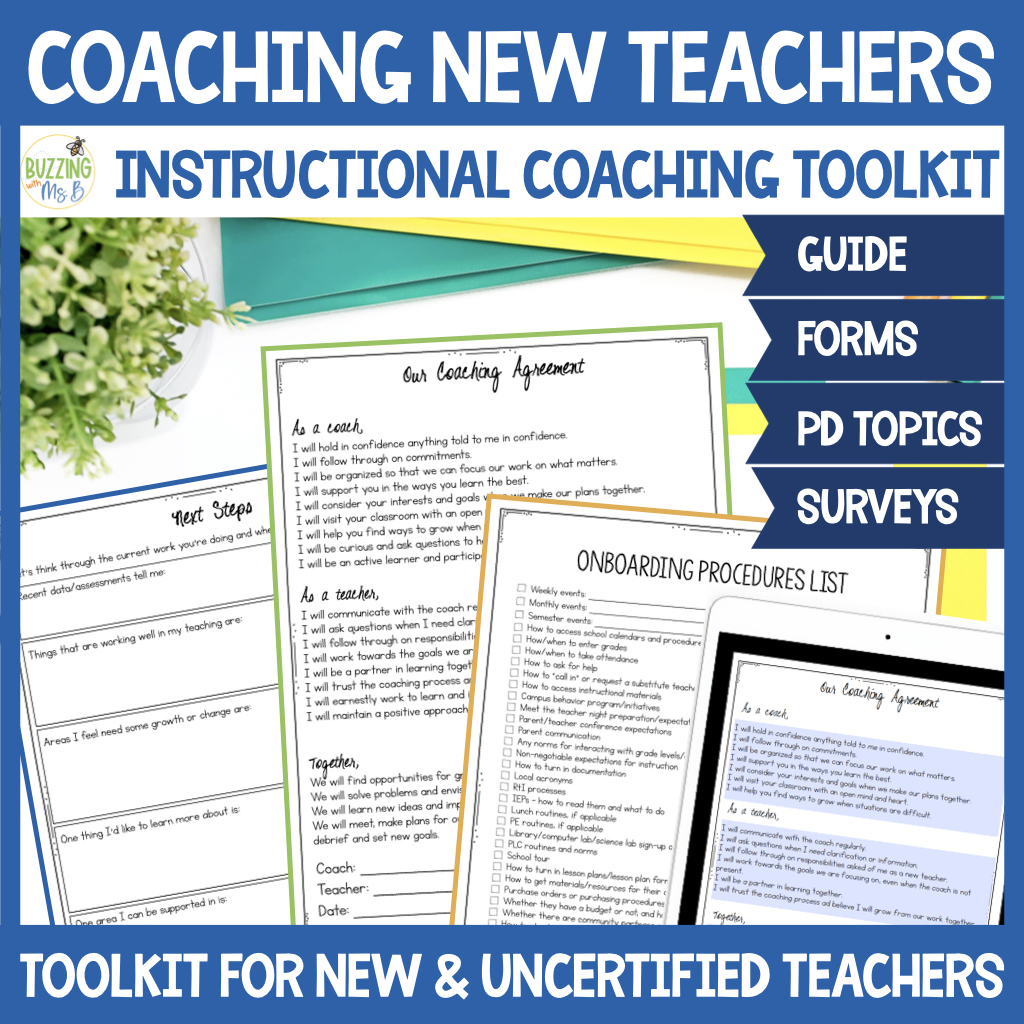
Have a plan for working with new and uncertified teachers with the Coaching New Teachers Toolkit!
It includes forms, templates, and everything you need to help your new and uncertified teachers! Figure out what support the need and provide PD and coaching with these resources. Grab the Coaching New Teachers Toolkit in my TpT Store!
⭐⭐⭐⭐⭐ “I support & coach new teachers and this resource is so valuable. I purchased it several months ago and often use tips you suggested when working with teachers. It is an essential section of my “Teacher Support Provider Binder” that I carry around with me everywhere.”
Using Effective Questioning to Check on Student Progress and Provide Feedback During a Lesson
Some studies say that teachers ask and answer between 200 and 300 questions per day! Being able to influence that can have a really profound impact.
So how can teachers use those questioning opportunities to actually check on student progress during a lesson and provide them with feedback? Glen says that one of the things about questioning techniques is that it’s so subtle that even small adjustments can really improve student learning.
In Australia, the average teacher wait time after a question is about 1.1 seconds. That leads to six or seven kids answering 93% of the answers in the class in his studies. If a teacher bumps up the wait time to three seconds, it can triple the average number of responses in class. Waiting just a little longer means you can hear many more voices and get a clearer sense of what everyone is thinking in the room.
A technique Glen highlighted is pre-cueing a question (“In five minutes, I’m going to ask you this question…”). He says he loves to use pre-questioning as an adjustment for students who might be struggling. It gives them time to formulate an answer and helps them have a voice in the classroom.
One of Glen’s favorite forms of questions is called an inverted question in Australia; some American teachers refer to it as a contextual situation. Essentially, instead of giving kids a question and expecting an answer, you give them an answer and get them to comment. You’ll get much richer answers.
Here are two examples:
- Instead of asking students, “Is 19 a prime number?”, ask, “19 is a prime number. Why?”
- Instead of asking, “Is this a fiction or non-fiction book?”, ask, “This is a nonfiction book. How do we know it’s a non-fiction book?”
Inverted questions are really powerful because they signal to students that we’re interested not so much in the answer but the reasoning behind the answer. Teachers are able to present a higher-order question to students and get them to tell us what they’re thinking.
In Glen’s work, he has seen that kids respond more to this type of question than to traditionally framed ones. He thinks it’s because students feel safe, they have been given the answer, and they’re just commenting.
He says what he really likes about this is that you get more sophisticated answers, and an instructional coach can help teachers make that adjustment. Asking these types of questions does not involve more preparation or correction of materials afterwards. It’s a really subtle shift that makes a big impact.
I love this because having kids express their reasoning is so important! It encourages longer answers instead of a single-word response. Turns out the real trick isn’t how many questions you ask in the classroom; it’s how you ask and how long you wait for a reply.
Fast, Formative Assessments for Quick Feedback
Glen’s amazing book, Fast and Effective Assessment, has lots of ideas for using quick feedback in the moment. During the episode, he shares two that are emblematic examples. Both strategies are quick, require no extra prep, and make feedback visible and actionable to all students in the classroom.
Traffic Lights
One of Glen’s go-to strategies is the Traffic Light System. After explaining a new concept to students, ask them to show with their fingers if they’re green (understood it), amber (sort of but would like to go over it again), or red (didn’t get it).
When kids were interviewed after, it was apparent that half of the kids who put up amber were actually red because they didn’t want to say they didn’t understand. When Glen flipped the script and asked students to rate how well the teacher explained the content, students were much more candid with their feedback.
Fist to Five
Another strategy Glen discussed was Fist to Five. When I was a new teacher, we were a big Kagan school, and this was a good one from them. Teachers ask students to rate their understanding on a 0–5 scale with their fingers. It allows you to quickly spot gaps and see where everyone is in the class. It’s a super simple but powerful tool.

Be ready for anything with the Instructional Coaching Editable Binder Megapack!
It includes forms, templates, and everything you need to get organized for instructional coaching! Coach teachers and document your coaching work with these printable and editable tools. Grab the Instructional Coach Binder Megapack in my TpT Store!
How Can Teachers Make Modifications to Summative Testing Strategies That Would Help Them Monitor Students’ Progress Formatively?
In Glen’s book, Fast and Effective Assessment, he argues that it’s really useful to bring tests back into the middle phase of learning. He says to do that and make them effective, there are adjustments teachers can make in the classroom. During the conversation, we explore creative ways to adapt summative tests for formative use.
Here are two ideas you can try out!
Red-Blue Test
You give students a standard closed-book test and have students answer in blue pen first. Then, switch to a red pen and give them an open-book test to fix or finish their answers using available resources.
This gives you a lot of information: blue answers show what students can do without assistance, red reveals what students can do with support, and errors expose misconceptions. That’s incredible data for a teacher to review because it helps them target the remaining learning precisely where students need it. I love this strategy because it requires nothing new for teachers to create.
Instant Indicative Test
Another method is the Instant Indicative Test. Glen says this one is so powerful, and I completely agree!
Students are given criteria for successful work (i.e., writing in paragraphs), and they self-score in real time. The trick is to make the criteria indicative and give extra points for things students don’t often do. As students actively review and revise their own work, they get ongoing feedback about their performance.
Formative Assessments: Quick and Easy Check-Ins
This episode is so good! I seriously took multiple little notepads of notes!
There’s something so exciting about hearing that quick and easy formative assessments don’t have to mean more work or more stress. All we need is a shift in when and how we gather information on student learning.
You don’t want to miss this actionable episode, Formative Assessments: Quick and Easy Check-Ins. Listen now!
Topics and Questions Discussed in Episode 279 – Formative Assessments: Quick and Easy Check-Ins with Glen Pearsall
- Formative assessments: quick and easy check-ins
- What distinguishes formative assessment from other assessment types, and common misconceptions
- How to use effective questioning to check on student progress and provide instant student feedback during a lesson
- Fast, formative assessment ideas for immediate feedback: Traffic Lights and Fist to Five
- Flipping the script: having students rate the teacher’s explanation
- Creative ways to adapt summative assessments for formative feedback
- The Red-Blue Test and Instant Indicative Test methods
- Student self-assessment and checklists to drive learning
About Glen Pearsall
Glen Pearsall is Australia’s leading Teacher Coach and a best-selling author. He specialises in instructional technique, student behaviour, and reducing teacher workload.
Turning Insight Into Action: Practical Steps You Can Take After Listening
Here are simple actions you can take today:
1️⃣ Try One of the Strategies Glen Mentioned
During the episode, Glen shared many practical ways to help students get feedback in the moment. Try out one of the strategies he suggested: wait time, pre-cueing questions, inverted questioning, Traffic Lights, Fist to Five, Red-Blue Test, or Instant Indicative Test. Let me know how it goes in the Instructional Coaching with Ms. B Facebook group or on Instagram @buzzingwithmsb!
2️⃣ Join the Instructional Coaching Club
The Instructional Coaching Club is an online membership designed to help instructional coaches improve instruction at their schools. It gives coaches the tools to go out and do it.
3️⃣ Get the FREE Data Bookmark & Data Analysis Forms
Get the tools you need to analyze data through different lenses, such as subpopulations, standards, and more. The Data Bookmark and Data Analysis Forms are free and perfect for digging into data any time of year! Head to buzzingwithmsb.com/dataplc to grab the free download!
Ready to listen?
This post contains links to products from one or more of our advertisers. This means I may receive commissions for purchases made through links in this post when you click on links to those products. Thank you for your support!
Learn more
- Episode 277 – How Required Lesson Plans Can Support Checks for Understanding with Dr. Jana Lee
- Episode 278 – An Introduction to Different Types of Assessments with Steve Ventura
- Buzzing with Ms. B on Instagram
- Join My Facebook Group: Instructional Coaching with Ms. B
- FREE Data Bookmark & Analysis Forms
- Contact Glen at Critical Agendas
Helpful Resources
- Join the Instructional Coaching Club
- PLC Forms for Team: Common Assessments
- Data Forms for Coaches and Admin
- Instructional Coach Binder Megapack – Editable Forms, Calendars, Planning Tools
- Instructional Coaching Binder Megapack – Editable Forms, Documents & Tools on TpT
- Buzzing with Ms. B TpT Store
- The Confident Literacy Coach
- Simply Coaching Summit
- Tilting Your Teaching (Glen’s teacher coaching book)
- Fast and Effective Assessment: How to Reduce Your Workload and Improve Student Learning (Glen’s book on feedback and questioning)
Listen on: Apple Podcasts, Spotify, or your favorite listening app

Thank you for listening to Buzzing with Ms. B: the Coaching Podcast. Want more coaching ideas
Check me out at buzzingwithmsb.com and on Instagram @buzzingwithmsb.
If you love the show, share it with a coach who would love it too, or leave me a review on iTunes! It’s free and it helps others find this show, too. Happy coaching!
Podcast produced by Fernie Ceniceros


