| |

How Required Lesson Plans Can Support Checks for Understanding with Dr. Jana Lee, ep. 277
Chrissy beltran smiling. These words are on the image, "How Required Lesson Plans Can Support Checks for Understanding with Dr. Jana Lee ".

Today, we’re kicking off a new mini-series about supporting better assessments. In this first episode, Dr. Jana Lee is here to discuss how required lesson plans can support checks for understanding.

A while ago, Dr. Lee shared some interesting thoughts online about lesson plans. As an instructional coach, I have a lot of thoughts about lesson plans, too, so I wanted to talk to her about this!

For some, the connection between lesson plans and assessment might be murky. But I believe if we don’t have that as part of our planning, it’s probably not going to happen.


During the episode, we discuss reasons for requiring lesson plans to be submitted to administration and outline what to include. We explore the steps to lesson planning with the Core 4, including how it allows us to check for understanding and respond appropriately.

Be sure to listen to the entire episode. Here are the highlights!

Valid Reasons to Turn in Lesson Plans

To start things off, I ask Dr. Lee to tell us some valid reasons for lesson plans to be turned in. She begins by acknowledging that the idea of submitting lesson plans has left many teachers with a bad taste in their mouths.

This practice has become centered around compliance, something teachers are required to submit. Often, they’re not even reviewed by building leadership or whoever is requiring them, and there’s no follow-up.

According to Dr. Lee, a major shift in our work is changing the way we view lesson plans. She encourages us to move from lesson plans just being a source of accountability to them being something that pushes high-impact instruction and student achievement. This means removing the fluff and focusing on the components that bring the skills and content to life for all students, including that assessment component.

Be ready for anything with the Instructional Coaching Editable Binder Megapack!

It includes forms, templates, and everything you need to get organized for instructional coaching! Coach teachers and document your coaching work with these printable and editable tools. Grab the Instructional Coach Binder Megapack in my TpT Store!

Lesson Planning Using the Core 4

Dr. Lee explains that part of our work as instructional coaches has been pushing what she calls the Core 4. She walks us through how teachers can plan lessons using the Core 4 method.

Part 1

The first part is essentially figuring out what we want students to know and be able to do by the end of this lesson. We’re identifying the skill being taught.

Part 2

Second, we need to decide the instructional activities that will allow students to engage with that skill in a meaningful way. This part includes “I do” and “we do”.

For “I do”, we’re modeling the skill students need to know by the end of the lesson and showing how our brain thinks out loud. During “we do”, we’re asking students for their input and doing an example together, mirroring the thought process.

Part 3

The third part of the Core 4 is the checks for understanding (CFUs), and where the assessment piece comes in. We’re giving students 60-90 seconds to try this on their own. We’re capturing real-time data on students’ understanding and monitoring proficiency in the moment.

Part 4

The fourth part is the response to the check for understanding. Teachers respond in the moment to the data. The students who are ready for independent work move on to “you do”.

Any student who does not produce the check for understanding and is not showing proficiency in the skill is pulled into a small group for targeted remediation. In these groups, teachers need to provide tiered support and not reteach the lesson like they did the first time because it didn’t work for those students.

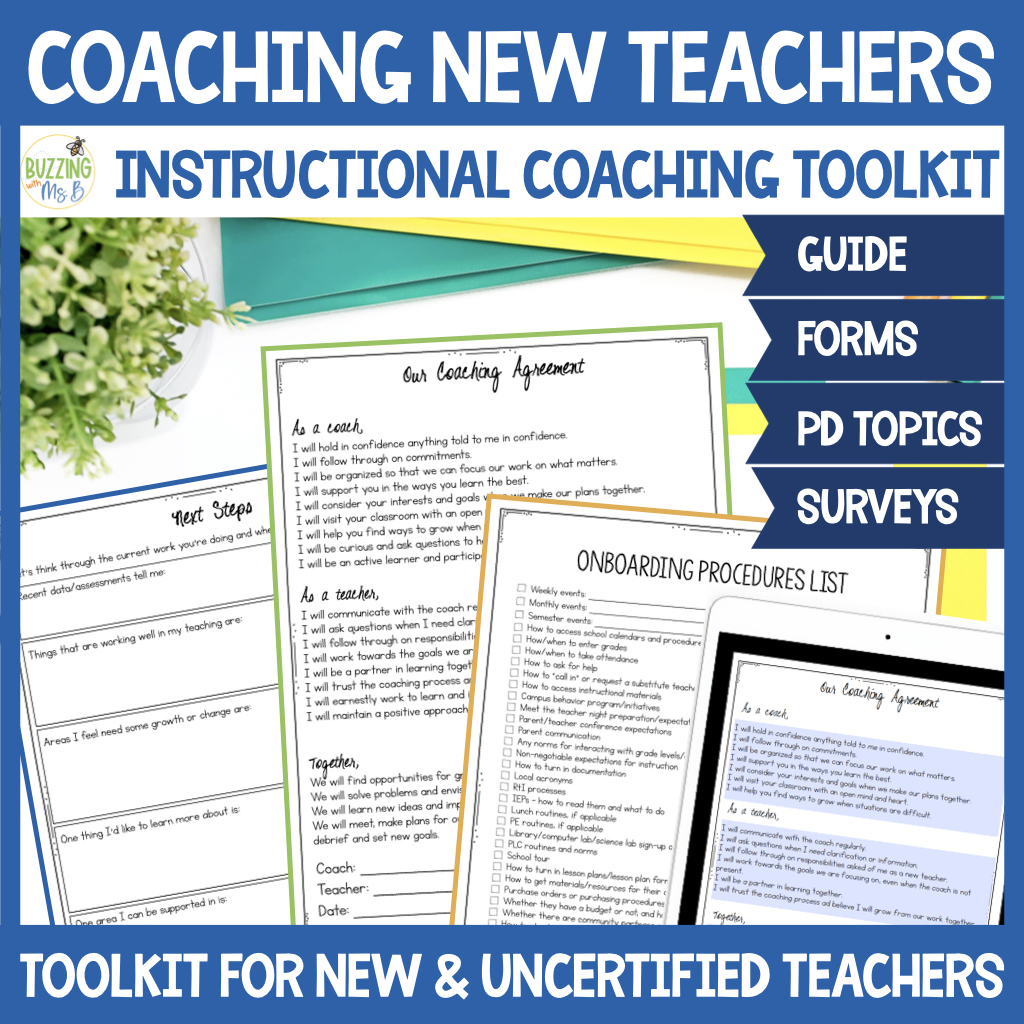
Have a plan for working with new and uncertified teachers with the Coaching New Teachers Toolkit!

It includes forms, templates, and everything you need to help your new and uncertified teachers! Figure out what support the need and provide PD and coaching with these resources. Grab the Coaching New Teachers Toolkit in my TpT Store!

⭐⭐⭐⭐⭐ “I support & coach new teachers and this resource is so valuable. I purchased it several months ago and often use tips you suggested when working with teachers. It is an essential section of my “Teacher Support Provider Binder” that I carry around with me everywhere.”
How Required Lesson Plans Can Support Checks for Understanding`

There are some people who see things as you do, and when you’re talking to them, you’re thinking “yes, exactly”. They get mad at the same stuff and are excited for things you like. That’s how I feel when I talk to Dr. Lee.

It’s refreshing to hear that we don’t have to make lesson planning complicated and can keep it simple! That’s the same thing I’ve been talking to teachers about for years.

This episode is full of ideas about how required lesson plans can support checks for understanding. I know you’re going to love this conversation. Listen now!

Be ready for anything with the Instructional Coaching Editable Binder Megapack!

It includes forms, templates, and everything you need to get organized for instructional coaching! Coach teachers and document your coaching work with these printable and editable tools. Grab the Instructional Coach Binder Megapack in my TpT Store!

Topics and Questions Discussed in Episode 277 – How Required Lesson Plans Can Support Checks for Understanding with Dr. Jana Lee 

  • Supporting better assessment
  • How required lesson plans can support checks for understanding
  • Valid reasons to require lesson plans be submitted to administration
  • What should be included in a lesson plan
  • Lesson planning with the Core 4
  • “I do”, “we do”, “you do” instructional teaching strategy
  • Responding to checks for understanding

About Dr. Jana Lee
As a school leader, Dr. Jana Lee develops systems to align stakeholders in supporting all students. With 15 years of experience as a teacher, administrator, adjunct instructor, literacy specialist, and consultant, her mission is to help leaders use research and data-driven decisions to drive meaningful, individualized student success.

Turning Insight Into Action: Practical Steps You Can Take After Listening

Here are simple actions you can take today:

1️⃣ Visit Dr. Jana Lee’s Instagram Page

Dr. Lee shares a lot of great resources and information on Instagram. Be sure to check it out!

2️⃣ Join the Instructional Coaching Club

The Instructional Coaching Club is an online membership designed to help instructional coaches improve instruction at their schools. It gives coaches the tools to go out and do it.

Ready to listen?

  • Ready to listen? You can listen below with the media player, or search for Buzzing with MS. B: The Coaching Podcast anywhere you listen to podcasts!

This post contains links to products from one or more of our advertisers. This means I may receive commissions for purchases made through links in this post when you click on links to those products. Thank you for your support!

Learn more

Helpful Resources


Listen on: Apple Podcasts, Spotify, or your favorite listening app


Thank you for listening to Buzzing with Ms. B: the Coaching Podcast. Want more coaching ideas

Check me out at buzzingwithmsb.com and on Instagram @buzzingwithmsb.

If you love the show, share it with a coach who would love it too, or leave me a review on iTunes! It’s free and it helps others find this show, too. Happy coaching!

Podcast produced by Fernie Ceniceros

How Required Lesson Plans Can Support Checks for Understanding with Dr. Jana Lee, ep. 277, Instructional Coaching with Ms. B Podcast

Chrissy Beltran [00:00:02]:

Can you remember the joy of opening up your favorite teen magazine? Getting it out of the mailbox, scouring the shiny cover for your favorite stars, sniffing the perfume samples, and taking the quiz? Well, over the years, I’ve realized that coaches are often missing out on that joy. Seeing behind the scenes of how a school works can be defeating and exhausting. Let’s bring back the spark to your coaching work. Head to instructionalcoachingclub.com to join the most fun membership for instructional coaches. You’ll get so many thematic and joyful resources to use for your own coaching work and ready to go teacher PDs too. Plus, my favorite part, the monthly bonuses truly take me back to 1997 when I was opening my own copy of 17 magazine. I cannot wait to see you in the club, instructionalcoachingclub.com. Welcome to Instructional Coaching with Misty, where we believe that every teacher deserves a coach and every coach does too. I’m Krissy Beltran, an elementary teacher who became a coach, and I had to create my own coaching program that worked. Now I teach coaches how to design their coaching programs, build a school wide action plan, and use differentiated strategies to support teachers. Plus, I’ve got a special spot in my heart for literacy coaches. Now let’s dig into the episode. Hey, coach, and welcome to instructional coaching with miss b. Today, we are starting our new mini series about better assessments, better data with an episode that might seem a little off topic, but I promise you it’s not. We are looking at how required lesson plans can support checks for understanding with my guest, Jana Lee. Now if you’ve had PLC meetings with teachers where you’ve tried to plan together or look at data together and you are just not having the conversations that you want, you are not alone. So many times, we have worked with teachers who are uninterested in the topic or who just struggle to really contribute to their team in maybe speaking for them. I have a free download that you’re gonna love. It’s PLC discussion dice, and you can grab them to use with your teachers and help you focus on the topic at hand. If you go to the show notes for buzzing with missb.com/episode27seven, you can grab that free download at the bottom of the notes. My guest today, Jana Lee, is a school leader who developed systems to align stakeholders in supporting all students. With fifteen years of experience as a teacher, administrator, adjunct instructor, literacy specialist, and consultant, her mission is to help leaders use research and data driven decisions to drive meaningful, individualized student success. So let’s jump right in to my conversation with Jana. So welcome to the podcast, Jana, and thank you so much for being here and making time for us.

Dr. Jana Lee [00:02:35]:

Thank you. I am, very excited to be in this space with you today, so thank you for having me.

Chrissy Beltran [00:02:41]:

Yeah. Well, you’re a repeat guest, and that’s only happened a handful of times, so that’s really great. I I’m so glad that you’re here again. So you’ve shared a little while ago online about some some interesting thoughts about lesson plans, and I I have a lot of thoughts about lesson plans too. And so, I was wanting to talk to you about this. You were talking in in the post that you shared. It was about, whatever lesson plans are required, if they must be turned in, then this is what they can kind of look like. So I’d love to dig into that today because we’re starting a series on assessment. And I know that to some, the connection between lesson plans and assessments might be a little less clear, but to me, it’s like if we don’t have that as part of our planning, it’s probably not gonna happen. So I would love to hear from you just to get started. What are some valid reasons to require lesson plans to be turned in? Because we know some schools do it, some don’t, and it’s a whole hot button issue.

Dr. Jana Lee [00:03:33]:

It so is. And I I think that the idea of lesson planning has become centered around compliance and it being just something that, you know, teachers are required to submit. And oftentimes, even when they are submitting them, they are not reviewed by, you know, building leadership or whoever it is that that is requiring it. And then, of course, you know, it it can leave teachers with sort of a bad taste in their mouth because here they are submitting these without there being any sort of follow-up. So I first, you know, wanna acknowledge the fact that there that there is I understand the the sort of, you know, foul taste in one’s mouth when they have to submit a plan knowing that it’s just because that’s what’s required from them. And I think a major shift I know in, you know, our work and and being able to support teachers and leadership is changing the way in which we, view lesson plans. And so rather than see rather than being a a source of, you know, a source of accountability, they become something that is actually used to push high impact instruction and student achievement. So that means, I don’t wanna say watering down, but taking out a lot of the fluff of what a typical lesson plan might need to include and instead really focusing on the components that are going to bring skills and content to life for all students in the classroom, including that assessment component.

Chrissy Beltran [00:05:24]:

Yeah. I think that’s a good point because I think that, like you’re saying, lesson plans have sometimes really lots of complicated boxes and categories and lots of things that have to be included, and that that might be helpful as you’re thinking about the plan. Like, to me, that’s like a planning document, like, that you’re gonna collaborate around, but then the actual lesson plan doesn’t need to look that way because you’ve done all the thinking. So, like, the actual plan is more like, what are you gonna do? Like, that’s what Exactly. What it it was to me.

Dr. Jana Lee [00:05:56]:

And it should read very linearly. Right? I think when you look at typical plans, whether they’re coming from, the the school themselves or part of a curriculum. It just seems like there are so many of these, you know, components in a lot of different boxes and and and and directions. And I think that that just cues a sense of immediate overwhelm and kind of like, okay. So where do I where do I start? Right? And so the focus becomes more on for teachers, it becomes more on, like, how do I take all of this information and just, like, put it into the the the boxes that the school is requiring from me rather than the lesson plan mimicking the high impact design in a linear way that,

Chrissy Beltran [00:06:46]:

you

Dr. Jana Lee [00:06:46]:

know, we know needs to exist in order for teachers to be able to to teach to those standards, but also respond to student needs in real time. So Yes. Part of, you know, our work has really been pushing what what, I’ve coined as the core four. So, essentially, you know, what is it that I want my students to know and be able to do by the end of this lesson? Not not tomorrow’s lesson, not by the end of the week Right. But by end of this

Chrissy Beltran [00:07:18]:

unit. Yeah.

Dr. Jana Lee [00:07:19]:

Yeah. What is that skill that I am teaching? And most of the time, it should not be a standard, because standards are broken down into many skills that eventually get our students there. But what is the skill that I’m focusing on so that my students eventually meet that standard expectation? So that’s that’s number one. Number two, what are the instructional activities that I am going to implement? And so part of that includes the I do, we do, you do. I do in terms of how am I modeling this skill that students have to know how to do by the end of today’s lesson. How am I modeling that? How am I showing how my brain thinks out loud, which I think oftentimes, a lot of teachers will share that they are modeling. But when you start to really look at that, it’s more so of, like, that we do. Right? Where they’re asking students for their input. And I’m not saying that that’s not important, but that should follow the thought process in terms of, okay. Now that I have shared with you how my brain is thinking, let’s do one together mirroring my thought process. And then, the the the Mhmm. The third component of that being the check for understanding. And that’s where that assessment piece comes in. So it’s not the exit ticket. Think of it as like an exit ticket being bumped up. Right? How are we designating sixty to ninety seconds of whatever it is that students are being asked to do independently? How am I giving that sixty, ninety seconds for students to try this on their own. And this is where the rubber meets the road in terms of capturing real time data on student understanding and proficiency in the moment. It’s really hard for teachers to do, but I like to explain it this way. I was in a classroom not too long ago, and the check for understanding popped up on the board, which I loved because I think when it’s there in the slide deck, it it it it becomes part of the lesson. Right? And the teacher kind of looked at me because there were students that were getting up for the CFU. There was a student that wasn’t, at school the day before so couldn’t complete it. There were a few students that just Right. Didn’t know what to do. And I said, that’s okay. Don’t don’t help them in this moment. You’re going to catch them all. Any student who doesn’t produce the the the check for understanding is not showing proficiency towards said skill, for whatever reason, it doesn’t matter Mhmm. You’re gonna pull them. And so when we give that first sixty, ninety seconds to let students work independently, right, what happens next is the fourth piece of core four, which is that check for understanding response. So now I’m grabbing all of you. Right? And we’re gonna go in a small group where while everyone else is continuing on with that you do of independent work. And what are we doing in that check for in that small group instruction? We’re remediating. We’re targeting response, meaning we’re not just reteaching the lesson because, obviously, the first way that we did it didn’t work for those students. But rather, we are finding, we’re kind of digging deeper into the tiered support that we provide, whether it’s changing the language by which we were using, whether whether it’s bringing in manipulatives, whether it’s chunking the the steps we need to get

Dr. Jana Lee [00:10:50]:

there. Whatever, you know, whatever that needs to be, that in that small group, that’s what true targeted remediation looks like. So, eventually, you move through a I do, we do, check for understanding because I have to know that you can do it before you do. And so then the students who are ready for that the rest of that independent work move on, and anybody who isn’t, you know, is with that teacher in small group flexible instruction. And so Yes. When we think about high impact lesson design and the incorporation of assessment, there is a science to that, and there it is research backed. Right? And those components should teachers we want teachers to build automaticity in those components. And and when they build automaticity in that, they are able to enter into their lessons not having to figure out how to teach the thing. Right? But more so be able to focus on the actual implementation of it to improve their own practice. So we kinda take the guesswork out of evidence based instruction and are rather allowing teachers to really speak to where are the the the the problems within or the challenges that they are facing in the implementation of that. And and where do we see students struggle the most in their behaviors, in their routines when it comes to the rolling out of of that, you know, of that design? And I think that in the beginning of a teacher moving more toward the that core four piece. Right? There is a there is a bit of a a period where the routines and structures and systems within the classroom may need to be reinforced in order to develop a really well oiled machine where small group instruction is happening. Students know what a teacher modeling really means. And not for nothing, but leadership can come in and know at what point in the lesson the teacher is at based on the instructional activities that they see going on. So those four pieces again being what is the skill that the that we need students to be able to understand by the end of the lesson? What are the instructional activities that are are going to allow our students to engage with that skill in a meaningful way? That’s where the I do and the we do comes in. Then the check for understanding, how are we monitoring proficiency, and then how are we responding? That’s number four.

Chrissy Beltran [00:13:26]:

Yes. Perfect. That’s all I wanted to know. No. I’m just kidding. Yeah. That’s great. No. I totally agree with all of that. That is essentially what I had my my teachers do as a as a coach whenever I work with teachers and whenever I was a campus, coach, that is the structure that we did as well. And because planning the lesson, you’re obviously thinking about a lot of things and then you use them to frame the lesson and you’re basically writing it’s not a script, but it’s like a guide for yourself to get to move through the lesson. Right? And so I just love that. I really like that you have built in that the check for understanding creates a response from the teacher because too many times we have the exit ticket. Kids do the exit ticket, the last three minutes of class, and then they leave or you move on to whatever other subject. And then the next day, you’re gonna come back and be like, oh, 80% of the kids didn’t get it. I guess we’ll try again. And so I feel like we’re missing the boat when we don’t have immediate response to that check for understanding. I do think there are situations in which this I do, you know, I do, we do, you do may actually extend over several days given you know, depending on the complexity or what they’re working with. Mhmm. But I think that without having a response to that check for understanding, we are we’re not we’re not getting anything out of it. Thank you so much for all of this. I’m sure it’s gonna give people some things to think about because this is like a constant debate at schools. Do we require lesson plans? What goes in them? How does planning look? So thank you for all of all the information you shared today. Thank you so much. You know when you talk to, like, somebody who just sees things the same as you and you’re just like, ah, yes. Exactly. And you you get mad about the same things. You get excited for the same things. That’s how I feel when I talk to Jana because it is, like, so refreshing to hear, like, we don’t have to make this so complicated. Let’s focus. Let’s keep it simple, and I just love it. And it’s the same conversations I’ve had with teachers for years. So I hope you check her out. She’s got a lot of great resources and and, information she shares on Instagram. Really great perspective. Next week, I am starting a new miniseries. It’s universal models or approaches for instructional coaching. And guess what? Guess who my first guest is, who’s never been on the podcast before. Okay? It’s Diane Sweeney. I hope I didn’t just blow out your eardrums. I’m just super excited because I love Diane’s work, and I cannot wait to share this with you. We’re gonna talk about student centered coaching. She’s gonna give us the, you know, the basic framework, how it’s different from other coaching models, some of her favorite strategies, and I just cannot wait to share this with you. It’s gonna be a really good one. We’re gonna dig into different models of coaching throughout June to help you get plan kind of an idea of how you can approach your coaching work because there are different ways to do it and you can kinda build your perfect program that really works for you and your teachers as you get all

Chrissy Beltran [00:16:12]:

these pieces and put them together. So that’s my episode next week. And until then, happy coaching. Now that you’ve got so much to think about, head over to buzzingwithmissb.com to grab some free downloads, become a VIB, and check out the podcast show notes. Happy coaching!

Share:

Similar Posts

Leave a Reply

Your email address will not be published. Required fields are marked *