| | | |

Supporting Mindset Shifts in Your Teacher Teams and PLCs with Connie Hamilton, ep. 266
Chrssy Beltran sitting and smiling with a cup of coffee in front of her. These words are on the image. "Supporting Mindset Shifts in Your Teacher Teams and PLCs with Connie Hamilton"

Sometimes our teacher teams get stuck in a certain way of thinking that holds them back. But instructional coaches can help our PLCs make mindset shifts and see things through a different lens!

In this episode, Connie Hamilton joins me to talk about supporting mindset shifts in your teacher teams and PLCs. We discuss the type of mindset we should be cultivating with our teams and the steps to make it happen. She offers ideas for changing our approach to data, including ways to make it more meaningful and better aligned with the work our teams do daily.

Connie explains how to shift our thinking from a deficit approach to asset-based thinking, what that looks like, and how coaches can embody it. She also tells us how we can grow asset-based thinking in our teachers.

This episode is packed with suggestions that support teachers’ mindset shifts! Listen now to the full episode!

Cultivating Mindset in Teacher Teams and PLCs

When asked about the mindset coaches should cultivate in teacher teams, Connie’s answer is simple: start with what’s going well already. She notes that teachers often hyperfocus on things that aren’t going as perfectly as they would like. It’s important for coaches to highlight the good things we see and recognize everyone’s desire to continuously improve their practice. While we focus on the positive components, we can also look for those small tweaks that move educators to the next phase.

In a group setting, you’ll likely have teachers at different stages with varying experience and levels of expertise. Because of this, Connie says that coaches have to keep in mind how we communicate with individuals, highlight different components, and bring other people into it.

What’s important is that we aim for a culture of equity, collaboration, and collective efficacy, where everyone feels they contribute not just to their own growth, but to others as well. We want to be aware of where every person is at and create a balanced, supportive environment where each person can participate, share, and help each other grow as a collective team. Connie says one of the best ways to do this is to give everyone something concrete to contribute to the conversation, and that usually comes in the form of data.

Working with a diverse group of teachers and helping them move towards a common goal can be really challenging. I’m grateful that Connie offered some ideas for how to approach it.

How Can We Change Our Approach to Data and Use It to Support the Work Our Teams Do?

When working with teams, one of the challenges that coaches face is using data in a purposeful, meaningful way. Many teams feel like data is a task or a chore to get through, rather than a tool for understanding what’s happening in the classroom.

I asked Connie how to shift that approach so data supports instructional work and thoughtful teaching. She responded that the first thing we need to do is broaden what we consider data.

If teams only focus on summative assessments, high-stakes testing, or end-of-unit results, data meetings can feel like a waste of time and disconnected from real classroom needs. Instead of relying solely on tests, coaches and teachers should look for real-time, actionable “microdata” during lessons. We’re looking at real-time pieces of information like:

  • Which students participate in class discussions (and which do not)
  • Student engagement
  • Types of questions asked
  • Student talk and collaboration
  • Quality and timing of transitions

Connie recommends teachers observe each other’s classrooms and collect different data points. By observing each other’s classrooms and collecting different data points, teachers can offer non-threatening, supportive feedback. They can make predictions before the lesson, see how students respond during the lesson, and then use the data to problem-solve and support each other.

This approach normalizes that lessons are imperfect. It empowers teachers to anticipate challenges, tap their gut instincts, and encourages collective problem-solving. Ultimately, such purposeful use of data helps teachers see patterns, adopt new strategies, share ideas, learn from each other, and see data as an asset rather than a judgment. Connie says it builds a sense of camaraderie, compassion, and support into the process, driving more effective instruction and professional growth.

I really appreciate that Connie brought up the importance of teachers visiting colleagues. I think one of the biggest mistakes we make is thinking the development of our teams only happens when we meet together as a PLC team in a room and have conversations. We need to be in each other’s classrooms and see each other teach because that’s when we see the biggest change in teaching.

Looking for PLC Resources to Grow Your Teacher Teams?

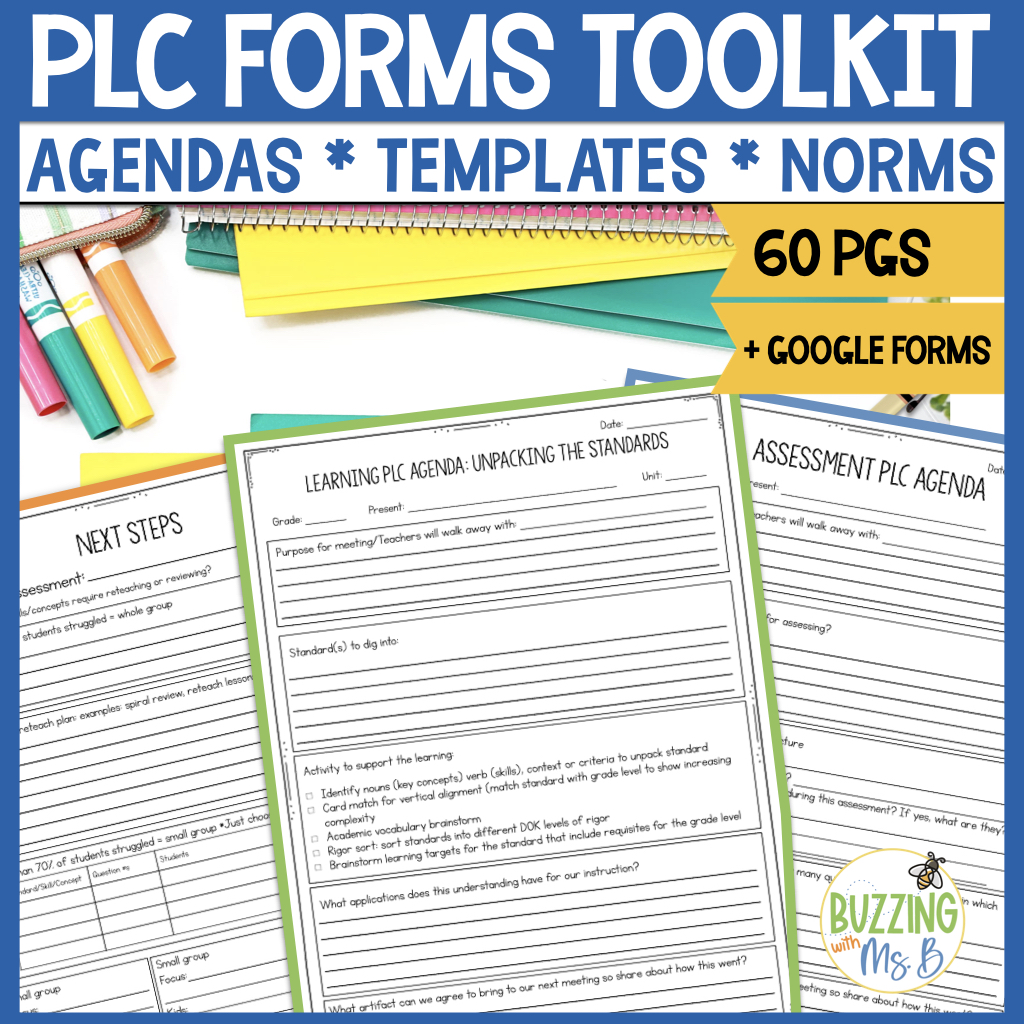
Grab the Instructional Coach PLC Binder Bundle: Norms, Meeting Agenda, Forms & Templates in my TpT Store! It has everything you need to establish purposeful, effective PLCs.
Shifting from Deficit Thinking to Asset-Based Thinking

Our brains are wired to spot problems. We do this to survive and ensure we’re safe. But it doesn’t really serve us well when we’re trying to support teachers if we’re too focused on deficits.

During the conversation, I ask Connie to elaborate on the shift from deficit thinking to asset-based thinking, including what it looks like and how coaches can embody it. Connie says that it’s important to have a continuum of success in mind: from teachers just learning a skill to someone who is having intermittent success.

Instead of worrying about what isn’t working, asset-based thinking starts with what the teacher CAN DO and highlights that. It may be tempting for coaches to encourage teachers to take big leaps, but Connie explains that lasting success comes from celebrating little wins and asking teachers to take small next steps. We want to focus on what’s already working and support incremental progress.

Connie shares a realistic strategy for working with teachers who might be a bit resistant, self-conscious, or defensive.  Instead of focusing on what the teacher is doing (and not doing), she reframes the conversation around what the students are ready for.

For example, she might say: “I really think your students are capable of doing think-pair-share. I think they could do turn and talk more frequently. Do you agree?” This naturally leads the teacher to consider the next step without feeling judged or overwhelmed.

Connie says that teachers appreciate a thought partner who gives them ideas and a jump start, but doesn’t completely take over the reins. I agree that it’s so important to offer teachers options that aren’t overwhelming and that we offer support as they try new things.

When we embody asset-based thinking as an instructional coach, we focus on what’s working, celebrate small wins, and build from strengths, not deficits. This approach boosts teachers’ confidence and creates a supportive environment.

Growing Asset-Based Thinking in Our Teachers

In this episode, Connie offers several practical ways to grow asset-based thinking in teachers. Here are a few strategies to try:

Model Asset-Based Conversations in Coaching

Instructional coaches play a critical role by modeling asset-based thinking. This starts with shifting conversations from focusing on deficits to celebrating what teachers and students can do! By modeling with strength-based language in conversations and feedback, coaches help teachers focus on students’ success rather than getting bogged down by gaps or areas for growth.

Use Asset-Based Questions When Discussing Students

Connie says that if we hyperfocus on needs assessments, which highlight deficits, then we’re working from the end and trying to fill gaps. Instead, encourage teachers to ask, “What can students do?” and “What background knowledge or experiences do they already have that we can build off?” This clarity helps shift the focus from deficits to strengths, making it easier to identify next steps.

Build on Existing Skills and Knowledge

Planning instruction is more effective when teachers know their students’ current skills and work from there. This approach provides students with targeted support that builds on their current levels. Start with where the student is at and then offer small steps to get them to the next level.

Supporting Mindset Shifts in Your Teacher Teams and PLCs

I really enjoyed this informative conversation with Connie. I absolutely love that she has teachers record different data points and focus on various things when observing lessons in other classrooms. I think that would give each person so much to share about and each teacher would walk away with so much.

Ready to learn more about supporting mindset shifts in your teacher teams and PLCs? Listen to the full episode now using the player below or your favorite podcast app.

Topics and Questions Discussed in Episode 266 – Supporting Mindset Shifts in Your Teacher Teams and PLCs with Connie Hamilton

  • Supporting mindset shifts in your teacher teams and PLCs
  • Cultivating a growth mindset in teacher teams
  • Managing diverse teaching teams and helping them move towards a common goal
  • Making data purposeful and meaningful
  • The power of classroom visits and “microdata” for team growth
  • Differences between asset-based thinking and deficit thinking
  • Shifting from deficit to asset-based thinking
  • The importance of celebrating existing skills and knowledge
  • Encouraging teachers and students to take small steps forward
  • How to grow asset-based thinking in teachers
  • Modeling an asset-based mindset in conversations with teachers

Turning Insight Into Action: Practical Steps You Can Take After Listening

Here are three simple actions you can take right now to help align your teacher teams:

1️⃣ Grab PLC Resources in my TpT Store

You’ll find PLC meeting resources in my TpT Store! Head over and search for “Buzzing with Ms. B PLC forms”. You’ll find so many PLC meeting templates, organizers, and more that will help you grow your teacher teams!

2️⃣ Download Your Free PLC Discussion Dice

How many times have you sat in a PLC meeting with teachers where the conversation is so off topic that the whole meeting is a waste of time? Or even worse, teachers don’t talk at all, or one person dominates the conversation so nobody else gets to share a single thought.

I’ve got a FREE download you’ll love to get teachers talking with each other! PLC Discussion Dice are easy to use with teachers, and they help you focus on the topic at hand and encourage participation from each teacher.

Enter your email below to get them for FREE!

About Connie Hamilton
Connie Hamilton is the author of seven books, including the bestseller Hacking Questions. She is a speaker dedicated to quality instruction that elevates engagement and cognitive demand, and educators consistently describe her workshops as “PD that’s worth it.”

Ready to listen?

  • Ready to listen? You can listen below with the media player, or search for Buzzing with MS. B: The Coaching Podcast anywhere you listen to podcasts!

This post contains links to products from one or more of our advertisers. This means I may receive commissions for purchases made through links in this post when you click on links to those products. Thank you for your support!

Learn more

Helpful Resources


Listen on: Apple Podcasts, Spotify, or your favorite listening app

Thank you for listening to Buzzing with Ms. B: the Coaching Podcast. Want more coaching ideas

Check me out at buzzingwithmsb.com and on Instagram @buzzingwithmsb.

If you love the show, share it with a coach who would love it too, or leave me a review on iTunes! It’s free and it helps others find this show, too. Happy coaching!

Podcast produced by Fernie Ceniceros

Supporting Mindset Shifts in Your Teacher Teams and PLCs with Connie Hamilton, ep. 266, Instructional Coaching with Ms. B Podcast with Connie Hamilton

Chrissy Beltran [00:00:00]:

Hey Coach, and welcome to instructional coaching with miss b. Today, we are talking about supporting mindset shifts in your teacher teams and PLCs with Connie Hamilton. If you have ever sat through an absolutely terrible and tedious PLC meeting where nobody wants to chat with you, I have a great free download that I really think you’re gonna love. It’s a handy dandy p d excuse me, PLC discussion dice. PLC discussion dice are easy to use with teachers, and they help you focus on the topic at hand and encourage participation in kind of a low stakes way from each teacher. You can actually grab it in the show notes for this episode at buzzingwithmissb.com/episode26six. Let me introduce you to my guest, Connie Hamilton. Connie is the author of seven books, including the bestseller, Hacking Questions. She’s a speaker dedicated to quality instruction that elevates engagement and cognitive demand, and educators consistently describe her workshops as PD that’s worth it. And isn’t that what we all want for people to walk away like they got something really great out of it? I cannot wait to introduce you to Connie today, and, let me just welcome our guest. Welcome, Connie, and thank you so much for being here today.

Connie Hamilton [00:01:08]:

Thanks, Chrissy. Great to be here.

Chrissy Beltran [00:01:10]:

You know, I’m I’m really excited to dig into some of your work around mindset and, you know, working with teams of teachers. And so if you would kind of get us started a little bit with the thinking about when coaches are working with teams of teachers, what is the mindset that we should be cultivating?

Connie Hamilton [00:01:26]:

So just like when you’re working one on one, you’re trying to make sure that we’re focusing on what’s going well, that we don’t overshadow what’s going well. Teachers tend to hyperfocus on all the things that aren’t going as perfectly as they would like them to be. So first of all, just making sure that we highlight all of those components and then also recognizing that we’re in this space and we’re in this profession because we have a desire to continuously improve. And so it while we’re focusing on the positive components, we also are looking at what are some of those really small tweaks that can help educators to move up to the next phase. So when you’re working a one on one, you can just hone in on where that single person is and where that single person wants to go and what are some of the ways that we can partner with them to help them to achieve their goals. In a group, you may have people that are in all different spaces, different, levels of experience, different levels of expertise. And so keeping in mind how you are communicating with individuals, highlighting different components, bringing other people into it. It’s important to make sure that everyone is equally in the space, equally contributing, and that we’re building a culture of equity and a culture of collaboration and efficacy collective efficacy where everyone feels like they can contribute not only to their own growth but to others as well.

Chrissy Beltran [00:02:58]:

Yeah. I’m so glad you mentioned that because I think that is one of the challenges that you have as a coach in working with teams. We have teachers who have been you know, they’re veteran teachers. They’ve been there for twenty some years. We have teachers who are brand new to the field or new to a grade level, so maybe they’re not as confident In their content knowledge or pedagogical knowledge for that group of kids. And then you have so many different personality types. And so managing that very diverse group of teachers and helping them all move towards a common goal can be really challenging.

Connie Hamilton [00:03:27]:

For sure. Yes. And, you know, sometimes you have people that are just sponges. Like, doesn’t matter. Just tell me what I can do to improve, and I have thick skin. I don’t want you to sugarcoat it. But then if you have other people in the group that are maybe a little more sensitive, they take their craft very seriously, they they read more into anything that is constructive. That’s a challenge to balance too is the transparency in the feedback that you’re providing or even suggestions because other people observing or part of the group may internalize that to think, oh my gosh. I’m not doing that well. So being really mindful about where every single person is, I’m constantly reading body language, reading facial expressions, being aware of the people who are the observers, and then just creating this ebb and flow of the conversation so that it doesn’t feel like I’m coaching one person, and then we have three observers. But it really feels like we are a collective team. So one of the ways one of the best ways to do that is to give everyone something really concrete to contribute to the conversation, and that usually comes in the form of some level of data.

Chrissy Beltran [00:04:42]:

I love that. So that’s actually the next thing I wanted to ask you about. One of the challenges that we have in working with teams is so many coaches are struggling to help their teams kind of look at data in a purposeful and meaningful way. Sometimes data can be like a task or a chore. And so, like, he’ll teachers go to data meetings, and they’re like, we have to like, this is what I have to do today because it’s Wednesday, and this is what we do on Wednesday. And and it just feels like there’s no meaning or purpose behind what they’re doing. They’re checking the box. They fill out their little graphic organizer, and then they go back and do exactly what they were already gonna do in the classroom. So how can we change our approach to data and help it you know, really help teachers use it to support the work that they do and be thoughtful about the kinds of instruction they’re providing?

Connie Hamilton [00:05:23]:

Yeah. I think I think the first thing is just broadening what we consider data to be. Yes. So if you’re in a school where data is primarily thought of as summative assessment data or high stakes testing data or end of unit data, we’re looking at student achievement or student success, and that’s the only data that we look at, then, yeah, it is going to feel like, okay. Here we go checking this data again, and it’s so far off. And this was three months ago, and I have a good class, and your class is better. And, like, we we really start to create a story around why the data is. So if we add to that component of looking at results, And we also look at what is happening in real time, and we bring those microdata components into the conversations. So, for example, we can get data around what students are participating in the classroom during a lesson, what students are volunteering to contribute their thoughts, and the opposite, what students aren’t. So I don’t know a teacher on the planet that can’t predict the five hands that are gonna jump in the air when we ask a question. We all know who those kids are. So when we pay attention to when do those other students outside of those primary five, what causes them to feel confident to contribute or offer their impact? And then what who are the students who don’t contribute, and what are the ways that we can get them to actively engage in the lesson as well? So we can look at participation. We can look at engagement. We can look at questions. We can look at student talk. We can look at timing. We can look at the quality of our transitions. And so all of those microdata components, a collective team can really serve an individual teacher by offering the opportunity to collect those microdata points around a specific lesson. So if I have a group of teachers, primarily, I have a single host that’s going to host a lesson, and we’re talking about the lesson before it happens. So now it is safer to be vulnerable because we all know lessons don’t go perfectly. We all know lessons take a turn one way or another. So we can begin to have conversations about what part of this lesson is gonna be the most challenging for students and what options do you have when that challenge point emerges. So now we’re talking about I might do this, I might do this, I might do this. Mhmm. So when the teacher shifts in that moment, we as observers, we all know exactly what they’re thinking, what the host teacher is thinking, and how they’re making some of those instructional decisions. So in the debrief after the lesson, we can provide the data that supports, yes, this is what the this you were losing the students. It was, you were right. It was gonna be a little too long for them to sit through that mini lesson or or whatnot. And so you you were spot on. So what that provides is even though the data appears negative, like the example that I just gave, students were losing interest. But we focus on something that the teacher is able to do, which is make that prediction. So in the pre brief, I could make the prediction that students might lose interest during this point. And so now we’re focusing on some things that happen normally in every single classroom, but we have a teacher that can predict it. So now our focus can be, if you know that that is very likely to happen, what are some of the things that you can have in your back pocket if and when it happens again and again and again? So it normalizes that lessons are not imperfect, but also empowers teachers to have choices and to tap into the gut instinct, the experience, the things that they notice as the experts that they are. So it’s a really nice balance to be just real about it. So we’re not looking for the dog and pony show. We’re not looking for protection. And also being supportive where we aren’t dismissing the fact that, well, you know, that was a really long lesson, and, oh, it’s Friday afternoon, or it’s a spirit day, or we aren’t dismissing why it happens because we have Friday afternoon every week. We have Right. Spirit weeks every semester. We all of those things we have all the time, and so we need strategies to address those situations when they happen. And groups of people can help an individual teacher who is hard on themselves to normalize that.

Connie Hamilton [00:10:03]:

Oh, yeah. That happens to me. Me too. Me too. Me too. And then when we all come together to say, well, when that happens to me, here are two things that I’ve tried, or here’s something I tried and it bombed. So don’t do that. You know? So we can just bring a sense of camaraderie, compassion, and support into those conversations to support the entire group. So because even the observers are looking at that data thinking the next time that I’m in a classroom, these are things that I can notice too. Yeah. And I just picked up on three other strategies that I can use.

Chrissy Beltran [00:10:36]:

You know, I love that you’re sharing about this because I think that we make the mistake when we think that the development of our teams only happens when we meet together as a PLC team in a room and have conversations. But they need to be in each other’s classrooms. They need to be, you know, seeing each other teach. That is whenever we see the biggest change in teaching is one is one of one of the opportunities that we have is to get people into each other’s rooms because we talk about things in isolation, and people are all envisioning different things.

Connie Hamilton [00:11:04]:

For sure.

Chrissy Beltran [00:11:04]:

Right? So we have to have, like, a common data point to talk about, and we have to all have seen it in action for that to have real relevance. So I love that you’re spending so much time getting teachers in into their colleagues’ rooms and having them collect data that is not meant to, you know, threaten anybody or make anybody feel uncomfortable. It’s about, like, what can we do? It’s problem solving together and figuring out what the next steps could be. I love that.

Connie Hamilton [00:11:28]:

It’s it’s interesting because when I work I usually work with six teachers at a time. And after the very first session, when that first teacher gets five specific data points because every observer has a different data point, when teacher number two and three and four go, it is you you would think it’s pulling teeth to try to get, oh, what kind of data can we collect for you? But oftentimes, they come to that pre brief ready. Like, I saw somebody else’s data, and I want that same data for myself. I’m really curious about how quick my transitions times are, or I wanna know how many questions and what type of questions that I’m asking, or I would really be interested in how students process my feedback after I walk away when I can no longer hear them. So you want us to gather that data for you? Great. We’ll be happy to. We’ll position somebody right by that student group. They’ll script everything a student says. We’ll put a note in there to say teacher approaching, teacher near, teacher engaging, teacher left, teacher far away. And that way, you can see how students are communicating and collaborating with their peers at a time when you’re not there. Is it different? Is it the same? Most of the time in my experience, teachers are pleasantly surprised. We’re always suspicious that they’re off task or they’re talking about the weekend or whatnot. But many times, even if they do drift off into some of those social conversations, they’re micro conversations, and they have the skill to bring them back to the purpose of the task without the teacher saying, hey. Gotta get to work.

Chrissy Beltran [00:13:07]:

Yeah. Yeah. I I thank you for bringing that up as well because I was gonna ask you about you mentioned having each teacher having a different purpose, right, to contribute to this meeting, but your what your purposes are are the different data points that they’re collecting. So they’re each observing something different. Yes. I like that. Okay. Great. So I’ve seen that you write about, the shift from deficit thinking to asset based thinking. And it seems so important to me because I feel like some of us are naturally programmed to see deficit. That’s, like, the way our brains function.

Connie Hamilton [00:13:37]:

And Every brain just functions that way. That’s

Chrissy Beltran [00:13:41]:

true. And it’s like a survival thing. Right? It’s how we help ourselves get through the day and how we make sure we’re safe and we’re, you know, solving problems as we go. But, you know, it doesn’t really serve you well when you’re trying to support a teacher if you’re so focused on deficits. So can you talk about the shift and what that looks like and how coaches can really embody it before we try to support it in teachers? Because we have to start with ourselves if we want teachers to function the same way.

Connie Hamilton [00:14:05]:

I think it’s just important to have maybe a concrete or or even a mental continuum in your mind as a coach. And so if someone is just learning a skill, then the the asset that they have is that they under they understand what expertise looks like. They’re familiar with let’s say, you’re looking at the gradual release of responsibility. So if I’m not doing that at all and I’m just lecturing all hour and I don’t have any gradual release at all, then the asset that you have is at least you know what it is. And so now we can build from there to say, alright. Here’s what you’re doing. How would you like your your instruction or your the way that your lesson unfolds, how would you like that to be different? So we have it from somebody isn’t using a strategy or a practice at all. Then we move to somebody who’s giving it a try, but they aren’t having success yet. Then we have maybe intermittent success and and so on and so on. Right? So we have this continuum of what success might look like. Let’s take think pair share, for example. So if somebody has think pair share, they’re not using it at all, and they want students to be more interactive or they want students to remember, we just kinda hone in on what is it that the teacher wants. That’s an asset of that clarity. So we focus in on what can the teacher do. We highlight that, and then we always want to give them a mini a baby step. So if a teacher is lecturing all hour, we aren’t gonna say, you know what? You should try Socratic seminar because they are far away from trying Socratic seminar. We might think that’s the greatest thing and we saw it awesome in a different teacher’s classroom, and now we wish it were in every classroom in our school. But somebody who isn’t even doing a think, pair, share is just isn’t ready for that. And so if we always wanna build on celebrations and we want the least amount of resistance possible, we want teachers to leave that coaching session to feel like, yeah. That’s something I could do. It would be comfortable for me, and I feel like it would work, and it would make a difference for my students. So we are always tempted to probably take bigger steps than we would like, but you will

Chrissy Beltran [00:16:21]:

have more success to take smaller steps, and then we build on that. Mhmm. So we are always tempted to probably take bigger

Connie Hamilton [00:16:21]:

steps than we would like, but you will have more success to take smaller steps and then we build on that success. Oftentimes, when you have a teacher who is successful and they aren’t the the students are still maybe dependent on that particular teacher, I will often or you another scenario that is similar where I use this, the same strategy is when maybe a teacher is a bit resistant or a teacher is self conscious or dangling on the defensive fence. Mhmm. In those circumstances, I typically talk about what I think their students are ready for. So the focus is less on this is what you’re doing. This is what you’re not doing. This is what other teachers are doing that you should be doing too. Even when you soften that, teachers hear it the same way that I just said it. And so if we take the spin to say, you know, your students are when you do your think pair share, they are able to do it. I think they probably could do some turn and talks or think pair shares more frequently throughout the lesson just so that you can get a check for understanding. It will allow you to hear what different groups are saying. You can walk around the classroom and listen in without having to call in students that don’t have their hands up. If you have everybody talking, then you can pick and choose who you’re listening to. And I really think your students are capable of doing that. Do you agree? Mhmm. Right? And you close it with that closed ended yes, no question. Do you agree when you set it up where they’re they’re going to agree. Right. And then we build to say, alright. When do you think the best time would be for that? What strategy do you want to use to launch a pair share or a turn and talk? You would you like some ideas or some suggestions, or do you have some tried and true? That’s where we bring that conversation in after we sort of plant the seed a little bit. So it’s a bit of a pallet balance between facilitating a coaching and directive coaching and and throwing in a little bit of, consulting in there as well. We don’t necessarily stay in that, well, what do you think you could do kind of mode. Teachers, in my experience, really appreciate a thought partner that will contribute to some of those ideas and maybe just give them a little bit of a jump start, but don’t completely take the reins over.

Chrissy Beltran [00:18:49]:

Yes. I totally agree with that. I think that sometimes kinda like if they knew what they could be doing, they would probably be doing that. But if we can, with our experience, look and say, you know, I think, like, I love the verbiage, you know, I think your students are ready for something like this. Then they can see a possibility there. And we can give them possibilities, not overwhelming ones and not something that’s so far out of reach, it’s unattainable, but a possibility of a next step that they could try that we will support them through trying. I like that.

Connie Hamilton [00:19:17]:

Yeah. I think I think the other spaces when a lesson feels less than perfect and you’re looking at this going, looks pretty good to me. I I think bringing them back to the purpose of the lesson. So what did you want students to learn? And they tell you, Did students learn that? Right. Yes. Then the lesson was the success. It doesn’t matter if it took them longer. It does that to get to get their supplies. It doesn’t matter if a few students were off task for a short period of time. We’re not looking at those micro moments that, maybe are not camera ready if there was a video crew in your classroom. The bottom line is, did students achieve the goal that you wanted them to achieve in the time that you wanted them to do? And if they did, then that is a success. And bringing that asset back around to saying that teaching is how it looks is imperfect. And so we have to look on that end result and remind teachers that focus on the success, not necessarily the journey because the journey isn’t always super attractive.

Chrissy Beltran [00:20:20]:

Right. Yes. And I think that you’re getting at something that I, was curious about myself was how we can grow asset based thinking in our teachers. And I think the first step is really in modeling it with these conversations that you’re

Connie Hamilton [00:20:31]:

having. Oh, 100%. And then that just shifts over into sometimes we get down and frustrated for students that are way behind grade level or have a lot of growth. And those are big challenges, and they do weigh heavily on teachers’ minds for sure. And so switching, adding the question into your repertoire of what can students do. What what are they capable of? What background knowledge or experiences do they already have that we can build off of? Bringing that to light, those are asset based questions, and that brings the positivity to the surface. And it also helps us to springboard off of success. If we hyperfocus on needs assessments, which highlight deficits, then we’re working from the end result and trying to fill in a gap that we don’t really know how big that gap is from a measurable perspective from where they actually are. And so if we say, hey. You know what? Students are not able to read complex text that has, you know, I don’t know, multiple structures in it, well, are they capable of reading a sequential structure? Can okay. Can they identify, compare, contrast when there are transition words? Okay. So how can we blend those sequential and compare contrast text structures if we know they can do them in isolation, we know they can do them in practice? How can we get them to do that in action? And so it’s we know, we know, and how can we combine those things? That’s that asset based component as opposed to this is too hard for them. Then everyone feels kind of frozen around what they can do. And that’s when the lack of confidence tends to filter in for teachers. Like, I’ve tried everything, and I just don’t know what. Typically, they’re trying at a level above where students are achieving, not where we want to meet them.

Chrissy Beltran [00:22:30]:

Yes. Yes. How many times have I sat in a meeting like maybe RTI where we’re talking about, you know, what kids need, what we need to work on next, and some of our recommendations, and we’ll say, so tell us about this student. And the teacher will say, well, they they can’t decode. Mhmm. I’m like, any of it? Like Right. None of it? Like, what is that’s a big that’s a lot of information. You know? Exactly.

Connie Hamilton [00:22:51]:

What what

Chrissy Beltran [00:22:51]:

can they decode so we can move them up to the next place that they need to go? If we don’t know where to start, then how are we starting from, like, phonemic awareness? Like, where are we going? How far back are we going? Right. And so, yeah, it’s it’s, like, way too big of a category, and we need to start with what do they already know how to do so we can start encouraging that forward movement By filling in the next piece that they need. You know? We if we don’t know where to start, if it’s like, well, they can’t multiply. Okay. That’s that’s a lot of things. You know? What do they already do they know how to add? You know? I mean, then we can because if we if we know they know how to add, then we can move on from there. But if they if they don’t have that in place, then we that’s a lot farther back we have to go. And Right. If we’re not precise in in discussing what kids are able to do currently, then, yeah, I don’t I’m not really sure how we’re supposed to get them anywhere.

Connie Hamilton [00:23:39]:

Well and it’s just we’re building in our own frustration. We’re feeding our own frustration. And so it’s just it’s more actionable, and it’s it’s better to plan if we just build from what the reality is. And, typically, that is a focus on the assets.

Chrissy Beltran [00:23:55]:

Mhmm. Yes. That’s great. Thank you so much for sharing all of this with us today. I really enjoyed our conversation. And how can people keep learning from you if they wanna learn more?

Connie Hamilton [00:24:03]:

My website is conniehamilton.org. Don’t go to conniehamilton.com. That’s a real estate agent in the Midwest somewhere. So conniehamilton.org. There are a lot of free things on my resources page. Everything on my website is free. And the data that we were talking about earlier in the podcast, there is a list of data points with descriptions that is downloadable for free. It’s multiple pages. And it just describes some of the more popular data points that teachers love to get, for from observers observers in their classroom.

Chrissy Beltran [00:24:33]:

That’s awesome. We’re gonna include the link to to your website in the show notes so people can access it from there if they want to. Thank you so much for being here today.

Connie Hamilton [00:24:40]:

My pleasure. Thanks for inviting me.

Chrissy Beltran [00:24:46]:

I absolutely love that Connie has teachers record different data points and looking for different focus during these lessons because I think that that would give each person so much to share about and it would give each teacher so much information to walk away with. I would love to do that myself. I wish that that had been the approach that we had taken whenever I was a classroom teacher and I just love it. I’m so glad Connie was here with us today to share about that. Next week we are going to keep digging into our team and PLCs topics with one more episode looking at how to make sure all teachers are included meaningfully and benefit from PLC meetings. And until next week, happy coaching!

Share:

Similar Posts

Leave a Reply

Your email address will not be published. Required fields are marked *