| | | |

How to Make PD Extra Special and Fun with Jessica Whittaker, ep. 291
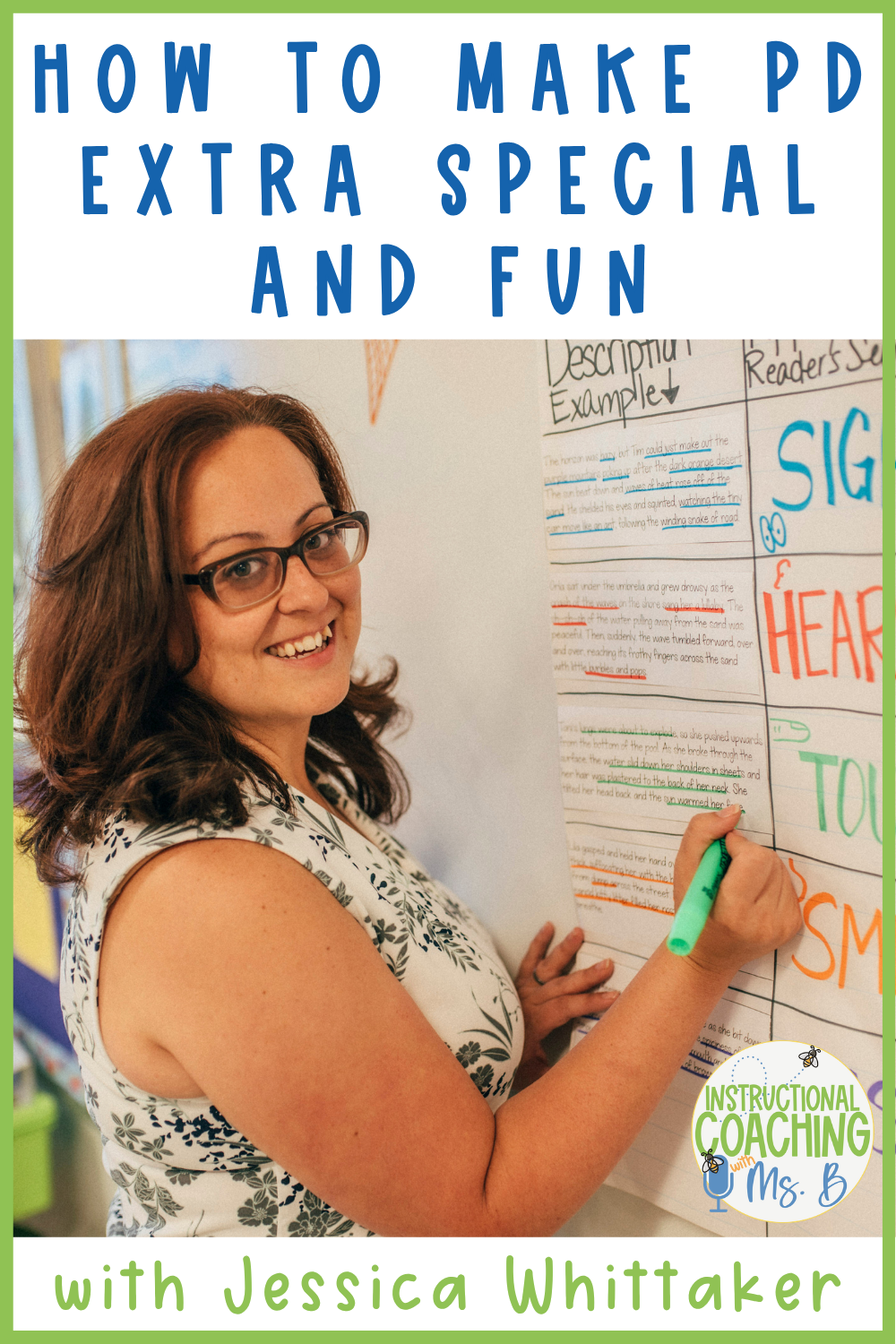
Chrissy Beltran in a school classroom writing on chart paper and smiling. These words are on the image: "How to Make PD Extra Special and Fun with Jessica Whittaker".

Want to learn how to make PD extra special and fun? Read on for ideas to make your next professional development session more interactive, relevant, and enjoyable! 

For the past few years, I’ve been following Jessica Whittaker on Instagram, and I’ve really enjoyed seeing the work she’s doing as an instructional coach. Recently, she posted about some of the amazing professional development opportunities she’s had with teachers. It got me curious about her planning process and how she approaches PD in general.

As a coach, I’m always interested in learning about how others approach professional development, so I invited Jessica on the podcast to talk about it! In this episode, Jessica shares strategies and ideas for making PD extra special and fun! 

She breaks down her planning process and explains the differences she’s noticed when she makes PD more engaging for teachers. You’ll discover meaningful professional development topics that teachers really enjoy and get ideas for memorable PD activities.

Listen now to find out how to make PD extra special and fun! Here are the highlights from this episode!

How to Pick PD Topics for Your School

During the episode, Jessica shares a little about her behind-the-scenes PD planning process. She reminds us that a big part of the job is building relationships and rapport with teachers. That gives us the foundation to have honest conversations about what teachers are noticing in their classrooms and what they need from us.

To identify PD topics, Jessica tunes into her “teacher brain” and thinks about which professional development sessions she’s enjoyed (and which she hasn’t). She also listens for topics during coaching conversations, quick hallway chats, and when she’s working with teacher teams. Additionally, her school also periodically sends out surveys to teachers. She keeps a running list of teachers’ interests and needs and uses it to plan professional development.

Save yourself hours of work with this Instructional Coach’s Professional Development Kit: Keynote and PowerPoint presentations, ice-breakers, surveys, planners, agendas, handouts, activities, and more- and it’s editable! Provide PD in a snap to your teachers.

PD Topics That Teachers Actually Enjoy!

When I was a teacher, there were professional learning experiences I was really excited about and others I wasn’t. But just because I wasn’t thrilled about certain topics doesn’t mean they weren’t important. I still needed to learn about them.

I ask Jessica to tell us about PD topics she’s found that teachers have really enjoyed. Over her four years as an instructional coach, she’s discovered that teachers are most engaged when topics are meaningful to them and connect to the classroom.

Here are a few PD topics that have been most meaningful and interesting for her staff:

  • Writing instruction: Aligning writing pieces K-5 and looking at high-stakes testing in all grades so they can see the big picture of where students are heading.
  • Engagement: Thinking about how we can have meaningful engagement and use engagement strategies.
  • Trauma-informed practices
  • Blended learning

Jessica mentions that, as part of a multi-year process, her staff created community agreements (norms) during professional development. These guidelines ground all of their work and create a shared understanding across the school.

She also recommends making clear connections between all the different pieces of the work. No matter the topic, Jessica wants teachers to understand how what they’re learning connects to the classroom and the school’s larger vision, so each professional learning session feels purposeful and part of a cohesive whole.

Starting out as an instructional coach can be so overwhelming! It can feel like there are too many things to do, and you just don’t know where to start. This resource includes a guide, printables, and fillable forms (PDFS) to build relationships, have a dialogue with your administrator, review data and make a plan, visit classrooms, and more! Get the First 20 Days of Instructional Coaching Start Up Kit and Forms today!

How to Make PD Extra Special and Fun for Your Teachers!

Jessica says that she’s very passionate about professional development, especially making it fun! She cares about her staff and brings the same enthusiasm she had as a classroom teacher to every PD session.

As coaches, we need to make meaningful learning come alive. Her mindset is to pour into her teachers so they can pour into their students. She hopes that even when someone isn’t excited by a topic, they’ll at least walk away with a strategy to try.

Here are a few of her favorite ideas to make PD extra fun and special:

Themes: Jessica uses themes to give her PD sessions a party vibe. Examples include “Camp Diamondback” (their school mascot), “Be a Marigold”, and “Make Your Mark”.

Snacks and treats: Whenever possible, feed your teachers! Ideas Jessica has tried include a make-your-own trail mix bar, popcorn station, donuts, and a build-your-own-drink table. If funds are tight, try to at least have chocolate and coffee available.

Intentional activities: During PD, choose reflective activities connected to the session and that teachers can also use with their students. Give the “bumper sticker” activity she mentions during the episode a try!

Use technology: Going through the staff binder at the beginning of the year can be really dry. To make it more fun, Jessica used the Goosechase app to turn it into a scavenger hunt. She had staff running around the building, laughing and bonding as they brushed up on new info and old reminders. We did a similar beginning-of-the-year scavenger hunt at my campus too. I highly recommend giving it a try.

Give teachers a heads-up: If you’re doing something physical or an activity that requires a lot of talking, try to let your shy or introverted teachers know in advance. Give them a warning so they can wrap their heads around it. You can also do this during the PD session: “In a few minutes we’re going to do this thing”. We’re designing PD for a lot of different personality types, and we need to keep everyone in mind.

Build connections: To build connections and a sense of community, Jessica’s staff built friendship bracelets when that was a big trend. It was a fun and creative way to reflect and get to know each other.

Personality work: Jessica says this is always a popular PD topic. Teachers not only learn more about themselves, but also about their colleagues and how to use that knowledge to strengthen their work together.

Reflections and celebrations: Build in moments to celebrate and reflect during every PD. Reflecting helps make the learning stick, creating a bridge between professional learning and the classroom.

Seasonal fun: Tie in learning to a season or holiday, for example, “Shamrock and Roll” during your March PD.

Connecting PD learning to the classroom: Jessica says every strategy is modeled with two purposes in mind. 1. To make the learning stick for teachers. 2. Connecting it back to something they can try with their students.

Cross-pollination: Create a space for teachers to articulate how they could use (or are using) strategies the school is working on. Jessica explains how, during a recent book study, teachers helped facilitate PD by discussing what they learned from the book and offering examples of how they used it in their classrooms. This encourages sharing of ideas across grade levels and areas. Learning from a peer is also more fun and inspirational!

Be ready for anything with the Instructional Coaching Editable Binder Megapack!

It includes forms, templates, and everything you need to get organized for instructional coaching! Coach teachers and document your coaching work with these printable and editable tools. Grab the Instructional Coach Binder Megapack in my TpT Store!

Have You Noticed a Difference When You Make PD Extra Fun and Special?

Jessica says she’s noticed that when teachers are more engaged in PD, the learning sticks better and they’re more likely to use what they’ve learned in the classroom. She’ll remind her staff about the bumper stickers they made, or the scavenger hunt they had at the beginning of the year. These shared memories become anchor points, making it easier to refer back and activate them.

Additionally, when Jessica sees teachers using strategies that they’ve learned in PDs, she builds positive momentum by highlighting their success in her weekly newsletter. In it, she shares stories and photos of colleagues putting new ideas into practice. This type of “marketing” helps to inspire others and keeps learning top of mind.

How to Make PD Extra Special and Fun!

I really enjoyed my conversation with Jessica! She gave us so many ideas for adding some fun to our PD sessions!

In the end, Jessica summed it up beautifully: “Every single teacher, every single kid deserves to have learning be fun and engaging”. I absolutely agree!

Listen now to find out how to make PD extra special and fun!

Don’t forget to grab the FREE PD Tools Download below, so you’ll be well on your way to having a consistent process for planning your professional development!

Topics and Questions Discussed in Episode 291 – How to Make PD Extra Special and Fun with Jessica Whittaker

  • Meaningful PD topics that teachers enjoy
  • Jessica’s behind-the-scenes planning process, including building rapport, gathering staff feedback, and using teacher surveys
  • How to make PD extra special and fun
  • Ideas for PD themes and activities
  • Encouraging staff to reflect and celebrate successes as part of each PD session
  • The power of teacher-facilitated PD and learning from colleagues
  • Observable differences when you make PD extra fun and special
  • Showcasing teachers’ successes and encouraging teachers to share strategies with each other
  • Modeling and using explicit bridging strategies to help teachers transfer PD learning to classroom practice

About Jessica Whittaker
Jessica Whittaker is a former 5th grade teacher, now Instructional Coach from the PNW with a passion for supporting and championing all teachers so that they can be the best they can be because kids deserve it. When she’s not in classrooms or facilitating PD or data dives, she can be found reading, playing board games, or trying out a new coffee shop in her area.

Turning Insight Into Action: Practical Steps You Can Take After Listening

Here are simple actions you can take today:

1️⃣ Grab the Professional Development Toolkit for Coaches & Administrators

Save yourself hours of work with the Instructional Coach’s Professional Development Kit: Keynote and PowerPoint presentations, ice-breakers, surveys, planners, agendas, handouts, activities, and more- and it’s editable! Provide PD in a snap to your teachers. Grab the Professional Development Toolkit for Coaches & Administrators here!

2️⃣ Add Something Extra Special and Fun to Your Next PD!

During the episode, Jessica shares a bunch of ideas to make your next PD extra special and fun! Pick one (theme, snacks, a special activity) and notice how it shifts the mood. Let me know how it goes in the Instructional Coaching with Ms. B Facebook group or on Instagram @buzzingwithmsb!

3️⃣ Join the Instructional Coaching Club!

The Instructional Coaching Club is an online membership designed to help instructional coaches improve instruction at their schools. It gives coaches the tools to go out and do it.

Ready to listen?

  • Ready to listen? You can listen below with the media player, or search for Buzzing with MS. B: The Coaching Podcast anywhere you listen to podcasts!

This post contains links to products from one or more of our advertisers. This means I may receive commissions for purchases made through links in this post when you click on links to those products. Thank you for your support!

Learn more

Helpful Resources


Listen on: Apple Podcasts, Spotify, or your favorite listening app


Thank you for listening to Buzzing with Ms. B: the Coaching Podcast. Want more coaching ideas

Check me out at buzzingwithmsb.com and on Instagram @buzzingwithmsb.

If you love the show, share it with a coach who would love it too, or leave me a review on iTunes! It’s free and it helps others find this show, too. Happy coaching!

Podcast produced by Fernie Ceniceros

How to Make PD Extra Special and Fun with Jessica Whittaker, ep. 291, Instructional Coaching with Ms. B Podcast

Chrissy Beltran [00:00:02 – 00:01:13]

Hey coach and welcome to instructional coaching with Ms. B. Today I am talking about how to make PD extra fun and special with my guest Jessica Whittaker. This is part of my staff development ideas for coaches mini series where we talk about how to take your ordinary PD and make it into something that actually impacts classroom instruction. To help you do a great job of planning and preparing for your PD, you can grab my free PD tools for coaches in the show notes. You’ll get the classroom sweep documents, a PD planner, a step by step guide to creating powerful PD, and the PD checklist, all in one download, plus PD and coaching tips right to your inbox. Jessica Whitaker is my guest today, and she’s a former fifth grade teacher, now instructional coach, from the Pacific Northwest with a passion for supporting and championing all teachers so that they can be the best they can be because kids deserve it. When she’s not in classrooms or facilitating PD or data dives, she can be found reading, playing board games, or trying out a new coffee shop in her area. I actually found Jessica a few years back, maybe longer than that, on Instagram, and, she shares her handle a little later in the episode, so you can follow her too. She’s a great follow, and I can’t wait to welcome her today. So welcome to the podcast, Jessica, and I’m so glad that you’re here again.

Jessica Whittaker [00:01:14 – 00:01:16]

Thank you for having me back.

Chrissy Beltran [00:01:16 – 00:01:57]

I’m glad you’re coming back because I have been watching you on Instagram, and you’ve been sharing about some really great PD opportunities that you’ve had for teachers. And I was so curious about your planning process for this. So I would love to chat about PD with you. Just in general, you know, what have you done to make it so special and fun? So let’s start with talking about some of the PD topics that you found teachers have actually enjoyed because I can remember being a classroom teacher, and there were things that I was, like, excited about going to, and then there were things that I was not excited about going to. And some of those things were still important. Right? Just because you’re not excited about it doesn’t mean it’s not important. But, when we can, we want to get teachers excited about the PD they’re gonna get. So what have your teachers really loved?

Jessica Whittaker [00:01:59 – 00:05:08]

Yeah. I’m so excited to talk about this topic because to me, PD is something I’m very passionate about, especially making PD that is important fun if the actual topic itself isn’t inherently fun. Yes. Just because I always try and have that teacher brain on whenever I’m planning things, thinking about who I was as a teacher, what types of things did I enjoy, did I not enjoy. So I have that in my mind first and foremost when it comes to, like, planning. But I have found just that teachers really enjoy the topics that are the most meaningful to them. So before I launch into those topics, I wanna share a little bit of my, like, behind the scenes process. That part of my job is just having that relationship and rapport with my staff. And so keeping that natural pulse, and just listening out for the things that they’ve indicated wanting more PD on. Sometimes those are through coaching conversations. Sometimes it’s working with when I’m working with an entire team, and sometimes it’s just those innocuous, hallway comments here and there that I just try and jot it down, whenever I hear those things that sound interesting and and just get it in my mind and then in that way I can share it with my admin. So we have surveyed our staff periodically for topics that will feel most meaningful or relevant to them. So I pull from that list that I’m writing down all of the time and then kind of creating from there. So this is my fourth year now in my role. So we’ve done lots of different types of PD, and some of those topics that have been the most interesting and meaningful that my staff have enjoyed, are getting into some writing instruction pieces, specifically aligning what that looks like in our building k through five, and then looking at the high stakes testing. Oh, excuse me. Aligning our writing pieces K through five and then looking at high stakes testing that even in kindergarten, first grade, second grade, we were looking at SBAC blueprints and rubrics with them, which they found very interesting, even though their kids will never take that particular assessment just because they got to see where their kids will be going down the road. We’ve done a lot of PD around engagement. I feel like in this post pandemic world, it is a huge topic that just keeps on, buzzing and coming up. And so thinking about ways that we can have meaningful engagement, it also ties into our model of instruction. And we have a whole portion about that. So that’s one that we keep on spiraling through and then also looking for ways how can we use engagement strategies. Even if we are looking at maybe a writing rubric, how can we get that to for experience? We’ve done a lot of work around trauma informed practices, thinking about blended learning, and then we’ve also created our community agreements or norms as a staff through PD, and that’s been a multiyear process. Just knowing that that grounds all of our other work that we do and then trying to make those clear connections between the different pieces. I know those are a lot of very different topics, so trying to make those clear connections whenever we can, we’ve we’ve received some positive feedback about that.

Chrissy Beltran [00:05:08 – 00:05:57]

That’s awesome. Yeah. Those some of those things that you described are so essential foundational they’re just foundational pieces for schools. You know, aligning writing. Writing is so challenging for so many teachers. It they just don’t have the experience. They cannot picture it. And so I think that that is such a great place to put your energy, to help really teachers understand this is what it’s gonna look like, and this is how it’s going to apply as they get older. That’s awesome. So then from for these PDs, some of these topics, I would find fun. Right? But not everybody does. Like, the norms, for example, can be kind of a tedious process. Or the, you the, you know, your vision, all of those pieces can be like they can take some time. So what are some of the things that you’ve done to make PD extra special and fun for your teachers? And this is what I saw online that I was, like, so interested to see.

Jessica Whittaker [00:05:57 – 00:06:05]

This is the part that I’m most excited about because I think, like like I mentioned earlier, when we have I’m so sorry.

Chrissy Beltran [00:06:05 – 00:06:06]

It’s okay.

Jessica Whittaker [00:06:12 – 00:09:02]

This is one of the parts I’m most excited to talk about because when we have those important topics like we discussed, we’ve gotta make that meaningful learning come alive. And so in the classroom, I was always thinking of ways that I could make things kind of extra or fun for my students. And I care about my staff so much, I wanna give them that same type of experience. My mindset is always I wanna pour into my staff so that they can pour into their kids. So any of those fun, exciting, engaging things comes out of my care for them and their learning because I I truly believe that when we’re having fun with the learning, it’s more sticky. It has longevity even if the exact topic might not. And so there are lots of different times where I pull in, strategies and activities that we’ll get more into, and I think, man, even if this exact topic is not someone’s passion, maybe they don’t walk away feeling super passionate about writing instruction, perhaps I can show them a strategy and I can model a strategy that they can put in their teacher toolbox and they can use with their kids tomorrow. So I try to do a lot of twofer, opportunities where we’ll use this thing to do this thing, hoping that between those things something will stick and have meaning. So I going back to the extra piece, I love to create themes for my staff. And so those themes have been created often collaboratively with my admin as we think about the vision that they might have for our school for the year. And then to me, I try to make PD kind of like a party. So how can we take that vision and how can we have a theme and then have some snacks and have some activities that make it very engaging? So our school mascot are the Diamondbacks. So we did Camp Diamondback a couple of years ago. We’ve done the theme of be a marigold. I think that that little, teacher proverb is probably pretty familiar with a lot of us out there, but really thinking about finding your people and being that bright spot and then how can we, you know, tie that into PD. And then this school year, our theme has been make your mark. So thinking about the impact that we can have, within the four walls of our classroom but in our community beyond. So within each of these themes, I try to bring in some fun snacks. So, like, for camp Diamondback, we had a build your own trail mix bar that was fun, just so that when teachers come in, they have something to snack on during the time. We’ve done a popcorn station. We’ve done donuts. We’ve done, like, a build your own little fun drink with, like, a soda and little fixins. It’s not always financially possible to make snacks work, so we don’t do them every single time at every single PD. But the days that we know are going to be longer, we try to do that for our staff. Very nice. Oh, sorry.

Chrissy Beltran [00:09:02 – 00:09:27]

Go ahead. No. It’s okay. I just I love that. I it’s I had a principal who’s, she with her budget, there were only so many things that she could use it for. Right? You can’t do certain things with a school budget. But what she one thing she would say is I am allowed to feed people. So that was one way that she would try to use a budget to make our PD experiences a little bit more fun and also, like, cozier and, like, more welcoming. Like, we thought of you, you know, before you got here.

Jessica Whittaker [00:09:28 – 00:09:28]

So that

Chrissy Beltran [00:09:28 – 00:09:30]

was Yeah, I remember her saying that.

Jessica Whittaker [00:09:31 – 00:09:42]

Absolutely. I feel like bare minimum is always having chocolate and coffee on hand, even if it’s just a bring your own mug. There’s a Keurig set up in my office across the way, and always lots of chocolate.

Chrissy Beltran [00:09:43 – 00:09:44]

Yeah.

Jessica Whittaker [00:09:45 – 00:11:17]

Yeah. Well, within those themes, that I try to also create some, like, activities and strategies that have, a connection to the theme, but that could also be possibly used with staff members’ students. And so the intentionality I try to think through is we’re not really doing icebreakers. We’re not doing activities just to do an activity. It’s what is the purpose behind this activity? What is the learning that I have in mind for my staff? And then how can I do something fun? How can I pull in a best practice strategy, and make it a little bit more engaging? And then also thinking like and how can I then encourage folks to use it with their kids? So one of my favorite ones that we’ve done is a bumper sticker strategy. This one is nice when you’re doing a bigger piece of PD and you want folks to just reflect on their learning. I think we’re all pretty familiar with bumper stickers. And so I just have cut out strips of paper, such an easy prep. And then I just have out markers, washi tape, whatever coloring supplies, and then staff get to write down a word, a phrase, some images that lock in their learning from the day. So it’s just a reflective activity, and then I encouraged them when we’ve done that in the past, go pin it by your desk, put it on your teacher planner somewhere where you will see it, and it will be that reminder to you. But that’s also an activity that could be kind of a fun, unique exit ticket that teachers could use with their students.

Chrissy Beltran [00:11:18 – 00:11:44]

I have a bad example. You know, I like that because and I like what you mentioned about how encouraging teachers to use these strategies in the classroom is part of your preparation. Because if we don’t explicitly say, and you can do this with your kids. When can you do it with your kids? They don’t often do it. They just are like, oh, that was interesting, and then they go back to their classroom and do something totally different. They don’t realize that they can add those strategies sometimes because they’re in learner mode. You know? They’re, like, learning the content. They’re not always thinking about the mode of delivery.

Jessica Whittaker [00:11:45 – 00:12:32]

It’s so true. And usually, once I’ve launched something, I try to make it very direct to, like, we’re doing this thing that ties into our learning today. But then when we come back together before we move on, I, break the fourth wall, if you will. And I will even say that to staff of, like, I’m just gonna put pause really quick on the PD. We’ll get back to it, but let’s just talk really quick. How could we use this with kids? And there are some times where I might share a few ideas, or I really find that there’s so much value in even just having folks popcorn out, turn and talk to someone near them. And I just keep on coming back to that idea that we are better together, and I think that that makes the learning more fun too when it’s not just, you know, just the PD person, the sage on the stage, but really honoring the voices and the expertise of every single participant in the PD.

Chrissy Beltran [00:12:32 – 00:12:48]

Yes. I love that. Yeah. That bridge is so important and getting them to think of their own bridge. Because if we say, you could do this, you could do that, you could do this, they’re like, that’s nice. But they good for you for thinking of all those things. But they need to really think about it and talk about it themselves to make kind of, like, a little plan of what it could look like.

Jessica Whittaker [00:12:48 – 00:13:33]

Yes. Absolutely. Some of the other fun activities that we’ve done, for the beginning of the year when we go through our staff binder and the nuts and bolts, that can get really dry. We do the same procedures pretty much every year, and we don’t always add on a lot of new staff, but yet we have to fulfill that requirement. And so I’ve used platforms like the GooseChase app which is like a little scavenger hunt, because there are times I feel like to intentionally leverage technology. And so for that particular one, we had staff running all around the building taking pictures of things. And it’s just so good for us to laugh together because it creates that culture, that community, while also saying, like, oh, do we remember where this thing is? Or do we need to kind of, like, brush up on that little reminder?

Chrissy Beltran [00:13:33 – 00:13:34]

Mhmm.

Jessica Whittaker [00:13:34 – 00:13:38]

We’ve also We’re sorry. I have to No. No. No. You’re fine.

Chrissy Beltran [00:13:38 – 00:14:15]

We did a similar we did a scavenger hunt one year, and it was for the same purpose because those trainings are just the worst. I mean, you’re just checking the boxes. You know? It’s not that it’s not important for people to know, but, realistically, how much are they walking away with there? So, at least it’s an opportunity for team building. So we did a scavenger hunt once, but we set it up. The custodians weren’t happy, though. We set it up, but we didn’t know until after the fact. Everybody had the idea was that each team member or each team, each grade level had had a a rolling chair from somebody’s classroom, and one person had to sit in the rolling chair the whole time, and then everybody else had to have their hands on the rolling chair as they raced around the school building.

Jessica Whittaker [00:14:15 – 00:14:17]

Oh, I’m jotting that down. That’s funny.

Chrissy Beltran [00:14:17 – 00:14:50]

It was so funny. I remember because I was one of the stations for the scavenger hunt because it was like it was no. It was more like a yeah. I guess the scavenger yeah. Because there we used to have more kids, but you go to each station, and it was like a riddle, you know, that you had to figure out to go to the next like, you know, you’d have to figure out the clues. And I was one of the clues. So I I was just standing there at the at the doorway in my classroom, and I could see all the way down the hallway just people racing across, like, the the I could just see them passing my little piece of the hallway, and it was one of the funniest sights I’ve ever seen because, like, the position, some

Jessica Whittaker [00:14:50 – 00:14:51]

of these people, some of them

Chrissy Beltran [00:14:51 – 00:15:06]

were being dragged, like the people who were on the chairs. I mean, people were laughing so hard, and it was such a fun day. And it took, you know, longer obviously than that norm that PD normally would have, but it sure was memorable, and it gave them some time to just hang out and do some fun things together, which they don’t get enough of that.

Jessica Whittaker [00:15:07 – 00:15:56]

No. It’s so true. I love that. And even through your example, it reminded me that I have a few staff members who are, like, very, very introverted, very shy. And so whenever I try to do some of those, like, more physical or, if I know we’re gonna really just be up chatting a lot, I try to just front load them. And I think it comes back to, like, having that relationship and that rapport where sometimes I’ll let them know ahead of time, like, maybe a day or two ahead of time, just so that they can kind of wrap their mind around it. Sometimes it’s even just in giving directions. And in a few minutes, we are going to be doing this thing. I think that that also helps with the buy in because there are gonna be folks like me who I would love to run around and do the rolling chair activity, but also knowing that I’m designing for a lot of different personality types. So trying to keep those users in mind is always really important to me.

Chrissy Beltran [00:15:56 – 00:15:57]

Yes. Very true.

Jessica Whittaker [00:15:58 – 00:18:36]

Some of the other activities that we’ve done come back to just reflecting and building some connections. So we’ve even, like, built friendship bracelets when that was a big trend with Taylor Swift. And, again, it was either, like, you wear your friendship bracelet, you can put it by your desk, just kind of those little milestone moments to remember those big pieces of learning. We’ve also done some work with personality types. That has always been a very popular PD topic, whether we’re talking about Enneagram types or there’s, like, a toolbox personality type that, folks just love to learn about themselves, of course, but also to learn about one another and then to leverage it with now that I know this about myself or about how you communicate, this can lead to better interactions. Some of our other activities that we do, I always try and start any PD session with our staff to build in a moment to celebrate and then a moment to reflect. Sometimes those things are very tied together. Our current model for PD, we are doing breakout sessions that was based on the survey results that we had received. We had just had a lot of things that were very interesting to people. And so what our model is this year whenever we’re having those PD days, then we come all together and we do a reflection celebration time and then we go to our breakout groups. The reflections and celebrations, sometimes I’m tying it into that school wide theme. So the make your mark, I’ve done some things to tie back to that so it keeps it cohesive. It also gives me the chance to say, hey, remember back in August some of our aspirations that we had for ourselves? You know, now that we’re in February and spring break feels too far away and state testing is looming over our heads, like, how can we tap back into these things? Trying to also do things that are just seasonal and fun. We’ve done like a little shamrock and roll before where everyone had a little shamrock and they got to reflect on some of the things that they’ve done that year, and then shout out and celebrate and appreciate other folks. Because sometimes when we’re in the trenches we forget the great things that we’ve done but the folks around us remember. And then also again just trying to tie it back in with, alright, this is something you could do for morning meeting with your kids or this is a reflection or celebration that you could do with your students because there’s so much research around the power of reflecting, and not just on the learning itself. So really just trying to give that dedicated time because I don’t know about you, Chrissy, but I feel like reflection is kind of one of the first things to go for me when I get busy. So carving out that practice.

Chrissy Beltran [00:18:37 – 00:18:46]

Mhmm. That’s great. And that’s what’s gonna help with that bridge building as well, building that bridge to the classroom so that the PD you’re providing actually impacts something that’s happening in the classroom.

Jessica Whittaker [00:18:46 – 00:20:24]

Yes. Absolutely. And then, the last thing I’ll share about this is just the cross pollination. I feel like it’s so important. I know that, you had mentioned, like, having staff share out and articulate themselves, like, this is how I could use this in the classroom. But this year in particular, I’m doing a wild card, book study if anyone’s familiar with the book The Wild Card. It’s all about engagement. It ties into our model of instruction. And so part of that time is a discussion time, but also I just feel like there’s so much power in staff actually facilitating part of it. I know that teachers have a lot on their plates, so trying to be really mindful and cognizant of how big of an ask that it is. But there’s just something about seeing your coworkers sharing and demonstrating their own learning from the book but with an engagement study or an engagement strategy that they might use with their kids in the book study that is just so fun. And knowing that we have folks in these studies that are teaching, you know, maybe specials or special education, maybe they’re teaching kindergarten or fifth grade. So kind of all over the board, just those sparks of inspiration, and and not siloing our practices, but really sharing here’s what I’m doing, here’s how this could be done, and creating those moments intentionally has been very meaningful and I think extra fun and special for our teachers because, you just never know your coworkers until you start seeing how they’re gonna put their own twist on presenting a PD. I’ve learned a lot about our folks, and the creativity that they have had has fueled my own creativity.

Chrissy Beltran [00:20:24 – 00:20:59]

Yes. Yeah. The most fun one of the most fun PDs I remember doing was really a teacher conference. We had a half day available to us. And so I met with individual teachers, and we, asked them to present on certain things. And then teachers other teachers got to sign up for those sessions. So, like, one teacher might run a session twice, and it was open to, you know, whoever wanted to sign up, and then each each session had spots for, like, six teachers to sign up for it. And it was so neat. They really got a lot out of it, and it was also a great way to build that capacity and, you know, and bring up those teachers into those leadership roles who were doing great things.

Jessica Whittaker [00:21:00 – 00:21:06]

I love that. There’s so many different ways to honor the teacher voice and expertise of everyone in the building.

Chrissy Beltran [00:21:06 – 00:21:20]

Yes. So have you noticed you’ve done so many different things. You made a point of adding in engagement and fun. Have you noticed a difference in the way people are responding to PD and the way they’re implementing what they’ve taken away from it whenever you’ve done something extra special?

Jessica Whittaker [00:21:21 – 00:23:01]

Yes. I feel like those things that people can really engage in, they stick with our staff. So I have been able to refer back to those more like extra moments of remember when we made our bumper stickers or remember when we were running around the building doing that scavenger hunt and it activates when we’re physically, tangibly doing something, having those laughs together. It’s a memory that we’re creating that then I can refer back to and activate some of that, remembrance. But also it’s been really fun when I pop into a classroom randomly and see someone doing something that we talked about, in a PD or if teachers even just invite me to come down. Sometimes I’ve been invited to come down and do that extra set of hands, especially when we’re trying something new. It’s helpful to have an extra body in the room sometimes. And then I’ll also hear sometimes, like, colleagues talking in the hallway about how they’re putting a twist on something and using it to continue their their own learning. So that has been so rewarding to me. And then I also send out a newsletter every week. So whenever I catch wind of someone doing something that we’ve done in a PD, I try and, go down and take a picture or I just ask them if they happen to take any pictures that they can send to me because I will try and shout that out in our next newsletter so that staff can see, like, here’s how this thing was actually, accomplished. And here’s the age, here’s the grade, and then ask some questions like, how could you use this in maybe this subject or with your, grade level? So, yeah, actually saying things has been really helpful and and exciting.

Chrissy Beltran [00:23:01 – 00:23:20]

I love that. And I love the way that you’re highlighting teachers who are trying things out because that’s almost like a little commercial, little advertisement, and a reminder for other teachers. Oh, yeah. I meant to do that. I I would I went back to my classroom and completely forgot about it, but then they see it again, and they go, okay. Yeah. I’m gonna try that out. So I think that’s a great way to to elevate what your teachers are doing.

Jessica Whittaker [00:23:20 – 00:23:35]

Yeah. Well, when you said that, it makes me think, like, it’s kind of like marketing. Like, we’re kind of marketing. Here’s how this thing could actually work. But I think it’s also in a way incentivizing that, hey. If you’re doing the thing, you might be the next person that gets a special little spotlight.

Chrissy Beltran [00:23:35 – 00:23:41]

Yeah. I love it. Alright. Well, thank you so much for sharing all these ideas, and, let us know how people can keep learning from you.

Jessica Whittaker [00:23:42 – 00:24:20]

Awesome. Well, thank you again for having me. It’s so much fun to talk about things that I’m so passionate about and that I truly believe. Again, every single teacher, every single kid deserves to have learning be fun and engaging, so I’m hopeful that this will help someone else out. I love to share about the things that I’m trying, and so I share about those things typically on Instagram and sometimes on TikTok. My handle is the same for both. So it’s my underscore teacher underscore style. And, yeah, I just look forward to, like, collaborating with anyone. So if anyone heard something, they wanna chat more about it, I love being a thinking partner.

Chrissy Beltran [00:24:20 – 00:24:40]

Awesome. Thank you so much. Alright, coaches. Don’t forget to grab that free PD download in the show notes, and you’ll be well on your way to having a consistent process for planning your PD. Next week, we’re gonna continue to dig into quality professional development experiences with a special guest. We’re looking at PD and PL that actually change classroom instruction. I can’t wait to share that with you, and until then, happy coaching!

Share:

Similar Posts

Leave a Reply

Your email address will not be published. Required fields are marked *