| | | |

PD and PL Strategies That Turn into Learning with Toni Rose Deanon, ep. 292
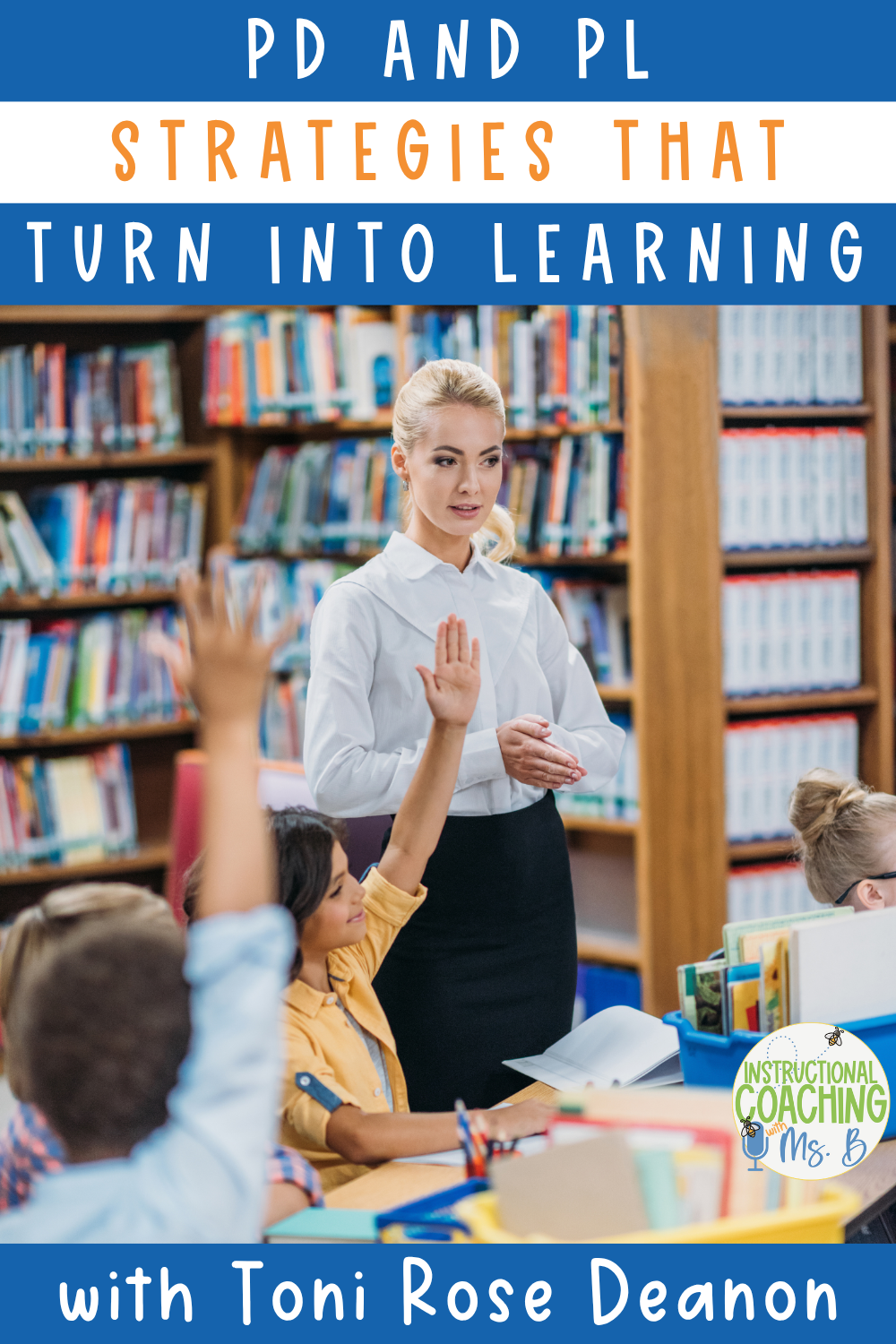
Teacher standing in a school library with students who are seated raising their hand. These words are on the image "PD and PL Strategies That Turn into Learning with Toni Rose Deanon",

More PowerPoint slides.

More time in workshops and trainings.

More strategies. More resources.

But is the learning making its way to the classroom?

Get ready, coaches, for an insightful conversation about professional development (PD) and professional learning (PL)!

Today, Toni Rose Deanon of Modern Classrooms Project is here to help us explore PD and PL strategies that turn into learning

During the episode, Toni Rose talks about the work they do with teachers through Modern Classrooms Project. They introduce their core values and what they look like in practice. Toni Rose shares how to help teachers embrace a new approach. Plus, learn how to address teacher burnout and promote well-being while balancing professional learning. 

If you’re ready for PD and PL that actually changes classroom instruction, you don’t want to miss this one! Start with the highlights below, then listen to the full episode for more insights, ideas, and actionable takeaways.

Save yourself hours of work with this Instructional Coach’s Professional Development Kit: Keynote and PowerPoint presentations, ice-breakers, surveys, planners, agendas, handouts, activities, and more- and it’s editable! Provide PD in a snap to your teachers.

Coaching Educators

To kick off the episode, I ask Toni Rose to share a little about the work they do with teachers. Toni Rose is a former middle school teacher, adult ESL teacher, and instructional coach for technology.

When they became a coach and started working with teachers, they noticed adults were very jaded. This got them thinking about how they can better support educators in a way that is receptive and not challenging them to the point of shutting down.

For the last five years, Toni Rose has worked with educators full-time through Modern Classrooms Project. Currently, they support educators in creating a blended, self-paced, and mastery-based learning environment. More simply stated, Toni Rose is their designated hype person, a personal cheerleader.

Toni Rose explains that it can be challenging when educators are trying to shift and transform their classrooms. Often, they feel like there’s a lack of community and they have to do it alone. That’s where Toni Rose comes in, making sure teachers feel supported and have a community of thought partners to bounce challenges and ideas off of, as well as help them celebrate wins.

I really love the ongoing support being offered by Toni Rose. So often we see the one-and-done PD model. We drop a ton of learning on teachers and then just walk away. It doesn’t work! Teachers can’t implement it because they don’t know enough about it to envision it and decide if it would be supportive of them.

Toni Rose adds that it’s the ongoing support and the intentionality behind it. They explain that if we are challenging educators to shift away from their old beliefs, we need to do that when we’re leading professional development. No more standing and talking at teachers. Instructional coaches need to create a learning environment for teachers that we’d want them to create for students. This way it trickles down into classrooms. We need to walk the walk and talk the talk!

Starting out as an instructional coach can be so overwhelming! It can feel like there are too many things to do, and you just don’t know where to start. This resource includes a guide, printables, and fillable forms (PDFS) to build relationships, have a dialogue with your administrator, review data and make a plan, visit classrooms, and more! Get the First 20 Days of Instructional Coaching Start Up Kit and Forms today!

Instructional Coaching Core Values

I had read about Toni Rose’s core values, and I was curious to learn more! Toni Rose starts by explaining that we often think of core values as static, but in reality, they change.

This year, Toni Rose’s core values have shifted. Their three core values are connection, integrity, and pleasure.

During the episode, Toni Rose discusses each value in detail. They explain that we can think of them as steps that build on each other. Here is a summary of each. To get all the details, be sure to listen to the entire episode!

Value 1: Connection

As humans, we need connection! Instructional coaches need to connect with educators with different experiences and expertise. Toni Rose tells us that their desire to connect with teachers makes them more curious. They say that by creating connections, they are better able to have vulnerable conversations. Connection builds trust, and that leads to the next step, integrity.

Value 2: Integrity

Toni Rose tells us they want to earn teachers’ trust. Their goal is to create a space where teachers can be brave enough to share that they don’t know what they’re doing. Toni Rose says that they want to become a truth-teller and do it in a way that educators can receive it. This means being mindful of the words used during conversations and the delivery.

Value 3: Pleasure

We all know children love to play and have fun, but somewhere along the way adults lose that joy! Toni Rose strives to create spaces where educators can play, make mistakes, take risks, and not be judged for it. Teachers can say things that they have been sitting on to release them, so they aren’t stewing in anger and resentment. Life is supposed to be fun, and Toni Rose encourages teachers to prioritize having fun with their students!

I really love this approach! Teaching is hard, and we’re asking teachers to change the way their classrooms work. It can feel threatening, but connections, integrity, and pleasure can make the change feel more manageable.

Helping Teachers Embrace a New Approach

Oftentimes, instructional coaches share strategies that can be challenging for teachers to implement in the classroom. I asked Toni Rose to tell us about how they help teachers embrace a new approach. Here are a few ideas they shared with us. To hear all Toni Rose’s insights, be sure to listen to the full episode!

Get to Know Educators Who Are Showing Up

Get to know the teachers who are showing up. Talk with them about challenges and successes.

Remind Teachers You’re Not There to Change Their Teaching and Learning Philosophy

While having conversations, remind teachers that you’re not there to change their teaching and learning philosophy. Instead, you’re there to enhance it for all stakeholders, including them! Toni Rose gives the example of shifting to student-centered learning and educators saying they feel so much better when using it.

Don’t Claim to Know Everything

Don’t claim to know everything. Instead, Toni Rose suggests working collaboratively with teachers to figure out what will feel good to everyone. We’re not mandating things; we want our teachers to have bought in and truly believe it.

Use Best Practices During Professional Learning

Toni Rose explains that the best practices we have in the classroom for students also go for adult learners. We need to provide different choices for PD and use different learning modalities, with a balance of talking, exploring, and creating. Coaches also need to provide transparency around what teachers will do during PD so that people who learn differently feel at ease during the session.

They also say we need to create spaces where there is a purpose for every minute with teachers. Toni Rose suggests that if teachers need to do pre-work, it should be factored into the PD, not done on their time. Teachers have enough on their plates and their time is valuable!

Be ready for anything with the Instructional Coaching Editable Binder Megapack!

It includes forms, templates, and everything you need to get organized for instructional coaching! Coach teachers and document your coaching work with these printable and editable tools. Grab the Instructional Coach Binder Megapack in my TpT Store!

Addressing Teacher Burnout and Promoting Well-Being

During the conversation, I ask Toni Rose how they address teacher burnout and promote well-being while balancing the depth of professional learning provided by Modern Classrooms Project. Toni Rose begins by stating that teachers who try self-paced, mastery-based learning in their classroom reported that they love teaching again. They realize they can do all the things that bring them joy while also teaching a really hard curriculum students need to understand.

Here are a few suggestions offered by Toni Rose:

Start Small

Toni Rose tells teachers all the time that they’re moving pebbles, not boulders. When teachers begin implementing a blended, self-paced, mastery-based learning environment, they should start small. Instead of focusing on all three things, start with one and get good at it!

Let’s Talk Energy Level

Toni Rose tells us that when they have conversations with educators, they ask about their energy levels. We don’t want to give someone too much if they can’t do it all. Be intentional in your focus and scaffold information in a way it can be received by teachers.

Find a Teacher Bestie

Teaching is difficult, and it can be really lonely. Community with others is so important! Toni Rose encourages everyone they coach to find a teacher bestie. Teachers can bounce ideas off each other, share success, and even complain. I love the idea of finding a teacher bestie, and think this is the best tip!

PD and PL Strategies That Turn into Learning

What a great episode, with so many important ideas to consider as we move forward in creating learning experiences for teachers. I especially love the focus on connection, integrity, and pleasure. Play can sometimes take a back seat when we’re overwhelmed by all the things we have to do. But teachers need joy, and so do the coaches who support them.

Listen to the full episode to learn more about PD and PL strategies that turn into learning!

Topics and Questions Discussed in Episode 292 – PD and PL Strategies That Turn into Learning with Toni Rose Deanon

  • Toni Rose’s work with educators through Modern Classrooms Project
  • Coaching core values and what they look like in practice
  • Connecting with teachers
  • Leading with integrity
  • Bringing play and pleasure back to PD and the classroom
  • Helping teachers embrace a new approach
  • Best practices during professional learning
  • Addressing teacher burnout and promoting well-being

About Toni Rose Deanon
Toni Rose Deanon (they/them) has been an educator since 2010, with experiences ranging from MS English Teacher, Adult ESL Teacher, and Instructional Coach for Technology. Toni Rose strives to be the educator they never had growing up, so they focus on anti-bias, anti-racist work and aspire to create a brave space for everyone around them. For funsies, they like to pretend they’re so much better on roller skates than they really are. Because they can’t sit still – thanks to their neurodivergence – home is wherever they are with their two dogs, exploring all parts of the world.

Turning Insight Into Action: Practical Steps You Can Take After Listening

Here are simple actions you can take today:

1️⃣ Grab the Professional Development Toolkit for Coaches & Administrators

Save yourself hours of work with the Instructional Coach’s Professional Development Kit: Keynote and PowerPoint presentations, ice-breakers, surveys, planners, agendas, handouts, activities, and more- and it’s editable! Provide PD in a snap to your teachers. Grab the Professional Development Toolkit for Coaches & Administrators here!

2️⃣ Join the Instructional Coaching Club!

The Instructional Coaching Club is an online membership designed to help instructional coaches improve instruction at their schools. It gives coaches the tools to go out and do it.

Ready to listen?

  • Ready to listen? You can listen below with the media player, or search for Buzzing with MS. B: The Coaching Podcast anywhere you listen to podcasts!

This post contains links to products from one or more of our advertisers. This means I may receive commissions for purchases made through links in this post when you click on links to those products. Thank you for your support!

Learn more

Helpful Resources


Listen on: Apple Podcasts, Spotify, or your favorite listening app


Thank you for listening to Buzzing with Ms. B: the Coaching Podcast. Want more coaching ideas

Check me out at buzzingwithmsb.com and on Instagram @buzzingwithmsb.

If you love the show, share it with a coach who would love it too, or leave me a review on iTunes! It’s free and it helps others find this show, too. Happy coaching!

Podcast produced by Fernie Ceniceros

PD and PL Strategies That Turn into Learning with Toni Rose Deanon, ep. 292, Instructional Coaching with Ms. B Podcast

Chrissy Beltran (00:01.678)

Hey coach and welcome to Instructional Coaching with Miss B. This is part of my staff development ideas for coaches series and I’m really excited to welcome my guest today, Tony Rose DeAnon of the Modern Classroom Project. Before we get started, I want to remind you I have a handy dandy download that can help you as you are thinking through professional learning for your school. You’ll get a classroom, you get some documents that will help you visit classrooms, make a plan, identify a step-by-step process to creating powerful PD and then a PD checklist all in one download.

plus PD and coaching tips right in your inbox. So you can actually grab that at buzzingwithmisspeed.com slash episode 292. My guest today is Tony Rose DeAnon. Tony Rose, they them, has been an educator since 2010 with experiences ranging from middle school English teacher, adult ESL teacher, and instructional coach for technology. Tony Rose strives to be the educator they never had growing up, so they focus on anti-bias, anti-racist work, and inspired to create a brave space for everyone around them.

For funsies, they like to pretend they’re so much better on roller skates than they really are, which I can relate to. Because they can’t sit still, thanks to their neurodivergence, home is wherever they are with their two dogs, exploring all parts of the world. So let’s welcome my wonderful guest, Tony Rose.

Chrissy Beltran (00:02.364)

So let’s welcome Tony Rose to the podcast. Thank you for being here.

Toni Rose Deanon (00:06.082)

Yeah, thank you so much for having me. I’m excited to have this conversation with you.

Chrissy Beltran (00:10.29)

I am too, I am too. So you get us started. Can you share a little bit about the work that you do with teachers?

Toni Rose Deanon (00:15.886)

Yeah, thank you so much for asking. I love this question because I think the question is like, what do I not do with teachers, right? So I am a former middle school English teacher, adult ESL teacher, and an instructional coach for technology. And so I’ve been in education since 2010. I always said that I was going to stay in the classroom and be with my middle schoolers for life because I love the toxicity that comes with it in the classroom. That is my jam. And so they kept me on my toes, right? And so fast forward.

or two during the pandemic, I told myself after 10 years of teaching, I wanted to take a break. And so I was like, I’m not going to work. I’m just going to chill, do no work. And then I decided that, you know what, actually, I can’t just sit here and do nothing. I’ll be an instructional coach instead because teaching wasn’t hard enough. Right. And so that was my my experience with educators full time, full time.

Right, so I had a point where it was like I was teaching two classes and then supporting educators the other half of my time. And so being full-time instructional coach was an eye-opener for me because I was like, man, adults, we are jaded. We are so jaded. And so I really had to have lots of conversations with myself about how can I better support educators in a way that is being receptive and not…

challenging them to the point that they’re shutting down, right? And so a lot of the things that I do now, the last five years, I can’t believe it’s been five years, I’ve been working with educators full-time through Modern Classrooms Project and it’s been so much fun. So essentially I help educators and I support them in creating a blended, self-paced and mastery-based learning environment, right?

And so what that means is I am basically their designated high person, a personal cheerleader, because everyone needs that. And so when we’re thinking about shifting and transforming our classrooms, it can be really challenging because we’re doing it by ourselves. People are questioning us. And there’s a lack of community that’s there to support us. And so part of my job is really to make sure that our teachers feel supported, our teachers have community.

Toni Rose Deanon (02:27.852)

so that they can go back and ask for thought partners, like, hey, I this thing, it didn’t work out, how can I make it better? And so, for me, I get to elevate teacher skill sets. I get to empower teachers as well. it’s, whether it’s getting published or presenting at a conference or sharing their stories on social media and our podcast.

And even visiting classrooms for observations and feedback, I’m there. And I’m really honored and I’m honored to be invited and trusted to be in the spaces when innovating their classrooms and shifting away from their old beliefs and creating new beliefs, right? So I don’t take that for granted because I know there’s that vulnerability piece of like, hey, something’s not working. And I have this group of students that I really, really want to reach, but I don’t know how.

And so that’s what I get to do. So teachers reach out to me or I create learning experiences for teachers so that we can continue supporting our students in a way that they are actually thriving in classroom settings or any kind of learning environments as opposed to just like barely surviving. So it’s been a lot of fun. I’m there to talk about like challenges. I’m there with them through the challenges, through celebrations. I get to celebrate a lot of teachers.

And it’s just been such an eye-opening experience and I’m so grateful for it.

Chrissy Beltran (03:45.232)

love that because I feel like so many times we see this once and done PD model where you drop a ton of new learning on somebody and then you walk away and it just doesn’t work and teachers cannot implement or don’t even want to because they’ve barely been given like the kernel of the idea and they can’t even envision it and decide if it would be supportive of them or not. So I just think that’s so great. The ongoing support is the piece that’s mostly missing in a lot of the work we do with schools.

Toni Rose Deanon (04:09.516)

Yeah, and the intentionality behind it too, right? So if I’m over here helping and challenging educators into shifting away from like their old beliefs, right? Then I also have to do that when I’m leading professional development. So I can no longer talk at teachers the entire time. I also have to create that space, that learning environment for teachers that I want them to create for their students, right? It’s like a trickle down thing of like, let me model this. You see how it looks, you see how it feels.

You see how it sounds and then you can be like, I can do this also, right? And so it’s been really great also having to shift away from my old beliefs and my resentment towards professional development because as somebody who’s neurodivergent, you’re gonna talk at me the entire time. I’m only gonna get maybe the first two minutes of the whole thing. And then I get frustrated because there’s no time to explore, there’s no time to create. It’s just like, here’s a.

crap ton of information, have fun with it, process on your own time, good luck. And it’s not surprising that we do the same with our students because that’s what’s being modeled in professional development. it’s really, again, a rewarding space where I’m at because if I’m gonna challenge teachers, I also have to challenge myself so that I am also walking the walk and talking the talk.

Chrissy Beltran (05:11.632)

Right.

Chrissy Beltran (05:27.91)

Yeah, I think that actually brings me to something that I’m curious about because I was reading about your core values. And so can you introduce us to those values and what they actually look like in your practice?

Toni Rose Deanon (05:38.126)

know, Christy, this is really funny because when I saw that question, I was like, oh, which core values are we talking about? Right? Because a lot of the times when we think about core values, we think about those values never shifting. Right? Mind you, we’re human beings. We’re always going to change. So my core values actually shifted a little bit this year. So it’s a little bit different than what you’ve read, I believe. I don’t know. I don’t know what you read. But so the three core values that I’m trying to live my life

Chrissy Beltran (05:43.282)

you

Chrissy Beltran (06:00.774)

That’s great.

Toni Rose Deanon (06:07.468)

or align my life with are connection, integrity, and pleasure, right? And it’s kind of like a step, like a step one is connection, step two integrity, step three is pleasure, right? And so when we think about connection, again, this human piece, like we’re all humans, we all need connections, right? We always say that students don’t learn from someone they don’t like, which essentially means that they don’t connect with that teacher, therefore I’m not gonna take anything away.

And so keeping that in mind with my work that I do with educators, I wanna continue connecting with educators with so many different experiences and expertise. Mind you, I don’t know everything. And going from teaching humanities to now supporting teachers who are teaching other content that I have no idea about, like building trades, like stage production or audio production or even math, right? Like, what am I doing in these spaces?

how did I get here? But it doesn’t stop me. If anything, I just get more curious because I want to connect with the teachers that I work with. And so the more that I learn, the more that I realize I actually don’t know anything. And that’s why connection is so important so that we can have that ability to have the vulnerable conversations as needed because now we’ve created this connection. You can trust me, which then leads to integrity. What a big word.

I joked around a lot with my friends Chrissy Beltran that in 2026 I wanted to be a better liar. I just wanted to lie, right? And then of course, my first book that I read this year is All About Love by Bell Hooks. Now, if you’ve never read this book, highly recommend. it’s also kind of, it was, it was a hard pill to swallow because I actually don’t know what love is because of all the things that it actually,

includes, right? Like yes, we’ve cared so much about others, but there are so many other things about love to make it really more fruitful, right? And so, Hooks, one of the sections that she mentions is that for us to love fully, we have to be truth tellers. And how much easier it is for people to actually lie than it is to tell the truth, right?

Toni Rose Deanon (08:27.574)

Now mind you, again, we have this connection piece, right? And then adding on that layer of integrity. I want to be trusted. I want to be, I want to be, I want to create this space for our teachers to be brave enough to share that they don’t know what they’re doing, right? That like, I may have caused harm and I didn’t know that I was causing harm. Or I may have created these barriers and I didn’t even know that I created them, right? And so,

I, with integrity, I really just want to become a better truth teller and doing it in a way where educators can receive it, right? So I also have to be mindful of my delivery. have to be mindful of the words that I use when having conversations. And I know with the connections, through the connections that I’ve made, that I can be like, I can say it like this in front of Chrissy Beltran, right? Like I could say this to Chrissy Beltran in this way.

Or I could say it to this other person in this way because I know that sometimes they need a lot more blank. So that connection piece really allows for me to continue practicing this integrity value. And then adding on pleasure. I worked with middle school students and we all know how much they love to play.

Chrissy Beltran (09:29.456)

Right.

Toni Rose Deanon (09:45.8)

In that age range, our students are playing, trying to figure out who they are as human beings, and really trying to engage in so many different ways to define who they are in society. Middle school is hard for everybody. And so I miss my middle school teaching days because my students forced me to play. They were so funny. We would laugh all the time. We would just have a good time in the classroom.

And so when I shifted to adults, I’m like, wow, we’re so jaded. We’ve lost the spark of joy. We’ve lost play. We’ve lost pleasure because we have all of these things that we have to do as educators. We have to grade. We have to provide feedback. We have to answer emails. We have to communicate with all the stakeholders. We have to do this. We have to do that. There’s so many things that sometimes we get lost in that sauce and we forget to play. it’s not.

I think this one is really important too, Chrissy Beltran, because it’s not something that’ll just show up, right? Like any of these values, honestly, there’s a lot of intentionality behind it. And so it’s like, how do I make my interactions, my connection, and the whole integrity thing, how do I make that more joyful?

for educators that I come across with, right? How do I create spaces where they can play, where they can laugh, where they can make mistakes, where they can take risks and not be judged for it, right? Where they can say the things that they have been sitting on to release it so we’re not sitting in our anger and resentment, right? And so…

pleasure is like, I just I want to have fun. Let’s have fun. Life is supposed to be fun. And I get it. We have so many things and we can also prioritize having fun with our students. We don’t actually have to snap at students all the time because we know that that student is going to say something off the wall, off task, you know, whatever. Like sometimes it is OK to just like let’s laugh about it. That was wild. I can’t believe you said that. And then let’s keep it moving. Right. Because when we hold on to those negative feelings, it really does hurt us.

Chrissy Beltran (11:37.926)

Right. Right. Yeah.

Toni Rose Deanon (11:45.44)

more so than anybody else, right? And so I want to put forward that this pleasure, right? Like let’s have a pleasurable life. Like this is supposed to be lived in a way where we’re laughing, where we’re doing things that bring us joy, and then we’re getting rid of all the things that don’t.

Chrissy Beltran (12:03.154)

and I love that. And I think that’s so important because you are working with something, with teachers on something that’s very challenging and it’s going to like change the way their classrooms work, you know? And that can be so, it can be threatening, right? For a teacher to accept, okay, this is gonna be a completely different way of doing things. My room is gonna look different, like I’m gonna use my time differently. The way that I was educated is not the way that I’m gonna be educating these kids. And so how, it seems like…

Play and pleasure is probably one of the things that you do that support teachers in embracing something new. But what other ways do you help teachers embrace a new approach?

Toni Rose Deanon (12:39.234)

Yeah, and this is again, just going back to connection, right Chrissy Beltran?

Chrissy Beltran (12:42.706)

Mm-hmm.

Toni Rose Deanon (12:43.574)

If we’re doing a new thing, we already know as educators, we’re like, here we go, another initiative, another initiative. There’s actually no accountability, so I’m not gonna do any of that actually, right? Like, ha ha, joke’s on you, you just wasted your time. And so what I love to do is I am able to, again, get to know the educators who are showing up. Let’s talk about it, right? Let’s talk about the challenges that you’re having. Let’s talk about what’s working, what’s not working, and then also reminding them that

Chrissy Beltran (12:49.894)

Right. Yes.

Toni Rose Deanon (13:13.568)

I’m not here to change your teaching and learning philosophy. I’m actually here to enhance it so that it can be better for all stakeholders, including you, right? Like this thing that we’re doing, this shifting away from traditional teaching and learning practices to a more student-centered learning experience for our students, like it’s not just for our students. It’s also for the teacher, right? Time and time again, we hear our educators say like, wow.

I feel so much better. I’m actually not bringing back anything home with me. I am utilizing every second of every minute while I’m at school so that I can have a life outside of school. Because oftentimes we hear, I have so much grading to do. I have so much blank to do, right? And so this sustainability piece is really important too when we’re having conversations.

And then I also don’t go in there claiming to know all the things, claiming to fix all of the things, right? It’s more so like, hey, there’s a needs assessment. Let’s figure out again, what is working for your community? What’s not working for your community? And then let’s try and figure out what we can do to make sure that everyone feels good. Everyone feels supported. And it’s not just a mandated thing, but something that our teachers have bought in and truly believe in, right? And so,

I’m not there mandating anything. If anything, I’m suggesting strategies based on what teachers and school leaders tell me. And another thing that I really love too is a reminder that best, what is it? Like best practices, you know how we call the best practices, right, for teaching? It’s like the best practices that we have in the classroom with our students actually also align and go with adult learners, right? So with that, what that means is, hey, let’s provide options.

Chrissy Beltran (15:00.85)

Mm-hmm. Yes.

Toni Rose Deanon (15:06.004)

Let’s provide different learning modalities. Let’s provide just options and choice, but not too many, right? Like two is good. Adults love, humans, regardless of age, love choices, right? And so making sure that our teachers feel like they have the choice to pick whatever it is that they want to focus on. And then the most important thing too is that, for example, if we have

Chrissy Beltran (15:16.283)

Yeah.

Toni Rose Deanon (15:35.006)

a 60 minute session together, right? I’m not talking at you for 60 minutes. I’m probably gonna talk at you for like 10 minutes. And the rest of the time is for you to connect with other people who are there and then to explore and then to create because now I know time is so important. And this is something we always hear from educators too, right? I don’t have time, I don’t have time. So now we’re gonna make time, we’re gonna make time. So this time that we have together, let’s make it that much more relevant.

Chrissy Beltran (15:56.882)

Yeah.

Toni Rose Deanon (16:04.674)

and more productive, right? Like I can talk all day long. I love to hear myself talk, but I know that that’s not the best way that anybody learns. And so being able to create those spaces where teachers are coming in and every minute of the time that we have together, there’s a purpose for it. There’s a reason behind it. And it’s more on

them to do than me as the facilitator to do. And that’s what I want our teachers to do as well with our students. And so again, it’s just going back to like, hey, make those connections, get to know the community, listen to the community, and then have those conversations of what could and what could not work, right? It’s not, I’m not mandating anything. I’m not telling you, you should do ABCD. It’s just maybe like.

Okay, based on the things that I’ve seen in other classrooms, here are the different ways that teachers are utilizing this or implementing this. And so I think our teachers really appreciate that because again, it goes back to them reflecting and processing and exploring and creating.

Chrissy Beltran (17:08.38)

You know, I’m glad that you made that point. It’s a fine point that you made, but it was about like limiting the number of options. You don’t have to have a million options. Cause I think that coaches and PD providers get overwhelmed with that whenever they try to do that in the first place. And then it also creates more decision fatigue for the people who are participating. It’s just too much. these people already have to make hundreds and thousands of decisions all day long. think, isn’t there like research that shows they make more decisions than like brain surgeons or something?

Toni Rose Deanon (17:36.14)

Yes, yes, yes.

Chrissy Beltran (17:37.554)

So it’s like too much. Just keep it simple. So somebody it’s not so overwhelming for people for the provider or for the people who are actually participating in the PD

Toni Rose Deanon (17:47.51)

Yeah, and that’s the whole piece about what the self-pacing to, right? There’s a lot of transparency behind it. There’s a lot of thought behind the creation of a self-paced learning environment, right? And so when we think about this too, keeping in mind neurodivergence, right? Like people who learn differently. I know my brain, this is something that’s always in my head too of like, accessibility. And then also neurodivergence cannot function well if it’s not clear.

if it’s not transparent and if we don’t see like a step one, step two, step three kind of deal, right? And so it’s really important again to create like, hey, this is what we’re gonna do so that you know how to show up in this space. And then also like here are all the things that we’re gonna do so that again, you know what to bring in in this space. So I don’t really, and that’s the thing with self pacing, right? Everything is transparent.

You know how many units, how many lessons you’re gonna have in each unit. You know how many assessments, what the assessment is from the get-go. And there’s just this, again, clear way for all stakeholders to know. like co-teachers, your admin, your caregivers. Literally everyone in your team now sees this plan of like, okay, what are we doing in this class? It’s no longer a student or anybody saying like, I don’t know what we’re doing. It’s like, no, this is what we’re doing. I can tell you. And so then it really helps with

Like you said, the decision fatigue, right? Because if I have to make another decision and if I don’t really know where I’m going, I’m just gonna shut down and do other things. I’m gonna go grade this work. I’m gonna go do this other thing because it’s not clear and it’s not simple to follow.

Chrissy Beltran (19:26.896)

You know, it’s funny you should say that because I always felt kind of silly. One time I sat in this. I remember it was a PLC meeting and we had somebody come into the school and she was doing training and training about small groups. And one of the one of the lessons one day we did like all it felt like to me a random collection of stuff like we just did a bunch of random things about small groups. And then afterwards, I saw her her notes and it said something about five strategies to use in small groups. And I am not sure why seeing that, I thought.

that’s what she was getting this whole time. But it was never made clear to them. It just felt like we didn’t know. Now, what about this? What about this? What about this? And it just was like it just felt really random. Like these things didn’t have anything to do with each other. And I really walked away from that with, know, we need so much clarity because teachers brains are already very full, especially for meeting with them during the middle of the day after school. They are thinking about all the other stuff that needs to get done. And so the clarity around, you know, this is what we’re going to accomplish today. This is what you’re to walk away with.

It needs to be verbalized, needs to be written, it needs to be clear to people, and we need a clear structure to help them know where to put that information as they’re figuring it out.

Toni Rose Deanon (20:36.444)

yeah, and another thing too that brought, that came up too, Chrissy Beltran, is the pre-work. as an educator, I hated pre-work. Don’t give me pre-work. Like, if you’re gonna give me pre-work, just don’t, cause I’m not gonna do it. What I need, what I need to happen is that you’re gonna make time and space for us to explore that work that needs to be done within that timeframe. So it’s like, what can we cut? If pre-work is so important, right? What can we cut from like the live?

session that we have so that we can actually include that because then, right, like if we have pre-work, there’s gonna be people who didn’t have time to do it, who didn’t prioritize it, didn’t read the email. Like there’s so many different entry levels and so you’re still gonna have to create time and space in the live session to cover what the pre-work was, so.

Chrissy Beltran (21:24.934)

Yes. Well, actually that kind of leads me to my next question, which is, you one of the tenants that I’m seeing on the website, Modern Classroom site is about addressing teacher burnout and promoting wellbeing, right? And so a piece of that I would imagine is that you are trying to honor teacher time, right? By saying, okay, we are gonna do this work together. There will be space and time during this time that we have together today, we are prioritizing you having an opportunity to.

Toni Rose Deanon (21:43.032)

Mm-hmm.

Chrissy Beltran (21:52.624)

make a plan or learn about this thing or figure something out instead of saying, okay, you go figure out on your own and then let me know what you figured out next week.

Toni Rose Deanon (22:01.088)

Mm-hmm. Mm-hmm. Yeah, and I love this too because, like I mentioned before, we have lots of teachers who say like, love teaching again, right? Like I was gonna quit this year, I was gonna retire this year, but now with this model, I want to stick a little bit longer because now I understand that I can do all the things that bring me joy and teach the students this really hard curriculum that I need my students to understand. And so they’re understanding that balance now. And so I just…

really appreciate that honesty and I really appreciate the receptive, the receptiveness of teachers who implement this model. And so one of the things that I tell my, I tell the educators that I work with all the time is that we’re moving pebbles, right? Like we’re not moving large boulders, like we’re moving pebbles. Every day is just pebbles, right? And so when you’re starting to implement a blended self-paced mastery-based learning environment, that’s a lot, don’t do all three.

Right? Like focus on the one that you want to do first, get really good at that and then add on. Right? So it’s like one of those things. And some teachers are good at adding all three. Great. Go for it. But if you’re a teacher that gets overwhelmed, if you’re like, I don’t know, start with something small, start with something that you’re already familiar with and then do it that way. Right? Like again, moving pebbles. I love this reminder that it’s just one step at a time trying to figure out what is actually the most relevant.

that will make the highest impact in the classroom. So it’s like that low effort, high impact piece that we have conversations about as well. Another thing that I really love when I have conversations with educators is like, hey, let’s talk about your energy level. Where are you? How are you feeling? How are you showing up today? What can you do?

Because if you can’t do all of these things, I’m not about to tell you all of these things. I want you to pick and choose whichever it is that you want us to focus on. So in that way, it’s a lot more intentional and it’s scaffolded in a way that can be received well, right? And so again, it’s just like, are those things of like, let’s have accountability partners, let’s be in community. I always tell the educators who are interested, like find your teacher bestie, do this with them.

Toni Rose Deanon (24:19.586)

Doing this alone is so difficult. It is so challenging. You’re gonna burn out because you don’t have a thought partner. So find your teacher best and be like, I wanna try this new thing. Let’s do it together so we can throw ideas at each other. We can complain together, right? Like we can figure things out. And so I think again, with the connection piece, right? Like I really want our teachers to be in community with others. I really want teachers to collaborate because teaching is often seen as very lonely.

and we don’t have to actually be alone in doing this work. So reminder to you all, like go find a teacher bestie or even like someone that you work with really closely and be like, I wanna do this thing. Anything, it doesn’t have to be our model. It could be anything that you wanna try. Bring in somebody there so then you both can have those conversations and reflect and process what it is that you’re learning so that you can start implementing those changes in the classroom.

Chrissy Beltran (25:14.31)

Yeah, that’s the best tip. I love that. So if people were intrigued by some of the things that you shared today, how can they keep learning from you?

Toni Rose Deanon (25:21.39)

I love this because it’s one of those things where like how can we keep learning from each other right like with each other? I my digital footprint is wild. I’m still trying to figure out how to lessen that So if you honestly just Google it my name, you’ll see all the things a different ways to get a hold of me I’m on all social media Modern classrooms is at modern class proj. So if you slide into those DMS, it’s me who’s responding for the most part

Chrissy Beltran (25:26.406)

You

Toni Rose Deanon (25:49.166)

And so definitely look into our Facebook group as well. We have about 20,000 educators who are sharing their celebrations, their challenges and resources and asking lots of questions. And our community is so positive and very much an asset-based thinking community. So it’s really nice to have those thought partners. It’s not gonna bring you down. And so highly recommend checking out our Facebook group if you’re on Facebook.

So those are just different ways. again, if you just Google my name, you’ll see also my professional social media stuff and LinkedIn and all of that good stuff. But I highly recommend going into Modern Class Proj. It’s me you’re going to be talking to.

Chrissy Beltran (26:31.346)

Thank you so much for being here today.

Toni Rose Deanon (26:33.74)

Yeah, thank you so much for having me. This was fun.

Chrissy Beltran (00:01.166)

All right, coach, I really loved some of the tenants that we talked about today, really important things to consider as we move forward in creating learning experiences for teachers. I love the focus on connection, on integrity, and on pleasure and playfulness. And I think that sometimes that does take the back burner for us because we are so overwhelmed with all the things that we have to do, but people do need joy, right? Don’t we? So I’m really excited that Tony shared, Tony Rose shared about that today.

We are continuing our work around professional learning next week with a unique approach from Curtis Huston. Curtis teaches about collaborative team response and how we can use it to grow our teachers. So until next week, happy coaching!

Share:

Similar Posts

Leave a Reply

Your email address will not be published. Required fields are marked *