| | |

Setting Norms with Your PLC Teams, ep. 268

Group of teachers looking at documents. These words are at the top, "Setting Norms with Your PLC Teams".

When teacher teams set clear norms together, something shifts. PLC meetings get easier, trust builds faster, and deep work gets done.

In this episode, I share a module from The Confident Literacy Coach about setting norms with your PLC teams. You’ll learn a simple process for developing norms and practical ways for team members to hold each other accountable during meetings.

Instead of putting out fires during meetings, you’ll be setting up proactive expectations. Teachers will know exactly how things should work in the team.

Listen now to hear the full episode! Below are some highlights!

What are Norms and Why Are They Important? 

Norms are the way we want our team to work. They are agreements about how we will act and the way we will hold each other accountable.

Through norms, we can address who talks, when they speak, how the meeting is run, the purpose of the meeting, the way we interact, and more!

Creating Meaningful Norms

When I was in the classroom, they would review norms with us during our district work. They were perfectly fine norms. Random but fine. They felt random because I wasn’t involved in creating them since they were district-wide.

At the beginning of each meeting, they would read the norms, but we wouldn’t talk about them or apply them. So, they didn’t seem really purposeful to me. Later, when I became a coach, I had a hard time initiating my work with PLCs because I had no experience setting shared expectations or a vision for how a team works together.

Setting Norms with Your PLC Teams

Over time, I developed a process to set meaningful norms and agreements with my teams. The Confident Literacy Coach includes a detailed guide that explains each step. You can use that document for reference when you’re working with teachers.

Here’s a little about each step:

1️⃣ Envision a Good Team

First thing you’re going to do is envision a good team. Basically, you want to decide what a functioning team looks like.

2️⃣ Brainstorm Behaviors

Individually or in pairs, teachers brainstorm behaviors they want to see in PLC meetings and those they don’t. The Confident Literacy Coach has a handy two-column chart you can use for this step.

3️⃣ Forming Norm Statements

In pairs, teachers use their notes to create four or five norm statements they would like for the group. Ask the team to frame the statements in positive language.

4️⃣ Charting Statements

Pairs share their statements as you chart them. You can also add your own here if something essential is missing.

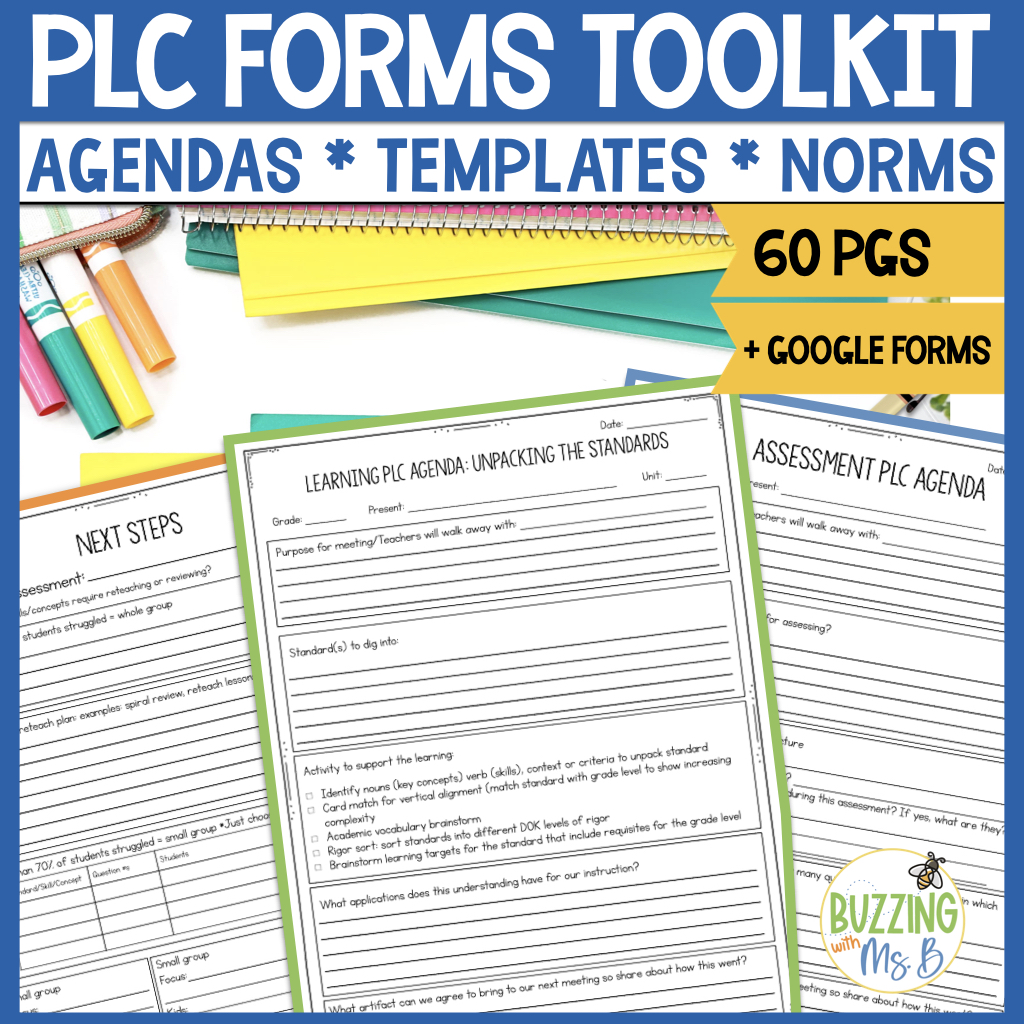
Looking for PLC Resources to Grow Your Teacher Teams?

Grab the Instructional Coach PLC Binder Bundle: Norms, Meeting Agenda, Forms & Templates in my TpT Store! It has everything you need to establish purposeful, effective PLCs.
5️⃣ Agreeing on 4 or 5 Norms

From those statements, the team decides on four or five norms they will use during meetings. You want to have a real dialogue about what is most important before deciding on your final ones. Ensure norms selected are complete, purposeful, and meaningful.

6️⃣ Deciding on Accountability

In the final step, you’ll need to have a tricky conversation with your team!

You need to answer questions like:

  • How will we hold each other accountable?
  • What will we do if someone starts monopolizing the meeting with a story that is not related to the work we’re doing?
  • What if people come late to several meetings in a row?
  • What if they arrive unprepared for many meetings?

As a group, identify two or three actions you can take when these situations arise. It could be things like facilitator guidance, colleague prompting, visual cues, or a one-to-one conversation after the meeting. For examples of what these could look like on campus, listen to the full episode.

Examples of Team Norms

During the episode, I offer several sample norm statements. Here are some ideas for your team norms:

⭐ Have a clear purpose and agenda to accomplish for each meeting

⭐ Honor each other’s time

⭐ Start and end on time

⭐ Come prepared for your role

⭐ Everyone contributes meaningfully to the work and conversation

⭐ Leave the meeting with a clear plan or next step

Setting Norms with Your PLC Teams

Establishing norms from the start can shape your team into a purposeful PLC that works together effectively. In this episode, I guide you through a process for creating norms with your teams! Plus, you’ll get ideas for keeping everyone accountable.

Listen to this episode to hear all about setting norms with your PLC teams!

Topics and Questions Discussed in Episode 268 – Setting Norms with Your PLC Teams

  • Setting norms with your PLC teams
  • What are norms, and why are they important for PLCs
  • A process for developing norms with teacher teams
  • Deciding how to hold each other accountable during meetings
  • Sample norms you can use with your team

Turning Insight Into Action: Practical Steps You Can Take After Listening

Here are simple actions you can take right now:

1️⃣ Grab PLC Resources in my TpT Store

You’ll find PLC meeting resources in my TpT Store! Head over and search for “Buzzing with Ms. B PLC forms”. You’ll find so many PLC meeting templates, organizers, and more that will help you grow your teacher teams!

2️⃣ Download Your Free PLC Discussion Dice

When teachers are part of PLC meetings for the first few times, it’s difficult to get the ball rolling. I’ve got a free download you’ll love! PLC Discussion Dice are easy to use with teachers, help you focus on the topic at hand, and encourage participation from each teacher.

Enter your email below to get your FREE PLC Discussion Dice!

3️⃣ Create Norms with One of Your Teacher Teams

  1. Choose one of your PLCs.
  2. Set a date and time to create norms together.
  3. Following the steps in the episode, create group norms with the team.
  4. After you try it, let me know how it went in the Instructional Coaching with Ms. B Facebook group or over on Instagram!

4️⃣ Join The Confident Literacy Coach

This episode contains a lesson from The Confident Literacy Coach about developing norms with your PLC teams. When you enroll, you’ll get a detailed guide for setting norms that you can use with your team! Plus, you’ll have access to all the other modules in the course!

Ready to listen?

  • Ready to listen? You can listen below with the media player, or search for Buzzing with MS. B: The Coaching Podcast anywhere you listen to podcasts!

This post contains links to products from one or more of our advertisers. This means I may receive commissions for purchases made through links in this post when you click on links to those products. Thank you for your support!

Learn more

Helpful Resources


Listen on: Apple Podcasts, Spotify, or your favorite listening app


Thank you for listening to Buzzing with Ms. B: the Coaching Podcast. Want more coaching ideas

Check me out at buzzingwithmsb.com and on Instagram @buzzingwithmsb.

If you love the show, share it with a coach who would love it too, or leave me a review on iTunes! It’s free and it helps others find this show, too. Happy coaching!

Podcast produced by Fernie Ceniceros

Setting Norms with Your PLC Teams, ep. 268, Instructional Coaching with Ms. B Podcast

Chrissy Beltran (00:07.522)

Hey coaches, welcome to module six, lesson two, creating norms and agreements. If you are here in this module, I hope that you have already viewed lesson one, identifying group dynamics, because we’re gonna use some of our understanding of the way that groups work to frame our norms and agreements. From here, we’re gonna move on to looking at student work together, digging into data together, and planning collaboratively throughout this module.

My goal for this session is to help you implement a process for creating norms with teams of teachers and to identify appropriate measures for holding each other accountable for the norms. This is so important because many teams will only work well together if we facilitate really purposefully. Teams are more productive when we know what is expected and we can support each other to do the work. But if you work with teams without norms, you’ll be putting out fires instead of building culture.

And norms are a way that we can hold each other accountable and create purpose and create expectation and support people in getting through that work together. Instead of putting out fires and saying, we shouldn’t do this, we shouldn’t do this, after the fact, you are setting up a proactive expectation of how things should work in your team. So what are norms? If you have worked on some teams that haven’t functioned very well and did not have norms and you haven’t really seen norms used effectively,

this might be a new idea for you. So whenever I was in the classroom, I remember that a lot of our district work was about, they would review these norms with us. And they were fine norms, but it was just random, it felt random to me that I was not involved in creating those norms because they were district wide. And they would read them at the beginning of any kind of PLC or anything we did together, but then we didn’t actually talk about them or apply them or anything like that. So they didn’t seem very purposeful to me.

And then later as a coach, I really had a hard time initiating my work with PLCs whenever I was first getting started because I didn’t have any experience in creating norms to set up, you know, our expectations and our vision of how we wanted things to work together. So I am excited to share this information with you because I think it’s going to save you a huge learning curve that I had to go through. So what are norms? Norms are the way we want our team to work. They are agreements for how we will act in a team.

Chrissy Beltran (02:25.474)

and they’re a way to hold each other accountable for productive and respectful teamwork. We can address through norms who talks when they talk, what they do and don’t talk about, how the meeting is run, logistics, purpose of meetings, preparation for the meetings, the kinds of attitude we bring to meetings, the way we interact. Some sample norms are have a clear purpose and agenda to accomplish, honor each other’s time, start and end on time, take care of your own needs such as restroom, et cetera.

No technology except for research or planning purposes, or you could say limit your use of technology. Come prepared for your role, or everyone contributes to the conversation. Those are just some sample norms. But we’re going to create a process to work through with teachers to actually create norms with our teams that are meaningful for each team. So here’s a process that I’m going to share with you for creating norms. First, we’re going to envision a team. Then we’re going to brainstorm behaviors. Then we’re forming norms statements.

charting out statements, agreeing on four to five statements, and deciding on accountability. And you have in your handy-dandy guidebook a really detailed document that spells it all out. I’m going to go through the process with you, of course, but this is a reference that you can use whenever you’re working with teachers. And then you also have your creating norms and agreements worksheet that you can use with teachers to create the norms that you’re going to use to work together.

So let’s talk about this process one step at a time. First, we’re going to envision a quote, good team. And you can either write descriptive statements in that box, or you can draw a sketch of what it looks like in the box and label it. Basically, you want to say, what does a good comma functioning team look like?

Then you’re going to brainstorm behaviors. And this is something that teachers can do in pairs or individually. So there’s a two-column chart in the middle of the handout. And you want teachers to brainstorm the things that they want to see happening and brainstorm the things that they do not want to see happening. So if I want to see that our team is going to be everybody contributing, I’m going to put that on the left side. If I don’t want our team to be bickering or arguing, I’m going to put that on the right side.

Chrissy Beltran (04:42.114)

From there, in pairs, your teachers are going to use their two-column chart and the notes that they wrote to create four to five norm statements that they would like to see your group adhere to. They’re going to frame them positively. So for example, instead of saying no sidebar conversations or don’t talk while someone else is talking, it could say avoid sidebar conversations. We’re going to frame them in a positive language.

After everybody has their sample statements, you’re going to chart their ideas that they’ve brainstormed and they’ve kind of agreed on with a partner, you’re gonna chart out some statements. Everybody shares out their statements and you chart them out on chart paper or you write them on a projected and projected or on a board or somewhere and you can put a check mark for duplicates. So if somebody has something more than once, you can put a check. You can also add your own here.

Because if teachers are missing something that you see is really essential for your work with that group of teachers or grade level, you can add your own statements there to make sure that gets addressed.

Now from those statements on that chart, you’re going to agree on four to five norm statements and ensure that they are complete, that they are purposeful and meaningful. And the idea is that just because something got more checks and another one got less check marks, it doesn’t mean that that one with less check marks doesn’t need to end up on your norms. You want to have a real dialogue about those norms that you wrote up and charted up that everyone shared out.

and talk about how you can combine them or which ones are most essential in order to ensure that you’ve got a complete set of norms that is going to really support your team in working together. And then you can rewrite or add to them when it’s necessary to make them more clear. So you can see in your guidebook, you have sample norms that I created with one grade level, and those norms include having a clear purpose and an agenda or list to accomplish for each meeting.

Chrissy Beltran (06:36.716)

honoring each other’s time, starting and ending on time, nobody monopolizes the meeting, coming prepared for your role in the meeting, that was a big one, everyone contributing meaningfully to the work and to the conversation, and leaving the meeting with a clear plan or next steps. Those were five things that we agreed to do together in order to maximize our effectiveness as a team.

From there, you have to have a tricky conversation. And that conversation is, how will you hold each other accountable? What will we do if someone starts monopolizing the meeting with a story that is unrelated to the work that we’re trying to do? What will we do if someone is coming late to several meetings in a row? What will we do if someone shows up to the meeting several times in a row and they are unprepared for their role in the meeting? So you have to identify as a group two to three actions that you can take.

So for example, the facilitator will remind so and so of the norm that is in question. So here are some ideas for accountability that you could use to hold each other accountable. It could be facilitator prompting or guidance. So the facilitator says, hey, so and so, make sure you’ve got this. I noticed that you’re not doing this. This is the norm. Let’s stay on track.

It could be colleague prompting. The colleague could actually point out, our norm number two is that we’re going to honor each other’s time, so let’s get focused on our agenda. It could be a visual signal. You could just hold up the number of fingers of the norm that people are struggling with that day. You could be pointing towards the norm, pointing it out on a chart where it’s placed visibly in the room. And it could also be a one-to-one conversation after the meeting. In tricky situations, sometimes the best way is to pull people aside and say,

Hey, Ms. So-and-so, I noticed that we were really struggling with our third norm, come prepared for your role in the meeting. And I know you’ve had some things going on that may have interfered with your ability to plan, but your team members are really counting on you. So is there a way that we can set up something so you’ll be prepared for the next meeting so we can make sure that you have your components ready?

Chrissy Beltran (08:35.488)

Establishing norms at the beginning of your work with a team can shape this collection of individuals into all those different types that we talked about in lesson one into a really purposeful PLC that can work together to accomplish work effectively. Okay? So what I want you to do, this is your action for today, you’re going to choose one of your PLCs, one grade level, and you’re going to set a date and time to create norms together following the steps in the guide. Okay? I recommend

that you brainstorm your own norms in advance based on how you’ve seen this group interact in the past or what you think a best practice for working together as a group could be. So brainstorm a little list just so you have some ideas for input if teachers are stuck or if you need to add them whenever you’re triding them out and you’re seeing something is missing. Okay, that’s your next step. And I’m really excited to share the next lesson with you. It’s lesson, module three, excuse me, module six, lesson three, looking at student work together. I’m gonna share a process with you.

that will help you look at student work and actually formulate thoughts and plans on what to do in response to that work. So, check it out for sure. That is going to be lesson three, looking at student work together.

Share:

Similar Posts

Leave a Reply

Your email address will not be published. Required fields are marked *