Metacognition: a hands-on lesson for monitoring comprehension in reading

The beginning of the school year is a time to establish so many things.
Routines, behavior expectations, and organizational systems top the list.
But if we’re really going to make a change in our students this year, we have to do more than tell them how to act.
We have to teach them how to think.
Specifically, we have to teach them how to think about reading.
If you’re an upper elementary teacher, you may have noticed what I noticed as a fourth grade teacher.
Sometimes kids have been focusing so much on decoding that their inner voice is gone. There’s nothing going on in there while they’re reading. They’re getting through the words, but nothing is happening in the ol’ noggin.
And that’s when you get blank stares when you say, “So what did you just read about?” Now, we know that there is a percentage of the population that just doesn’t have that voice (what is that heaven like??) but for the most part, kids should be able to hear their thoughts in their brains as they read.
We just have to teach them to stop and notice!
Hands-on reading lesson for metacognition
This lesson is designed to shake things up and help students acknowledge their thinking as they read. It’s all about metacognition, baby: thinking about our thinking!
Have you ever tried it? It’s the Reading Salad and it’s a fun, hands-on way to teach monitoring comprehension!

Here’s the step-by step plan. You can grab this lesson and 19 more in my First 20 Days of Reading Instruction resource!It’s all the lesson plans you need to plan for
- How to choose books
- Learning the classroom library
- Setting goals
- Monitoring our comprehension
- Responding to reading in notebooks
- Marking our thinking with sticky notes
- Sharing with a reading buddy and more!
The Reading Salad:
*NOTE: This is a great way to introduce monitoring comprehension, but it’s not the only time you’ll want to work with this idea. Consider this the engaging activity that starts at least several days of working on monitoring comprehension, and then you’ll gradually release responsibility over time. Learn how in the First 20 days of Reading lessons!

1. Teacher introduces the idea of monitoring our comprehension: noticing our thoughts as we read and thinking about our thinking. Build just the top part of the anchor chart: Reading = thinking.
2. Teacher will introduce the Reading Salad. The reading salad is a hands-on way to show how readers interact with the text by thinking and responding to the text. The text is represented by pieces of green construction paper cut into rectangles. The thinking is represented by pieces of red construction paper cut into rectangles. Place a salad bowl in front of you along with the two stacks of colored construction paper.
3. Read aloud a mentor text, pausing to make your reading salad by adding green paper to the bowl when you read the text and red paper when you think aloud about your response.
4. Ask students to listen to a portion of the book read aloud, holding up a red piece of construction paper when they have a thought.
5. Have students share their thinking with a partner and then choose several students to share their thinking out to the whole class. Record some of their thoughts on the sticky notes and add them to the anchor chart. As students share their thinking, label the comprehension strategy by saying, “That’s a great question!”, “You’ve made a good prediction,” etc.
6. Practice independent reading and building stamina. Have students add to their reading log if needed.
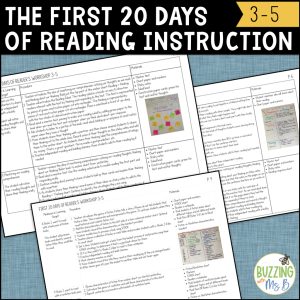
You can grab the first 20 lessons for reading instruction here!
By the end of the first month of school, our students should be able to write structured reading responses that include their thinking!
Get the lessons to make it happen this year!