| |

Help! I’m Not Trained as an Instructional Coach!, ep. 284

Teacher standing holding a notebook with a frazzled expression. These words are on the bottom, "Help! I'm Not Trained as an Instructional Coach!".

When I first started coaching, I remember thinking, “Help! I’m Not Trained as an Instructional Coach!

Coaching came as a complete surprise to me. I was planning to loop with my class from third to fourth grade.

Then, a few days after school let out, I got a call from a parent who encouraged me to apply for an instructional coaching position. I cried on the phone.

I waffled and agonized.

Finally, I applied.

My principal told me it was a bad idea and that I wasn’t a good match for the school.

I went to the interview anyway (and cried there too!).

When I was offered the job, I accepted. Then I went on a cruise (and you guessed it, I cried some more!)

That July, I started as an instructional coach.

It’s unlikely you spent as much time crying as I did. You may have even sought out the job and were likely excited when you accepted the position.

But even if you were excited, you may have felt unprepared for your new coaching role. I know I did. When I started coaching, I had no idea what I was doing!

Now, some coaches do have formal training, but they usually focus on specific components of coaching, like the coaching cycle. They don’t help you situate yourself as a coach in the school system.

Starting out as an instructional coach can be so overwhelming! It can feel like there are too many things to do, and you just don’t know where to start. This resource includes a guide, printables, and fillable forms (PDFS) to build relationships, have a dialogue with your administrator, review data and make a plan, visit classrooms, and more! Get the First 20 Days of Instructional Coaching Start Up Kit and Forms today!

So, what do you do if you’re not trained as an instructional coach, but you’ve suddenly found yourself in that position?

You’re going to build the plane while you fly it! You can’t avoid it! It’s not ideal, but we all go through it. Give yourself the grace of being new! Just like being a new teacher, you’re finding your way. It will get better!

In this episode, I share my handy-dandy COACH Framework that will help you create a purposeful coaching program that brings meaningful, lasting change to your school. You’ll discover the five key things you need to do to establish yourself as an instructional coach and build a strong coaching foundation.

If you’re just getting started as an instructional coach or need a little refresh, be sure to listen to the full episode! In the meantime, here are some of the highlights.

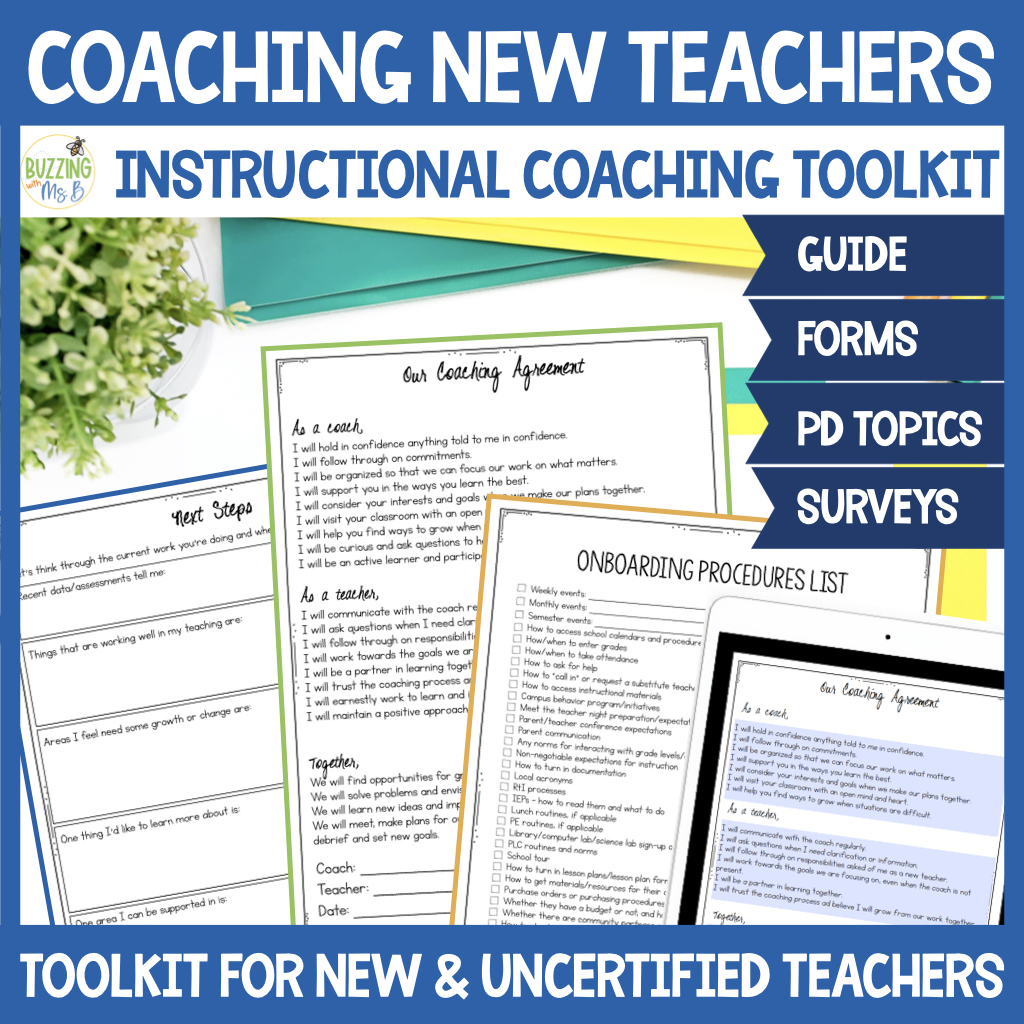
Have a plan for working with new and uncertified teachers with the Coaching New Teachers Toolkit!

It includes forms, templates, and everything you need to help your new and uncertified teachers! Figure out what support the need and provide PD and coaching with these resources. Grab the Coaching New Teachers Toolkit in my TpT Store!

⭐⭐⭐⭐⭐ “I support & coach new teachers and this resource is so valuable. I purchased it several months ago and often use tips you suggested when working with teachers. It is an essential section of my “Teacher Support Provider Binder” that I carry around with me everywhere.”
The COACH Framework: A Quick Breakdown

The COACH Framework will help you build a coaching program that creates school-wide change! Each letter in this coaching framework represents a foundational component of effective coaching.

Be sure to spend time developing each component at the beginning of the school year so you know where you’re headed and what you’re trying to build. It’s also helpful to revisit the framework mid-year to make sure you’re on track.

C – Clarify and Communicate Your Role

You won’t accomplish anything if people don’t know what you’re there to do! Make sure everyone, especially you and your principal, are clear on your role and responsibilities. This helps establish realistic expectations and builds trust by letting teachers know how you can support them.

O – Organize Systems for Coaching

A huge component of coaching, just like teaching, is organization. But unlike teaching, you don’t have a curriculum or schedule every day telling you what to do. Set up systems for organizing your space, time, and materials. Intentionally align your work with the school calendar so you’re ready for weekly team meetings and testing windows.

A – Analyze Data to Build Your Action Plan

Start by looking at data from a few different sources (test data, anecdotal data from admin, teacher input, observation data). Analyze it to make a three-tiered action plan for how you’ll support everyone, from school-wide professional development (PD) to individual coaching opportunities.

C – Coach at 3 Different Levels

A solid coaching plan involves support at the school, team, and individual levels. You analyzed the data and built an action plan in the last step. Now, it’s time to actually plan your PD opportunities to support the school with its learning goals.

H – Hone Your Coaching Toolbox

Meeting teachers’ varied needs requires a range of strategies! The more tools coaches have in their coaching toolbox, the easier it is to connect with teachers, respond to individual needs, and support learning.

This is at the heart of my upcoming book, Expand Your Coaching Toolbox, where I share 20 practical ways coaches can meet teachers where they are and help them grow, one step at a time. More on the book soon!

One way you can share your coaching toolbox with teachers is with a coaching menu that spells out the different ways you can help. Whether that’s talking through problems, working together on planning, or visiting colleagues, a coaching menu helps teachers see the many ways you can support them. Teachers pick what works best for them, which makes coaching feel more like a partnership.

These are just a few of the strategies that can help you build a stronger coaching program. Looking for ongoing coaching support? Join the Instructional Coaching Club. You’ll get access to the COACH Framework video that can help you implement these practices.

Be ready for anything with the Instructional Coaching Editable Binder Megapack!

It includes forms, templates, and everything you need to get organized for instructional coaching! Coach teachers and document your coaching work with these printable and editable tools. Grab the Instructional Coach Binder Megapack in my TpT Store!

Help! I’m Not Trained as an Instructional Coach!

If you’re a new coach or you’ve had virtually no training, like I did at the start, do not panic! Focus on what’s essential and build your coaching program from there.

Start by listening to the entire episode so you can learn the five things to do to establish yourself as a coach. Then build a program that is purposeful and going to impact teachers meaningfully over time.

This podcast is part of our Get Focused on Instructional Coaching series, where you’ll learn how to get your head in the right place for the next school year. Be sure to come back next week for more episodes on this topic!

Topics and Questions Discussed in Episode 284 – Help! I’m Not Trained as an Instructional Coach!

  • Help! I’m not trained as an instructional coach! – My coaching story
  • The COACH Framework
  • Clarifying and communicating your role/responsibilities
  • Organizing your systems for instructional coaching
  • Analyzing data to build your action plan
  • Coaching at 3 distinct levels – school, team, individual
  • Honing your coaching toolbox
  • Differentiating coaching to meet each  teacher’s unique needs
  • Using a coaching menu

Turning Insight Into Action: Practical Steps You Can Take After Listening

Here are simple actions you can take today:

1️⃣ Join the Instructional Coaching Club

If you’re looking for ongoing coaching support, I would love to see you in the Instructional Coaching Club! You’ll get access to the COACH framework video that can help you implement these practices!

2️⃣ Grab the FREE First 20 Days of School Checklist

If you’re gearing up for a new year or need a reset, download the FREE First 20 Days of School Checklist to set yourself up for a successful, impactful year of coaching!

Ready to listen?

  • Ready to listen? You can listen below with the media player, or search for Buzzing with MS. B: The Coaching Podcast anywhere you listen to podcasts!

This post contains links to products from one or more of our advertisers. This means I may receive commissions for purchases made through links in this post when you click on links to those products. Thank you for your support!

Learn more

Helpful Resources


Listen on: Apple Podcasts, Spotify, or your favorite listening app


Thank you for listening to Buzzing with Ms. B: the Coaching Podcast. Want more coaching ideas

Check me out at buzzingwithmsb.com and on Instagram @buzzingwithmsb.

If you love the show, share it with a coach who would love it too, or leave me a review on iTunes! It’s free and it helps others find this show, too. Happy coaching!

Podcast produced by Fernie Ceniceros

Help! I’m Not Trained as an Instructional Coach!, ep. 284, Instructional Coaching with Ms. B Podcast

Chrissy Beltran (00:02.274)

Hey coach and welcome to another episode of instructional coaching with Miss B. Today we are talking about what to do if you get an instructional coaching job and you are not trained as an instructional coach. This is part of our focusing on instructional coaching series where we’re going to help you get your head in the right place for the next school year. So if you’re feeling a little overwhelmed with figuring out the beginning of the school year and you’re just not sure where you’re supposed to start, I have a really great

checklist that you’re going to love. It’s the first 20 days of school checklist. You can go to buzzingwithmissby.com slash first two zero first 20 and you’ll be ready to coach your teachers this year with an idea of where to invest your energy the first month of school. Now, if you haven’t listened to episode one of this podcast, I’m just going to summarize quickly in phrases and you can fill in the missing pieces with your own imagination. but basically coaching came as a surprise to me.

So a few days after school let out, planning on looping from third grade back to my fourth grade, which is my favorite grade with my students, got a call from a parent. I had taught both of her kids a few years back. She said I should apply for a coaching job at their school. I cried on the phone. I waffled. I agonized. And then I applied. My principal tried to convince me it was a bad idea, that I wasn’t a good match with the school for a few different reasons, mostly about dual language. I went on the interview.

I cried in the interview. I got offered the job. I accepted the job. I went on a cruise and I cried on the cruise. And then I started at the end of July. That may or may not resemble how you got your job. I mean, it’s unlikely that you spent as much time crying as I did. And you might even have sought the job out. And you probably did. And because of that, you’re probably way more excited than I was when you accepted.

I was very torn because I was leaving my kids who were looping with me and I struggled with that. But even if you were feeling excited, you probably feel unprepared. And as a teacher who has suddenly become a coach, I can completely understand this. When I was a teacher, I had leadership roles on my campus and I provided PD and facilitated teams and meetings and modeled for my colleagues and helped them dig through data and look at their assessments and figure out what was going wrong.

Chrissy Beltran (02:24.086)

I wrote curriculum and I served in so many positions with various acronyms for my school and for the district. So I had spent a lot of hours working with other teachers at a school level. And still, when I started coaching, I had no idea what I was doing. I’m sure you can relate to that, at least some of you. Some coaches have formal training, maybe master’s degrees in specific areas or coaching programs through their district or state, but I had none of that. And many coaches are in the same boat.

And honestly, even if you went through a program, many of those programs focus on specific components of coaching, such as coaching cycles, but they don’t really help you situate yourself as a coach in the school system. So it’s kind of like being a teacher where you maybe learn some content and some basic pedagogy, but then you walk into your classroom and you’re like, I feel completely unqualified to do this. So what do you do if you’re not trained as an instructional coach, but you’ve suddenly found yourself in that position?

it’s gonna be a little bit of building the plane while you fly it. You just can’t avoid it. It’s obviously not ideal, but pretty much everybody who is new to this role is building and flying the plane at the exact same time. And so as you’re moving through, especially the first part of the year, but really the whole year, give yourself the grace of being new. It’s okay to be new. You are new and you will make missteps and do things that you’ll sort of wish you didn’t. And just like being a new teacher, you are figuring it out.

and it will get better. That’s what’s gonna happen in the beginning and there’s no way around it. So you may as well just accept it. I also have a handy dandy acronym that can help you figure out what you’re trying to build as a coach. So if you are trying to understand like, okay, what does my coaching role look like in this school setting? Because that’s really who I’m talking about here. People who are in a school setting, although these principals are gonna be supportive of you regardless of where you coach. This is going to help you out. It’s the coach acronym.

Now, before I jump into it, I just wanna mention, if you’re looking for ongoing coaching support, I would love to see you inside the Instructional Coaching Club. It’s a monthly installment of coaching how-to PD, PD kits to build teacher toolboxes for instruction, and fun bonuses that you’re gonna love that help you keep the joy in coaching. Head to instructionalcoachingclub.com and you’ll get access to the Coach Framework video that can help you actually implement these practices. Today, I’m gonna give you a little bit of an overview, okay? The Coach Framework, letter C-O-A-C-H,

Chrissy Beltran (04:51.032)

help you build a coaching program that creates school-wide change. The C stands for clarify and communicate your role. The O stands for organize systems for coaching. The A stands for analyze data to build your action plan. The C, C, is coach at three different levels. And H is hone your coaching toolbox.

So we’re gonna talk about each letter briefly so you get an idea of what it is that you’re trying to build as you’re spending time those first few weeks and months of school and you really know where you’re headed. In terms of clarifying and communicating your role, this is so important because without a clear and clarified role, you will accomplish nothing as a coach. If people don’t know what you’re there to do, they’re not gonna welcome you in.

And if you don’t really know what you’re there to do, you’re always gonna be like doubting, am I saying yes to this? Should I be saying no? And it really creates a lot of frustration in terms of how nebulous your responsibilities are. A solid coaching program stands on the foundation of a clarified role and responsibilities. And this actually enables a coach to build coaching relationships where each participant in the partnership understands what they’re there to do. It kind of helps remove some of that doubt from teachers.

and add in some credibility when you have a clearly defined role. So one thing you need to do, and I get into more detail in the session for the club, but I just want to give you an overview. One thing that you really want to do to establish this piece of your coaching role is you want to clearly define the role with your administrator. And I’ve shared over the years roles and responsibilities checklists. You have access to that in the club, actually. And so those can help you kind of go through all the different things that coaches might have to do.

and then decide, okay, but which ones are for me? Which ones are in my realm, in my purview, responsibilities in terms of things that you will be responsible for daily, weekly, and maybe across the whole school year. Sometimes we say yes to things that are not within our job responsibilities, and then we’re like, why don’t we ever have time to do our jobs? The next letter is, organized systems for coaching. So a huge component of…

Chrissy Beltran (06:59.074)

Coaching, just like teaching, is organization. But unlike teaching, you don’t really have like a curriculum. You don’t have a schedule every day that tells you what to do and where to be. There are gonna be blocks of time that are designated for specific leadership meetings or vertical alignment or planning meetings or data review or PLCs, of the PLC meetings, all of these will have designated times, but in the white space in between those times, you gotta figure out what to do with yourself that’s going to make the most impact.

And sometimes your administrator might say, I really want you to focus on this. I want you to make sure that you’re spending time here. Make this a priority this week or this month or whatever. But beyond that, you got to figure it out, right? So we have to organize our space, our time and our materials. And it’s such an essential part of our coaching role. Without these systems, a coach will find themselves putting out fires and handling urgent tasks daily instead of making a lasting impact on classrooms. So one thing that is really important to do

is to spend time understanding the school calendar and then pacing your coaching work in coordination with that school calendar. If you meet with teachers every Tuesday, for example, for PLC team meetings like I did, then you probably need to some time Monday or Friday preparing for those meetings, especially for the facilitator. If you know that you have to provide some testing support at certain times of the year, maybe April and May, then you’re gonna wanna block off those times as you get a little closer to them.

and make sure that you have dedicated time and space to support teachers in the classroom or intervention or whatever it is that you’re being asked to do. Now, without an understanding of your coaching role, you won’t be able to do that. So you need to know what you’re in charge of before you can organize your time. The A stands for analyze data to build your action plan. And so this is so important because a coaching action plan is essential for supporting your school in a truly thoughtful way. You’ll want to start by analyzing data from a few different sources and that can be test data,

anecdotal data from administrators and their input, course, teacher input, and then your own observation data. And you can use this data to build a three-tiered plan. That three-tiered plan is gonna help you focus on school-wide professional development in tier one, PLCs and differentiated teams in tier two, and individual teacher coaching opportunities in tier three. And so the first thing you’re gonna wanna do, as I mentioned, is gather that data, go through it and identify your school needs.

Chrissy Beltran (09:24.45)

to make sure that you are providing support in the areas that your school actually needs you to provide support in, and then you can use it to build your three tier plan. The second C stands for coach at three levels. A solid coaching action plan involves coaching support at the school, team, and individual level. And so in order to support teacher learning and development across the school, coaches work with teachers at all three levels. Now I mentioned that you’re building that plan under the letter A, right? But in this case, you’re actually planning your professional development opportunities.

that support the school in accordance with its learning goals and develop understanding over time. This is where you actually build out your plan and do the specific work for those three levels. And so in this case, you can think about this approach in two different ways. You can say, okay, either I’m gonna focus on this one big thing that is our school-wide initiative, and we’re gonna break that down to differentiated teams for our tier two, and individual coaching support is going to be reflective of that. Or you can instead say, this is our school-wide focus.

but I know my differentiated teams need something different, so we’re gonna work on different topics with them, and I’m gonna have individual teachers choose the coaching support that they need based on whatever their needs are in their classroom. The last letter is H. This stands for hone your coaching toolbox. And I actually have a book coming out about this in November. It’s called Expand Your Coaching Toolbox. And the idea is that there are 20 different practical strategies you can use.

to meet teachers where they are and push them forward a little bit or pull or whatever it is, whatever verb you wanna use, you can grow your teachers one step at a time. So meeting teachers, varied, varied needs requires a variety of strategies and a coaching toolbox that includes strategies for relationship building, learning and alignment and classroom implementation can make an impact with teachers across the school. So in the toolbox, I teach about…

Level one strategies, which are relationship building strategies. Level two, which are alignment and knowledge building strategies. And level three, which are classroom skill strategies. And so these three different levels, if we can meet teachers’ needs in these three different ways, we will be able to take those teachers who we’re barely building relationship with and maybe don’t have a lot of trust with us yet and move them forward into more impactful strategies like looking at data together, creating assessments.

Chrissy Beltran (11:41.454)

planning to collaboratively or looking at student work to really have aligned conversations and then moving them also forward into the classroom skill building, such as visiting their colleagues to see what something looks like in action or co-teaching with us and having those conversations that really change and impact coaching. So you want to think about your coaching toolbox. And one way you can share this with teachers is with a coaching menu where you actually spell out, these are the main strategies I’m focusing on this year.

And these are the ways I can help you. So when you approach a teacher and you’re saying, I would love to support you in this area, I see that you’re working on this, you can offer that menu as a way to say, which of these approaches might be the most helpful for you in this moment to move forward in this specific area. Those are the five things that you’re gonna wanna do to establish yourself as a coach and to really start building a program that is purposeful and going to impact teachers meaningfully over time. So if you’re a new coach and you have had

virtually no training like me, you just show up on the job and you’re like, I guess I’m a coach now. Do not panic, focus on what’s essential and build your program from there. Thank you so much for listening today. Next week I’m introducing one of my favorite ways, some of my favorite principles for instructional coaching. We’re gonna focus on six foundational principles of instructional coaching and I’m gonna tell you how I got the idea to write these. And hopefully you’re a Jurassic Park fan like me.

and it makes sense to you. until then, happy coaching.

Chrissy Beltran (00:02.274)

Hey coach and welcome to another episode of instructional coaching with Miss B. Today we are talking about what to do if you get an instructional coaching job and you are not trained as an instructional coach. This is part of our focusing on instructional coaching series where we’re going to help you get your head in the right place for the next school year. So if you’re feeling a little overwhelmed with figuring out the beginning of the school year and you’re just not sure where you’re supposed to start, I have a really great

checklist that you’re going to love. It’s the first 20 days of school checklist. You can go to buzzingwithmissby.com slash first two zero first 20 and you’ll be ready to coach your teachers this year with an idea of where to invest your energy the first month of school. Now, if you haven’t listened to episode one of this podcast, I’m just going to summarize quickly in phrases and you can fill in the missing pieces with your own imagination. but basically coaching came as a surprise to me.

So a few days after school let out, planning on looping from third grade back to my fourth grade, which is my favorite grade with my students, got a call from a parent. I had taught both of her kids a few years back. She said I should apply for a coaching job at their school. I cried on the phone. I waffled. I agonized. And then I applied. My principal tried to convince me it was a bad idea, that I wasn’t a good match with the school for a few different reasons, mostly about dual language. I went on the interview.

I cried in the interview. I got offered the job. I accepted the job. I went on a cruise and I cried on the cruise. And then I started at the end of July. That may or may not resemble how you got your job. I mean, it’s unlikely that you spent as much time crying as I did. And you might even have sought the job out. And you probably did. And because of that, you’re probably way more excited than I was when you accepted.

I was very torn because I was leaving my kids who were looping with me and I struggled with that. But even if you were feeling excited, you probably feel unprepared. And as a teacher who has suddenly become a coach, I can completely understand this. When I was a teacher, I had leadership roles on my campus and I provided PD and facilitated teams and meetings and modeled for my colleagues and helped them dig through data and look at their assessments and figure out what was going wrong.

Chrissy Beltran (02:24.086)

I wrote curriculum and I served in so many positions with various acronyms for my school and for the district. So I had spent a lot of hours working with other teachers at a school level. And still, when I started coaching, I had no idea what I was doing. I’m sure you can relate to that, at least some of you. Some coaches have formal training, maybe master’s degrees in specific areas or coaching programs through their district or state, but I had none of that. And many coaches are in the same boat.

And honestly, even if you went through a program, many of those programs focus on specific components of coaching, such as coaching cycles, but they don’t really help you situate yourself as a coach in the school system. So it’s kind of like being a teacher where you maybe learn some content and some basic pedagogy, but then you walk into your classroom and you’re like, I feel completely unqualified to do this. So what do you do if you’re not trained as an instructional coach, but you’ve suddenly found yourself in that position?

it’s gonna be a little bit of building the plane while you fly it. You just can’t avoid it. It’s obviously not ideal, but pretty much everybody who is new to this role is building and flying the plane at the exact same time. And so as you’re moving through, especially the first part of the year, but really the whole year, give yourself the grace of being new. It’s okay to be new. You are new and you will make missteps and do things that you’ll sort of wish you didn’t. And just like being a new teacher, you are figuring it out.

and it will get better. That’s what’s gonna happen in the beginning and there’s no way around it. So you may as well just accept it. I also have a handy dandy acronym that can help you figure out what you’re trying to build as a coach. So if you are trying to understand like, okay, what does my coaching role look like in this school setting? Because that’s really who I’m talking about here. People who are in a school setting, although these principals are gonna be supportive of you regardless of where you coach. This is going to help you out. It’s the coach acronym.

Now, before I jump into it, I just wanna mention, if you’re looking for ongoing coaching support, I would love to see you inside the Instructional Coaching Club. It’s a monthly installment of coaching how-to PD, PD kits to build teacher toolboxes for instruction, and fun bonuses that you’re gonna love that help you keep the joy in coaching. Head to instructionalcoachingclub.com and you’ll get access to the Coach Framework video that can help you actually implement these practices. Today, I’m gonna give you a little bit of an overview, okay? The Coach Framework, letter C-O-A-C-H,

Chrissy Beltran (04:51.032)

help you build a coaching program that creates school-wide change. The C stands for clarify and communicate your role. The O stands for organize systems for coaching. The A stands for analyze data to build your action plan. The C, C, is coach at three different levels. And H is hone your coaching toolbox.

So we’re gonna talk about each letter briefly so you get an idea of what it is that you’re trying to build as you’re spending time those first few weeks and months of school and you really know where you’re headed. In terms of clarifying and communicating your role, this is so important because without a clear and clarified role, you will accomplish nothing as a coach. If people don’t know what you’re there to do, they’re not gonna welcome you in.

And if you don’t really know what you’re there to do, you’re always gonna be like doubting, am I saying yes to this? Should I be saying no? And it really creates a lot of frustration in terms of how nebulous your responsibilities are. A solid coaching program stands on the foundation of a clarified role and responsibilities. And this actually enables a coach to build coaching relationships where each participant in the partnership understands what they’re there to do. It kind of helps remove some of that doubt from teachers.

and add in some credibility when you have a clearly defined role. So one thing you need to do, and I get into more detail in the session for the club, but I just want to give you an overview. One thing that you really want to do to establish this piece of your coaching role is you want to clearly define the role with your administrator. And I’ve shared over the years roles and responsibilities checklists. You have access to that in the club, actually. And so those can help you kind of go through all the different things that coaches might have to do.

and then decide, okay, but which ones are for me? Which ones are in my realm, in my purview, responsibilities in terms of things that you will be responsible for daily, weekly, and maybe across the whole school year. Sometimes we say yes to things that are not within our job responsibilities, and then we’re like, why don’t we ever have time to do our jobs? The next letter is, organized systems for coaching. So a huge component of…

Chrissy Beltran (06:59.074)

Coaching, just like teaching, is organization. But unlike teaching, you don’t really have like a curriculum. You don’t have a schedule every day that tells you what to do and where to be. There are gonna be blocks of time that are designated for specific leadership meetings or vertical alignment or planning meetings or data review or PLCs, of the PLC meetings, all of these will have designated times, but in the white space in between those times, you gotta figure out what to do with yourself that’s going to make the most impact.

And sometimes your administrator might say, I really want you to focus on this. I want you to make sure that you’re spending time here. Make this a priority this week or this month or whatever. But beyond that, you got to figure it out, right? So we have to organize our space, our time and our materials. And it’s such an essential part of our coaching role. Without these systems, a coach will find themselves putting out fires and handling urgent tasks daily instead of making a lasting impact on classrooms. So one thing that is really important to do

is to spend time understanding the school calendar and then pacing your coaching work in coordination with that school calendar. If you meet with teachers every Tuesday, for example, for PLC team meetings like I did, then you probably need to some time Monday or Friday preparing for those meetings, especially for the facilitator. If you know that you have to provide some testing support at certain times of the year, maybe April and May, then you’re gonna wanna block off those times as you get a little closer to them.

and make sure that you have dedicated time and space to support teachers in the classroom or intervention or whatever it is that you’re being asked to do. Now, without an understanding of your coaching role, you won’t be able to do that. So you need to know what you’re in charge of before you can organize your time. The A stands for analyze data to build your action plan. And so this is so important because a coaching action plan is essential for supporting your school in a truly thoughtful way. You’ll want to start by analyzing data from a few different sources and that can be test data,

anecdotal data from administrators and their input, course, teacher input, and then your own observation data. And you can use this data to build a three-tiered plan. That three-tiered plan is gonna help you focus on school-wide professional development in tier one, PLCs and differentiated teams in tier two, and individual teacher coaching opportunities in tier three. And so the first thing you’re gonna wanna do, as I mentioned, is gather that data, go through it and identify your school needs.

Chrissy Beltran (09:24.45)

to make sure that you are providing support in the areas that your school actually needs you to provide support in, and then you can use it to build your three tier plan. The second C stands for coach at three levels. A solid coaching action plan involves coaching support at the school, team, and individual level. And so in order to support teacher learning and development across the school, coaches work with teachers at all three levels. Now I mentioned that you’re building that plan under the letter A, right? But in this case, you’re actually planning your professional development opportunities.

that support the school in accordance with its learning goals and develop understanding over time. This is where you actually build out your plan and do the specific work for those three levels. And so in this case, you can think about this approach in two different ways. You can say, okay, either I’m gonna focus on this one big thing that is our school-wide initiative, and we’re gonna break that down to differentiated teams for our tier two, and individual coaching support is going to be reflective of that. Or you can instead say, this is our school-wide focus.

but I know my differentiated teams need something different, so we’re gonna work on different topics with them, and I’m gonna have individual teachers choose the coaching support that they need based on whatever their needs are in their classroom. The last letter is H. This stands for hone your coaching toolbox. And I actually have a book coming out about this in November. It’s called Expand Your Coaching Toolbox. And the idea is that there are 20 different practical strategies you can use.

to meet teachers where they are and push them forward a little bit or pull or whatever it is, whatever verb you wanna use, you can grow your teachers one step at a time. So meeting teachers, varied, varied needs requires a variety of strategies and a coaching toolbox that includes strategies for relationship building, learning and alignment and classroom implementation can make an impact with teachers across the school. So in the toolbox, I teach about…

Level one strategies, which are relationship building strategies. Level two, which are alignment and knowledge building strategies. And level three, which are classroom skill strategies. And so these three different levels, if we can meet teachers’ needs in these three different ways, we will be able to take those teachers who we’re barely building relationship with and maybe don’t have a lot of trust with us yet and move them forward into more impactful strategies like looking at data together, creating assessments.

Chrissy Beltran (11:41.454)

planning to collaboratively or looking at student work to really have aligned conversations and then moving them also forward into the classroom skill building, such as visiting their colleagues to see what something looks like in action or co-teaching with us and having those conversations that really change and impact coaching. So you want to think about your coaching toolbox. And one way you can share this with teachers is with a coaching menu where you actually spell out, these are the main strategies I’m focusing on this year.

And these are the ways I can help you. So when you approach a teacher and you’re saying, I would love to support you in this area, I see that you’re working on this, you can offer that menu as a way to say, which of these approaches might be the most helpful for you in this moment to move forward in this specific area. Those are the five things that you’re gonna wanna do to establish yourself as a coach and to really start building a program that is purposeful and going to impact teachers meaningfully over time. So if you’re a new coach and you have had virtually no training like me, you just show up on the job and you’re like, I guess I’m a coach now. Do not panic, focus on what’s essential and build your program from there. Thank you so much for listening today. Next week I’m introducing one of my favorite ways, some of my favorite principles for instructional coaching. We’re gonna focus on six foundational principles of instructional coaching and I’m gonna tell you how I got the idea to write these. And hopefully you’re a Jurassic Park fan like me. and it makes sense to you. until then, happy coaching!

Share:

Similar Posts

Leave a Reply

Your email address will not be published. Required fields are marked *