| | | |

Strengths-Based Coaching with Steve Barkley, ep. 283

Two women smiling while sitting at a desk with a laptop on it. These words are on the top "Strengths-Based Coaching with Steve Barkley".

What if the secret to great coaching is focusing less on weaknesses and more on strengths?

In this episode, education consultant Steve Barkley joins me to explore what it really means to coach from a place of strength. Drawing on decades of experience in education, he explains why teachers are more responsive to coaching when we shift from what’s missing to what’s already working. Instead of focusing on deficits, strengths-based coaching builds on the skills teachers already have, helping them feel seen, valued, and more confident in their practice.

Steve shares real-life examples of strengths-based coaching conversations, along with practical pre- and post-observation strategies to keep feedback focused on what teachers are doing well. We also discuss why it’s important to use the teachers’ language during feedback and how instructional coaches can address areas for growth without shifting into a deficit-based or evaluative approach. Along the way, Steve reveals how strengths-based coaching can strengthen teams, improve instruction, and create a more positive school culture.

Listen now for practical ideas, inspiring stories, and insights for making strengths-based coaching a meaningful part of your practice.

Starting out as an instructional coach can be so overwhelming! It can feel like there are too many things to do, and you just don’t know where to start. This resource includes a guide, printables, and fillable forms (PDFS) to build relationships, have a dialogue with your administrator, review data and make a plan, visit classrooms, and more! Get the First 20 Days of Instructional Coaching Start Up Kit and Forms today!

Strengths-Based Coaching

Strengths-based coaching starts by building on what’s already working rather than focusing on what’s missing. Steve explains that if it’s not strengths-based, it probably falls outside the definition of coaching. 

He says that part of the reason many teacher evaluations have not led to meaningful growth is that they rely on checklists of “look-fors” and emphasize deficits. As a result, teachers often feel criticized instead of supported because they receive feedback that highlights what they lack rather than what they do well.

Why Are People More Responsive to Coaching When We Use a Strengths-Based Coaching Approach?

Drawing from positive psychology research, Steve tells us that people build and grow from their strengths, not their weaknesses. Strengths-based coaching is about seeing what’s working and how we can do more of it, rather than what’s lacking or broken. Positive feedback is motivating and creates the conditions for trying new ideas.

Steve brought up the example of the movie Moneyball, where Billy Beane built a winning team by betting on overlooked players’ strengths. By intentionally identifying what teachers do best, school leaders can build better teams. Recognizing and leveraging individual strengths will give the team superpowers.

He says instructional coaches and school leaders need to intentionally look for strengths during classroom visits. Instead of walking in with a checklist or looking for mistakes, coaches should train themselves to watch for what’s going right.

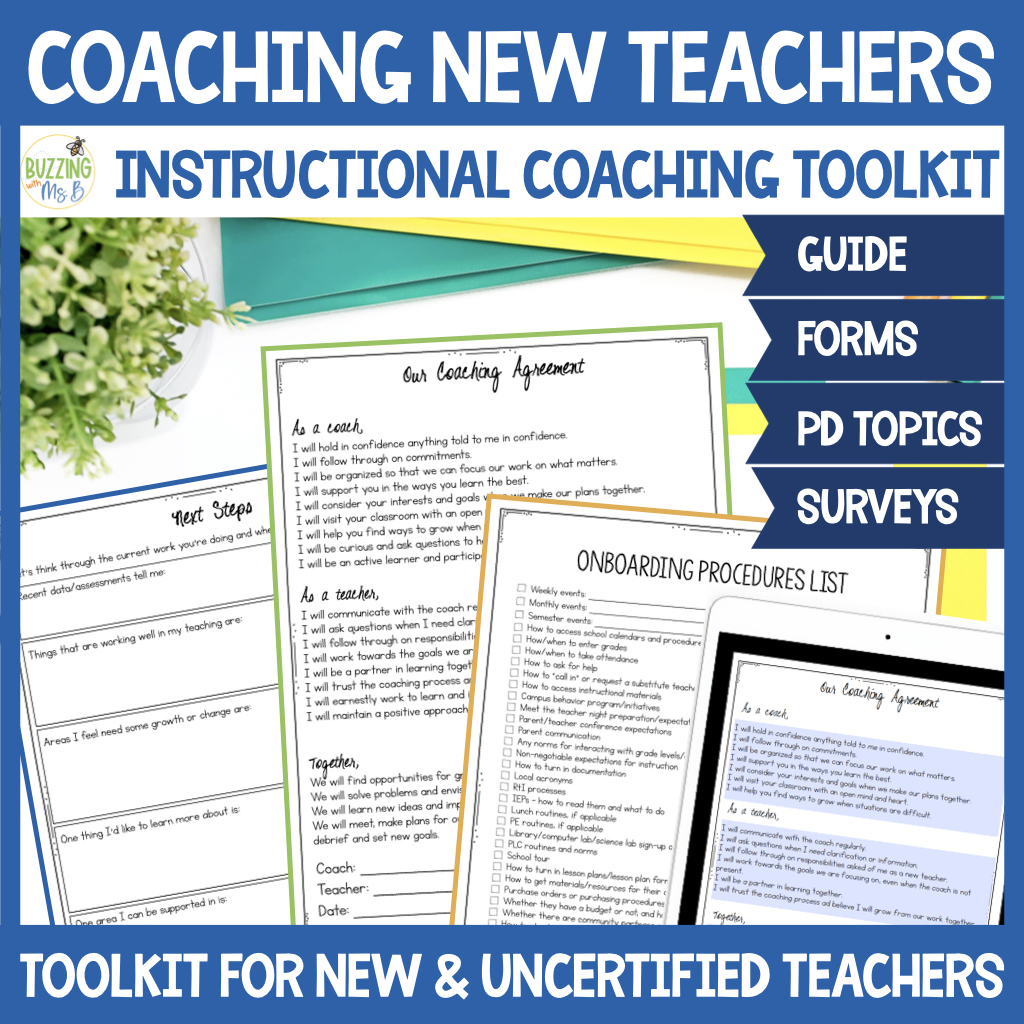
Have a plan for working with new and uncertified teachers with the Coaching New Teachers Toolkit!

It includes forms, templates, and everything you need to help your new and uncertified teachers! Figure out what support the need and provide PD and coaching with these resources. Grab the Coaching New Teachers Toolkit in my TpT Store!

⭐⭐⭐⭐⭐ “I support & coach new teachers and this resource is so valuable. I purchased it several months ago and often use tips you suggested when working with teachers. It is an essential section of my “Teacher Support Provider Binder” that I carry around with me everywhere.”
How to Have a Positive Post-Observation Conference

Steve tells a story about modeling a post-conference meeting during a mentor training and how participants were surprised by the number of strengths he identified in the teacher’s practice. During classroom visits, he quickly identifies ONE area the teacher needs to improve and then looks for strengths. In post-conferences, he highlights what’s working first because any area a teacher wants to tackle can be approached by building on their existing strengths.

He goes on to explain that to have the right post-conference, you need to have the right pre-conference. Here’s what he suggests:

Pre-Conference

Coaches should ask teachers about their strengths and what’s important to them. 

When working with a new teacher, ask:

  • How would you describe your natural approach to teaching? Tell me why that fits naturally for you?
  • What do you want students to learn from your classroom management?
  • When you think back to teachers you had as a student, what stands out as their strengths?

During the Classroom Visit

When you go into the classroom, look specifically for the things that the teacher told you were important to them during the pre-conference.

Post-Conference

Steve says that evaluators tend to use the words of the system (i.e., words that come with the curriculum or the evaluation tool). Coaches use the words of the teachers.

During the post-conference, talk about strengths using the teacher’s own language. For example, if the teacher calls it “group work”, the coach should call it that also.

Be ready for anything with the Instructional Coaching Editable Binder Megapack!

It includes forms, templates, and everything you need to get organized for instructional coaching! Coach teachers and document your coaching work with these printable and editable tools. Grab the Instructional Coach Binder Megapack in my TpT Store!

Addressing Areas for Growth Using a Strengths-Based Approach

Addressing areas for growth doesn’t have to mean shining a spotlight on what the teacher is doing “wrong.” Instead, Steve recommends that coaches frame the conversation around student learning goals and outcomes rather than what the teacher is doing.

During the post-conference, Steve invites the teacher to describe what they noticed and what they wanted to happen during the lesson. He explains that his usual approach is to take something the teacher is doing well and look for ways to use that to meet their objective. To hear an example, listen to the full podcast!

Steve highlights that a strength-based approach is not really about being positive; it’s about being strategic. As a coach, you’re studying what’s already moving learning forward, and then helping the teacher do more of that with students on a deeper level. He concludes by saying that even working in an area of weakness, you’re focusing on the strengths that exist in that area and building up from there.

Strengths-Based Coaching

That was an amazing conversation about strengths-based coaching! I love the way Steve says things in such a simple, accessible way.

I think it’s so important to take a strengths-based approach to coaching. We should look at what teachers are doing well and how we can help them build on those areas. When we anchor coaching in strengths, we create the trust and momentum needed for meaningful growth.

Ready to learn more about strengths-based coaching? Listen now using the player below or wherever you get your podcasts.

Topics and Questions Discussed in Episode 283 – Strengths-Based Coaching with Steve Barkley

  • What strengths-based coaching is and isn’t
  • How a strengths-based approach differs from other coaching approaches
  • Why traditional evaluation models fall short
  • The research on positive psychology and its connection to instructional coaching
  • Real-life examples of strengths-based coaching in schools
  • Why teachers are more responsive to coaching using a strengths-based approach
  • Pre- and post-conference strategies for focusing on strengths
  • Why it’s important to use teacher language when giving feedback
  • Addressing areas of growth without shifting into a deficit-based or evaluative approach

About Steve Barkley
Steve Barkley entered his career in teaching decades ago in an environment of coaching and teaming before the terms instructional coaching and professional learning communities were in our educator vocabulary. He has dedicated his career to building teachers’ engagement in shared reflective practices with building a coaching culture as a continuous focus.

Turning Insight Into Action: Practical Steps You Can Take After Listening

Here are simple actions you can take today:

1️⃣ Grab the FREE First 20 Days of School Checklist

If you’re gearing up for a new year or need a reset, download the FREE First 20 Days of School Checklist to set yourself up for a successful, impactful year of coaching!

2️⃣ Join the Instructional Coaching Club

The Instructional Coaching Club is an online membership designed to help instructional coaches improve instruction at their schools. It gives coaches the tools to go out and do it.

3️⃣ Center Your Feedback Around What’s Working

During your next coaching conversation, name at least two teacher strengths you observe, using the teacher’s own language from your pre-conference.

Ready to listen?

  • Ready to listen? You can listen below with the media player, or search for Buzzing with MS. B: The Coaching Podcast anywhere you listen to podcasts!

This post contains links to products from one or more of our advertisers. This means I may receive commissions for purchases made through links in this post when you click on links to those products. Thank you for your support!

Learn more

Helpful Resources


Listen on: Apple Podcasts, Spotify, or your favorite listening app


Thank you for listening to Buzzing with Ms. B: the Coaching Podcast. Want more coaching ideas

Check me out at buzzingwithmsb.com and on Instagram @buzzingwithmsb.

If you love the show, share it with a coach who would love it too, or leave me a review on iTunes! It’s free and it helps others find this show, too. Happy coaching!

Podcast produced by Fernie Ceniceros

Strengths-Based Coaching with Steve Barkley, ep. 283, Instructional Coaching with Ms. B Podcast

Chrissy Beltran [00:00:00]:

Coach, and welcome to Instructional Coaching with Ms. B. Today, we are talking to one of my favorite guys, Steve Barclay. We are looking about strength strengths based coaching and how we can kind of start thinking about this as the approach that we use as a foundational approach, in this universal coaching models series that I’m doing, this month on the podcast. I actually am really excited to welcome Steve. He did an episode with me back a few years ago, and, he’s just a great, person to chat with. He has a podcast of his own. You should check it out. Steve Barclay entered his career in teaching decades ago in an environment of coaching and teaming before the terms instructional coaching and professional learning communities were in our educator vocabulary. He has dedicated his career to building teachers’ engagement and shared reflective practices with building a coaching culture as a continuous focus. Such important work. So excited to chat with him. He’s just, like, one of the goats. This this episode, I do wanna share with you. If you’re feeling a little bit overwhelmed with figuring out the beginning of the school year and you’re not sure where to start, I have a really great resource for you that I think you’ll love. The First Twenty Days of School is a checklist that I have put together for you. It’s perfect for helping you narrow down the millions of things that you could be working on to the specific tasks that you actually need to do in the first twenty days of school to set your up yourself up for a successful, impactful year of coaching, you can grab the handy checklist at buzzingwithmissb.com/firsttwenty, that’s first 2zero, and be ready to coach your teachers this school year. Okay. Without further ado, let’s welcome our wonderful guests. So welcome to the podcast, Steve, and thank you so much for being here.

Steve Barkley [00:01:34]:

It’s great to, to join you again. I enjoyed our last conversation. Look forward to this one.

Chrissy Beltran [00:01:39]:

Awesome. Yeah. It’s been a while, and so I’m really excited to hear from you again. Today, we’re looking at strength based coaching approaches. And so how does a strength based approach to coaching differ from other coaching approaches?

Steve Barkley [00:01:53]:

Well, I don’t know that I wanna get into other coaching approaches because I think I think anybody who is who is really in what I would call coaching Is focused on a on a strength based approach. If it’s not strength based, I think I’d be looking at a different title for it.

Chrissy Beltran [00:02:18]:

Sure. Okay. Yeah.

Steve Barkley [00:02:19]:

That makes sense. If if you think about taking it to the, to to the classroom. A a classroom with with taking it to the classroom with students, a classroom teacher needs to know that she’s going to build from the strengths that students have

Steve Barkley [00:02:40]:

Rather than build from the weaknesses or what kids what kids are missing. So I I I think I think historically, that’s been part of why teacher evaluation didn’t bring about much teacher growth because the evaluation process generally had a set of look force and people went in and identified things that were missing. So that most of the feedback a teacher got was on things that were missing.

Steve Barkley [00:03:17]:

So so I I think that the strength based is there. If I if you look at the positive psychology research, that all ties in that, that people build and grow from their strengths, not not not not from their weaknesses.

Chrissy Beltran [00:03:38]:

Yes. And I’m I’m so glad that you brought that up, positive psychology, because people are so much more responsive whenever we focus on strengths. Right? Can you share a little bit about that?

Steve Barkley [00:03:52]:

Well, I I’ll tell you the the as as I was thinking about our topic, the, the piece that jumped into my mind was the movie, Moneyball.

Chrissy Beltran [00:04:02]:

Oh, yes.

Steve Barkley [00:04:02]:

And that movie is is based on the the real story of, Billy Bean, who, identified and built a baseball team by going out and picking players that everybody else was overlooking.

Steve Barkley [00:04:18]:

And because everybody else was overlooking, they could afford them.

Chrissy Beltran [00:04:21]:

Right.

Steve Barkley [00:04:22]:

But but he brought each player in based on the strength that that player had and then ended up building that, that that into a team.

Steve Barkley [00:04:36]:

And if I were to put in my head school leadership and the instructional coaches in a building, that that’s where you’re at. If if you think about we’re we’re gonna we’re gonna study the staff that we have. What strengths does a staff have, and how are we going to build from those strengths? And we’re we’re we’re in effect putting the best team forward for the school by identifying those strengths of teachers and, and and and and and building off of them. I I a whole lot of years ago, very early in my career, I used to say to people that if you if if you, if you’re going in and looking at negatives, truly in my head, the only reason to do that is you’re looking for a reason to get rid of people. So if you’ve got people that you want to get rid of, go ahead in and collect that data that you need, and and build it off of that. But if you’re if you’re if you’re going in to make the best team you’ve got better, that’s gotta be built off of the strengths that you’ve identified in people.

Chrissy Beltran [00:06:03]:

That’s really interesting to think about. Like, I even think about in terms of a grade level team, you know, how how each person had a really different set of strengths, you know, whenever I was a classroom teacher. And whenever we would plan for our like, let’s say we’re doing a test review and we were going to rotate kids and try to do something a little more engaging and give them a different perspective on things and movement, we would try to sit there and say, okay. What is the thing that you’re doing really well? Because we want you to do that with the kids. You know? We would try to pull out those strengths and focus on that as we were building our plan and make sure the kids who really needed certain things were with certain teachers for those things.

Steve Barkley [00:06:44]:

Yeah. And if if you if you think about that as teachers get to know each other better Mhmm. Which is which is my big push for for for peer for peer coaching.

Steve Barkley [00:06:56]:

Yes. You know, my my language is the, the job of an instructional coach in a school is to be the coach of coaching.

Chrissy Beltran [00:07:05]:

I like that.

Steve Barkley [00:07:06]:

So how do you get how get how do you get everybody engaged in that in that coaching process? Well, then the more that you know people’s strengths across your school and you you’re we as a staff become able to able to tap into them.

Steve Barkley [00:07:22]:

It it jumped to my mind when you when you talked about that as a as a teaching team. One of the problems I sometimes have when I work with teams is a person leaves a team and a new person comes in. And the expectation of the team is that the new person is gonna do what the person who left did.

Chrissy Beltran [00:07:42]:

Right.

Steve Barkley [00:07:43]:

Instead of saying, no. It’s it’s it’s reorganization time. It’s back to looking at everybody’s strengths. So, while this new person when this new person came in, they actually are stronger in one of the areas that one of us used to be the strongest one. So how do we pass to them? How do how do we learn from them? And, and and and and and how do how do we shift? But, I I did that in my within my own organization. I I had a staff member who was retiring and he came to me and, his his name was Floyd and he he said, he said, Steve, word’s gotten out that I’m gonna retire. And there’s some people who are interested in in, in my job. And, he said, is it okay if if I tell them so they can they can apply? And I said, well, I’m glad to have people apply. Just make sure they understand they aren’t applying for Floyd’s job. K? Because nobody can do what Floyd did.

Chrissy Beltran [00:08:44]:

Right.

Steve Barkley [00:08:44]:

Right. Floyd leaving means there’s gonna be a position. There’ll be a new person brought in, but we’re not gonna bring that person in to do what Floyd did. We’re we’re looking to bring that person in to to to put them on the team. So coaches who are doing a strength based approach to coaching, I believe, are modeling for teachers that teachers should be looking at that strength based approach with each other, Mhmm. Which is modeling that that’s the same approach we need them to be taking back into their classrooms as they look at their students.

Chrissy Beltran [00:09:20]:

Yeah. That makes sense. And why is it such a challenge? You know, as coaches, it is easy, especially when you’re first starting out and you’re, like, very raw. Right? You’re very new to the role, and you’re trying to figure out what it’s gonna look like. And I feel like that transition from classroom to coach is so difficult because you, a lot of times, have been in your classroom bubble. And so you’ve kind of tried worked really hard to figure out what the the, quote, best way for you to do things is. And then you move into the coaching role, and things look so different. And we’re like you walk into other classrooms, and you’re like, what is going on here? This isn’t I didn’t know teaching even looked like this in other classrooms.

Steve Barkley [00:09:59]:

Yeah. Okay. So so that’s so that says something that’s a problem with our whole culture of the school, isn’t it? Yeah.

Chrissy Beltran [00:10:05]:

Yes. It is.

Steve Barkley [00:10:05]:

Most coaches most new coaches have been teaching with the assumption that’s what’s been happening in their classroom is happening in everybody else.

Chrissy Beltran [00:10:15]:

Yes.

Steve Barkley [00:10:15]:

Okay. So now for a new coach, I think it’s extremely critical that they begin training their, themselves in a strength based approach.

Steve Barkley [00:10:28]:

Years ago, I was I was training, mentors, working with beginning teachers. And I would model a, post conference with them. So I’d model giving feedback to the teacher. And when we would debrief, people would say to me, Steve, how did you have so many positive things to give to that teacher? And I said, well, I spent most of my observation looking for them. You know, you go into a new teacher’s classroom, it’s not gonna take you but a minute or two to pick up something

Chrissy Beltran [00:11:08]:

Right.

Steve Barkley [00:11:08]:

That that teacher needs to grow on or an area they need to improve. Right. That’s gonna jump right out at you. Mhmm. Okay? Well, once you got one, don’t spend any more time looking for more because that’s not setting you up for a coach approach.

Steve Barkley [00:11:25]:

So now really focus in on, okay, what are the strengths that I’m seeing so that I can, in this post conference with this beginning teacher, begin to point out those strengths areas because whatever the issue is that the teacher wants to tackle is gonna start from a strength that already exists. Mhmm.

Chrissy Beltran [00:11:49]:

Yeah. Can you share a little bit about what that post conference can look like?

Steve Barkley [00:11:54]:

Yeah. So let’s go let’s go back. In order to have the right post conference, you have to have the right pre conference.

Chrissy Beltran [00:12:00]:

Yes.

Steve Barkley [00:12:00]:

Okay? Mhmm. So part of what I would naturally build into my pre conference with with a teacher that I don’t know that well yet is I’m in my pre conference, I’m getting the teacher to talk to me about their strengths. Mhmm. So if if I’m working with a, with a teacher who’s new to me or somebody who’s new to teaching, my pre my pre conference, questions might be, how would you describe your natural approach to teaching? Mhmm. And and and tell me why does that fit naturally for you? When you think about classroom management, what is it you want kids to learn from your classroom management?

Steve Barkley [00:12:46]:

K. When when you think back to to teachers that you had as a student, what things stand out as their strengths? And as I’m listening to those, I’m jotting them down and that teacher is telling me those things are important to her. Mhmm. So now, I’m gonna go into the observation and I’m specifically looking for those things. And when we get to the post conference, I wanna come back and not only point them out, but point them out using the language that the teacher used.

Steve Barkley [00:13:24]:

So I talk about about teachers’ words are important. And I described the the difference between evaluation versus coaching in the words. Evaluators tend to use the words of the system.

Steve Barkley [00:13:41]:

So they’re the words that come with our curriculum. They’re the they’re the words that might be in the evaluation tool. Coaches use the words of the teacher. And I think that helps you, you know, if if the teacher if if the teacher called it group work, I’m gonna stay with group work.

Chrissy Beltran [00:14:01]:

Right.

Steve Barkley [00:14:01]:

If the teacher called it an anchor chart, I’ll call it an anchor chart. If the teacher called it something else, I’ll call it what the teacher called it and, and and and be able to give that feedback of why is that working for you.

Chrissy Beltran [00:14:18]:

So then in this approach, where how can we grow areas, like, like you mentioned, you walk into the classroom within a couple minutes, you’re like, okay. This is something that we probably should, you know, improve in this in this classroom somehow. How do we address those areas that need to grow using a strengths based approach?

Steve Barkley [00:14:38]:

Yeah. The the it’s it’s it’s the it’s the the it’s focusing on the student and the goal. Mhmm. So if not on what the teacher’s doing. So if you get the teacher to talk about and that’s pretty easy. If there’s students who are off task, okay, now if the teacher doesn’t see that they’re off task,

Chrissy Beltran [00:15:04]:

then

Steve Barkley [00:15:04]:

what are my coaching may need to to be to do that, to to to to bring to bring around a way to get the teacher to see what I saw. Mhmm. K? So that’s another common post conference strategy for me is I I tend to, I tend to not tell the teacher, anything that I saw until I let the teacher tell me what she saw. So during that activity, what did you notice about the students? What did you see them doing? Mhmm. And then I can come back and reinforce that I saw the things she saw. And then I can share something that I saw that she didn’t see. Now if I get the teacher to describe to me what it is that she wants to have happen with kids, it’s unlikely that I’m gonna approach that by telling her to stop something she’s doing wrong.

Chrissy Beltran [00:15:58]:

Steve Barkley [00:15:59]:

I’m likely to approach it by taking something that she’s doing right and looking at a way for her to use that to address it to this particular issue.

Chrissy Beltran [00:16:09]:

Yeah. I that’s interesting, to think about is whenever a teacher tells you what they how they felt about the lesson, it’s very enlightening, right, about, you know, what what did they see, what did they notice, how do they perceive What’s happening in their classroom? Where is their attention going during the lesson? That’s a very interesting conversation to have.

Steve Barkley [00:16:30]:

And and make them feel comfortable. I I I like to use the John the John Hattie, description. He suggests that 80% of what happened in your classroom, you didn’t see. Mhmm.

Chrissy Beltran [00:16:44]:

Yeah.

Steve Barkley [00:16:44]:

So now take that as the we can we can set that as a given. That’s why it’s so great to have the the coach’s eyes in here. But but if I keep coming back to it’s getting the teacher to describe what she wants to have happen with kids

Steve Barkley [00:17:01]:

And then I’m gonna build that from strengths that the teacher already has.

Chrissy Beltran [00:17:08]:

Yeah. That’s interesting to think about too. The the idea that, I mean, teachers, they want certain things to happen. They can’t always maybe pinpoint what it is. They would like something to be better. And I think that if we can have that conversation to kinda dig down a little bit, like, how would what would that look like if kids were doing what you wanted? If things had gone the way you wanted, what how would that have looked different than what you saw in your classroom?

Steve Barkley [00:17:36]:

So so imagine that you have a teacher who, isn’t doing much, rapport building Mhmm. With students, relationship building. And so the teacher’s complaining to you about the, the the the students who, aren’t following directions or the students who are, are are off task.

Steve Barkley [00:17:58]:

So I’m I’m not going to approach that by saying what the teacher’s doing wrong.

Chrissy Beltran [00:18:07]:

Right.

Steve Barkley [00:18:07]:

I’m gonna approach it and and I don’t even know that she’s doing anything wrong. I’m I’m gonna approach it that you you want you want more student attention being paid to you.

Chrissy Beltran [00:18:17]:

Yeah. If we can reframe it in terms of this is what you’re wanting.

Steve Barkley [00:18:21]:

Now that you want more student attention being paid to you, let’s consider some things that some people do to approach that.

Chrissy Beltran [00:18:29]:

Yeah.

Steve Barkley [00:18:31]:

And some students need a, a closer one on one connection with a teacher to get that.

Steve Barkley [00:18:41]:

Do you think you have any of those students?

Chrissy Beltran [00:18:47]:

Yeah. That’s really a that question is so simple, but I can see teachers really spending time thinking about, well, yeah. I probably do. You know? And it might be an angle that they had never considered. But because we know this is what you want, this is where you’re trying to get, well, let’s think about what what has been done, what people can do. These are some possibilities. Right? And where do you see yourself in those possibilities? Where do you see your kids?

Steve Barkley [00:19:12]:

And and the reason you the reason you want the students to be paying attention, the reason you want the students investing their energy is all based on a positive.

Chrissy Beltran [00:19:22]:

Right.

Steve Barkley [00:19:22]:

It’s positive. It’s a positive that you want the students to be able to achieve more than they’re achieving.

Chrissy Beltran [00:19:28]:

Right. You want them to learn.

Steve Barkley [00:19:29]:

I can give you praise and encouragement for that.

Chrissy Beltran [00:19:32]:

Yeah.

Steve Barkley [00:19:33]:

Great. Now now that I can now that I can reinforce that that positive value system that you have Mhmm. Okay, now we can explore all the alternative ways to get there.

Chrissy Beltran [00:19:44]:

Yeah. I love that. I think teachers respond to that because it really acknowledges their good intentions, and I think that’s something that we can struggle with sometimes as coaches is is understanding that teachers are doing what they think they should do to get where they wanna get.

Steve Barkley [00:20:02]:

I I just got there’s there’s nobody there’s nobody there’s nobody who’s touching the the the door to their classroom to walk in. There’s nobody doing that and saying inside their head, well, I’m I’m gonna go ahead and teach a terrible lesson.

Chrissy Beltran [00:20:17]:

Right. It’s gonna be great. I can’t wait.

Steve Barkley [00:20:20]:

Or or, you know, I I don’t I don’t have any interest in the kids being successful.

Chrissy Beltran [00:20:25]:

Right.

Steve Barkley [00:20:25]:

That that it’s Yes. You you can assume as a coach that that isn’t out there. Yes. If it if it is if it is, we’re we’re talking about somebody who needs help that’s outside coaching.

Chrissy Beltran [00:20:34]:

Yes. That’s for sure.

Steve Barkley [00:20:36]:

So as a coach, you may as well make the assumption Mhmm. That that people have that have a a bottom line belief of wanting to be successful. Even even if it’s for the fact that it’s easier.

Chrissy Beltran [00:20:50]:

Right. Nobody wants a struggle.

Steve Barkley [00:20:52]:

It’s a whole lot easier to be successful in the classroom with kids.

Chrissy Beltran [00:20:57]:

Yeah. It it’s it’s something I say a lot about students is, you know, whenever teachers are like, they know by now. They know this, and they should know that, and I taught this or whatever. And I say, well, if they knew how to do it, they probably would because their life would be better and happier and easier if they just did it. Right? They don’t wanna go through all this stuff of not knowing. You know? But teachers are the same. If they if they knew a way to make that happen, they would probably do that thing. You know?

Steve Barkley [00:21:22]:

Yeah. Yeah. Mhmm.

Chrissy Beltran [00:21:25]:

Well, thank you so much. I you know, this has been a really great conversation about strength based coaching. I hope it helps people kind of reframe. I love the way you’re you’re just saying things in such a simple, accessible way to people, and I think that we can get really caught up in, like, jargon and, like you’re saying, expectations that are more evaluative. And, if we can avoid that and just be really down to earth and and, you know, keep it simple, what do you see people need? You know? I love that.

Steve Barkley [00:21:53]:

So here’s here’s a thought to, pull it together.

Chrissy Beltran [00:21:56]:

Mhmm.

Steve Barkley [00:21:57]:

Strengths based approach

Chrissy Beltran [00:21:59]:

Mhmm.

Steve Barkley [00:22:00]:

Is really not about being positive. It’s about being strategic. Mhmm. So what I’m doing is I’m studying as what I’m doing as a coach is I’m studying what’s already moving learning forward Mhmm. And helping the teacher to do more of that with more students for more often at a deeper level.

Chrissy Beltran [00:22:29]:

Yeah. Yeah. If we go in if if you’re if you were a a kid who plays baseball or something and your your weakest skill set is not what the coach is likely to tackle first because you’re gonna get disheartened, you’re not gonna wanna keep playing. You’re gonna give up because it’s gonna be impossible. If you’re throwing, you know, 30 miles per hour, you’re not gonna throw 80 miles per hour by the end of the season. Right? They’ve gotta do some other more foundational things to support you in the long run. And whenever we go into a classroom and see somebody throwing 30 miles per hour and we try to get them to throw 80 because we think that’s what would be beneficial, it’s not really helpful.

Steve Barkley [00:23:05]:

And so even working in an area of weakness Mhmm. You’re working on the strengths that exist within that area

Chrissy Beltran [00:23:16]:

To build on.

Steve Barkley [00:23:17]:

And and and and and and and and building up from it.

Steve Barkley [00:23:22]:

And that’s a whole lot easier to do also for any individual when you know your strengths in other areas. Because your your strengths in other areas build your, build your confidence. They build a a growth mindset that that with energy, I I can grow and and and succeed. And now I can take that belief and value system and bring it into an area where I might have to struggle.

Steve Barkley [00:23:49]:

If there was one other loop that jumps out to my mind, it’s a mistake we’ve always made in elementary classrooms where we take the area child’s struggling in and we send it home for parents to work on.

Chrissy Beltran [00:24:00]:

Yeah. Oh my god. Yes. And we send it home at grade level, even better. Right? We don’t go down to where they they are. We we put way up here. We’re like, you just you just catch them up.

Steve Barkley [00:24:12]:

You know, I I I mean, the times I’ve said to teachers, you know, if you if you wanted to ask the parents for help ask them ask them ask them to to assist in a in a in an area where the child and the parent are likely to be successful.

Steve Barkley [00:24:27]:

And and by doing that, creating more time for you within the school Mhmm. Working with the student with that struggling area.

Chrissy Beltran [00:24:35]:

Yes. That’s a great example.

Steve Barkley [00:24:37]:

And it it’s the it it’s it’s it’s it’s the same thing in in coaching. Mhmm. Taking that time to know the strengths that we’re gonna build from.

Chrissy Beltran [00:24:46]:

That’s great. Well, thank you so much for being here today, Steve. How can people keep

Steve Barkley [00:24:51]:

learning to tissue.

Chrissy Beltran [00:24:52]:

No. Yeah. Anytime.

Steve Barkley [00:24:53]:

I’m I’m easy easy to find at, barkeleypd.com. My, weekly blogs and weekly podcast, are are there. Mhmm. And, you can drop me a question, connect with me, barkeley p d dot com.

Chrissy Beltran [00:25:08]:

Awesome. Thank you so much.

Steve Barkley [00:25:10]:

You bet. Have a great day.

Chrissy Beltran [00:25:12]:

Thanks. You too. Bye bye. I love chatting with Steve because he is just so grounding, and you can just feel the good vibes. Like, wouldn’t you love to have him come into your classroom? And think about why that is. What characteristics does he embody, and how is he speaking that make you feel like, you know what? If he walked into my room, he would really help me figure something out. And it’s a strengths based approach. It’s looking at what people have in place and how we can support in building on those areas of strength to kind of spread out and encompass the other areas as well. Right? I just love chatting with him. He’s just such a, down to earth guy. Next week, we are talking about what to do if you are not trained as an instructional coach. And this is going to be probably relatable to a lot of people because when I started coaching, I know I wasn’t trained on instructional coaching. And I had only worked with a coach in very specific, maybe structures and, like, really classroom coaching, you know, coaching cycles was not really one of those. So whenever I started coaching, I was bringing a lot of a whole lot of nothing. Just a whole lot of instinct. Right? And so we’re starting a a whole series next week on get focused on instructional coaching, and the first episode is all about what do you do if you’ve never been trained as a coach and you’re like, I don’t even know where to start. Can’t wait to share that one with you next week, and until then, happy coaching.

Share:

Similar Posts

Leave a Reply

Your email address will not be published. Required fields are marked *