| | |

An Introduction to Different Types of Assessments with Steve Ventura, ep. 278
Children in a classroom with raised hands. There words appear at the top, "Episode 278 - An Introduction to Different Types of Assessments with Steve Ventura".

Better assessments give us better data, and better data leads to better instruction.

When teachers have quick access to information about how students are doing in the moment, they can make instructional shifts that have an immediate impact on learning. That’s why formative assessment is a critical, often missing, piece of instruction. If we wait for something like a summative assessment, the learning time has often passed, and we miss the in-the-moment feedback that can help us adjust instruction right there in the lesson.

We’re continuing our mini-series with an introduction to different types of assessments with the G.O.A.T. of assessment, Steve Ventura! We talk about all things data, evidence, and assessments.


An Introduction to Different Types of Assessments

Steve offers an introduction to the different types of assessments we can use in the classroom and explains a little about each one. He says the goal is to get teachers to actually give assessments and then match the instructional needs with the students’ needs.

Formative Assessments: This is something we do “during instruction” to gather evidence on student learning in real time. This allows teachers and students to start making good, immediate adjustments that improve their learning outcomes.

Benchmark Assessments: These assessments are somewhere in the middle. They provide a checkpoint for the end of the quarter/semester for trying to gather additional information after instruction.

Summative Assessment: According to Steve, this is the “autopsy report”. There are no more chances to intervene after that.

Digging into data form, pencils and markers on a desk. The words "Data forms: for coaches and admin is at the bottom"

Understanding your school data is so important to school leaders and instructional coaches! These 18 different data forms will help you collect, organize, and analyze your data. Then you’ll use your data and analysis to reflect and make a plan for next steps!

How Instructional Coaches Can Support Teachers in the Creation of Assessments

As instructional coaches, we want to help teachers create assessments that improve instruction and student outcomes. During our conversation, I asked Steve to discuss some ways we can support teachers in the creation of the different types of assessments.

When it comes to formative evaluation, Steve recommends learning the process of assessments first. Teachers need to learn what a good question stem is, what good distractors are, and make answers plausible. When working with his clients across the country, he gives them a little cheat sheet that is a menu with types of questions to ask for different Depth of Knowledge (DOK) levels.

Steve says the design of the assessment has to be based on the current level of rigor. What he’s seeing in the field is that teachers are creating assessments, but they cannot determine if it’s the true level of rigor based on the standard they’re assessing. These teachers are giving assessments to students who already know information, and the students come back 90 to 100% proficient. What’s missing is the rigor and challenge. He explains that people don’t really understand what kind of items go with what kind of rigor.

He goes on to say that the more the assessments are aligned with the standard, the more teachers are able to easily identify the need. That’s when things really get moving! He explains that teachers are struggling to figure out where their students are, so they tend to go a bit lower, because they’re not quite sure how rigorous those items should be.

Finally, he tells us assessments are really a measure of our practice. The result we get from the assessments should be more of the instructional effort than the students.

The Difference Between Data and Evidence

Steve says he’s been spending a lot of time helping teachers understand the difference between data and evidence.

Data is just information: attendance records, behavior, and testing.

Evidence is about the “why”. It’s the story behind the numbers that lets you identify root causes and make targeted decisions.

What we see with the evidence piece is more about a root cause, like can we identify the antecedents that took place before we actually got it?  We have the data, but the evidence is what we’re looking for. It’s the “why” and where we can identify what took place before those results, and that’s when the conversation came alive. I refer to this as the context around data.

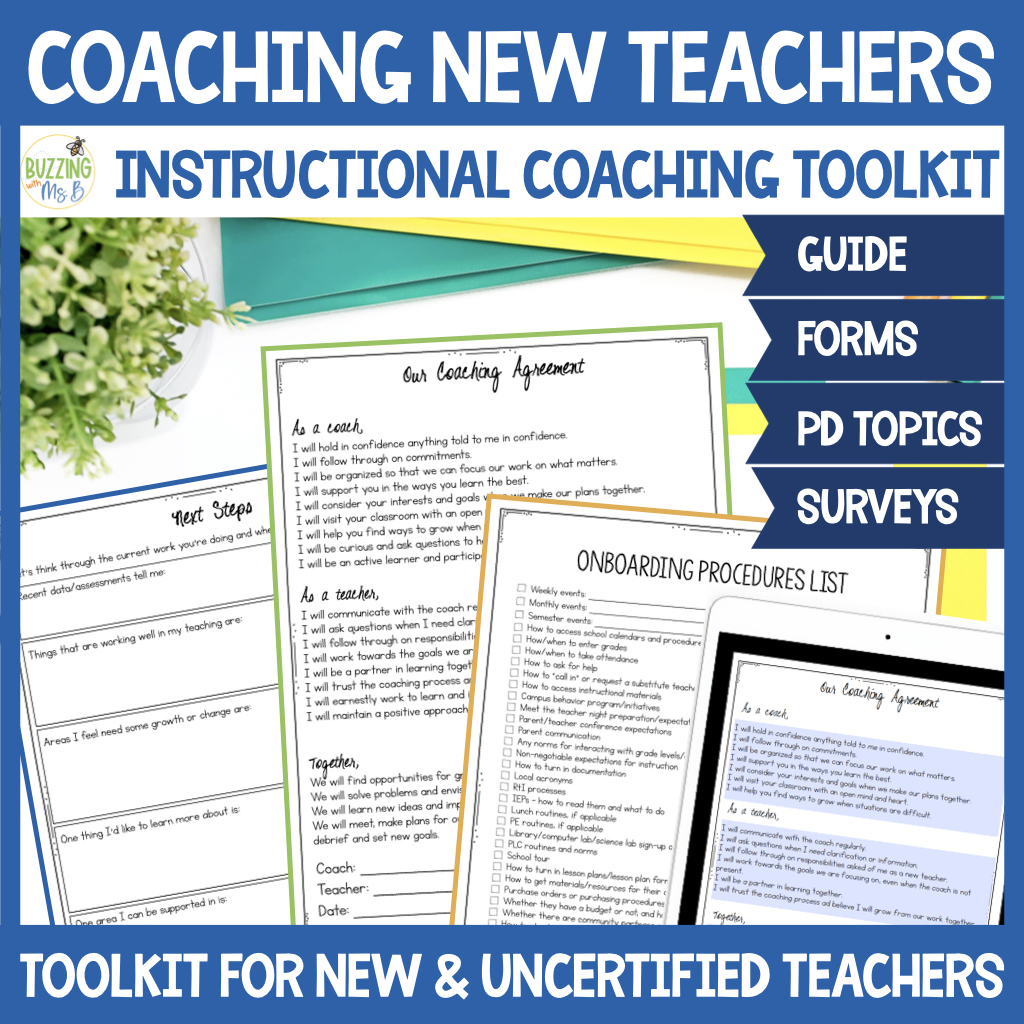
Have a plan for working with new and uncertified teachers with the Coaching New Teachers Toolkit!

It includes forms, templates, and everything you need to help your new and uncertified teachers! Figure out what support the need and provide PD and coaching with these resources. Grab the Coaching New Teachers Toolkit in my TpT Store!

⭐⭐⭐⭐⭐ “I support & coach new teachers and this resource is so valuable. I purchased it several months ago and often use tips you suggested when working with teachers. It is an essential section of my “Teacher Support Provider Binder” that I carry around with me everywhere.”
5 Key Buckets of Student Understanding

Steve says you can’t teach kids surface all year long. Based on assessment results, some of the issues could be conceptual or procedural.

He has a new book coming out with ASED, in which he identified 50 plus strategies into five key areas: surface, procedural, conceptual, reasoning, and transfer.

  • Surface builds foundational knowledge with new material and content.
  • Procedural addresses the steps students follow, like in math operations.
  • Conceptual means to be able to describe your procedural works.
  • Reasoning is where we use those reasoning skills to determine next steps and solve problems.
  • Transfer is having kids learn something in one context and apply it to a new and novel situation.

I think that such a great way to categorize the results that teachers are looking at. Sorting errors into these categories makes it much easier to figure out what the student needs in the moment.

When I work with teachers looking at assessments, we actually look  at student work because I want to see where it went wrong. Just because they circle B or C doesn’t tell you anything about their thinking. I can envision people scoring or looking at data together and then sorting questions into those different buckets so they can make decisions about their future next steps.

Benchmark Assessments

During our conversation, Steve and I discuss what makes a really good benchmark assessment and some of the limitations. Benchmarks are commonly administered at the end of instructional units or quarters to gauge student progress. They’re great for determining how well the teaching went and where the kids were proficient or not proficient.

Steve says the only issue with benchmarks is that there may not be another opportunity to go back after instruction for reteaching. He says benchmarks are more summative than formative.

One thing we touched on was the idea of building “buffer days” after benchmarks. On my campus, we gave teachers a few days after the assessments to respond quickly to the data, provide enrichment, or offer interventions.

Be ready for anything with the Instructional Coaching Editable Binder Megapack!

It includes forms, templates, and everything you need to get organized for instructional coaching! Coach teachers and document your coaching work with these printable and editable tools. Grab the Instructional Coach Binder Megapack in my TpT Store!

Looking at Data Through Different Lenses

I asked Steve to tell us about some other lenses that we can look at data through that are really supportive of teachers making decisions. He says it doesn’t have to be an assessment all the time. It could be data on the room environment, how the kids work with each other, or the way they exchange ideas. Steve says he likes to listen to the strategies the kids use to work a problem out, not just listen for their answers.

Steve highlights authentic performance assessments, where students perform, as they do in music or art. Assessments don’t have to be paper and pencil; they can be through a project or creation.

He says that assessments are the definition of equity. Every kid should be able to take an assessment, even if you have to read it to them or they need to take it orally.

An Introduction to Different Types of Assessments

I loved chatting with Steve! If I were to walk away with one thing from this conversation, it would be those five buckets that he talked about. We can use them to identify the way that students are responding to questions and what their next learning needs are. I think that could be so beneficial for you in your instructional coaching work. That’s absolutely the language that I would take and run with from this episode. I’m so glad that Steve was able to join us today.

Listen to the full episode now to learn more.

Topics and Questions Discussed in Episode 278 – An Introduction to Different Types of Assessments with Steve Ventura

  • An introduction to different types of assessments
  • How instructional coaches can support teachers in the creation of assessments
  • The difference between data and evidence
  • Five categories of student understanding
  • Benchmark assessments
  • Looking at data through different lenses

About Steve Ventura
Steve Ventura is the founder and president of Advanced Collaborative Solutions, ACS. A movement dedicated to empowering educators and students through collaboration, innovation, and impactful professional learning. With a vision of ensuring every child, regardless of background, has access to highly effective teachers and leaders, Steve provides practical, research-based strategies to drive meaningful changes in education.

Turning Insight Into Action: Practical Steps You Can Take After Listening

Here are simple actions you can take today:

1️⃣ Grab the Data Forms for Instructional Coaches and Admins

Understanding your school data is so important to school leaders and instructional coaches! These 18 different data forms will help you collect, organize, and analyze your data. Then you’ll use your data and analysis to reflect and make a plan for next steps!

2️⃣ Join the Instructional Coaching Club

The Instructional Coaching Club is an online membership designed to help instructional coaches improve instruction at their schools. It gives coaches the tools to go out and do it.

Ready to listen?

  • Ready to listen? You can listen below with the media player, or search for Buzzing with MS. B: The Coaching Podcast anywhere you listen to podcasts!

This post contains links to products from one or more of our advertisers. This means I may receive commissions for purchases made through links in this post when you click on links to those products. Thank you for your support!

Learn more

Helpful Resources


Listen on: Apple Podcasts, Spotify, or your favorite listening app


Thank you for listening to Buzzing with Ms. B: the Coaching Podcast. Want more coaching ideas

Check me out at buzzingwithmsb.com and on Instagram @buzzingwithmsb.

If you love the show, share it with a coach who would love it too, or leave me a review on iTunes! It’s free and it helps others find this show, too. Happy coaching!

Podcast produced by Fernie Ceniceros

An Introduction to Different Types of Assessments with Steve Ventura, ep. 278, Instructional Coaching with Ms. B Podcast

Chrissy Beltran [00:00:02]:

Can you remember the joy of opening up your favorite teen magazine? Getting it out of the mailbox, scouring the shiny cover for your favorite stars, sniffing the perfume samples, and taking the quiz? Well, over the years, I’ve realized that coaches are often missing out on that joy. Seeing behind the scenes of how a school works can be defeating and exhausting. Let’s bring back the spark to your coaching work. Head to instructionalcoachingclub.com to join the most fun membership for instructional coaches. You’ll get so many thematic and joyful resources to use for your own coaching work and ready to go teacher PDs too. Plus, my favorite part, the monthly bonuses truly take me back to 1997 when I was opening my own copy of 17 magazine. I cannot wait to see you in the club, instructionalcoachingclub.com. Welcome to Instructional Coaching with Misty, where we believe that every teacher deserves a coach and every coach does too. I’m Krissy Beltran, an elementary teacher who became a coach, and I had to create my own coaching program that worked. Now I teach coaches how to design their coaching programs, build a school wide action plan, and use differentiated strategies to support teachers. Plus, I’ve got a special spot in my heart for literacy coaches. Now let’s dig into the episode. Hey, coach, and welcome to Instructional Coaching with Misty. Today, we are talking about different types of assessments with Steve Ventura, the goat of assessment. I’m so excited to include this episode in my series on better assessments, better data because I think that having an understanding of the purpose of different types of assessments is going to be so helpful to you. Plus, he’s gonna share some really valuable information about what we actually do with that assessment data, and you’re gonna love it. If you are having a hard time getting your teacher to look through data with different lenses, such as subpopulations, standards, etcetera, you can grab a data bookmark freebie. It has, all the different ways we can look at data on it, and it’s free and it’s perfect for digging into data any time of the year. So if you go to buzzingwithmissb.com/dataplc, you can grab that free download. So my guest today is Steve Ventura. He’s the founder and president of Advanced Collaborative Solutions, ACS, a movement dedicated to empowering educators and students through collaboration, innovation, and impactful professional learning with a vision of ensuring every child, regardless of background, has access to highly effective teachers and leaders, Steve provides practical, research based strategies to drive meaningful change in education. So let’s welcome him to the podcast. Thank you so much for being here today, Steve. I really appreciate you making time for us.

Steve Ventura [00:02:32]:

Thanks, Chrissy. I’ve been looking forward to this.

Chrissy Beltran [00:02:35]:

Yeah. I’m glad we we figured out how to make it work. We are in a miniseries all about better assessments that give you better data. And so I’d love to kind of give an overview of assessment types today and talk a little bit about, you know, the benefits of each one, how we can support teachers in creating those assessments and also in reviewing that data more effectively. So could you give us an introduction to different types of assessments that includes the purpose?

Steve Ventura [00:03:03]:

Sure. Sure. And I’ll start off with, you know, formative assessment. I’ve heard a lot of people say, well, I’m not gonna I’m not gonna call it formative anymore. I just wanna call it during instruction. But formative assessment isn’t something we do after instruction. It is something we do during instruction. So the per the purpose is to just gather evidence on student learning, and that would be in real time, Chrissy. That way, the teachers and students can start making really good immediate adjustments that improve their learning outcomes. You know, the benchmark assessments are kind of in between, and those are good checkpoints for end of quarter, end of semester, you know, trying to gather enough information after instruction. I still think it’s a little bit more after instruction. And then our summative assessments are kind of like the autopsy report. Like, that’s it. Right. There’s no more after that. So but in in our business, what we’ve been doing mostly is just trying to get teachers to actually give assessments and then match the instructional need with the students’ needs. And then off we go.

Chrissy Beltran [00:03:58]:

Excellent. Yeah. And I think that that is that’s something that we’ve really been talking a lot, in this series is really how to ensure teachers have quick access to information about how students are doing in the moment. That formative assessment sometimes is the missing piece in in our instruction. And it’s I mean, it does happen during the lesson. It does give you immediate feedback. And if we’re waiting for something late, like a summative assessment, the learning time has passed. You know? If we’re waiting for benchmark, you’ve missed an opportunity there even though, yeah, you can adjust instruction after that. But we’re we’ve kind of missed the in the moment feedback that can help us adjust the instruction right there in that very lesson.

Steve Ventura [00:04:35]:

Perfect. Yeah. True.

Chrissy Beltran [00:04:38]:

So from there, I’d love to look about look at okay. Day to day, we’re digging into formative assessment. How can we support teachers in the creation of of formative assessment specifically? And then I’d love to talk about the others.

Steve Ventura [00:04:50]:

Yeah. Well, in the creation is I know everybody goes to artificial intelligence a lot, but I always tell people, like, learn the process

Chrissy Beltran [00:04:57]:

Yeah.

Steve Ventura [00:04:57]:

Of assessment first. Learn what a good question stem is, and learn what good distractors are. And make all your answers possible so the students just don’t get to pick something very easy. What I’m experiencing right now with some of the assessments that teachers are creating is that they can’t determine if it’s the true level of rigor based on the standard they’re assessing. So what’s happening is they are getting assessment results back on students. They’re they’re giving assessments to students that already know that information. So everything comes back, like, 90 to a 100% proficient. And what’s missing is the rigor and the challenge, and I think people are a little bit afraid to give the student at grade level assessment because, you know, the results may not be that great. Mhmm. And so I think that the design of the assessment has to be based on the current level of rigor in the standard. And I’m not saying that, you know, just because you can tell what a d o k one, two, three, or four verb is means that you you have it. I think some of the guidelines are is that d o k one, skills usually can be assessed with true, false, or multiple choice. But, like, d o k three skills, that’s more analysis. That’s more short constructive response, extended constructive response. And then DLK level four is a whole different kettle of fish because you really can’t really assess a DLK level four with matching or true false. I think people don’t really understand what kind of items go with what kind of rigor. So when we do work with our clients across the country, we give them a little cheat sheet that said these are the type of questions you ask for identify, and these are the kind of questions you ask for analyze. And we try to give them, like, a little more of a, like, a menu to pick from. Like, now at least we’re assessing at the correct level of cognitive rigor and demand, the correct level.

Chrissy Beltran [00:06:39]:

Yes. I think that’s a really good point. You know, so many times, we’re using a formative assessment, obviously, to make sure that kids are are hitting the target, right, the learning target, and so we need alignment there. But we also need that rigor in if we’re doing, like, a multiple choice or something, we need it in the answer choices because we’re using that as a as a way to see how are our kids progressing towards what they will, in the end, be held accountable for.

Steve Ventura [00:07:02]:

Right. Yeah.

Chrissy Beltran [00:07:03]:

And people need to be really familiar with that final assessment if that’s what we’re using it for, is to gauge how we’re we’re getting there.

Steve Ventura [00:07:10]:

Well and that’s it. You the evidence is only as good as the assessment. And so, you know, we’ve been spending a lot of time, Chrissy, with helping teachers understand the difference between data and evidence. And those are two different completely things. And we want our our folks to focus on the evidence that they’re getting back from those assessments so they can actually do a formative assessment cycle where they can actually adjust the instruction based on the need. You know, the more the assessment is aligned with the standard, then the teachers are more easily able to identify the need.

Chrissy Beltran [00:07:42]:

Yes.

Steve Ventura [00:07:42]:

And then that’s when things start moving really well. But sometimes if you get an assessment that’s already a 100% proficient, I don’t I don’t know how that I don’t know what the next step is. Why would you give that assessment to your

Chrissy Beltran [00:07:53]:

teacher if they

Steve Ventura [00:07:54]:

already knew that?

Chrissy Beltran [00:07:55]:

Yeah. You know? Right.

Steve Ventura [00:07:56]:

And that’s what’s happening. I think teachers are struggling trying to figure out, well, where are they? So they tend to give a little bit lower, not because they’re bad people. They just they’re not quite sure how rigorous those items should be.

Chrissy Beltran [00:08:08]:

Yeah. I think it’s a a sense of safety. Sometimes they’re a little nervous about it. Like, oh, well, they’re not ready for that. Right? And the thing is that one of the benefits of formative assessment is that because it happens during the lesson, kids are practicing retrieving that information, and that’s how we know they move that into long term memory. Right? If they don’t have that retrieval practice, they’re not really gonna learn it. And so if they’re not practicing thinking at those levels and retrieving that information and combining it and, you know, all the thought processes we know, then they’re not really solidifying that learning at deeper levels either.

Steve Ventura [00:08:40]:

I agree a 100%. Because I think the goal is not to collect grades, but is to collect the next steps

Chrissy Beltran [00:08:45]:

Yes.

Steve Ventura [00:08:46]:

And see what we’re we’re gonna be doing there. No. I mean, I I’m I’ve learned so much about formative evaluation and assessment, you know, through Visible Learning and some other colleagues like Larry Ainsworth. But what I see is the the research is pretty solid about the assessment, but the transport application still seems to struggle a little bit.

Chrissy Beltran [00:09:04]:

Mhmm.

Steve Ventura [00:09:04]:

And so when we get a chance to help people, you know, decide what kind of items would be the best for this type of, standard or learning target, then the evidence is truly accurate, and then we can make really good inferences about where the students are. You know, those assessments are really an assessment of our practice. So we have to understand that the results we get from the assessment should be more the instructional effort than the students’ effort, and that’s how we should look at the some of those results. So Mhmm.

Chrissy Beltran [00:09:35]:

So you mentioned you talked a little bit about the difference between data and evidence. Can you talk a little more about that?

Steve Ventura [00:09:40]:

Yeah. I think when we we we’re we had a lot of data. You know that. You’ve been around. So I I mean, I used when I was a new administrator, like, data was everything. Mhmm. But data didn’t, in itself, help us decide what the prescription was. The data was organized by attendance, by behavior, by testing. And that was all going into, you know, red, yellow, you know, green, and blue.

Chrissy Beltran [00:10:03]:

Pocket charts or whatever. Yeah. Index cards. Yeah.

Steve Ventura [00:10:06]:

Yeah. But what what we see with the evidence piece is more about a root cause. Like, well, what happened before the data came out? Like, can we identify the antecedents that took place before we actually got it? So we have the data, but the evidence is what we’re looking for.

Chrissy Beltran [00:10:21]:

Yeah.

Steve Ventura [00:10:22]:

And, you know, in in our business, we do, like, fishbone diagrams. We try to help people and teachers understand, like, what was the cause for only twenty four percent of your students being proficient

Chrissy Beltran [00:10:31]:

on Mhmm.

Steve Ventura [00:10:32]:

You know, informational text. Once we have that conversation, then the data is very helpful. But if you don’t if you can’t actually use that information, then to make those connections, and it seems like the two are completely separate. So Yeah. I I think the evidence pieces can we identify what took place before those results. That’s when the conversation really comes alive.

Chrissy Beltran [00:10:55]:

I love that. That’s something I refer to as the context around the data. Like, you can you can look at, you know, seventy five percent failing on a math test or on even a specific question. But if you don’t know why they did that, if you don’t know what the teaching was and what the kids did in that moment and what it looked like, then you really don’t know why they didn’t do well in that area. We have to have context.

Steve Ventura [00:11:16]:

And then you start guessing with intervention and strategies and meetings, and you never really get a chance. Meetings, and we never really get a chance to hit the target. So Yes. I think it’s really important that we distinguish data and evidence for

Chrissy Beltran [00:11:27]:

sure. Yes. That’s such a good point. Yes. I love that. I mean, how many times are math problems on a math test issues that kids have had actually reading issues? They’re not math issues at all. And if we’re saying, oh, well, they don’t understand fractions. They may or may not understand fractions, but they maybe didn’t understand the whole word problem that was set up to where they even didn’t even know they were intended to use fractions.

Steve Ventura [00:11:48]:

Exactly. Exactly. Mhmm. I was I was gonna add one thing too about, you know, just the, the results, the, the evidence. What I’m you know, what we’re seeing is the better the evidence, then the the better the teachers can identify. Like, okay. Is that a surface level need, or is it conceptual, or do you need procedural strategies or maybe reasoning or even transfer strategies? So we’re trying to help teachers decide, like, well, what would be the intervention based on the evidence?

Chrissy Beltran [00:12:16]:

Mhmm.

Steve Ventura [00:12:17]:

And, you know, service is foundational. It’s not superficial, but you can’t teach a kid service all year long.

Chrissy Beltran [00:12:22]:

Right.

Steve Ventura [00:12:22]:

So we want, people to understand that based on those assessment results, some of the issues could be conceptual or procedural, and then those are a whole another set of instructional strategies, not just low level recall memorization.

Chrissy Beltran [00:12:36]:

Would you dig into those a little bit more so so listeners have, like, a really clear framework for what that looks like? You mentioned transfer, conceptual, you know, particular.

Steve Ventura [00:12:44]:

Yeah. And I’ll give you the background because we have another book coming out with ASCD. And so what we were trying to identify is, you know, 50 plus strategies that we identified and divided them up by these five areas. Like, so what’s a surface level strategy, and what does that involve? And surface level, again, is building foundation. Right? The this is new material, new content. The students may not have ever seen it. But then procedural is, like like in math, Chrissy. I mean, kids know the order of operations, and procedurally, they need the next steps. Like, how do we do this? Yes. Then conceptually, it means to be able to describe your procedural works. Like, well, what were the concepts from us doing a certain formula or steps? And then I think where we get deeper now is to show kids how to reason more and use those reasoning skills to determine next steps. And then transfer, Chrissy, is having kids learn something in one context and apply it to a new and novel situation. So they’ll say, wait a second. That strategy in science actually worked in math today. And so we want kids to be able to transfer their learning to other places. So, again, we start off, like, with surface, you know, conceptual procedural reasoning and then transfer. And then the teachers, based on the pre assessment, should be able to tell exactly not exactly. But, you know, here’s a hint of where we might come in with, the strategies to close the gap, and then maybe there’s a post assessment or something like that. Yeah.

Chrissy Beltran [00:14:13]:

Yeah. I love that. I think that is, such a great way to categorize the results that people are looking at is you know, whenever I work with teachers and looking at assessments, whether those are common assessments or, you know, more of a benchmark or something like that or, shorter assessments, like formative assessments, we’ll we actually look at the student work because I wanna see where it went wrong. And you can’t tell what they did with by because they circled letter b or c. You know? It doesn’t tell you anything about their thinking. So if you can look at their work, you can see, oh, they didn’t like, conceptually, they had they didn’t know where to start here. They were misunderstanding what the question was even asking them to do. Or procedurally, like you said, they just don’t understand the algorithm or they don’t understand, you know, next steps. Yeah. I’d love that. I I could see I can envision people, like, scoring looking at data together and then sorting questions into those different categories so they can make some decisions about their their future next steps. I love that.

Steve Ventura [00:15:06]:

It’s really helped with some of the folks that we’re working with, and I think that, you know, not everything has to transfer, but that’s, like, that’s the teacher’s, like, the the best time of their life when they see kids Yeah. See, wait a second. That can go over there.

Chrissy Beltran [00:15:20]:

Yes.

Steve Ventura [00:15:20]:

And they can carry over that that information and apply it to something that’s novel. And so all those strategies are built to try to get them there, but they’re already based on assessment results first. So, I mean, you can’t teach a kid transfer if they don’t have surface. So you have to understand, like, where are they, and then we start, like, filling in and scaffolding. I think sometimes, Chrissy, we hear on some of the assessment results or the work we do that that teachers say, you know, these are all really good, but my kids are not at grade level. They just can’t do that. Mhmm. And I want people to kinda reframe that and say, listen. There’s a better way to say that, and probably it would sound like this. All kids are capable of learning. We just need to find the starting point for them and start, you know, scaffolding up.

Chrissy Beltran [00:16:05]:

Yes.

Steve Ventura [00:16:06]:

And I think that’s a better way to say, my kids will never be able to do that. It’s kind of like almost a fixed mindset. And I think, well, you gotta find out where they’re at, but then you can start progressing up and see what happens. So a lot of that can come from really good, assessment, really good assessments where kids get another opportunity to get feedback from that assessment and then try it again.

Chrissy Beltran [00:16:25]:

So you mentioned a little bit about, benchmark assessments. Can you help us understand what makes a really good benchmark assessment?

Steve Ventura [00:16:32]:

Well, I think a benchmark is really like for me, when I remember when I was a principal, our district gave benchmarks every quarter. So four Mhmm. Four benchmarks a year. And, normally, they were assessing the units that were that were taught during that that quarter or that unit. And I think benchmarks are a great check midyear to find out where kids are. The only issue with the benchmarks is there may not be another opportunity to go back. They’re a little bit after instruction as well, and so there’s not a lot to go back and do. They’re great pieces of data to share and find out where the progress is being made. But I think benchmarks are more summative than formative. Although Although if you give four benchmarks a year, a lot of people say, well, those are all formative. But I still think that we’re kind of on the fence, sir. I think the I think a benchmark assessment is really designed to to to assess the students’ knowledge after a unit of study. Yeah. Benchmarks usually don’t happen during instruction. They usually are after that that unit, and and they’re very good pieces of information. I would never say not do a benchmark. Mhmm. But those are some of the issues that I see with benchmarks. I just think that they’re great to determine how well all that teaching went and then, you know, where the kids were proficient or not proficient. But it doesn’t seem like you get a chance to go back and intervene, though, many times because we’re on to the next quarter or unit. Yes. So they’re a little more I don’t know. I I just think they’re a little more summative than than, than formative, but they’re done after teaching most of the time I’ve observed them.

Chrissy Beltran [00:18:02]:

Yeah. I agree.

Steve Ventura [00:18:03]:

And I did it in my school too. We did it that way. We just that was it. You just gave a benchmark.

Chrissy Beltran [00:18:08]:

Yeah. You finished your unit on poetry, and so then you gave your poetry assessment. And it looked a lot like your end of your assessment, but it was just that one little piece of it. And then and maybe you could get kids in tutoring after that. You could, like so that’s kind of how we would use that information, but the

Steve Ventura [00:18:21]:

to do.

Chrissy Beltran [00:18:22]:

Math right instruction is you’re right. It’s gone. Like, that’s you’re now you’re on to drama. Right? You’re not going back whole class wide to do poetry again, unless you explicitly built in some time. And one year, I actually did a couple years, in working as an instructional coach out of school. We did build in a few days after an assessment because teachers could get immediate data from their assessments, you know, with our our online system. So they scanned in their bubble sheets, and then they got immediate data back as far as numbers go. And then they could could build in the next few days specifically for responding to that data. And it was tricky. It was a little it was like, you had to be very quick. You know what I mean? Yeah. To sort kids, and, I mean, the turnaround had to be fast. But that was helpful, but it was really only a couple of days even then.

Steve Ventura [00:19:06]:

You know? But those are I I call those, like, buffer days. So let’s say you they say you end your your benchmark one week before the end of the Mhmm. Quarter, then it’s exactly what you said, then you have five more days to react to that information

Chrissy Beltran [00:19:21]:

Yes.

Steve Ventura [00:19:21]:

And try to buffer it out before the new quarter comes. Because it just it’s such a a a very, cyclic, you know, situation where you you end, but it wouldn’t be great to give the benchmark at the very last day of the unit. I think I like your idea. That’s what we propose too. Like, maybe ten days before the end of the unit, there’s the last benchmark. Seven or eight days where teachers have time to buffer, and then come in with some interventions or even some enhanced strategies for kids who already get it. So there has to be, you know, some challenge as well. Many students will do really well on the on those benchmarks, but then at least it gives them three or four days of buffer. I think it’s better than just ending it and saying, you didn’t learn it, and we’re moving on.

Chrissy Beltran [00:20:05]:

Yeah. It’s over. Yeah. I agree. And then you can differentiate for those kids to do really well. Like you said, you can give them something more engaging and and challenging and maybe transfer activities, application to do, while you work with those kids who need that intervention in those areas. So that’s one way we did that. I love that. So then, in terms of looking at data together, you mentioned, like, analyzing really questions and and errors, really looking at an error analysis and figuring out where kids are going wrong, right, and into these five different buckets. What are some other lenses that we can look at data through that are really supportive of teachers making decisions?

Steve Ventura [00:20:42]:

I think there’s we could collect data on room environment, on the where how the kids work with each other. Doesn’t have to be an assessment all the time. Mhmm. It could be, the way they collaborate with each other, the way they exchange ideas. I mean, a lot of times, I like to listen to kids just talk about the strategies they use to work a problem out. I may not be listening for the right answer, but I am listening for the strategies they use to do that. And then, of course, we’re the safety net. We would come in and say, okay. That’s pretty good. But I think I mean, some of the items the opportunity we have to look at other areas to assess don’t necessarily have to be paper pencil. I think they could be authentic performance assessments. We can have students, you know, actually, you know, perform their I mean, like we do in music and three-dimensional art where they actually demonstrate their proficiency through a project or a creation. I also think that, you know, we’ve had, some people say, hey. My students can’t even read the assessment. Should they take it? And I always say, you know, I mean, to me, assessments is the definition of equity. Like, Like, every kid should be able to take an assessment even if you have to read it to them. But I wouldn’t just say if they can’t take it because they can’t read. I would say, you know, we can actually give the assessment orally too, and that’s great information too. That’s another set of data that we can look at as well. But we’ve had people, you know, just wondering if they should assess kids who can’t read at grade level yet, and I just don’t think it’s fair if we don’t.

Chrissy Beltran [00:22:11]:

Yeah. Well, because what are you looking for? Are you assessing if you’re assessing reading ability at grade level, that’s one thing. Right? But if you’re assessing whether they can, you know, explain scientific concepts and label a diagram, then they can do that orally, and you would know if they have that knowledge.

Steve Ventura [00:22:26]:

Definitely. They can talk about concepts and skills. Yeah. They can’t read them about them. They still might be able to articulate those out. So there’s a lot of different ways to collect data. And I think, like, when I when we work with physical education teams and some of our, fine arts, they don’t typically do paper pencil assessments. They, you know, they they

Chrissy Beltran [00:22:46]:

get,

Steve Ventura [00:22:47]:

segmented lessons, and then they get a lot of feedback. And then, of course, the performance is based on the a rubric. So it doesn’t always have to have them, you know, write, you know, pay paper, pencil, or or electronic. Lots of great datasets out there.

Chrissy Beltran [00:23:02]:

Yeah. Well, thank you so much. Steve, this was this flew by. It’s already been twenty minutes.

Steve Ventura [00:23:07]:

Yeah.

Chrissy Beltran [00:23:07]:

And we talked about so many things. I keep it here. How can people keep learning from you if, if they want to, learn more or follow-up on any of this?

Steve Ventura [00:23:16]:

They can just go to our website. It’s just steveventura.com. And there’s a ton of free resources there, so people can just kinda hit the resource button and kinda see, some other additional ways to continue to improve assessment and, evidence. So, yeah, they can do that, and, that’s the best place to find me. Then I’m on, like, all social, like LinkedIn and Instagram and Facebook, all those areas. But the website would be a great place to start just to kinda take a look at what we have there.

Chrissy Beltran [00:23:43]:

Okay. That’s awesome. Thank you so much for being here.

Steve Ventura [00:23:45]:

Yeah. Oh, my pleasure. This was great. Thank you for being so flexible.

Chrissy Beltran [00:23:50]:

Oh, sure. We we got it. We figured it

Steve Ventura [00:23:53]:

out. Yeah.

Chrissy Beltran [00:23:54]:

That was so great. I love chatting with Steve. And if I were to walk away with one thing from this conversation, probably my favorite part would be those five buckets that he talked about where we can, you know, identify, the way that students are responding to questions and what their needs are next. I love that. I think that could be so beneficial for you in in your instructional coaching work, and that’s absolutely the language that I would take and run with from this episode. I’m so glad that he was able to join us today. Next week, we are continuing our series about better assessments, better data with a conversation with Glenn Pearsall, and he actually talks about, a more formative assessment strategies, but it’s, like, very specific strategies you can try out, which I love. Super actionable. And until then, happy coaching. Now that you’ve got so much to think about, head over to buzzingwithmissb.com to grab some free downloads, podcast show notes. Happy coaching!

Share:

Similar Posts

Leave a Reply

Your email address will not be published. Required fields are marked *