| | | |

How to Include Special Education Teachers in PLC and Team Meetings with Julie A. Schmidt, ep. 267
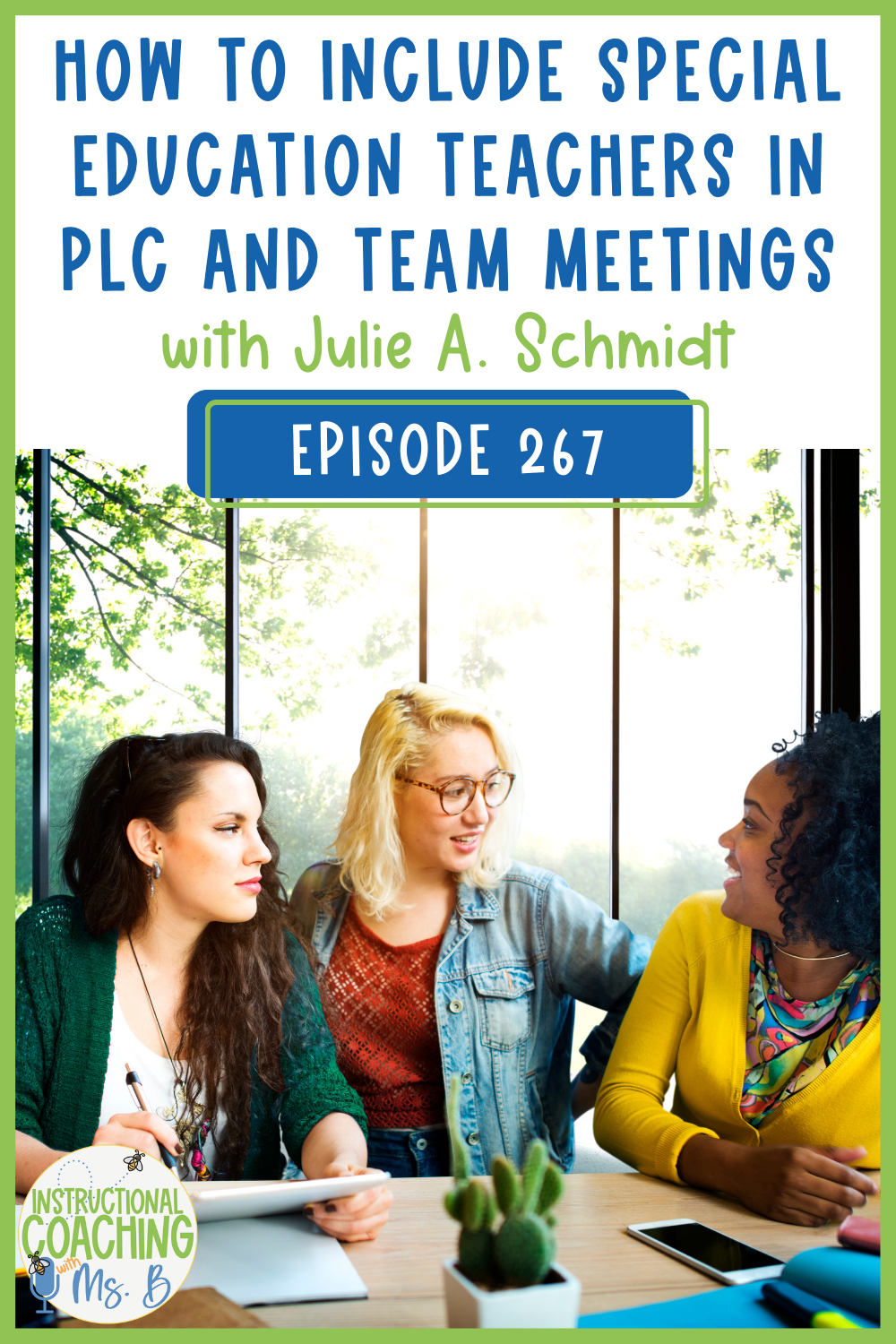
3 teachers sitting together smiling at each other. These words are at the top "Episode 267 - How to Include Special Education Teachers in PLC and Team Meetings with Julie A. Schmidt".

No matter where you coach, you’ve probably noticed that special education teachers are often left out of PLCs and team meetings, despite their important role.

They rarely have the same schedule as the rest of the team, and finding meaningful time to collaborate with general education teachers is a constant challenge.

So, what can you do about it?

In this episode, author Julie A. Schmidt joins me to talk about how to include special education teachers in PLC and team meetings. We explore why they are often left out, reasons to include them, and why closing the gap can’t rest solely on their shoulders.

Julie gives actionable tips for aligning your school’s mission statement with daily practices and actions. She shares strategies for designing a master schedule and explains what a PLC meeting can look like when special education teachers are in the room.

You’ll learn how to build collaborative teams that include ALL teachers and improve outcomes for ALL students! You won’t want to miss this conversation!

Make sure you listen to the full episode for all the details. Here are a few highlights!

Aligning Beliefs to Daily Practices and Actions

To start things off, Julie says we need to continually examine the alignment between what we believe with our day-to-day actions, policies, procedures, and behaviors. The school’s mission statement was not meant to be stuck on the wall and never looked at again, but so often that’s exactly what happens!

She explains that the work to close the gap for students cannot rest solely on the special educator. Instead, there must be collective ownership for all kids. This requires a cultural mindset shift to bring actions into alignment with the school’s mission.

Structures and Processes to Ensure Collaboration Between General and Special Education Teachers

Collaboration among educators must be a fundamental priority for school leaders and built into the master schedule. Julie suggests intentionally creating your school’s master schedule to maximize the possibility that special education teachers can be a part of collaborative team meetings.

This may be challenging since some teachers span grade levels, subjects, and even school buildings. The schedule may not be perfect on the first try, but you’re looking for progress, not perfection.

Once you have your schedule done, it’s time for the second part, prioritizing what teachers should be focusing on in these collaborative conversations. Julie tells us that structuring for collaboration and getting clear about what teachers should be collaborating about was a game changer.

Looking for PLC Resources to Grow Your Teacher Teams?

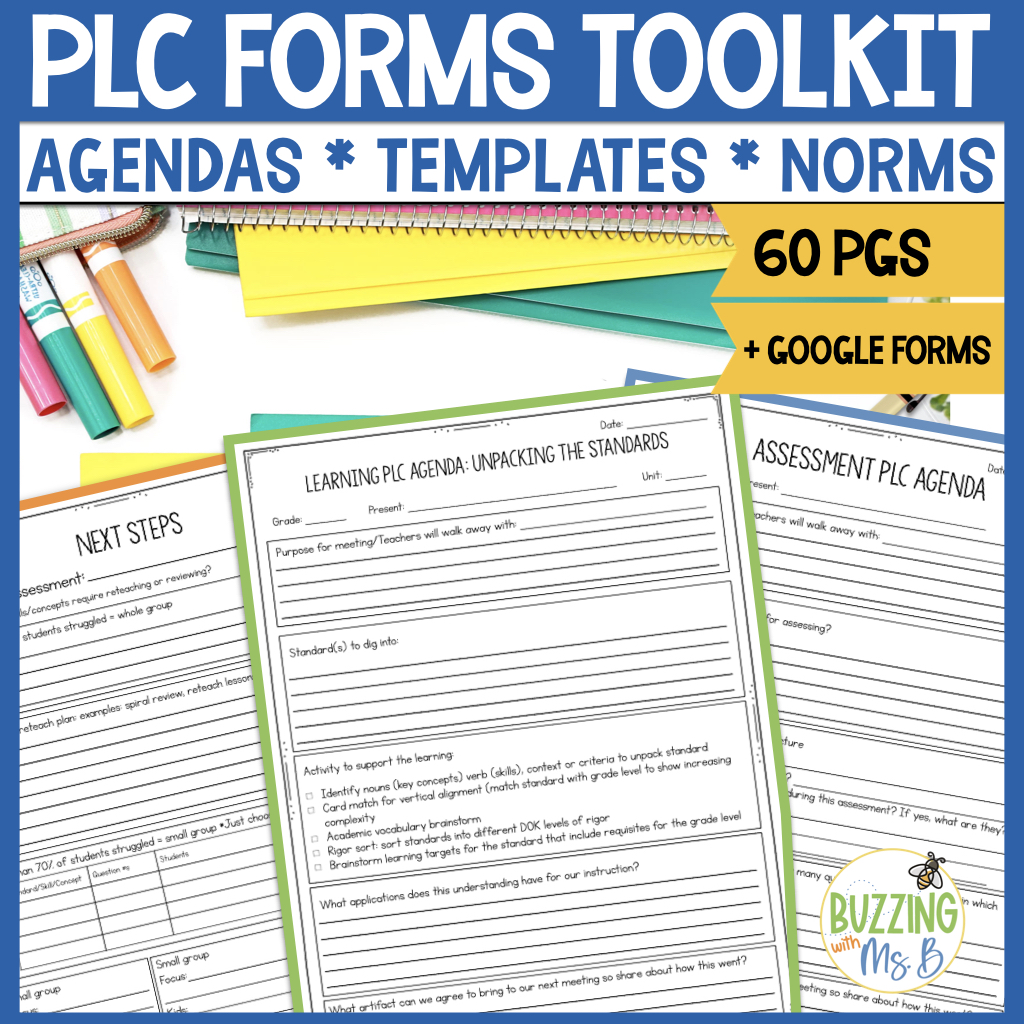
Grab the Instructional Coach PLC Binder Bundle: Norms, Meeting Agenda, Forms & Templates in my TpT Store! It has everything you need to establish purposeful, effective PLCs.
She says what they found was that when teachers were spending time around the table together, special educators were involved in conversations around deeply understanding content standards. Things like what the essentials were, what proficiency looks like, and what the most complex pieces of the standards were. This helped them build self-efficacy.

On the other side, general education teachers started to build out their toolbox for how to scaffold and support, not just students with disabilities, but every kid. The accommodations, scaffolding strategies, and differentiations benefited all students.

Prioritizing High-Leverage Collaboration

I asked Julie to tell me what it looks like to facilitate a meeting when general and special education teachers are collaborating as a team. She said there are several protocols she likes to take her teams through.

In the episode, she offers two high-leverage collaboration meeting recommendations. These are meetings that both general and special education teachers should attend together.

1️⃣ Pre-Unit Planning

This meeting is a walkthrough of the upcoming unit.

The pre-unit protocol:

  • Decide priorities
  • Identify essential standards and what proficiency looks like
  • Anticipate where students will struggle and where they will likely do best
  • Plan scaffolds, accommodations, and extensions to differentiate instruction
  • Use tech tools to help make complex concepts accessible for all

Julie points out that planning this way benefits all learners, not just students with IEPs!

2️⃣ Mid-Unit Data Review

The other high-leverage recommendation is the mid-unit data review. In the middle of the unit, teachers come together to look at data and plan collective interventions based on it.

How to Include Special Education Teachers in PLC and Team Meetings

Why and how to include special education teachers in PLC and team meetings is an area that does not get enough attention!  So often, special education teachers find themselves on the sidelines when it comes to team meetings, but there are things school leaders can do to ensure they have a seat at the table!

In this episode, Julie gives us practical strategies for how to include special education teachers in PLC and team meetings. I loved that this conversation flowed so naturally, and I know you’ll get a lot out of it. Be sure to listen using the player below or wherever you listen to podcasts.

Topics and Questions Discussed in Episode 267 – How to Include Special Education Teachers in PLC and Team Meetings with Julie A. Schmidt

  • How to include special education teachers in PLC and team meetings
  • Why special education teachers are often left out of PLCs and the reasons we need to include them
  • Collective ownership for all students’ success: Why closing gaps isn’t only the special education teacher’s job
  • Addressing the realities of school schedules
  • Aligning your school’s mission statement with daily practices and actions
  • Strategies for structuring master schedules that allow special and general educators to have common planning time
  • Moving beyond “one teach, one assist” to true co-teaching and co-planning
  • Prioritizing which meetings special education teachers will attend
  • Pre-unit planning with the whole team
  • Reviewing assessment data and making collective intervention decisions
  • Using technology, scaffolding, and other tools to support all learners
  • How ongoing collaboration leads to improved outcomes for all kids, not just those with IEPs
  • Tips for facilitating high-functioning collaborative meetings

Turning Insight Into Action: Practical Steps You Can Take After Listening

Here are three simple actions you can take right now to help align your teacher teams:

1️⃣ Grab PLC Resources in my TpT Store

You’ll find PLC meeting resources in my TpT Store! Head over and search for “Buzzing with Ms. B PLC forms”. You’ll find so many PLC meeting templates, organizers, and more that will help you grow your teacher teams!

2️⃣ Download Your Free PLC Discussion Dice

When teachers are part of PLC meetings for the first few times, it’s difficult to get the ball rolling. I’ve got a free download you’ll love! PLC Discussion Dice are easy to use with teachers, help you focus on the topic at hand, and encourage participation from each teacher.

Enter your email below to get your FREE PLC Discussion Dice!

3️⃣ Get PLC Forms for Reviewing Data and Planning Next Steps

One of the things Julie suggested is a mid-unit data review. During the review, teachers look at data together. This helps teachers identify gaps and figure out what to do next. You can get PLC Forms for Reviewing Data and Planning Next Steps here!

About Julie A. Schmidt
Julie A. Schmidt is the author of Yes We Can and All Means All. She has been an educator for 35 years. Her career began as a school psychologist, and she has served in administrative roles, both at the elementary and secondary levels. She recently retired after 13 years as superintendent of CCSD 96 in the suburbs of Chicago. She works with schools internationally on the implementation of professional learning communities practices and even more specifically on strategies to close the gap between all students and students entitled to special education services.

Ready to listen?

  • Ready to listen? You can listen below with the media player, or search for Buzzing with MS. B: The Coaching Podcast anywhere you listen to podcasts!

This post contains links to products from one or more of our advertisers. This means I may receive commissions for purchases made through links in this post when you click on links to those products. Thank you for your support!

Learn more

Helpful Resources


Listen on: Apple Podcasts, Spotify, or your favorite listening app

Thank you for listening to Buzzing with Ms. B: the Coaching Podcast. Want more coaching ideas

Check me out at buzzingwithmsb.com and on Instagram @buzzingwithmsb.

If you love the show, share it with a coach who would love it too, or leave me a review on iTunes! It’s free and it helps others find this show, too. Happy coaching!

Podcast produced by Fernie Ceniceros

How to Include Special Education Teachers in PLC and Team Meetings with Julie A. Schmidt, ep. 267, Instructional Coaching with Ms. B Podcast

Chrissy Beltran [00:00:06]:

Hey, coach, and welcome to instructional coaching with miss b. Today, we are talking about a topic that is in our mini series about PLCs and coaching teams of teachers. We’re really gonna dig into this idea that does not get near enough attention, how and why to include special education teachers in team meetings. If you have been teaching for any length of time or coaching for any length of time, you probably have seen firsthand how little time special education teachers tend to spend with general education teachers talking about the work. And this is such a foundational issue that we have in our schools. It’s a structural problem, a logistical problem, and also a philosophical problem. Because if we don’t think something is important, we’re not gonna try to figure it out. So I’m really excited to share this with you. Before we get the ball rolling here, I wanna talk to you a little bit about a free download I’ve got for you. When teachers are part of PLC meetings for the first few times and maybe they haven’t been in those meetings before, it can be really difficult to help people really communicate. I have a free download to help you with this. The PLC discussion guides are easy to use with teachers, and they help you focus on the topic at hand. They encourage participation in each teacher with a specific sentence starter about a specific topic, and you can grab this in the show notes for episode two sixty seven by going to buzzingwithmissb.com/episode26seven. My guest today is Julie Schmidt, and Julie Schmidt is the author of Yes We Can and All Means All. There are two other authors who were gonna join me today, but you know what? They work in the school system, working with schools, and you know how that goes. Whenever you are working with a school, you don’t always get to control every minute of your day. So they were unable to join me, but Julie did, and I’m so glad that she did. She has been an educator for thirty five years. Her career began as a school psychologist, and she served in administrative roles both at the elementary and secondary levels. She recently retired after thirteen years as superintendent of schools that in District 96 in the suburbs of Chicago. She works with schools internationally on the implementation of professional learning communities, practices even more specifically on strategies to close the gap between all students and students entitled to special education students. She’s a perfect fit for this topic, and I can’t wait to welcome her. So let’s welcome the authors of Yes We Can to the podcast. Welcome.

Julie Schmidt [00:02:21]:

Hi. Thank you. Thank you so much for having us. We’re really excited.

Chrissy Beltran [00:02:24]:

I am really excited to talk about this topic because I feel like it is often neglected whenever we roll out, you know, PLC communities, you know, at schools, whenever we start talking about PLC meetings. So many times, we are not thinking about so many of the teachers that provide those necessary interventions for kids and supports for kids in the classroom. And having been a classroom teacher who had one year I did a, a co teaching model. I had, about half of the students in my class were in special ed program, and finding the time to work with my counterpart was so challenging because logistically, our schools are not set up to support this. You know? So I’m really excited to dig in this. I know you’re gonna have a lot of unique perspective on it, and I wanna start with understanding the idea of what a PLC meeting can look like when special education teachers are really truly part of the team.

Julie Schmidt [00:03:14]:

Yeah. So so that’s it’s great that you bring that up because, the impetus of our work, we at the time that we originally wrote our first, book around collaborative practices between general and special education in a professional learning community, Yes We Can was published in 2016. And the reason that we wrote Yes We Can was was aligned exactly to what it is that you’re describing. What we found was we had begun our PLC journey and we’re knee deep into identifying essential standards and developing a robust and balanced, you know, cycle of assessment. All of those things. And and what happened was we started to see the gaps between all kids and students entitled to special education services. We started to see that gap close. Now on the other end of the continuum, we also started to see, higher and higher percentages of students being extended and enriched. Right? So all this was happening at the same time. And while it wasn’t why we started the PLC journey, we really started to see outcomes for kids improve, right, across the board. So we wanted to memorialize the practices we thought we made a different that made a difference. Right? So so one of the the there’s six cores to the work that we do. And the first one is, and it acts as a barrier if it’s not addressed. The first one was you we have to continually examine, right, an alignment between what we say we believe in in our schools and in our systems and our day to day actions, policies, procedures, right, behaviors. Right? If we say we believe, right, our mission is for all kids to learn at high levels, how are we defining all? And how are we defining high levels? Right? And we define high levels of grade level proficiency or greater and all truly means all. Now, we all know there are are a small, very small percentage of kids in our schools, who have very complex needs, right? And so so that is that that is the only time when we modify, exposing to and making progress toward grade level standards. So so the very first thing we learned is that the work to close the gap for kids cannot rest solely on the shoulders of special educators. There has to be collective ownership, right, collective ownership for the learning of all kids. So so what we were finding is when we were doing PLC institutes or we were visiting with schools, we would say, so those of you in the in the room who are special educators, raise your hand. Mhmm. And historically, there were none because they weren’t being invited to the table. And we would get questions all the time like, well, what does special ed have to do with PLCs? Wow. And we we realized that we have to be more explicit about it. And we also realized that we needed to make sure that our work couldn’t be construed in a way to infer that closing the gap rests solely or could even is even possible solely on the shoulders of special education. There’s no longitudinal data to support that that can happen. Right? So it’s examining that. Then then the second one is really looking at both the structures and the processes to ensure that general and special educators collaborate together. Right? So so so making sure that special educators who support grade level teams or content teams are a part of those collaborative team structures. Now we also recognize that depending on resources, depending on a lot of things, it may not be possible for special educators to be at every single collaborative team meeting. But how do you structure your master schedule in a way that that that maximizes that possibility and you’re thoughtful about that before you finalize the master schedule. How do we put people together? Right? So part of what you’re describing with the co teaching model, that service delivery model, it can be very high leverage. But not if you live in the one teach, one assist where one person’s actually teaching and a special ed teacher is acting as a glorified aid. Right? So how do you structure, your collaboration in a way that gives general and special educators access to each other, right, to collaborate around teaching and learning? So what we found is that when when they were spending time around the table together, for the first time, special educators were involved in conversations around really deeply beginning to understand content standards. What the essentials were, what proficiency actually looked like, what the most complex pieces of those standards were, all of those things, right, which helped to build the self efficacy of

Julie Schmidt [00:07:55]:

special educators. The other side of the table, general educators started to build out their toolbox related to how to scaffold and support, not just students with disabilities, but all kids. Right? How how to do those kinds of things because I think we we probably agree that that really good scaffolding strategies and and all of those kinds of, you know, differentiation, they’re good for all kids. They’re not just good for for special education entitled kids. So, you know, even things like accommodations. Right? Graphic organizers. Aren’t they good for all kids? Right? So so by structuring for collaboration, but also getting really clear about what general and special ed educators should be collaborating about was a game changer for us. Right? So giving them access to each other and being really clear on what the high leverage collaboration folk, topics were. So for instance, we always advocate very strongly for movement towards in a professional learning community, pre unit planning.

Chrissy Beltran [00:08:59]:

Mhmm.

Julie Schmidt [00:08:59]:

Right? So seven seven to ten days before a unit. And if people say, well, how do you prioritize if special educators can’t join every meeting? Our very first response is prioritize pre unit planning. Right? So let’s look at the next the upcoming unit. What are the essentials being taught in that unit? So what what would proficiency look like? How might we assess? And then they get to the really the really high leverage conversation knowing our kids the way we know them, where would we predict they might struggle? Before you even head into the unit of instruction, let’s predict where they might struggle and let’s build into our initial instruction some scaffolds and ways to address where we know kids are gonna struggle. Right? And and even predict where where are we gonna have students who are proficient before it’s time to move on and we need to really think about extending them. So so really, really pushing leadership to be cognizant of how you structure your master schedule in ways that put people together and give them access to each other. But then the second prong, when you do give them access to each other, how do you prioritize what they should be focusing on in those collaborative conversations?

Chrissy Beltran [00:10:07]:

I love all of this because it so accurately describes the experience that I’ve had as a classroom teacher and as a support person trying to support, you know, special ed teachers in working with general ed teachers. Right. So it’s it’s clear that this is you know, regardless of where you work, you’ve probably seen some elements of this where where special education teachers logistically do not fit into the rest of the the schedule that everybody else has, or they do, but maybe with, like, one grade level. And that was a real challenge that we’ve had many of them serve multiple grade level ranges Yeah. Different content areas, and their schedule is so all over the place. They have twenty minutes here, thirty minutes there. And so making a priority for these teachers to be part of these conversations is so important, and I think it takes a real adjustment on on, obviously, you know, administration. They have to see things differently. But even the classroom and general ed teachers have to see things differently as well Absolutely. In order to be like, okay. This is what we’re gonna get out of this. This is why I’m here as part of this meeting.

Julie Schmidt [00:11:08]:

Right. Right. And so and so when you think about master schedule building, I feel like one of the mistakes we’ve historically made and I’ve I’ve I’ve been in positions where I’ve had to build master schedules high school, middle school, elementary school, is oftentimes what happens is a couple people kinda hunker down, you know, and do the work of building a master schedule. And after the master schedule is built, then we try to jam all the complexities into the master schedule. Yeah. Rather than first, you know, developing a process that really ensures everyone understands the complexities. Right? So more of a collaborative process. So that I mean, it’s not possible for one or two people to understand all the domino effects of moving things around in the master schedule. So how do we really get a handle on what our complexities are? Some you may have staff that travel for, you know, different buildings like related services folks, that kind of thing. But but how do we understand the complexities? How do we consider those complexities first and then build a master schedule around it? Now does that mean that that that you’ll be able to, you know, address every complexity? And we like to describe that process not all of this work really. It’s not an on off switch when you think of a light switch. It’s really more of a dimmer switch. Right? Like, how do you how do you make one improvement to give people more access? Okay. How did that go? And it’s it’s more of a continuous cycle of a a of considering, you know, a dimmer switch. So is it perfect? No. But how do we take the first next step in giving people more access to each other and getting clearer on how to prioritize? Also recognizing when you talk about those cultural pieces, this can’t be the sole responsibility of the special educator running around trying with a, you know, like a chicken with a head cut off trying to figure out who do I need to touch base with and planning on the fly. Right? All those things. That’s not high leverage. Right? So how do we get more intentional? How do we structure for it? And and ensure we’re focusing on the right things.

Chrissy Beltran [00:12:56]:

I love that.

Julie Schmidt [00:12:57]:

So, yes, let the so when whenever we do this work and we do three day institutes, we do two day workshops, it is only powerful if you come with a team that represents special educator, general educators, leaders. Right? Because then you sit together for these blocks of time and really think through, right, that co ownership and and what your steps can be collectively together. Right? To make progress.

Chrissy Beltran [00:13:22]:

Yeah. You know, I’m thinking about what you mentioned about the one teach, one assist and how often I’ve seen that. Mhmm. And I think that’s what my special ed teacher was actually you know, that’s what she was comfortable with. That’s what had been done to that point. And, and so I actually we had to sit together and we had to make, like, a little table where we planned out every single thing that was gonna happen and what each person was gonna be doing during that time. And that really changed everything. But if I didn’t sit with if they didn’t show up for planning or whatever happened Right. It was like she walked in and just kinda hovered in the room and just wondered.

Julie Schmidt [00:13:52]:

Where can I help? Yes. Yeah. And and to be just blunt, right, in that kind of model, you cannot expect higher levels of learning for kids to be the result.

Chrissy Beltran [00:14:03]:

Yeah. No. Because all they can do is check-in on the individual kids they know and kind of, you know, okay. You’re doing okay. Okay.

Julie Schmidt [00:14:09]:

But it also it also doesn’t mean that, like, that co teaching model, it doesn’t mean that both people have to be in front of the room truly team teaching a 100% of the time. Like, their six models are co teaching, their station teaching, and and parallel teaching, and like, all of those kinds of things that you can fluidly move in and out of. The key is that you’re communicating, you’re planning together, and you’ve identified what the roles and responsibilities are gonna be. Right? Yeah. And when you’re using each of those. You know, and hopefully moving more and more towards a true, like, team teaching more of the time. But but but even starting with some of those higher leverage models really builds the self efficacy of both general and special educators. Right? As you work together to plan.

Chrissy Beltran [00:14:50]:

Right?

Julie Schmidt [00:14:50]:

And then you you just see improvement time, you know, over time. And and what we find is as you develop that relationship and really get to know each other’s strengths and what you bring to the table, then you really start to see improvement take off.

Chrissy Beltran [00:15:04]:

Yeah.

Julie Schmidt [00:15:04]:

And both people start to feel not only more confident, but feel feel really good about the outcomes, right, that you’re seeing. So that’s that’s where we start with the work. Right? Because as as you point out, like, part of it is a mindset, a cultural shift.

Chrissy Beltran [00:15:20]:

Mhmm.

Julie Schmidt [00:15:20]:

Right? Then comes the collaborative pieces of putting people together. Then we get deeper into, you know, that making sure that we’re focused on standards aligned instruction and assessment. Right? Really taking a look at higher leverage IEPs that are more clearly aligned. You know, what what role and intervention an MTSS system has, right, to support all kids, particularly kids with disabilities. So so then we get into all of those. But, really, those first big rocks are the cultural mindset pieces and then the the structures for collaboration and what we collaborate about.

Chrissy Beltran [00:15:53]:

Can you talk us through a little bit of what it looks like when you facilitate a meeting for teachers collaborating with with special ed teachers, general ed and special ed teachers working together that are focused on these essential things that you’re talking about?

Julie Schmidt [00:16:05]:

Yeah. So so there are lots of protocols that we recommend. We have several of them, like, that that really take teams step by step through, for instance, pre unit planning during a collaborative meeting. Right? And we really encourage people when they create their unit plan, identify their collaborative meeting during which they’re gonna start to do. Right? They’re gonna start to talk about the next unit.

Chrissy Beltran [00:16:28]:

Mhmm.

Julie Schmidt [00:16:28]:

Right? So, like, let’s say you have seventeen days in a unit and you meet weekly. Right? Which meeting is it that you’re going to really embed that in your calendar? So then if it’s a pre unit plan in meeting, we have very specific, protocols, right, and options that we lay out for people, some more complex than others. Others. But walking right. Really walking through. So let’s take a look at the next upcoming unit. What are the what are the priorities? What are the most complex pieces of the standards we’re gonna be teaching to? What resources and materials are we gonna use? Right? And and and what does proficiency look like? Let’s get on the same page because that impacts feedback. Like, you know so and for students with disabilities, one of the other, you know, I think sometimes misguided things that we do is we when it comes to that, we start to focus on the least complex part of those standards when you think about learning progression and not the most complex. And we really should be pulling out the most complex to start with. But but what I’m describing now is kind of that pre unit planning part. And then once you kinda talk about the the couple of standards you’re teaching to in the next unit, that’s where you then get into let’s let’s kind of hypothesize. Where do we think our kids are gonna struggle? Right? And not just students entitled services because other kids struggle besides just those entitled services. Where do we think we’re gonna struggle? Now let’s really think about differentiated instruction, how to scaffold. Right? How do we like, kind of a UDL process. Right? How do we present information in multiple ways? Multiple ways to demonstrate their learning? What and and, again, in today’s world, what tools do we have available to us, right, like AI tools, right, to really hone in on this? If you have a student who’s reading below grade level and they’re you’re struggling to give them access to complex text and content, we have so many tools available to us now. And during that pre unit planning, you say, okay. You know what? We’re kinda hitting a wall. Like, if when we have students who struggle who’s struggle in this particular unit, right, let’s use the tools available to us. Put it exactly the standard in. Put exactly where students are. Say now we need to scaffold to this. Like, give us some ways to intervene, right, to build into the instruction, ways to give students access. So I’ll give you a great example. We see lots of of teams starting to use notebook l m. Right? So notebook l m is an AI tool, where, you can take a PDF of of an upcoming text. You upload it. Right? With a push of a button, it creates, right, an interactive podcast. So those kids who who learn auditorily or struggle with, then you can, you know, use DIP IT or you can use lots of tools to say, so now now take this content and describe it to me, right, at a different instructional level. Right? Mhmm. But you’re doing all of that to preload learning before you head into the unit. Mhmm. So now kids have had exposure to complex concepts and a complex text before they even enter. Right? Before they even enter the unit. So you’re you’re front loading background knowledge, You’re front loading exposure to complex concepts and text. So so those are some of the conversations around because we all know that you can get really good at, okay, what’s this gonna look like and the logistics of the unit, But you really when only when teams become higher and higher functioning do they get to the conversations around instruction.

Chrissy Beltran [00:19:57]:

Yeah.

Julie Schmidt [00:19:58]:

Right? And the content teacher, what’s worked in the past? What hasn’t been effective? What have you found? Right?

Chrissy Beltran [00:20:03]:

Mhmm.

Julie Schmidt [00:20:04]:

So so really getting to those instructional, conversations, that’s where the key is. Yeah. So I’ve kinda described like a pre unit planning. Right? Piece. But the second priority is really making sure that that when you have, let’s say, common formative assessment data

Chrissy Beltran [00:20:22]:

Mhmm.

Julie Schmidt [00:20:22]:

In the middle of that unit, that you’re sitting down together to look at it to plan on how you’re gonna respond collectively. Because that’s really right? So then you think about, like, t intervening at tier one. Mhmm. Whether it’s station, whether it’s parallel, really capitalizing on those two skilled certified teachers taking a look at that data and planning collectively around how you’re gonna intervene right there in their unit that your unit of instruction. So when you think about that cycle of instruction, what I just described, right, that looking at that CFA data, really getting to deep into deep conversations about how you’re gonna address it, like, and then doing so, that is the pure definition of high leverage tier one intervention. Right? Right there in your cycle of instruction. So those are the the the pre unit planning and then looking at that data, right, mid unit to plan collectively what you’re gonna do about it are the two highest leverage recommendations we make.

Chrissy Beltran [00:21:17]:

Yeah. Those are great. I’m I’m thinking back to whenever you’re talking about building background knowledge at the beginning of a unit and and differentiating to make sure kids all have access to that. I remember I went to a training years ago when I was a new teacher. She said something that’s stuck with me forever. She said, we put up a KWL chart, and we say we’re gonna learn about the spleen. What do you know about the spleen? And kids say, I don’t know anything about the spleen. And then we say, what do you wanna know about the spleen? And they say, I don’t wanna know anything about the spleen. I don’t care. So I think That’s not excite me. Right. Right. Yes. I’m not excited about spleens. And so I’m not even sure I know what it is. Right. And so I feel like that those conversations sometimes there are without having the conversations around how we build background knowledge, how we make sure each kid has access to, you know, a starting point, how we differentiate the the learning around, like, something brand new that kids have never been exposed to. Right. I think those are so important, and those are often not conversations you have whenever you sit down and say we’re gonna do page 37 out of the workbook.

Julie Schmidt [00:22:14]:

Exactly. That’s exactly right. Right? And and if you think about I mean, you just you think about Marzano’s research on the power of pre teaching academic vocabulary. Right? Now think about pre exposing and pre teaching some of the more complex, right, concepts and vocabulary in in units for and and not just for students with disabilities, students learning second language. Right? All all of the different students we work with. But, but it’s really, really powerful and significantly increases the likelihood they’re actually gonna be able to access, right, that complex learning.

Chrissy Beltran [00:22:46]:

Mhmm. Yeah. That’s beautiful. Thank you so much. This was so great. I feel like you packed so much into

Julie Schmidt [00:22:52]:

I know. I felt like, oh, we gotta get all this in.

Chrissy Beltran [00:22:54]:

I know. I know. Well, I I don’t love twenty minute episodes, but the people. This is what the people said they want, so this is what we do.

Julie Schmidt [00:23:00]:

Well, and so and so we’re really walking away with two things. Right? Like, two two areas of focus. Right? That alignment of your of what you say you believe in to your day to day practices. Number two, both the structure and the content of of collaboration between general and special education. And a little bit about, so what what would those conversations look like?

Chrissy Beltran [00:23:18]:

Yes.

Julie Schmidt [00:23:18]:

Right? What are the highest leverage pieces of those conversations? So I feel like we did a lot in twenty minutes.

Chrissy Beltran [00:23:23]:

You got a lot in there. That was great. Yeah. Yeah. I do I do have to mention about what you said about mission statement and alignment with actual practices and actions.

Julie Schmidt [00:23:29]:

Yes.

Chrissy Beltran [00:23:30]:

I thought that was so good because we don’t do that. We write a mission statement and we put it on the wall, and then we don’t ever talk about it. Right.

Julie Schmidt [00:23:36]:

And and sometimes I think we’re so busy. Yeah. And leaders have so much on their plates. We feel like going back to a conversation around our our mission and our vision and our values and Yeah. How that aligns. We feel like that’s fluff work and we don’t have time for it. Right. And when that’s the case, it acts as an elephant in the room and a barrier, right, to moving forward oftentimes. Yeah. So so right those cross role, those cross role experiences with examining that are really powerful, which is why we really encourage that multidisciplinary attendance when when people are are really hunkered down to learn this content.

Chrissy Beltran [00:24:10]:

Yes. That’s great. Thank you so much. Such an important message. And thank you so much for joining us here today, sharing your knowledge. How can people keep learning from you if they’d like to learn more?

Julie Schmidt [00:24:19]:

Sure. Well, there’s lots of ways. I mean, we we do do events. We have a full three day institute. We do two day workshops specifically on this topic. But we also do things like, interactive web you know, webinars and and and all of that. So there are lots of ways. We also not only is Yes We Can been on the market since 2016, All Means All, which is the follow-up to Yes We Can, which really takes the same six core principles but attaches protocols, processes, and activities to it that really help educators day to day in the time in the crunch time frame we know they have. Yeah. Helps them with protocols in order to facilitate the work.

Chrissy Beltran [00:24:55]:

That’s great.

Julie Schmidt [00:24:55]:

What was the beauty of the practice management? Yes.

Chrissy Beltran [00:24:58]:

Yeah. That’s great. Alright. If you wanna send us any links to any of these resources or events, you know, I’m happy to put them in the in the show notes so people can click right through and grab them. And thank you so much.

Julie Schmidt [00:25:09]:

Perfect. I’ll I’ll send those to you now. Great. Alright. Thanks so much.

Chrissy Beltran [00:25:14]:

Alright, coach. That was jam packed, but wasn’t it so good? You know, I just love those conversations that flow so naturally because, the guests just know so much about their topic, and they’re so well versed in how to make it work for a school, you know, really actually functionally work. So I really enjoyed that, and I hope that you’re able to take some of this learning and apply it to your school and follow-up with Julie. Next week, we’re gonna continue this PLC’s theme. It’s going to be our last episode in this miniseries, and it’s about something that’s kind of granular but super important because it’s a major contention point with many teachers. We’re gonna talk about what required lesson plans should look like with Jana Lee. Now the idea is not that you have to require lesson plans, but many schools do and there are reasons to do so. So we’re gonna talk about what that can look like, how to use it to where it actually supports teaching and learning, and until then, happy coaching!

Share:

Similar Posts

Leave a Reply

Your email address will not be published. Required fields are marked *