| | |

How to Plan a Family Literacy Night for Your Elementary School, ep. 263
Mother and child dressed in superhero costumes reading a book These words are at the bottom, "How to Plan a Family Literacy Night for Your Elementary School".

In today’s episode of Instructional Coaching with Ms. B, we’re talking about how to plan a Family Literacy Night for your elementary school!

In my first year of coaching, I was asked to plan a Family Literacy Night, and I didn’t really know where to start! I participated in literacy events at my school when I was a teacher, but they were small and mostly involved the librarian reading a book while the teachers stood around. It wasn’t fun or super exciting.

There was no blueprint for a Family Literacy Night at the school. Nobody could tell me anything about what they looked like in the past, so I don’t think they’d had any!

I really had to start from scratch. I remember asking myself:

  • What could a Family Literacy Night look like?
  • What could the purpose be?
  • Why are we asking families to come to school, and what are they going to get out of it?

We probably all have different answers to that question, but over the years, this is what I’ve landed on for our Family Literacy Nights.

I want families to…

  • Engage with literacy in a fun, low-pressure setting.
  • Work side-by-side with their children on meaningful reading and writing activities.
  • Strengthen the home-school connection by building a sense of community. This means parents are welcome at the school and are an important part of their child’s literacy development.
  • Learn about literacy topics and ideas they can implement at home.
  • Read, write, talk, and listen! It’s so important we remember that language includes these four things.

In this episode, I explain how to plan a Family Literacy Night for your elementary school and offer lots of ideas for your school’s event. Listen to the full episode to get all the details. Here are the highlights!

How to Plan a Family Literacy Night for Your Elementary School – Your Step-by-Step Guide

Planning your first or next Family Literacy Night at your school can feel overwhelming, but it doesn’t have to be! Below are the steps I suggest when planning your event.

1. Decide Your Purpose

You want to decide what families will take away from the event. This is going to shape your stations, activities, and setup.

2. Pick a Theme

While this isn’t necessary, I find it helpful to choose a theme for a few reasons. First, it makes your event more fun for families because people love a good theme! Second, it’s easier for you to think of books to use, to narrow down your selection, and to help you focus on specific kinds of activities.

Here are some Family Literacy Night themes I’ve used at my school. Click any theme to access done-for-you materials you can use for your next event!

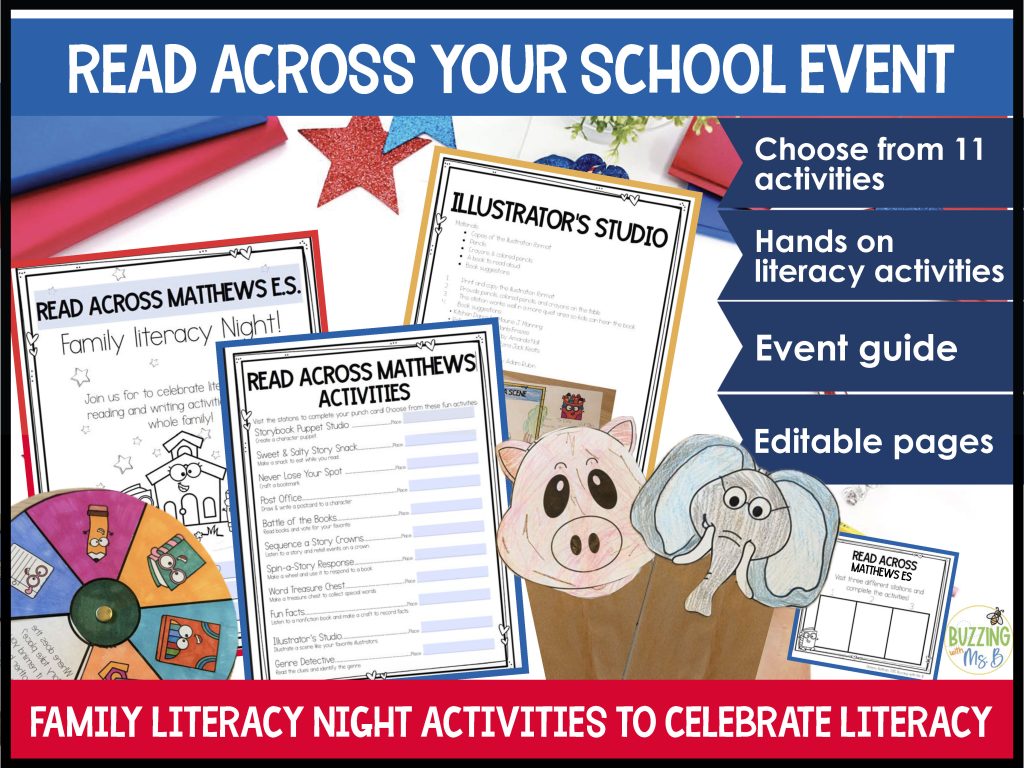
Instead of a theme, you could also focus on a book series or an author. During our Read Across the School Family Night, I included some Mo Willems activities because I love his books, and so do the kids! We also incorporated books that are inclusive and expand diversity.
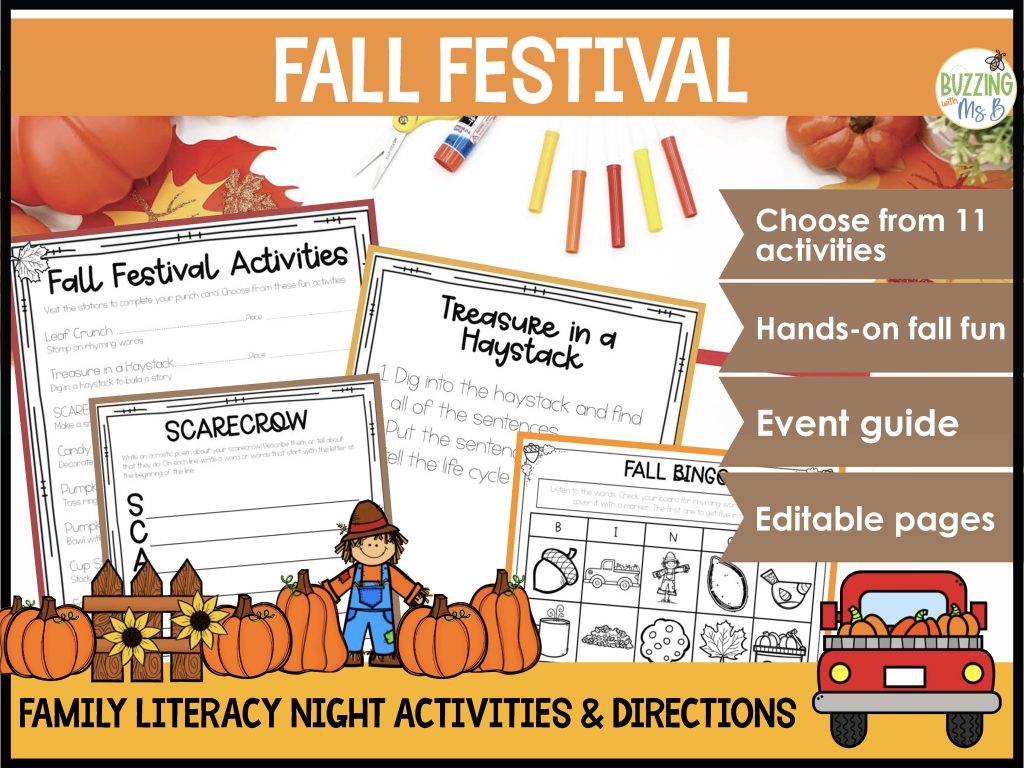
Fall Festival Family Literacy Night Preview
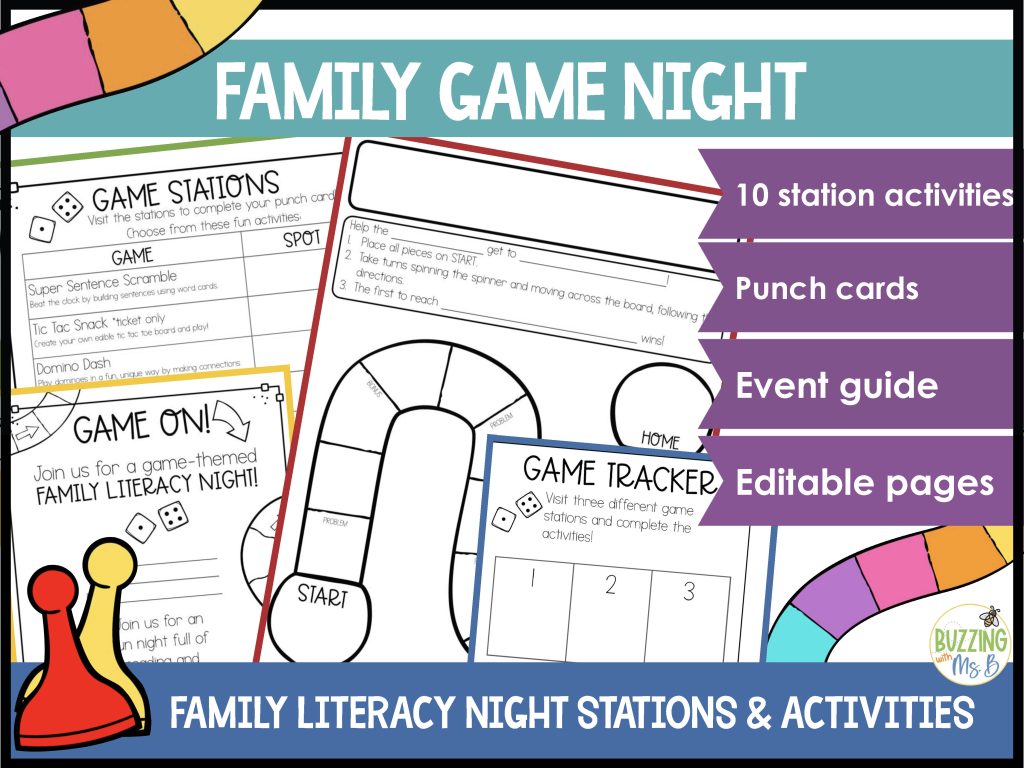
Family Literacy Game Night

Grab Everything You Need to Plan Your Next Family Literacy Night!

The Family Literacy Night Bundle with 9 Themes is packed with ready-to-use resources to help you host a successful Family Literacy Night. Click on the link to purchase it!

3. Get Sponsors

Sponsors aren’t required, but if you’ve got some time, why not? When I planned my events, I was able to get some small local companies and universities to give us books and goody bags for our students.

4. Incentivize It

Next, you’ll want to decide if you will incentivize attendance. At our school, every child who attended got a free dress pass when they left. That meant that they could wear whatever they wanted and didn’t need to wear their uniform the next day. You could also do a no homework pass.

Food is also a great incentive. We handed out popcorn for our Movie Night event. We served hot dogs and chips at our Family Future Dream Night event.

5. Think of the Experiences You Want Kids to Have with Their Grown-Ups

What experiences do you want students to have with their families? We want to include opportunities for the four dimensions of language: reading, writing, speaking, and listening.

I’ve found that setting up stations is the easiest way to get people to try different things and move through them, especially if you have a lot of people. You also want to consider your purpose and theme as you design your activities.

These are some of the things I want families to do throughout the night:

  • Read together
  • Write something creative together
  • Make a fun game they can play at home
  • Read something together to practice fluency or comprehension
  • Play an interactive game, where they actually move
  • Make a fun craft to get them talking and develop creativity
  • Prepare a snack while following a procedural text
  • Respond to a book somehow

I usually end up with between six and nine stations, but you can have as many as 12 if you have a lot of people attending the event.

6. Figure Out Staffing

When you have the activities planned, you can figure out the staffing. Each station needs about two to four people to run it.

I send out an email a few weeks before and ask who will attend from each grade level. Then I identify who will work at each station. Once I had everything figured out, I sent an email to everyone explaining where they would go that evening and what time they should arrive.

7. Plan and Prepare Your Stations

As you’re deciding your activities, you’ll need to figure out what materials you’ll need and create a list. You’ll want to create materials for each station and a handy little cart or couple of bins for them.

Make sure you include directions, handouts, and graphic organizers. I also make samples of things that might be confusing for the teachers or students.

It’s important to remember parents’ language here. At our school, we have a lot of parents who speak Spanish, so translating materials is a must.

8. Make a Map

Next, you’ll want to map out areas you plan to use for your Family Night. Personally, I’ve always used the bigger spaces like the front entrance, science lab, gym, and cafeteria. I also used the outdoor space.

You’ll also need to decide if you want people to rotate or free wander. I’ve found that giving people free will is easier, and they end up choosing the things they’re most excited to do. Just be sure that families do at least a few stations.

9. Make a List of Materials You Need

You’ll want to figure out what materials you’ll need for the event. Decide what you’ll need to purchase, the things you’ll make, and what you can borrow. When we did the Camping Family Literacy Night, I borrowed tents and lots of décor!

10. Organize Everything on a Cart

I set up everything on a cart, and it was really helpful for keeping materials organized. Once you have everything organized on a cart, you’re ready to go!

11. Send Out Invites

I sent out invitations a week or two before the event to each student on colored paper. We announced it every day over the announcements and put it on the marquee too. I also made a cute graphic that teachers could use to send directly to parents through the apps they used for their class.

The day before the event, I sent out a half-sheet to remind parents. We also sent notifications via our messaging system.

How to Plan a Family Literacy Night for Your Elementary School

I hope this post gives you lots of ideas for how to plan a Family Literacy Night for your elementary school. If you have a Family Literacy Night coming up this year or you’re going to plan one next year, get it on the calendar now! Once you have the date, you can work backwards to plan it.

Be sure to listen to the full episode to get all the details and lots of examples too!

Topics and Questions Discussed in Episode 263 – How to Plan a Family Literacy Night for Your Elementary School

  • How to plan a Family Literacy Night for your elementary school
  • What a Family Literacy Night could look like
  • Choosing a purpose for your event
  • Picking a theme
  • Tips for getting sponsors
  • Staffing your Family Literacy Night
  • Preparing stations for the event and creating a map
  • How to organize materials
  • Sending out invitations and boosting attendance

Need More Help Planning Your Family Literacy Night?

If you want more guidance or still have questions, here are five easy things you can do:

1️⃣ Read the Blog: How to Plan a Family Literacy Night (Without the Stress!)

This post walks you through the planning process from start to finish, with clear steps and photos for inspiration!

2️⃣ Explore More Ideas:

Use the search feature to find additional Family Literacy Night activities you can add to your event.

3️⃣ Purchase My Resources:

Visit my TpT store to check out the Family Literacy Night Bundle with 9 Themes or browse any individual theme. These materials make planning a fantastic event easy!

4️⃣ Grab the FREE Planner:

Download the Free Family Literacy Night Planner at the bottom of this post. This step-by-step guide will help you plan a fun, engaging event. Just enter your email, and I’ll send it straight to you.

5️⃣ Reach Out:

Have more questions? Email me at chrissy@buzzingwithmsb.com, or join the Instructional Coaching with Ms. B Facebook group to connect with other coaches.

Ready to listen?

  • Ready to listen? You can listen below with the media player, or search for Buzzing with MS. B: The Coaching Podcast anywhere you listen to podcasts!

This post contains links to products from one or more of our advertisers. This means I may receive commissions for purchases made through links in this post when you click on links to those products. Thank you for your support!

Learn more

Helpful Resources


Listen on: Apple Podcasts, Spotify, or your favorite listening app

Thank you for listening to Buzzing with Ms. B: the Coaching Podcast. Want more coaching ideas

Check me out at buzzingwithmsb.com and on Instagram @buzzingwithmsb.

If you love the show, share it with a coach who would love it too, or leave me a review on iTunes! It’s free and it helps others find this show, too. Happy coaching!

Podcast produced by Fernie Ceniceros

How to Plan a Family Literacy Night for Your Elementary School, ep. 263, Instructional Coaching with Ms. B Podcast

Chrissy Beltran (00:04.376)

Hey coach and welcome to this latest episode of instructional coaching with Miss B. Today we are talking about how to plan a family literacy night for your elementary school to support family engagement. So my first year of coaching when I was asked to plan a family literacy night, I didn’t even really know where to start. I had participated in literacy night events when I was a teacher, but they were small, just organized by grade level and mostly they involve the librarian reading a book while the teachers stood around. I don’t remember it being.

fun or super exciting. There was really no blueprint for a literacy night at the school that I was working at either as a coach. Nobody could tell me anything about what their literacy nights had looked like in the past. So I don’t think they actually had any. And so I really had to start from scratch. And I remember asking myself, what could a family literacy night look like? What could the purpose be? Why are we asking families to come to school and what are they going to get out of it?

We probably all have different answers to that question, absolutely, but over the years, this is what I’ve kind of landed on for our Family Literacy Night events. I want families to engage with literacy in a fun, low-pressure setting. I want them to work side by side with their children on meaningful reading and writing activities. I want them to strengthen the homeschool connection by building a sense of community and a sense that parents are welcome at the school and they have a place there, and that they are an important part of their child’s literacy development.

I want them to learn about literacy topics and ideas they can implement at home, and I want them together to read, write, talk, and listen. It’s so important that we remember that language encompasses all four of those things. So if you are stuck, you’re having some similar questions that I did. I want you to go to buzzingwithmissb.com slash family. That post explains how to plan a family literacy night and it has pictures. I’m gonna go through it here, but just that way you have a reference, it’s handy, it’s all written out for you.

And you can also grab a free guide. I created this guide for the person who replaced me when I left the school that I was a literacy coach at. And they had so many questions and I wanted to make sure they had everything they needed if they wanted to plan similar events. So now I share it with coaches who are trying to plan their own family events and I’ll walk you through the steps you can follow. If you’re putting together an event and you want some materials all ready to go so you don’t have to reinvent the wheel, you can grab resources for 12 different themes. Currently, I always add more.

Chrissy Beltran (02:21.997)

Some of them are available in Spanish too from Teachers Pay Teachers in my store, Chrissy BeltranBeltran, Buzzing with Ms. So let’s dig into this guide, okay? So first you’re wanna decide on what you want families to walk away with from your event. And obviously that’s going to shape the kinds of stations and activities and setup that you have. And then this is what I always do. I always choose a theme. A theme is not explicitly necessary. You can just have a bunch of different activities, but…

I find it’s helpful to choose a theme for a few reasons. One, your event will be more fun for families because people love themes. It makes it easier to set up the space to make it engaging. And two, it’s easier for you to think of books to use, to narrow down your selection, to really focus on specific kinds of activities if you have a theme. To me, it helps me think of more fun and differing ways to approach the kinds of activities that I want kids to do instead of just always pulling out the same stuff every time.

So different themes that I’ve done are camping, superheroes, pirates, movies, space, amusement park, beach, and then read across America, but it’s like read across your school. So, you know, if your school is named Matthews, it would be read across Matthews. There probably are, I feel like I’m missing a couple of them there, but that’s the general idea.

Game Night, Family Game Night is another really fun one because there’s lots of literacy games that you can do. So those are some really fun games that you might enjoy trying out at your own school. You could also really focus on a book series or an author. So like for the Read Across America type event, I included some Mo Willems activities because I personally, my kids love Mo Willems, they just love them. And so I tried to put in like books that were super fun and engaging as well as recommendations for books that

are inclusive and expand our diversity. And so if you wanted to do that, you could focus on a specific author or a specific book series and make a family night all about that. That would be really fun. The next thing you could consider is getting sponsors. And this is another thing that isn’t 100 % necessary if you’re just gonna bare bones this thing. And I get it, sometimes that’s where we are. But if you’ve got some time, why not? Or even for next year, why not try and see if you can get some goodie bags for your kids? Or if you can get…

Chrissy Beltran (04:37.911)

some books donated, that was always my favorite thing. There’s a local organization here in El Paso, Texas called Books Are Gems, and they donate books to kids. You can go to their location in a nonprofit, you can get like, I think it’s five books per kid every time you go, it’s amazing. But they also very kindly gave us books to give away to our students for our special events, and that was amazing. I also got a small company to provide just really simple, colorful party bags, and that was really great.

We’ve had our high school and university provide items for prizes, like our local university, UTEP. And those kinds of things were great. I mean, if you can get some cool stuff for your kids, especially around literacy, do it. Just give it to them. And I like the idea of having a bag for each child as they walk in the door. It helps to organize like a ticketed item, which I’ll share about that in a minute. And it also helps for them to be able to put their stuff in there. Because if not, if they make a bunch of different cool stuff, or if they like make a game they can take home, or if parents get a newsletter about information about literacy,

That has to go somewhere. And if it just like in their arms, it’s very it’s kind of complicated for them to keep track of that stuff. I always appreciate having a handy dandy bag to put my stuff in. You can also do if you got a little budget, those drawstring bags. And I found some really cute ones in the post where the where I describe my latest Read Across America resource. I included a link to these drawstring bags because they’re like, I love reading. I thought those were really cute. They’re not super expensive, depending on how how many kids you might have.

The next thing you can think about is will you incentivize attendance? So at our school, every child who attends a family night, they get a free dress pass when they leave. And so that means they can wear a free dress rather than the uniform the next day. And you could also do like a no homework pass or something along those lines. Food is also a really good incentive, especially for families in specific communities that may be providing meals is something that the school can do that is helpful to them.

So we always almost always hand out popcorn, like especially for our movie family literacy night, I roll out the red carpet. But we actually, for our family dream night one year, which is like a dreaming about the future night, what kind of a, you know, just like a planning, like a goals for your future sort of thing. Every teacher brought in a bag of hot dog buns and a package of hot dogs. And actually somebody one year donated the buns, but other years we just brought them in. And then our admin pitched in to get the rest and our coaches grilled everything up and they gave out a hot dog and a bag of chips.

Chrissy Beltran (07:02.945)

and a bottle of water to each person that shows up at that event. And we have the biggest turnout for that event because sometimes taking care of dinner, I mean, there’s a reason that car dealerships give out hot dogs, guys. Taking care of dinner is something we can do for our families because they can trade that time to come be with us at school. The next thing is probably what you think of when you think of family literacy night, which is what are they gonna do, right?

What experiences do you want kids to have with their grownups? And I just mentioned reading, writing, speaking, and listening. Those are these four dimensions of language, right? The way that I try to think about it is, OK, we want opportunities for them to do those four things. So then I want stations because that’s the way I structure our literacy night. I found that’s the easiest way to get people to do different kinds of things and move through, especially I have a lot of people.

I divide them into stations and think about, what kinds of activities can they do at each station that will support them in doing one of those four things or more than one of those four things? Read, write, listen, and speak. So it’s good for you to think about your purpose and your theme as you design your station activities around those four dimensions. So for example, I know that might sound a little confusing. When I’m planning a literacy night, I want families to do the following things. This is kind of some of the things I want them to do throughout the night. I want them to write something creative or fun together.

I want them to make a fun game they can play at home to practice accuracy or fluency. I want them to read something together to practice fluency and comprehension. I want them to play an interactive game, something where they actually move. I want them to make a fun craft to get them talking and develop creativity and oral language. I want them to make a snack while following a procedural text. Our people show up when we feed them. Lots of people do. I want them, either while following a procedural text or while…

describing the snack, I want them to do something food related. I want them to respond to a book somehow. We either read one aloud or we have a short video of one being read aloud. And obviously I want them to read, like read together. Please let these people read together. So whenever I work from that, I usually end up between six to nine stations. Some of my resources have, you know, between 10 and 12 and you can select the ones that’ll work best or you can do all 12 if you think that’ll work for you and you have that many people who are gonna attend.

Chrissy Beltran (09:17.663)

Each station needs about two to four people to run it. So crafts or snacks might take more people than something simple like, you know, where you just have baskets out and people read and they get a bookmark or they get to vote on their favorite book or something like that. So from there, once you’ve identified your activities, and I just gave a couple of generic examples, but you can dig into more examples on my website. Just go to buzzingwithmisspeed.com, search for family literacy night. Tons of activities will pop up for you. If you.

have you have your identified activities, then you could figure out your staffing. So the way I do it is I send out an email to teachers about three or four weeks before a family night asking who will attend from each grade level. So on our campus, there are representatives from each grade level at every family night, and our teachers would rotate, taking turns either coming to family math night or family literacy night. And then at the end of the school year, the dream board night, like I mentioned a few minutes ago, that when everybody comes to you because we expect a big turnout, it’s kind of like our end of year celebration.

So teachers respond to my email and then I start identifying who will work at each station. And after I have everything figured out, I send everyone an email explaining where they will go that evening and what time they should arrive. Now I try to keep grade levels together because I was a teacher, I haven’t forgotten, I wanna be with my buddies. So if two fifth grade teachers are coming, I try to put those two together at a station. If a station is gonna require three people, I might put somebody together who didn’t have a team.

Maybe somebody like a special teacher who doesn’t have a team but is arriving for that night The next thing you’re gonna do is actually plan out and prepare your stations, right? And so as you’re deciding what kinds of activities you’re going to do you have to figure out Okay, what materials do I need? You’re gonna break it down to a little list You can hunt for Pinterest for ideas related to your theme that you can integrate into a station if you’re stuck There’s tons of ideas there. I’m like I mentioned tons on my website at buzzing with miss B calm

You want to create materials for each station and kind of create like a handy dandy little cart or a couple of bins. One year I was a literacy coach at a school and my friend was the math coach, math and science. She was planning her family math night, right? And she told me I’ve got my cart all set up. She was pregnant, by the way. She was like five months pregnant.

Chrissy Beltran (11:32.686)

It’s like, I’ve got my cart all set up for family math night because you told me to have it all ready. It’s ready to go for next week. I have all my activities set up. I have the little sign for each activity on top of the materials for that station. It’s ready to go. And then she had gallstones and she was out for like a month. And so have your stuff done and set up and organized so somebody else could even run it for you. And also it just makes it easier for you on that night.

She was like, I’m so thankful that I my things ready or we would have had to cancel or we would have had to make it all up, you know, from our, like we would have had to pitch in, but she already had it ready to go, which was amazing. So when you create materials, make sure you include the directions. And I personally like to print directions out and then blow them up on like a poster maker. If you have, if you’re using classrooms, you could also have people project them with a projector, but I mean, a poster works really well regardless of where you’re putting each station.

So I make that into a poster and then any handouts or graphic organizers, I copy those. Sometimes I put them on colored paper, sometimes they’re on white paper. It depends on what I’m trying to do. And then I make samples of things that might be confusing for teachers or kids. So like the Read Across America resource, I have retelling crowns. And so I wanted people to know what those look like. So I made a retelling crown, you know? So that way as they’re putting it together, they know what they’re trying to build. Because if not, they don’t know what that looks like, you know?

Whenever I do word building activities and they have to write the word across a sentence strip with a little space between each letter and then they’re going to cut between each letter to build words, I put a sample of the sentence strip with the letters written across it and the cut up cards so that way they can see the step by step process of what they’re going to be trying to do. If they’re writing an acrostic poem, I will put a sample acrostic poem up on the wall just so they know what an acrostic poem is and how it works because I have the directions there, but sometimes we need to see samples and that’s normal.

It’s also important to remember language here. So at our school, we have a large percentage of parents who speak Spanish, and that’s their language of preference. And so translating materials is a must. I do have some Spanish family literacy nights, and I would love to add more, but I do have a couple of them that I have used with parents and they’ve already been translated. And so you can grab those in the same place. After that, I make a map. And so I map out the areas that I use for family night. I have always used…

Chrissy Beltran (13:54.466)

the larger spaces in our school. So I’ve used the front entry of the school for book and bag distribution. So I put out the tables full of books organized by grade level or kind of grade range that kids can choose from. And then everybody at the door gets their bag with a ticket stapled to it. The ticket is for the food activity station. So for example, for the…

concession stand snacks for the beach themed family night. They get a little ticket there so that whenever they actually go to make their little, you know, beach Teddy Graham snack on a graham cracker, they have a ticket and I’m not getting the same kid coming in seven times because they love Teddy Graham. We have to be realistic and we had to buy supplies. So we want to make sure everybody gets in to build those things. So then the kids bring their little ticket and you take their ticket and then that child has been through that station and they do not need to go through again.

So I always put that in the science lab if possible because I like having it in a kind of a smaller contained space and the science lab generally has like a cleaner area with like tables that’s easier for kids to do the activity there. It’s also not as noisy and I don’t know I find that beneficial when they’re working with food. I also use the gym or the cafeteria both if you have two separate ones. I have also used an outdoor space like a patio.

I really use that one over. did our camping family night. I’ve used it for dream board night for a couple of activities just to kind of spread things out. For the camping family literacy night, we set up big tents and baskets of books and fake fire, like campfires. And then we had families come read in the tents and they loved it. It was so cute. So I totally recommend doing that. You can do that no matter what theme you’re doing, but that’s a cute one. Messy activities need an easy to clean space.

and noisy activity should be separated from quiet activities because if part of the activity requires kids to listen to a story read aloud or watch the projection of a story read aloud, they got to be able to hear it or else they can’t do the thing you’re asking them to do next. So I try to put those into like quiet spaces that are kind of removed. So as you think about your space, even if it’s all in a gym and it’s a big open space, well, we had a stage at the top part of our gym, so I could put stations.

Chrissy Beltran (16:06.057)

up on the gym that needed to be a little more quiet because it was kind of removed at a different height and that helped it be a little quieter than the rest. We’d set up comfy seating and book baskets and then whatever fun theme that we had, we would provide decor on the stage because it was kind of like an enclosed space. Then I would have tables set up in the middle of the space with empty space for people to work there and then I’d put baskets of supplies. So,

things that they need at every station or many stations would be like colored pencils, crayons. They might need scissors. You might put scissors on the station only that they are going to use scissors on. like, let’s say that the station that I mentioned a minute ago where they cut up letters. So like in the camping one, they cut up the words from a camping spree because the word, the book that we read for that station was a camping spree with Mr. McGee. So they cut up those letters. Well, I needed them to have scissors and sit-in strips. So I make a special table.

For that station, I cover it with a thematic tablecloth. put up the poster with the directions. And then on the table, we have the sit-in strips, we have the markers, and we have the scissors. And then they can return the scissors as they’re done. You can also put baskets of scissors in the middle of the room and it doesn’t matter. It’s just a difference in how you want to run it. Either way works just fine. Then we have people kind of maneuver through the stations as they choose. So that is…

matter of choice. You have to decide, do you want people to rotate or do you want people to just kind of free, just wander? And it’s up to you how you want that to work. I have found that having people go through stations as they choose means that they will choose things they’re excited to do, which is great. And if a station takes longer or shorter than another station, it doesn’t matter. So like if you have a parent go to

a station where they are having to read a partner play. And that doesn’t take that long, right? And maybe they make like a little crown to wear with it has a picture of their character on it and they read the partner play and then they’re done. But other people are still working on creating a game to read high frequency words. Then those people, where are they going to go? Like if you’re rotating, you’re cutting people off or people are spending too long in a station. I find it’s great to just let people kind of move through stations, but to make sure that they do at least a few of them, I give out punch cards.

Chrissy Beltran (18:27.499)

And you can either have teachers initial on each little square or you can have teachers punch it with a hole puncher. But either way, the idea is that they have to complete at least three or four stations, depending on how much time you’re giving them to do these stations. And then they have to have either the signature or the hole punch to get their free dress pass at the end of the evening. So that’s one way to make sure that people go through a bunch of stations without making them go through a kind of a rotation, which can be a lot to manage. And I found it was just easier to let people have free will.

So one thing that you might consider as you’re thinking about the materials that you need for your family night is there are certain things that you can just borrow that you don’t need to order all the time, right? So like for the amusement park family literacy night, I had a station where it was like you’re matching ducks in a pond, know, cause ducks in a pond is like an amusement park game. And so I actually put little paper ducks and you could actually write words on plastic ducks, but I didn’t do that.

I have little paper ducks and I set them out in the bottom of a wading pool, like a plastic one. Well, that wading pool can be borrowed so you don’t have to be buying it. What are you going to do with a wading pool again until next year? What you do is you send out an email to our teachers and say, hey, anybody have a wading pool, right? Handy fly swatters, although you want them to be clean. But like there was a smack attack game we played during our superhero family night where they had to match rhyming words. So you read a word on a card and then they have to look at the wall and see which one rhymes and they have to smack it with their fly swatter.

Those fly swatters, you can buy them and store them till next year. Or if people have some that they just aren’t even using, you could borrow those. Tents is another really good example. Lots of decor can be borrowed for camping night. If you want to set out little trees like pine trees, little fir trees that are fake, obviously. If you want to set up for the fishing station, you can borrow those pools. You can borrow lots of decorations from people and you don’t have to invest so much in your budget.

However, on the recent Family Night posts that I’ve done, I’ve do have recommended links if you’re looking for decorations to make it really cozy. For example, the Winter Wonderland Family Nights, I included like snowflakes and twinkle lights because my gosh, can you imagine how cozy and sweet that would be? Once you’ve got everything organized on a cart, you are ready to go. You’ve labeled each station with the, know, station one and has all the materials for that station. You wanna send out invitations. And I send out a week or two before the event,

Chrissy Beltran (20:49.515)

to each student on colored paper. We announce it every day over the announcements. Make a cute graphic, go to Campbell, they have cute stuff. Or if you need the resource, there’s editable stuff in the resources that I have created and you can edit all your information in there. We announce it every day over the announcements and we put it on the marquee as well. And then the day before the event, I send out a half sheet to remind parents and we send notifications via our messaging system again. also have, know, teachers can send things directly to parents through the apps that they use if you provide that cute graphic that you’ve made.

they can send it out to parents and kids. My advice to you is if you have a family literacy night coming up this year or you’re gonna plan one for next year, get it on the calendar now because once you have a date, you can work backwards from it, but adding to a busy calendar is always a lot harder. So set your family literacy night dates at the end of the year when you’re building the next year’s calendar to make sure that they’re actually on your radar. So I, again,

I include in that handout that free guide that I mentioned at buzzingwithmisfy.com slash family. There is a handy dandy planning guide and you can, you know, need to make, need to copy, need to do, and need to email are the four categories that I use when I plan a family night. So I included that guide for you and all the steps that you need in order to actually create your own super fun family literacy night where you get kids engaged with literacy. And I hope you love it.

If you go to TeachersPayTeachers.com and visit my store, Chrissy BeltranBeltran, buzzing with Miss B, to plan your family night, you will use ready-made materials used by thousands of educators over the years. You can choose from 12 different themes. And the most recent one is the Read Across America resource. You actually edit the text to say, read across whatever your school name is. So like your school name is Matthews, it says Read Across Matthews. And it’s so much fun for celebrating literacy. You can use it any time of the year. I hope that helps you out. If you’re responsible for planning your family night event, and if you need any help,

don’t hesitate to send me an email at Chrissy Beltranat Buzzing with Miss B or talk to your friends in the Facebook group Instructional Coaching with Miss B. Next episode starts our new mini series. For March, we’re starting a mini series about helping get your teams on track. So, so many times our PLC teams, they meet once a week or once a month, they check all the boxes on their agendas, they complain a little bit, and then they go back to class where nothing has changed and the meeting had no effect. So this month, we’re gonna talk about

Chrissy Beltran (23:07.96)

how to get your teams aligned, how to include special education teachers and PLCs, what collective efficacy is, and so much more to help you get your teams on the right track and make them actually purposeful and meaningful. I’m really excited to start that mini-series with you. I think it’s gonna be super helpful. And until next week, happy coaching!

Share:

Similar Posts

Leave a Reply

Your email address will not be published. Required fields are marked *