| |

Qualities of a Great Instructional Coach, ep. 262
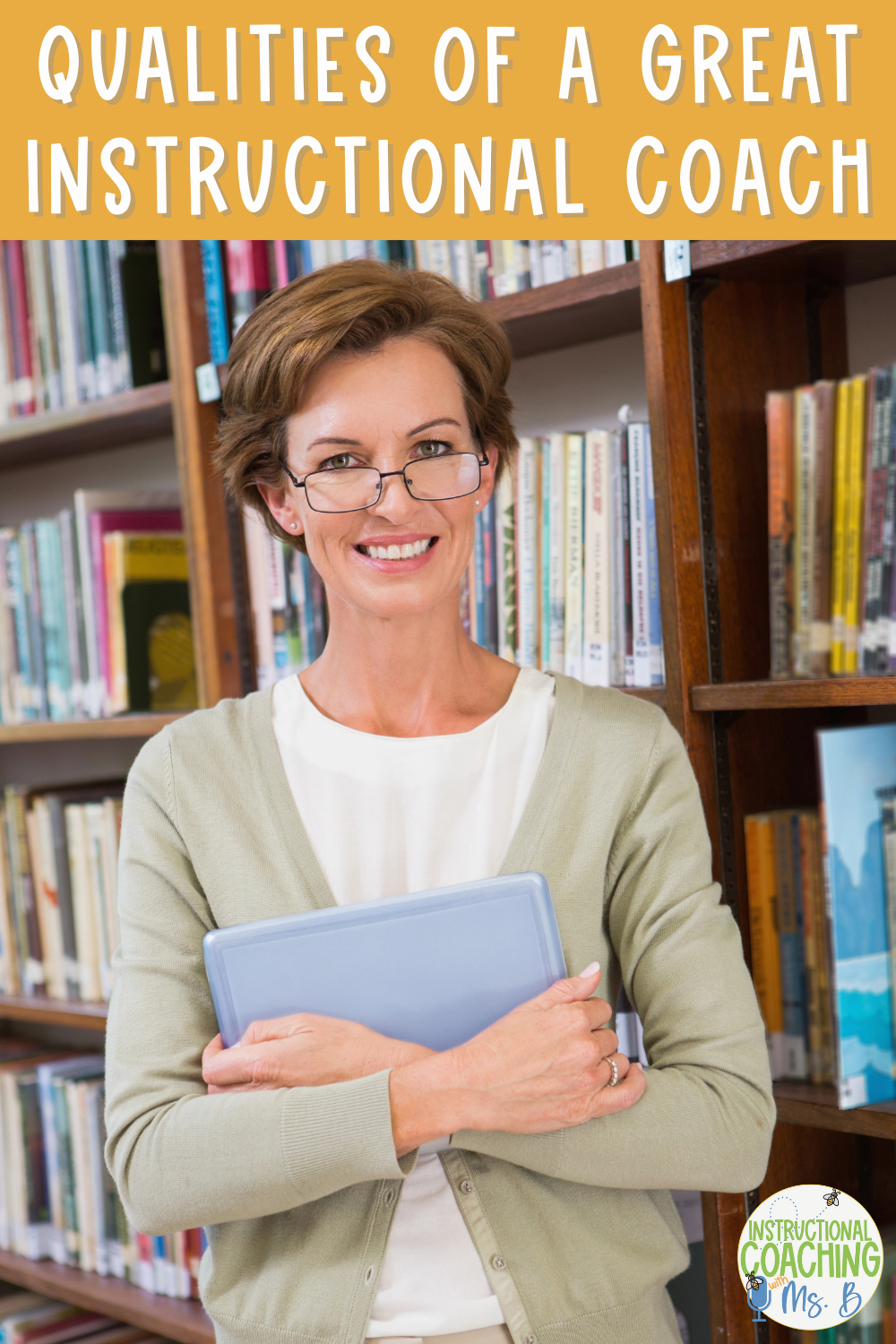
Teacher smling in a library. These words are at the top "Qualities of a Great Instructional Coach".

What are the things that separate a good coach from a GREAT one?

Perhaps you’ve seen coaches who work magic with teachers, and you’re wondering what makes them so special!

In this episode of Instructional Coaching with Ms. B, we’re talking about the qualities of a great instructional coach. I break down seven traits every coach needs to make a big impact on campus.

We discuss how your personality shapes your coaching style. I share my own experiences transitioning from the classroom to coaching and how my strengths as a teacher had to evolve to fit my new role. Plus, I give you actionable tips and ideas for navigating relationships with teachers.

The qualities you develop as a coach will make your work less stressful and more meaningful! Listen to the entire episode to learn the characteristics every coach needs to be successful!

7 Qualities of a Great Instructional Coach

Today, I’m highlighting 7 qualities of a great coach and what they actually look like when you’re coaching! Some of these things don’t come naturally to us, and that’s all right! The idea is to keep showing up with good intentions and make the effort to improve in the areas we want to work on.

1. Becoming a Collaborative Problem Solver

It’s interesting how the qualities we have as strong teachers can translate into coaching, but it’s not always a 1:1 relationship. I’ve always been a problem solver. Got a kid who is struggling, send her to me and I’ll get her moving. Need a poem with 17 different examples of figurative language, I’ll find one or write it myself.

But as I transitioned to coaching, I realized that being the “right answer fairy” isn’t really coaching. Teachers don’t learn through being told what to do. Telling your idea to somebody doesn’t mean it will be implemented the way you expect. Doling out advice isn’t coaching! Becoming the advice monster doesn’t work!

Instead of being a solo problem-solver, I had to become a collaborative partner, asking questions to understand first, and then offering classroom support. This can sound like: “That’s a really great focus for your work right now! Why don’t I come by tomorrow, and we can work together to figure this out?”

Set a date to collaborate on problem-solving by learning together or starting a coaching cycle. You’re not just going to problem-solve and tell them you solved it. When you have that gift of being a collaborative problem solver, coaching is going to be much easier and more effective.

2. Building Relationships

Coaching is all about relationships. Good coaches are always reaching out and finding ways to build bridges.

Building relationships with kids is much different from building relationships with adults. When working with adults, we need to find very specific opportunities for bridge building. A true relationship builder is a good listener, someone who values other people, finds the good in them, and acknowledges there’s a whole life story to every person.

3. Being a Good Team Member

I was shocked by the amount of time I spent on teams as a coach. Leadership team, RTI, CEIC, district level teams, PLC teams, vertical teams, oh my!

The truth is, I’m not naturally a great team member. I appreciate amazing teams, but I tend to be pretty self-directed and independent. I always felt like teams make things more complicated, but the reality is that teams are how most schools operate.

So, we have to be good team members. We have to listen, highlight people’s strengths, be vulnerable, ask for help, and coordinate with others. All of that takes real effort, but for some people, this is their best quality!

4. Patience

Patience with kids is one thing; patience with teachers is something completely different! Kids are little, and it can be easier to be patient because we know they don’t have the life experiences or the frontal lobe development they will have someday.

Adults have their own perspectives. Much like students, they don’t always realize what an inconvenience it can be to ask for the same document multiple times, or neglect to turn things in on time. That means we have to dig deep sometimes and make the effort to have patience even when we feel like they haven’t had patience with us.

5. Continuous Learning

Coaches must remain lifelong learners, continually growing in their understanding of teaching and learning. We have to model learning, try new things, make mistakes, and reflect. And we often have to do our learning alongside a teacher, because we’re partnering together to figure out something in their classroom. You don’t have to know everything, but you need to be open to learning new things.

6. Nonjudgmental Approach

This was my hardest skill to develop. Being nonjudgmental could actually be part of the relationship builder quality, but I think it’s important to highlight it on its own.

When we visit classrooms, it can be hard to refrain from passing judgment. But when it comes to a teacher who is struggling, being judgmental about their teaching doesn’t help you be patient with them or partner with them to change things. 

Instead, observe what’s happening and how it affects students. Focus on how students respond to instruction and interactions with the teacher, rather than what is “good or bad”. Then you can actually work together on making things change in a positive way.

7. Resilience

This is a BIG quality that coaches need to possess. Teachers aren’t always nice to coaches, and they aren’t always happy to see us. That’s just the reality!

I talk about the three Cs for building a coaching relationship in episode 197. The three Cs are: clarity, connection, and consistency. If you don’t show up regularly for teachers, they don’t believe that you are really there to support them. If you let the general disagreeableness of certain teachers drag you down, you can’t make a difference in teaching and learning. Being rebuffed and then showing up again with a positive, collaborative attitude is a very special skill, and it’s so important for coaching.

The Qualities of a Great Instructional Coach

There you have it, seven qualities of a great coach. I hope you loved those traits and see some of them in yourself! 

Remember, we don’t all have all the qualities all the time, but you can work towards them! Pick one area to work on, starting today. If you do, send me an email at chrissy@buzzingwithmsb.com to let me know, or join my Facebook group so you can share all about it!  We’d love to have you!

I can’t wait for you to listen and identify which qualities of a great instructional coach you have and which you want to work on!. Listen now to get all the details!

Topics and Questions Discussed in Episode 262 – Qualities of a Great Instructional Coach

  • 7 qualities of a great instructional coach
  • How your personality shapes your coaching style
  • Why classroom strengths may (or may not) translate to coaching
  • Drawbacks of simply providing solutions
  • Importance of collaborative problem solving
  • Ways to build real relationships with teachers
  • Being a good team member
  • Benefits of patience in fostering positive teacher relationships
  • What you need to make your coaching more effective
  • Being a lifelong learner
  • Learning alongside teachers
  • Having a non-judgmental approach when visiting classrooms
  • How to be a resilient coach

Your personality as an instructional coach affects the work you do with teachers every day, and you might not even realize it. Learn about what your coaching personality is, what your strengths are, and how to become an even better coach! Head to buzzingwithmsb.com/quiz to take the two-minute quiz!

Ready to listen?

  • Ready to listen? You can listen below with the media player, or search for Buzzing with MS. B: The Coaching Podcast anywhere you listen to podcasts!

This post contains links to products from one or more of our advertisers. This means I may receive commissions for purchases made through links in this post when you click on links to those products. Thank you for your support!

Learn more

Helpful Resources


Listen on: Apple Podcasts, Spotify, or your favorite listening app

Thank you for listening to Buzzing with Ms. B: the Coaching Podcast. Want more coaching ideas

Check me out at buzzingwithmsb.com and on Instagram @buzzingwithmsb.

If you love the show, share it with a coach who would love it too, or leave me a review on iTunes! It’s free and it helps others find this show, too. Happy coaching!

Podcast produced by Fernie Ceniceros

Qualities of a Great Instructional Coach, ep. 262, Instructional Coaching with Ms. B Podcast

Chrissy Beltran (00:01.634)

Hey coach, and welcome to Instructional Coaching with Ms. B. Today we are talking about the qualities of a great instructional coach. Your personality as an instructional coach affects the work that you do with teachers every single day and you might not even realize that it does. You can learn about what your coaching personality is, what your strengths are, and how to become an even better coach if you head to buzzingwithmissb.com slash quiz to take the two minute quiz. It’s kind of funny how the qualities we have as strong teachers can translate into coaching

but it’s not always like a one-to-one relationship, right? So I’m gonna tell you a little bit about my experience as a coach who was using my classroom strengths in a coaching position and what I learned about that. As a teacher in the classroom, there’s always so much to do. And so we’d like sit in meetings together as a third or fourth grade team, and then you know everybody has a role, right? My role was multifaceted, but I tended to be the questioner, right? I’m a questioner at heart.

But I’m the kind of questioner where like if something seems illogical, I will ask a million questions about it until I feel like the case has been made and now everybody can see that it’s illogical. And then the other thing that I was good at is I was a problem solver. You got a kid who’s struggling in math, send him to me. I’ll add him to my small group and we’ll get him moving. We need a poem that has 17 different examples of figurative language for our lesson on Tuesday. By God, I will either find one or I will write it myself.

You can’t get your kid to learn a complete sentence. Just do what I do. This is how you do it. These are the resources you need. Try it out and let me know if it works. And then I became an instructional coach. And this quality of mind as a problem solver was a challenge for me, big time at first. I mean, it’s a daily challenge, but at the time it was especially difficult because as soon as I could would hear a teacher talk about what was going on in their classroom, I could think of several ways they could try to change that outcome and what I could do to help fix it.

And the problem with that is multi-fold. Teachers don’t learn through being told what to do, right? So if I just tell her what to do, nothing’s gonna change. Telling your idea to somebody doesn’t mean it’s gonna be implemented in the way that you’re thinking it’s gonna be implemented. Becoming the good answer fairy, right, has a bing, here’s a good answer to your problem, bing, has a negative effect on your teacher’s autonomy and their independent thought. Because if you position yourself as a good answer fairy,

Chrissy Beltran (02:22.274)

they’re gonna use you as a good answer very. And then the last one is it’s just not real coaching. You’re just doling out advice, right? And I think the advice monster, right? Is a common, it’s a phrase that we hear frequently because we know that advice monsters, according to Michael Bungay, senior, it doesn’t work. There are so many reasons that giving advice to somebody doesn’t impact teaching and learning in their classroom. So while being a problem solver is a real asset,

It’s one of those qualities that looks different when you become a coach. So today I’m gonna share about some of those qualities of a great coach and what they actually look like for instructional coaches. I’m gonna start with problem solving, because we just talked about that one. The idea that whenever you become a coach, problem solving is valuable, it’s because you have to change it. It turns from solo problem solving, because even if you were on a really great team as a teacher, you spend a lot of time solving your own problems, right? You have a lot of autonomy and independence as a teacher.

in the classroom moment to moment into collaborative problem solving with teams or individual partners. So to do this, we have to ask questions to understand first and then offer classroom support. And it could sound like that’s a really great focus for your work right now. Why don’t I come by tomorrow and we can work together to figure this out. So you’re gonna collaborate on problem solving together. You’re gonna solve things together by learning and working and trying things out and inquiry and all of that.

You’re not just gonna solve the problem and tell them, I solved it, here you go, right? And if you can do that, if you have that gift of being a collaborative problem solver, coaching is gonna be so much easier for you. The second characteristic or quality of a great coach is that they are a relationship builder. Good coaches are always reaching out, finding ways to build bridges to teachers. And when we do that with kids, it looks different than with adults. I mean, both kids and adults want us to know who they are as people, right? But knowing an adult,

and who they are, it takes more effort in many cases than it does with kids. Kids don’t have the walls yet, right? They haven’t been disappointed by as many people yet. With adults, we have to find very specific opportunities for bridge building. So a true relationship builder is a good listener, someone who values other people and finds the good things in them, highlights those good things, and acknowledges that there is a whole life story behind every person that they’re working with, that we don’t always know why they do what they do, but there’s a reason.

Chrissy Beltran (04:46.144)

And we can either acknowledge that or really struggle to try to build relationships with certain people at our schools. The third one that I want to share is they’re a good team member. And I don’t know how to put this in like collaborative, I guess would be the word, but I was shocked at the amount of team member time I spent as a coach having moved out of the classroom. Leadership team, RTI, CEIC, district level teams, PLC teams, where I wasn’t a grade level member, but I was part of the team, vertical teams.

And the truth is I am not naturally a great team member. I appreciate great teams, but I tend to be pretty self-directed and independent. And in teams, I always felt like we were making things more complicated because we had to schedule everybody and get everybody’s approval and everybody has your ideas. And I struggle with having patience for that. That’s something I’ve really had to work on as a coach. But the reality is we have to work on it because being on a team is the way schools operate.

having one person be completely responsible for a child’s education for the whole year. Holy cow, that’s a lot of responsibility guys. So we have to be good team members. Then that means we have to listen. We have to highlight each other’s strengths and we have to use them well for the benefit of the team and the kids. We have to be vulnerable. We have to ask for help and we have to coordinate with other people. And all of that takes some real effort for some people like me, but others, if you work best on a team,

This is one of your best qualities. The next characteristic is patience. Kids try our patience. So as teachers, we’ve had to develop some pretty good patient skills, right? But teachers, that’s a whole nother level, okay? Kids are little and it can be easier to be patient. I mean, not all of them are a little bit, they’re younger because we know they don’t have the life experiences or the frontal lobe development that they will someday have. But when coaches work with teachers, those teachers,

are seeing from their own perspective as an adult and they may have kind of decided what they think about a lot of things. Much like students, don’t always realize that things that they do can be an inconvenience, like to ask for the same document multiple times or to neglect to turn things in on time or to say they don’t know how to access the online curriculum after they were supposedly using it for three months or any of the things that drive us crazy as coaches. That means we have to dig deep sometimes and make the effort to have patience

Chrissy Beltran (07:09.166)

even when we feel like they haven’t had patience with us, or possibly even especially when they haven’t had patience with us, because those people tend to be the ones who need the most effort when it comes to building relationships. So if you have patience for adults, that doesn’t mean you’re a pushover, but you are patient, you will be able to take that skill far in coaching. The next skill or the next quality is to be a learner. And this one’s pretty self-explanatory. We have to keep learning.

We have to keep moving towards a better understanding of teaching and learning. The kinds of things that we learn as coaches are similar, but they’re not completely the same as the things we learned as teachers. And we often have to do our learning alongside a teacher because we are partnering together to figure out something in their classroom. So if we are modeling, learning, trying things out, not knowing everything, making mistakes, reflecting, then that’s going to be a huge asset for us as coaches. Non-judgmental.

is the next one I’m gonna share. And this was probably the hardest for me, although I know I did spend a while talking about how problem solving collaboratively and being a team member were hard for me, but that’s okay. These things are hard for us, right? So let that be your PSA. These things don’t all come naturally to all of us, and that’s all right. The idea is you keep showing up with good intentions and make the effort to improve in the areas that you wanna improve in. So being non-judgmental could actually be part of the relationship builder quality, but I think it’s really important to highlight it on its own.

When we think about visiting classrooms, it can be hard to step inside someone’s room and refrain from passing judgment. Now that doesn’t mean like acknowledging that some practices are better than others. They just are. Like we have research to support some things and some things we don’t. Or that some things like racism, sexism, inappropriate behavior, know, cruelty or unkindness, those are just unacceptable. Okay. So we don’t refrain from using good judgment. But when it comes to a teacher who is struggling, passing judgment, good or bad.

on their teaching doesn’t help you be patient with them or partner with them to change things. Instead of really looking at the teaching and saying, this is bad, this is bad, this is bad, it can help to take stock of what’s in place, not what’s good or bad, but just what’s happening and how it affects students. Focus on how students respond to instruction and to the interactions with their teacher rather than what is good or bad, because then you can actually work together on making things change in a positive way.

Chrissy Beltran (09:33.826)

The last one I’m gonna share is a big quality that we’ve gotta have, because if not, we can’t be coaches. We have to be resilient. Teachers aren’t always nice to you. I know you already know this. They’re sometimes afraid of having someone in their classroom and that turns into anger or frustration that’s aimed at you. They can be annoyed with your input when you’re not teaching their exact class. They can be dismissive.

They can say that, you you aren’t even in the classroom anymore. What do you have to offer me? They can be forgetful or they could fail to follow through on things. There are so many things that teachers can do that can make a coach feel frustrated and ineffective and just useless, right? And we all feel those things. It’s normal to feel angry or disappointed or hurt when a teacher isn’t responding to you positively as a coach or when they’re downright negative, right? But we have to keep showing up.

I talk about the three C’s for building a coaching relationship in episode 197, and those C’s are clarity, connection, and consistency. If you don’t show up regularly for teachers, they don’t believe that you really are there to support them. And if you let the general disagreeableness of certain teachers drag you down, then you can’t make a difference in teaching and learning. Being able to be rebuffed and then show up again with a positive, determined, problem-solving, collaborative demeanor,

is a very special and unique skill and it is so important for coaching. I hope you have that one. I also hope that you loved all these qualities and see some of them in yourself. So remember, we don’t have all the qualities at all the time, know, all the time of every day. We can sure work towards them though. So a good way to use this information would be to know which qualities you have and then choose one that you’d like to work towards over the next month. And if you do that, please send me an email.

at Chrissy Beltran at budzywithmissb.com to let me know, or join my Facebook group so you can share all about it. Instructional Coaching with Miss B is a Facebook group that I run and it’s a perfect place to get ideas, share your coaching thoughts, and get some great feedback from members. Next week, we are talking all about family engagement. And I’m really excited about this episode. Getting families involved in schools is the best way to provide support to the students we teach and help them bridge learning.

Chrissy Beltran (11:44.674)

from school to home and from home to school. So I cannot wait to share this episode with you about family engagement and planning a family literacy night. Until then, happy coaching!

Share:

Similar Posts

Leave a Reply

Your email address will not be published. Required fields are marked *