| |

Qualities of Solid Tier I Instruction with Olivia Wahl, ep. 247
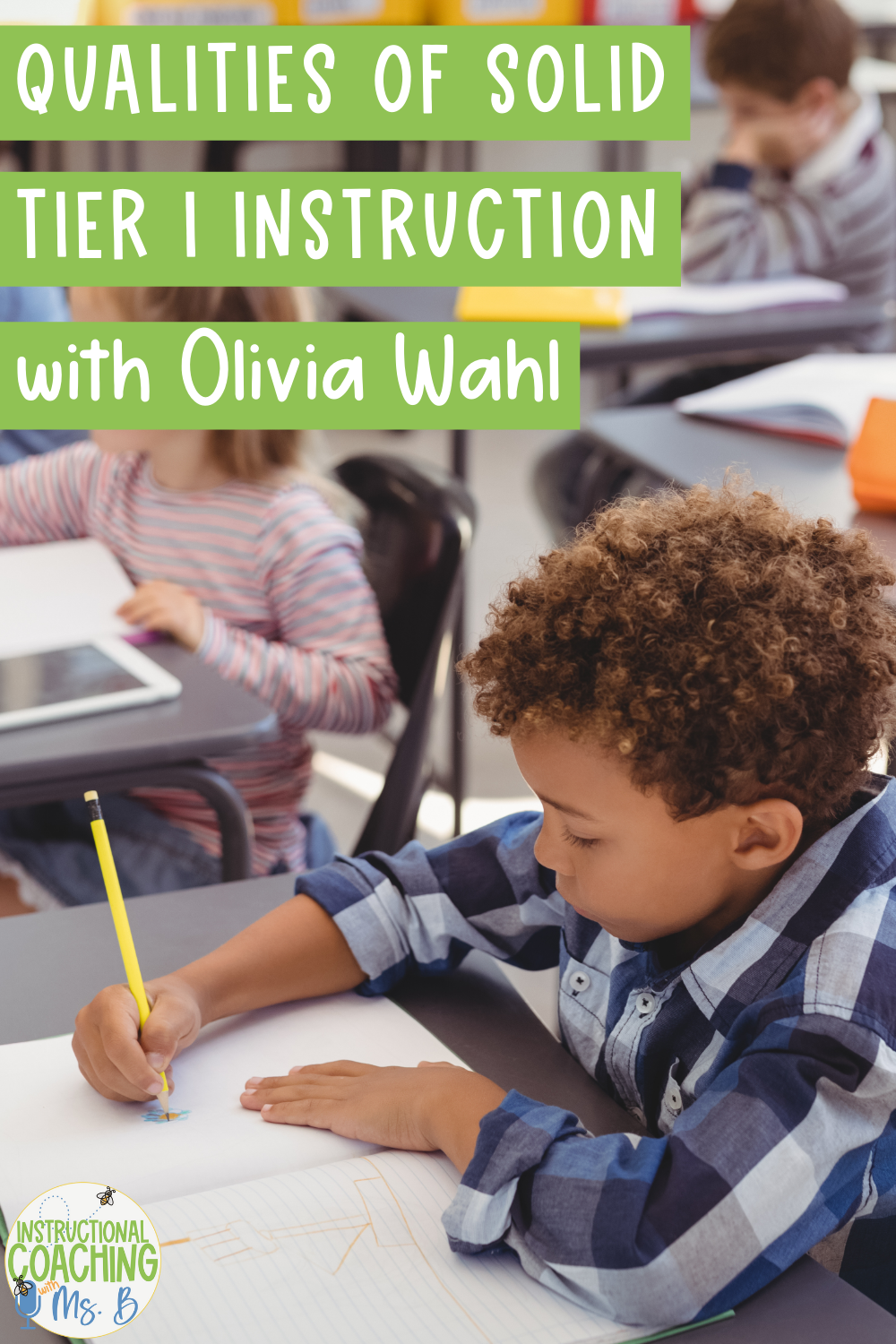
Students writing at a desk in a classroom. These words are at the top, Qualities of Solid Tier I Instruction with Olivia Wahl

So much of our time in schools is dedicated to Tier II intervention, rather than creating really great Tier I instruction. But wouldn’t it be better if students learned what they’re taught the first time around? When students understand what’s taught during Tier I instruction, the interventions we provide later can be more focused and effective.

To kick off our new series on instruction & lesson planning, collaborative coach Olivia Wahl joins me to break down the qualities of solid Tier I instruction.

In this episode, we examine some of the issues with Tier I instruction that lead to an increased need for Tier II intervention, including the impact of pre-packaged curricula, loss of teacher autonomy, and an overemphasis on fidelity instead of adapting instruction to meet student needs. Olivia shares some things teachers can do to create better student engagement and discusses the importance of responsive, student-centered teaching.

Together, we explore the teaching practices we should be including in Tier I instruction. She explains the differences in instructional practices between primary and secondary grades and highlights how instructional coaches can help teachers design lessons that offer kids what they need from Tier I instruction. Plus, she gives us an introduction to Learning Labs and the benefits of collaborative problem-solving.

Be sure to listen to the full episode to hear all the details. Here are a few highlights from our conversation.

The Problem with Tier I instruction

Olivia says there’s a huge problem with Tier I instruction that leads to Tier II intervention. The issue? Scripted curricula.

Many school districts were recently forced to purchase pre-packaged programs. These scripted curricula seriously limit teachers’ autonomy. They also create a lot of fear and resistance.

Teachers feel pressure to follow the program’s scripts with strict fidelity, rather than adapting the lessons to meet the needs of the kids in their classrooms. Olivia says this negates the most important thing in the room: the students!

She emphasizes the need for a critical shift to an asset-based mindset. Olivia recommends assessing what our students understand and using a system to document it effectively. She explains that if we’re not keeping track of what students are saying and doing as evidence of learning, we’re shooting in the dark.

How to Engage Students

Olivia shares three ways to strengthen student engagement during Tier I instruction:

  • Get to know students as individuals: Find out their interests and what matters most to them. Learn about their caregivers and their background.

  • Foster three types of engagement: Olivia says many students are compliant and show good behavior in school, but that does not mean they’re engaged in learning. Using Sam Bennett’s framework, she highlights the three circles of engagement: emotional, behavioral, and cognitive. When all three meet in the middle, we have the child at their heart.

  • Ensure access for all students: Strong Tier I instruction starts with access. Olivia says teachers need to ensure all children have access to grade-level standards and text sets. We need to think about how to create access around a topic that’s interesting and relevant to students.

Qualities of Solid Tier I Instruction

When I asked Olivia to describe Tier I instruction and the main practices that make it powerful, she said the keyword is responsive. Part of that means being intentional about how we collect evidence about what our students understand in writing.

Here are a few practices Olivia suggests to ensure Tier 1 instruction leads to better outcomes for every learner:

  • Start lessons with clear learning targets

  • Use exit tickets and documentation to assess what students have learned

  • Analyze student work to identify patterns and inform next steps

  • Differentiate instruction based on what most, some, and individual students need

How Can Instructional Coaches Support Teachers in Creating Better Tier 1 Lessons?

I asked Olivia how instructional coaches can support teachers in creating better Tier I lessons. She shared a couple of interesting ideas:

  1. Focus more on metacognitive strategies: Help teachers and students think about their own thinking. Then students can label it so they know what they’re doing and can sustain it independently.

  2. Run Learning Labs: Olivia says instructional coaching in a school district is not enough. We need to embrace the idea of the collective, so we are all growing together. Learning Labs create a space where teachers collaborate, take risks, and troubleshoot real problems of practice.

Qualities of Solid Tier I Instruction

Meaningful Tier I instruction is about being responsive and fostering genuine student engagement. Listen now to hear all about the qualities of solid Tier I instruction!

Topics and Questions Discussed in Episode 247 – Qualities of Solid Tier I Instruction with Olivia Wahl

  • Problems with Tier I instruction that lead to an increased need for Tier II intervention
  • Impact of pre-packaged curricula and loss of teacher autonomy
  • Over-emphasis on fidelity instead of responsive, student-centered teaching
  • Things teachers can do to create better student engagement in their classrooms
  • Sam Bennett’s three circles of engagement: emotional, behavioral, and cognitive
  • Getting to know students as individuals, beyond just academics
  • Distinguishing between compliance and true engagement
  • Practices that should be included in powerful Tier I instruction
  • Using clear learning targets and exit tickets
  • Documentation and pattern analysis of student work
  • Differentiation of lessons based on what most, some, and individual students need
  • Differences in instructional practice and expectations between primary and secondary education
  • Over-reliance on lectures in middle/high school
  • How instructional coaches can support teachers in creating better lessons that give students what they need from Tier I instruction
  • Metacognitive strategies – Thinking about thinking and modeling it for students
  • Learning labs and collaborative problem solving

Ready to listen?

  • Ready to listen? You can listen below with the media player, or search for Buzzing with MS. B: The Coaching Podcast anywhere you listen to podcasts!

This post contains links to products from one or more of our advertisers. This means I may receive commissions for purchases made through links in this post when you click on links to those products. Thank you for your support!

Learn more

Helpful Resources


Listen on: Apple Podcasts, Spotify, or your favorite listening app


Thank you for listening to Buzzing with Ms. B: the Coaching Podcast. Want more coaching ideas

Check me out at buzzingwithmsb.com and on Instagram @buzzingwithmsb.

If you love the show, share it with a coach who would love it too, or leave me a review on iTunes! It’s free and it helps others find this show, too. Happy coaching!

Podcast produced by Fernie Ceniceros

Qualities of Solid Tier I Instruction with Olivia Wahl, ep. 247, Instructional Coaching with Ms. B Podcast

Chrissy Beltran  00:01

Hey, Coach, if you’ve been waiting for the confident literacy coach course to open up, your wait is almost over. The course is opening soon, and I want you to be the first to know make sure you’ve signed up at confident literacy coach.com to be included on the wait list. You’ll be notified as soon as it opens for enrollment. This year is going to be even better than before. I’ve updated the reading and writing modules to provide you with the knowledge. You need to support your school in implementing practices that are proven to build skilled readers and writers. Get the PD. You need to provide the PD and learning. They need join the wait list so you can join the course.

Chrissy Beltran  00:37

Welcome to instructional coaching with Miss B where we believe that every teacher deserves a coach, and every coach does too. I’m Chrissy Beltran, an elementary teacher who became a coach, and I had to create my own coaching program that worked. Now I teach coaches how to design their coaching programs, build a school wide action plan and use differentiated strategies to support teachers. Plus, I’ve got a special spot in my heart for literacy coaches. Now let’s dig into the episode.

Chrissy Beltran  01:01

Hey coach and welcome to episode 247 today. We are talking about the components of strong tier one instruction with my guest, Olivia Wahl. I’m really excited about this series. I think it’s so important, and so we’re moving into this episode today, because I feel like so much of our focus is on intervention, how we can support kids who are not getting it the first time, but if we could get more kids to get it the first time, wouldn’t that be better for everybody? Our intervention could be more targeted, and really we should be focusing in that way, because that’s where we’re kind of missing the boat. So I’m excited to welcome my guest in a few minutes here. I want to remind you about the the confident literacy coach wait list, which is open if you go to buzzing with Miss B slash, oh, sorry you don’t go there. Go to www dot confident literacy coach.com, and you can sign up for the wait list, and then you get a little coupon when the course opens in a couple of weeks. It’s a great course if you’re a literacy coach. It walks you through all the things you need to know about literacy, plus everything you know about coaching to get started. You can also grab my free mini course. It goes right to your inbox at buzzingwoods b.com/literacy coach. It’ll teach you the five changes that literacy coaches can make to promote better literacy at their schools. So let’s go ahead and jump into our episode with Olivia. So let’s welcome Olivia to the podcast. Welcome.

Olivia Wahl 02:18

Thank you. It’s I’m so happy to be here.

Chrissy Beltran  02:21

I’m really glad that you’re here too. If you could introduce your Yourself to us, it’d be great if you could share a few things about you. Who do you help and how do you spend most of your time and energy at work? Yeah.

Olivia Wahl  02:32

So I’m Olivia Wahl, and I have the gift of being a coach. I have deemed myself a collaborative coach these days, because I collaborate mostly with teachers and leaders as well as coaches around learning labs, and we’ve been crafting some instructional playbook one pagers based on Jim Knight’s work. So just trying to figure out how we can have a sustainable structure. So that’s what most of my days are consumed by. I love it and in schools on the ground. And yeah,

Chrissy Beltran  03:09

I love that. So then what is this? Is this sounds like a silly question in the context of what we’re talking about, but I have made it my mission this year to share hobbies with people, because I feel like coaches get very stuck in their work. We’re very dedicated, and then we don’t make time for things that we love. So what is the hobby that you love?

Olivia Wahl  03:25

I love to paint. I love I think it’s important for us to get lost in flow and to be able to just take breaks and rest. And so I take photographs, and then I chunk them by one inch squares and then blow them up on 36 by 36 inch canvases and recreate them in a painting. So I absolutely love to paint. It’s very peaceful. What

Chrissy Beltran  03:53

an interesting process, too. That’s neat. Yeah, yeah. Okay, so this is what we’re going to talk about today, tier one instruction, yes. And we’re, you know, we’re, the issue is this problem of practice that we’re having is so much of our time is dedicated to tier two intervention rather than creating really great tier one instruction. So can you explain a little bit about what the problem is with a lot of our tier one instruction that causes so many kids to need tier two intervention?

Olivia Wahl  04:19

Yes. So I think a huge layer right now, especially in education, it’s been happening the last few years in particular, is so many teachers were, I’m going to even take a step back, so many school districts were forced to purchase programs, pre packaged curricula options. And this goes across all content areas, especially though, with a focus on literacy and mathematics. And so what happened when districts invested copious amounts of money in programs pre packaged scripts? Teachers lost a lot of autonomy. They lost there’s also fear, and so with fear. Comes that resistance to agency, and I think teachers, I think coaches, are the smartest folks in the room, and if they are not trusted to adapt the curricular resources based on the needs of kids, we are in big trouble. So I would say that’s the biggest issue I see and I hear often from coaches and teachers like we are required to use this curricula, and my push is always, how are you adapting? And that curricula to meet the needs of all of your children, to be responsive. So

Chrissy Beltran  05:35

yes, the word that bothers me the most in those trainings is always fidelity, because they have their own sponsored research that says this curriculum works if you do it exactly this way. And then they’re like, Well, have you used it with fidelity? So then principals are asking, teachers are using it with fidelity. We have to use it with fidelity. And so it’s like this constant push to tie yourself directly to whatever that manual says. And I just like, that’s anybody could do that. You don’t need a professional to do that.

Olivia Wahl  06:04

No, you don’t, and it’s negating the most important thing in the room, the children. And so I think the shift a critical shift that needs to happen, and that I’ve been having conversations with folks all over the country about, is we need to be really having a better understanding of what our children actually understand, so shifting to that asset based mindset in right now, I’m zooming in on tier one. Okay, so what do all learners in my community know and understand based on the math we’re studying or the literacy skills they have. And then, how am I keeping a record of that? If I’m a teacher, how am I keeping track of my conferring notes to lift patterns with children? If I’m a student, how do I have autonomy over my learning journey and growth? And so that idea of documentation, and again, I think it goes back to engagement. And so if we’re talking about engagement, I have had a mentorship with Sam Bennett, and she has three circles of engagement, emotional, behavioral and cognitive. And when I’m going to just zoom in again on cognitive What are kids saying and doing, and what are the adults saying and doing in the classroom, if we are not keeping track of what our students are saying and doing as evidence of learning, we’re shooting in the dark. If we’re just following a script because someone handed it to us. We have no idea what our kids are getting out of the learning experience, which is why we show up every day.

Chrissy Beltran  07:48

I totally agree. Would you like to share a little bit more about engagement, like some of the things that teachers can do to create better engagement, some of the ways that coaches can help them do that?

Olivia Wahl  07:58

Yeah, absolutely. So I think one of the most important things that kind of falls to the wayside is, how are we tending to children? How do they know we truly care about them as humans outside of the walls of the school? So one of the most important things you do, whether you’re teaching pre kindergarten to seniors that are getting ready to embark on whatever journey after high school, they are it’s to truly know each of your learners. What they care about is to know their caregivers, what matters most to them, and then you’ll get a lot more engagement and investment in whatever learning you’re taking on as a classroom community. So I would say that’s critical, but I think also a lot of children are compliant behaviorally, but that doesn’t mean they’re engaged. And so that circle of behavioral engagement that some school districts I serve, the children are very well behaved, but they could be thinking about what they’re having for lunch or what’s going on in their life. So you can’t just go by behavior, and that’s why the idea of emotional engagement, like, what do they what matters? How do kids engage with each other, emotionally with their teachers? And this is all Sam Bennett’s thinking and work that I have. It’s just a grounding force for me as a teacher and coach, so that the three circles of engagement are everything, and if we meet in the middle, that’s where we have our kids at their heart.

Chrissy Beltran  09:26

Mm, hmm, that’s such a good point. I’ve worked with many teachers, and one of the comments that I that I’ve heard is over the years, is that such a good student, so quiet, she never

Speaker 2  09:37

talks, so compliant? What? How do you

Chrissy Beltran  09:41

know, first of all, that they’re a good I don’t even understand what that means exactly. She never talked No, like, what does that look like?

09:51

It’s crazy. Yeah. It

Chrissy Beltran  09:53

is, yeah. It’s concerning that that is, like, valued,

Olivia Wahl  09:57

yeah. And I would say too, one of the. Other pieces, especially at middle and high school, is access. So again, going back to tier one, I feel like it’s a huge responsibility for the gen ed that tier one person to make sure that all children have access to the grade level standards. But it’s also creating text sets. We’re not having to teach. I just had a conversation this morning with someone that said, but I have to teach Romeo and Juliet. No, you don’t. No, you don’t. And so we’re not teaching books. We’re teaching kids. So how can we create access around a topic that’s interesting and relevant to them and give them targets so they know what they’re trying to learn out of this experience, like the bigger how are we creating better humans for this work? And so I would say access to texts is also a critical step at tier one and creating relevant topics based on resources that we have or want to expose kids to, that’s critical too.

Chrissy Beltran  11:03

Yeah, I think that people can get stuck in the way things have been done, and so like, they get stuck to, like you said, middle and high school. This is the canon that somebody else decided, and what goes in there, you know, and how did they pick it? And, you know, a lot of time has elapsed since that was chosen, and there’s been a lot of stuff published since then, so maybe we could reevaluate what goes in there and who decides, and you know who it’s meaningful for, yeah,

Olivia Wahl  11:26

and it doesn’t say anywhere in the standards. I don’t care what state you’re teaching in, but you have to teach that resource. And there’s, there’s different ways of innovating, right? And so that are captivating to kids, and that can speak to relationships and impulsivity. So I’m not, I’m not saying don’t use Romeo and Juliet, right? There are other ways to go about this work. Yeah, I think,

Chrissy Beltran  11:48

yeah. So then what can you describe, you know, to your one instruction, what some of the main practices should be included that will make it especially powerful?

Olivia Wahl  11:57

Yeah, absolutely. So I would say the keyword is responsive. And so going back to cognitive engagement, how are we collecting in writing, what kids are understanding? So one of the easiest practices is to always make sure that you start your instruction with a very clear learning target for students. You have them annotate, and so they’re crystal clear on what their learning journey is in that moment. And then you wrap it with an exit ticket, you zip the backpack a colleague of mine says, and so you debrief, and you can debrief throughout the time together, but you have a clear understanding on what each individual learner left that learning experience with. And then it’s also going to be very important that you are looking for patterns so very strong tier one instruction in my world, I am seeking out patterns for what most need moving forward based on their cognitive engagement, their written understanding, what some need moving forward, and what one on one instruction I need to provide, if it’s it’s rarely all. That’s why I lean on most. If it’s most that’s going to be moving forward, what I probably address with my whole group, tier one, if it’s some that is tier one, small group instruction opportunities that I can offer. Not everyone needs it. So why would I follow a script that says tomorrow? Teach this if only five children are showing me they’re either ready for it or they need that as reinforcement doesn’t make sense. And then the one on one usually hits outliers, or it can be conferring that that one on one instruction. So I think if we’re looking at patterns in our instruction and our conferring notes and exit tickets, studying student work, most some one, we can use any curricular option we have, and we can look at the next day’s lesson and say, Does this match the needs of most? Okay, that’s a lesson I’ll teach. Is it only some All right, I’m either going to move forward or reteach to the whole group and use just a small group for this, so it gives us some of that autonomy back to meet the kids needs while we’re I suppose we could use the word fidelity while we’re also giving fidelity to the curricular option.

Chrissy Beltran  14:20

Yeah, I like that. If you’re thinking about primary versus secondary, that’s a question that I get a lot. And I think sometimes if you’ve only taught elementary, it can be difficult to envision what they look like at a secondary level. If you’ve only taught secondary, it can be difficult to take something from an elementary level and kind of, you know, figure out what that would look like at a secondary level. So can you talk a little bit about what good instruction looks like, and how that changes from primary to secondary?

Olivia Wahl  14:45

Absolutely. So I have the privilege of coaching K 12, and so I get to see the how the work evolves, especially with kids, and something that’s been fascinating, especially at Middle and High. School, it’s the time that teachers believe students can actually attend to a task. And I hate to say it, but the expectation is usually really low. And so when I’m speaking to middle and high school teachers, and I don’t know them very well, it’s often Well, I think kids could read for about 10 minutes or write for about 10 minutes without losing focus. And that’s crazy to me, because a lot of the elementary classrooms I’m serving, the children are reading, if they are given the time, voluminously, they’re reading kindergarten for 20 minutes, right? And so I think we have to raise the bar, because children rise to the expectations we have if we’re supporting them and giving them the love they need to reach that I would also say that there’s a significant shift from elementary to middle and high school when it comes to lecture. There is a huge, I think, misunderstanding around what teaching can be at middle and high school, and we are lecturing at kids guided notes fill in the blank for way too long. So if we go back to that keyword responsive, then what I would say, I would ask middle and high school teachers specifically. How do you know what each of your students, if you have five preps, 30 kids each prep, how do you know what 150 students know and are able to do at the end of a period? If you don’t have an exit ticket, if you don’t have a clear target starting out, you don’t, you don’t know. But then also, how are you using what you want kids to know and be able to do, and making sure that two thirds of that class period, they’re doing the work right? You are not talking at them. You are a facilitator, just like the elementary teachers are in the classroom.

Chrissy Beltran  16:59

Yeah, I think that’s like, if you look at the standards in Texas, we’re going Texas, for example, the standards are not what you tell them about. The standards are what they can do. So like, students demonstrate that they can do this. Students can explain the difference between this and this. It’s all Yeah, student tasks that they should be able to do in order to show that they learn the stuff. So if you’re just telling them that, and then at the end, you go, well, now they know it. You have no evidence, and they’ve also had no practice in actually doing the thing that the standard said they have to be able to do by the time they leave that grade.

Olivia Wahl  17:30

Yeah, yeah, it. I’ll never forget, I was in a session with high school teachers, and the facilitator said the kids are leaving the school day way too energetic. Teachers are leaving the building way too exhausted. We are doing too much for kids, and unless we trust and open up space for them to talk to each other, put the cell phones away and that middle and high school, you know, we have to carve space for that. It doesn’t have to be back to back minutes. But as a facilitator, as a teacher, I would ask myself, if these are learning targets I want kids to hit by the end of this period for for whatever it is, I would say, How much what are the tasks they need to do? How much time do they need? What are they going to read? Are they going to write? What are they going to talk about? Talk about? So it’s tailoring, and I wish at middle and high school that kids had more block chunks of time again across all content. So sticking to that 3540 45 minute period is just it’s pretty futile. So if we rethought, nothing has to actually change in the schedule. But if you, as a teacher, saw a you have a 60 minute chunk of time over a couple of days, or a for a 90 minute chunk, that changes everything, because then you can have that ebb and flow that you don’t feel so handcuffed to getting everything in and lecturing.

Chrissy Beltran  19:02

So if we like view time a little differently and say, Okay, I don’t have to fit everything into the 35 minutes, I have to be thoughtful about how I’m using my time over several days to achieve this purpose, instead of maybe over one day. Like, absolutely, yeah, yeah. In terms of coaching support, for developing lesson plans, developing lessons. How can instructional coaches support teachers in creating better lessons? Because, you know, we like you’re talking about some of the things that kids are missing in tier one, and it’s a lot, and it’s really a lot of what I’m hearing is like a philosophy change. Because, you know, people who truly believe that kids learn from lecture, we’re asking them to make a huge shift. We are whenever we say no, they don’t. If they did, they would have learned it, and they so, you know, it’s not working. And it’s one of the things that I remember seeing earlier in my career as a coach. It’s someone general, and obviously it’s a generalization. So it’s not, you know, always accurate, or even maybe. Most of the time, but we do see it often. Elementary teachers maybe don’t have all the content in content areas, but they may have more of the pedagogy and the strategies and the instructional methods. Secondary teachers, we tend to see more content knowledge and maybe not as many strategies you know, not as much of in terms of pedagogy. So how as as a coach, what are some things that you’re focusing on. How are we helping teachers create better tier one

Olivia Wahl  20:24

instruction? Yeah, no, you just set me up for success, though, because you did. Thanks for that. I would say a fascinating work that I’ve been studying is, you know, what are the threads that go across all and so just last week, I was in element. I was coaching coaches in elementary buildings, and then the same week, also coaching teachers in a high school. It so it was, it was really cool to see. And one of the pieces, I think we need to focus more on metacognitive strategies. So how are we thinking about our thinking and naming that for teachers, but also naming that for students. So as a coach, when I was at the high school, I actually asked a teacher, it was a Global Studies class, and I was asking him, in your AP classes, what are you noticing? I started to categorize in my notes for him all of the the different questions kids were asking, what they were saying and doing during that period. And then we sat and labeled, what are these behaviors or practices showing us that kids are doing? They were questioning, they were analyzing, they were inferring. And I said to him, you have a striving class of freshmen right now, what if we could bottle these strategies and start to plan as a high school teacher? How can we help kids have agency to question? How can we help kids infer based beyond what’s on the page? So that’s one lens that I’ve been trying to tackle as a coach like thinking about thinking that kids are doing and labeling it for them so they know what they’re doing and can sustain it individually or independently. The other piece is something I spoke to before it’s coaching coaches and so running Learning Labs has been absolutely phenomenal work. I’m so excited because I’m presenting at CC Ira this week, and I’m presenting about learning labs and the power of collective efficacy. So that’s I think that there’s so much value. If you look at Hattie’s research around effect sizes, collective efficacy hits 1.57 we know anything point four, which is the hinge, point or higher, has a positive impact on student learning. Point seven, five is knocking it out of the park. So point 1.57 collective efficacy, we get smarter together. Our children need to understand that our teachers need to understand that. So I think just making sure we’re creating sustainable resources, and that idea of thinking about thinking is it could be everything K 12. So

Chrissy Beltran  23:13

I completely support that. I love that that’s one of the things I’m giving a keynote. Well, I think by the time this comes out, I will have given it but, and it’s about reading and writing across the curriculum, because I believe that one of the things that we can do that is really document our thinking and help notice, you know, I’m writing a reflective response here, because that is, you know, I’m using all these different strategies as I’m doing this. What can I do to kind of slow my thinking down, become more aware of it? So I just love that. And I can, I would love to have you back maybe next season to talk about the learning labs, because that sounds amazing, but Oh, that’d be great. I would love it. Could you give us kind of a summary of how you actually ran them? Because I know, I mean, that looks different in different places, so we’d

Olivia Wahl  23:54

love to hear Yeah. And so I think something I’m learning, and I’ve known it forever, kids will never take a curiosity stance unless we model that for them as grown ups. Our children will not take risks as learners unless we model that as grown ups. So the whole guise, the whole premise behind labs, it’s not what I lived when I was teaching and coaching in New York City of expert sage on the stage, watch me work, and then everyone mimic me. That’s not at all what labs are in my world. It’s all about collectively, trying, taking a risk together. There’s typically a host for the experience. It’s grounded in an inquiry, something we’ve noticed with children, something we’ve noticed with teacher practices, and we if it’s one host, whether it’s a coach or a teacher, we get to know what matters most to that human deeply inside and outside of school. And then we jump into a space where there’s an event, or what’s called the lab, and we are analyzing and studying. What our teachers saying and doing what our kids saying and doing that, then we can craft a target. It’s usually a two session classroom experience or event experience, so you get to see the growth when we laser line focus on a target for a teacher or a coach, taking a risk in front of kids, in front of other grown ups. So it truly is a lab. It’s based on something we haven’t figured out yet. And what I’m finding that’s groundbreaking, and that I’m presenting on this week at CC IRA, is that you cannot just have instructional coaching in a school district. It’s not enough. The effect size of instructional coaching, of coaching is only point two six. It’s still great, but it’s not enough. It’s got to go to that idea of collective and so where we are all growing together. And I don’t see coaching as sustainable because alone, because it’s one human You’re an amazing coach, and it’s gotta be teachers also doing the work, right? So I think it’s that sustainability that labs create, and it’s a safe space, because we’re not experts. We don’t have answers. We’re trying to find answers and figure things out together. So that’s, that’s how I still labs.

Chrissy Beltran  26:21

Yeah, I love that. That was, I’m glad that you clarified it. Whenever I was a years ago, I was still a classroom teacher, and I was, I became part of the writing project, the National Writing Project, yes, and my local branch was the West Texas writing project. And we all of the work that we did was around inquiry, and then we did similar learning lab experience where we were investigating things we did, like we were trying out different lessons and different approaches, and we had to write articles about it. And it was great. Yeah, it was, I was it was like life changing with the best PD I’ve ever had in my life.

Olivia Wahl  26:53

Yeah, it’s, it’s amazing, and it it feels so it feels so inspiring, because it’s it’s us troubleshooting together, and it’s all grounded in student work. So any of the decision we decisions we make moving forward, we’re analyzing, we’re giving feedback to kids. So going back to what you mentioned about writing, and really deeply looking at writing, whatever content area it is, it’s us analyzing what are students writing and what does it show us about their level of understanding? And it’s the same thing for teachers. When teachers are documenting that, what does it show that they believe to be true about teaching right? Our beliefs and practices come through in everything we do. So

Chrissy Beltran  27:36

that’s awesome. Thank you so much for sharing about that, and thank you for being here today. Is there a way that people can follow you if they want to learn more, they can find you online?

Olivia Wahl  27:44

Yeah, I’m all over social. I have a website. It’s my name, Olivia wall.com, and I host solutions podcast. So it’s solutions coaching and teaching podcast. So I’m trying to just cultivate a season where we’re doing the same thing of troubleshooting and just I’m seeking out change makers that are doing the really hard work that we know teaching and being an educator is. So yeah, my website would probably be the easiest.

Chrissy Beltran  28:13

Awesome. Thank you so much. Thank you. You know those those moments, whenever you get to talk to somebody else about your work and they agree with you on so many things, that’s how I felt at the end of this episode. I really love talking with Olivia. I believe in so many of the things that she’s working on, and I hope that you take some of her ideas and you’re able to implement them at your school. Just a reminder, you can grab that five changes literacy coaches can make to promote better literacy today, one of the changes I’ll give you a little sneak peek is reading and writing across the curriculum. So definitely check that out. That’s at buzzing with mcfee.com literacy coach. Next week, we are talking to Rick warmly about differentiation to meet varied student needs. This is another episode that was fun. It was like jam packed. It was like a train. Once we got started, it was like a train just rolling down that path of differentiation. So I can’t wait to share that episode with you, and until then, happy coaching.

Chrissy Beltran  29:17

Now that you’ve got so much to think about, head over to buzzing with Miss b.com to grab some free downloads, become a VIBee and check out the podcast show notes. Happy coaching!

Share:

Similar Posts

Leave a Reply

Your email address will not be published. Required fields are marked *