| | |

How Do I Support All Classrooms with Instructional Coaching? with Lindsay Deacon, ep. 246
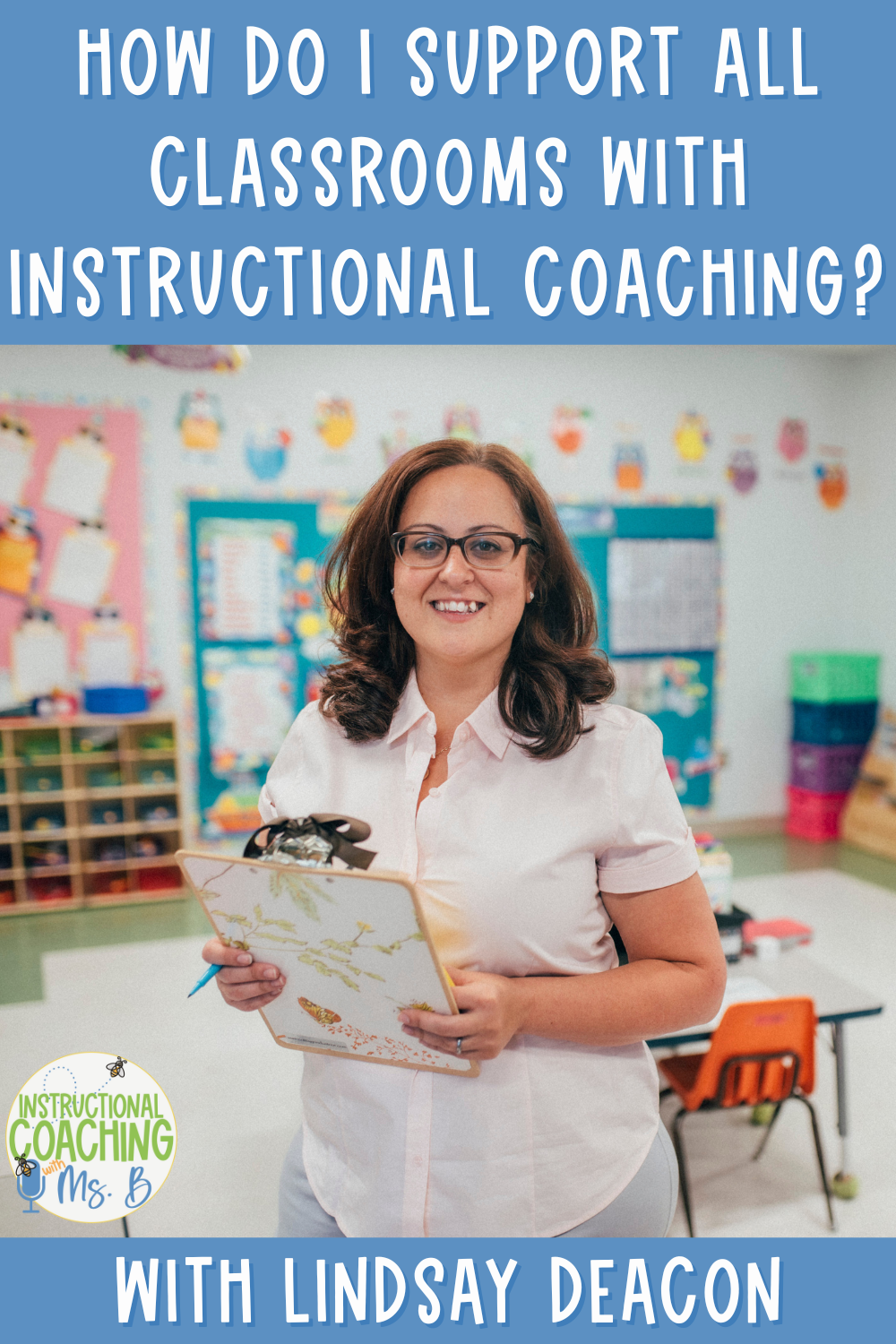
Chrissy Beltran smiling while holding a clipboard in a classroom. These words are on the image, How Do I Support All Classrooms with Instructional Coaching? with Lindsay Deacon.

An instructional coach’s job is to help improve instruction for every child! That may leave you wondering: How do I support all classrooms with instructional coaching?

In this episode, coach and author Lindsay Deacon shares strategies for working with all teachers. Together, we discuss the challenges of coaching an entire school and explore creative solutions to overcome them. Lindsay offers practical tips for managing administrators’ expectations, differentiating support, tracking our work, and creating a culture where teachers welcome coaching.

If you’ve ever wondered how to make coaching both manageable and meaningful across all classrooms, this conversation is full of takeaways you can use today. Listen now to get Lindsay’s realistic take on what we can actually do as instructional coaches to support all classrooms.

Here are a few of the highlights from the episode!

Challenges and Practical Solutions for Supporting All Classrooms

We all know coaching isn’t easy! During the episode, Lindsay and I discuss the challenges of supporting all classrooms, and she offers practical solutions for each.

Here are a few of the challenges discussed in the episode:

Unrealistic Expectations from Leadership

Lindsay says that leaders know they want coaching, but aren’t sure how to implement it. This can lead to wildly inaccurate expectations of what a coach is able to do, especially if they are the only one serving an entire school. It can also lead to uncoordinated resources and coaches getting stuck in the weeds.

She recommends working directly with leadership to manage expectations. If you work with multiple schools, the expectations may be different, so you’ll want to get clarity from each principal.

Limited Time and Resources

It’s difficult to balance coaching cycles, planning time, professional development, and other responsibilities. Lindsay suggests creative solutions, like forming cohorts for new teachers and bringing in district specialists for areas outside your expertise.

Resistant Teachers

We all know there are some teachers who actively avoid coaching or resist coaching opportunities. This makes it difficult to provide support. Lindsay recommends documenting your efforts and communicating with administration when teachers repeatedly decline support, since that becomes an administrative rather than coaching issue.

Supporting Teachers with Diverse Needs

The teachers we work with often have different levels of experience, willingness to engage, and needs. This requires differentiating our approach. Some solutions include tiering teachers based on needs or interests, offering flexible meeting times and formats, and providing different types of support, from intensive coaching cycles to light resource sharing.

Negative Coaching Experiences

Some teachers may have had a bad experience with previous coaches or mentors. Ask teachers about their past experiences to understand any baggage they bring to the coaching relationship.

How Do I Support All Classrooms with Instructional Coaching?

During the conversation, Lindsay offers innovative ideas for supporting all classrooms. Here are a few she suggests coaches try:

Learn How the School Works

If you’re a new coach or new to the building, spend time talking to people and learning how the school operates.

10-15 Minute Introductory Check-ins with Teachers

Schedule brief meet-and-greets with teachers at the beginning of the year to learn who’s interested in coaching support. Lindsay advises keeping these conversations short because teachers are really busy. Focus on building relationships and avoid the rookie mistake of positioning yourself as the expert who has all the answers.

Track Your Coaching Work

Document who you’re working with, how often, and what type of support you’re providing. This helps identify patterns and ensures you’re meeting with every teacher, not just those who seek you out.

Differentiate Your Coaching

Lindsay offers flexible coaching opportunities, tailoring the frequency and length of meetings to accommodate teachers’ schedules. She also tailors where and how sessions take place, as well as what they work on.

Create Teacher Groups

There are a lot of creative ways for coaches to work with teachers. Lindsay suggests forming cohorts for new teachers to build their network. You can also tier teachers for support. This allows you to serve more teachers and gets teachers talking to each other.

Practice Strategies Together

Lindsay makes coaching sessions interactive by role-playing and practicing new instructional strategies with teachers before they use them in the classroom. This hands-on approach builds confidence and gives teachers immediate, practical value.

To hear all of Lindsay’s tips for supporting classrooms with instructional coaching, be sure to listen to the entire episode.

Creating a Culture of Coaching

Lindsay offers a three-pronged approach to building a culture of coaching on campus.

  1. Be Someone People Like to Be Around: Start by being an approachable, positive person that teachers want to work with. Act like a scientist and notice whether people want to talk to you or try to avoid you to gauge their receptiveness to working with you.

  2. Model Being a Life-Long Learner: Coaches need to model that we are learners too. Demonstrate that you don’t know everything and are constantly learning new things. Ask teachers if you can visit their classrooms to see how they do things and learn from them. She also recommends being transparent about your experiences with coaches, including whether you currently have one.

  3. Connect Teachers to Each Other: Help build a supportive community by connecting colleagues with each other. Act as a bridge between teachers rather than being the sole source of support. If one teacher is doing something great, have other teachers see it in action!

How Do I Support All Classrooms with Instructional Coaching?

As an instructional coach, it can feel overwhelming to figure out how to support every classroom in your school. If you’ve ever wondered how to balance it all, you’re going to love this episode! Lindsay provides a realistic vision of how you can do it! You’ll walk away with a clear plan for supporting all teachers. Listen now to this episode: How Do I Support All Classrooms with Instructional Coaching?

Topics and Questions Discussed in Episode 246 – How Do I Support All Classrooms with Instructional Coaching? with Lindsay Deacon

  • How do I support all classrooms with instructional coaching
  • Challenges coaches face when trying to support teachers and creative solutions to overcome them
  • Managing expectations and workload as a coach
  • Does Lindsay wait until teachers seek her out, or is it expected that all teachers will be coached
  • Differentiating coaching opportunities based on teacher needs, interests, and availability
  • Building relationships and creating a culture of coaching
  • Coaching teachers who are resistant or have had negative past experiences
  • How to provide support for a large group of teachers
  • The roles and responsibilities of instructional coaches
  • Tracking coaching work and teacher engagement
  • Strategies for managing time and prioritizing teachers to support
  • Coaching strategies, including modeling, role-playing, sharing resources, and connecting teachers to each other

Ready to listen?

  • Ready to listen? You can listen below with the media player, or search for Buzzing with MS. B: The Coaching Podcast anywhere you listen to podcasts!

This post contains links to products from one or more of our advertisers. This means I may receive commissions for purchases made through links in this post when you click on links to those products. Thank you for your support!

Learn more

Helpful Resources


Listen on: Apple Podcasts, Spotify, or your favorite listening app


Thank you for listening to Buzzing with Ms. B: the Coaching Podcast. Want more coaching ideas

Check me out at buzzingwithmsb.com and on Instagram @buzzingwithmsb.

If you love the show, share it with a coach who would love it too, or leave me a review on iTunes! It’s free and it helps others find this show, too. Happy coaching!

Podcast produced by Fernie Ceniceros

How Do I Support All Classrooms with Instructional Coaching? with Lindsay Deacon, ep. 246, Instructional Coaching with Ms. B Podcast

Chrissy Beltran  00:00

Hey, Coach, how do you start the year as an instructional coach? How do you set yourself up for success in the first month of school? To a new coach, these questions are huge, and even to an experienced coach, the New Year can bring butterflies and back to school nightmares. I know I’ve had plenty well. If you’re feeling like this, I’ve got you I have the course that’s going to change your life. Instructional coaching startup helps you start the year with a roadmap that tells you exactly what to do each day for the exponentially important first 20 days of school, the things you do the first month of school will make or break your coaching year. So let’s do the right things together. Head to buzzing with Miss b com slash startup to join the waitlist for my instructional coaching startup course. The course opens soon, but if you join the wait list, you’ll receive a coupon code for 15% off when the course actually opens up. I can’t wait to help you start strong and coach better this year, buzzing with Miss b.com/startup and I’ll see you in the course.

Chrissy Beltran  00:56

Welcome to instructional coaching with Miss B, where we believe that every teacher deserves a coach, and every coach does too. I’m Chrissie Beltran, an elementary teacher who became a coach, and I had to create my own coaching program that worked. Now I teach coaches how to design their coaching programs, build a school wide action plan and use differentiated strategies to support teachers. Plus, I’ve got a special spot in my heart for literacy coaches. Now let’s dig into the episode.

Chrissy Beltran  01:23

This is episode 246, how do I support all of my classrooms with instructional coaching, with my guest, Lindsay Deacon. I am so excited to talk to Lindsay because I actually was able to spend a little bit of time with her. This past summer, we both went to the instructional coaching conference in Austin, Texas, and it was such a good conference. I had such a nice time. There was some great sessions. I got to see some of my favorite long distance people who I hardly ever get to see. So I had a really good time. And I hope next summer you check it out too. But in the meantime, you can listen to me and Lindsay talk about how you we can support all of our classrooms. This is a question that I got whenever I sent out my survey for this season, podcast season, and it’s something that I think we all feel the pressure to do, to support every classroom in our school. And the problem is we feel like if we’re not supporting every classroom in the same way, then we’re not doing it right. If we are not doing a quality coaching cycle with every teacher at least three times a year, or whatever magical number we have set up in our heads, we feel like we are not doing the work of supporting that classroom, but in reality, that’s not going to happen. We just need to stop pretending that’s even ever going to be the case. We really have to think about differentiating and providing different kinds of support to teachers to meet them where they are when we think about supporting every classroom at our school. So that’s what we’re going to talk about today with Lindsay. I cannot wait to I wait to have you listen to this episode, because she always had such a great perspective on working with CO with teachers. And before you get started, I do want to remind you about my action plan toolkit. The action plan toolkit will help you set your goals, get your action plan set up for the rest of the school year, so you know where you’re headed and what it is you’re trying to accomplish every single day. It’ll really help you prioritize the work that you do for all three tiers of your school, your whole school, tier one, your differentiated teams, which is tier two, and your individual teachers, which is tier three, really, truly differentiated in a completely personalized way. So you gotta check that out. You can get that at buzzing with Ms b dot com slash action plan. I have a really cool, free little mini course for you that will walk you through the action plan toolkit and teach you exactly what to do. You don’t need the toolkit to do the mini course. It gives you everything you need. So check that out, and I hope you love this episode. Let’s welcome Lindsay. So welcome to the podcast, Lindsay, thanks for being here. Thank you for having me. We know you’ve already been a guest on the podcast before with your partner, Angela, but I would love to hear you introduce yourself in a few ways. And we’d want to know who you help and how you spend most of your time and energy at work.

Lindsay Deacon  03:53

I feel like every time I talk to you, I have a different What am I doing? Yeah. So I am no longer working for like one organization or one school. Well, I guess I work for myself now, really. But the way I see it is, I work for multiple teachers, coaches, school leaders in a variety of districts. So I help new and developing teachers, as well as all the way to school leaders, and help them developing school systems and Angela, my co author, and I, we still collaborate with writing, and so I’m kind of coaching in person. Sometimes I’m coaching virtually. I’m leading workshops, so I’m all over the place. Yeah, it’s so much fun.

Chrissy Beltran  04:35

And then we want to know about the hobby that you love, because I’m on a mission this year to introduce hobbies to coaches, because I feel like we don’t spend enough time on things that we enjoy. Oh, man,

Lindsay Deacon  04:43

you probably don’t know that I’m a professional bucket Lister. I’ve been making an annual bucket list since 2011 so I have many and an overwhelming amount of hobbies. One thing that is one of my bucket list goal. Was a couple years ago, was I wanted to learn how to, like, really ride horses. So I’ve been taking weekly riding lessons for two years. So I love riding horses.

Chrissy Beltran  05:10

That is so neat. I love that you just decided to start that. What made you decide to to invest in that? I think

Lindsay Deacon  05:16

it was something, you know, like, in the back of my mind, like, Oh, I wish, I wish, I wish, I wish. And I was like, well, you’re never going to learn unless you just do it. Yeah, yeah, that’s great. I love it. I didn’t realize I was choosing the most expensive

Chrissy Beltran  05:30

hobby little I knew, yeah, that’s the big one. Not for the faint of heart,

Lindsay Deacon  05:36

bro, luckily, I don’t own a horse, so, okay, yeah,

Chrissy Beltran  05:41

that’s that would, that would probably double your expense at least. Oh my gosh. I have a friend who owns a horse, and I just cannot imagine, no,

Lindsay Deacon  05:48

yes, and I like, especially as an educator, I don’t feel like it generally fits in our budget or in our schedule, but I’ve made it work. I’ve told him,

Chrissy Beltran  05:56

I like that. You made it work. So today we’re, we’re looking at supporting all classrooms, because this is a question I keep getting from coaches, how do we support all classrooms with instructional coaching? And so as you’re thinking about that, what are some of the challenges that you have faced in trying to support all classrooms at a school with an instructional coaching model, any model,

Lindsay Deacon  06:19

I would say, one common theme that I often see is just that leaders know they want coaching, but they aren’t sure how to implement it, so they have some I don’t I don’t mean this to be mean, just like wildly inaccurate expectations of what a coach is able to do, because they’re only one person serving an entire school, and there are some schools that have multiple coaches, but then often the resources aren’t coordinated, and it’s just really easy to get into the weeds. So I would say, as being generally the sole coach in my building. From my experience, I’ve just learned that it’s really important to work with leadership, like, what are their expectations? And really helping them manage that to know how much I’m able to do. Also, I like, would get gym night on the horn, like, hey, you know, how many coaching cycles is a coach really expected to do in a certain amount of time? And it was very helpful to hear from him that if a coaching cycle takes on average, five to eight hours, and you know that you need your planning time, and you’re also maybe leading PD in your building, or doing these other things like start mapping out your time. So that is one way I think that I would recommend that folks at least manage their expectations on reaching every teacher. Does that make sense?

Chrissy Beltran  07:40

Yes, absolutely I agree. Because I think the question is not, you can’t just answer the question, if that makes sense, because I can’t either. I have like, well, we support teacher students, fresh criminal coaching in different ways, but in terms of, like, if we’re thinking like coaching cycles, which is only, to me, one piece of the coaching work that we do, okay, yeah, if we’re thinking just about that, I then we, you don’t do that at all. You don’t do all of your everybody is not in a cycle at the same time. It would just be and you really couldn’t, I don’t even know even how it would work. I mean, like, logistically, or even if some people, like, put them on a schedule, in a rotation, I don’t love that myself, yeah, because I don’t think it’s very responsive. I think it’s just the way people are like, well, I don’t know how else to do this, which I totally get. So they’re like, Well, I guess I’ll put them on a rotation, so at least I know by the end of the year I’ve gotten to everybody at least

Lindsay Deacon  08:30

once or twice. Yeah, well, and I’ve seen so many coaches be really creative about how they reach, you know, different, you know, different groups of teachers. So I love when they get, like, teachers who are new to teaching and or new to their building, and just have them meet as a cohort, you know, once a month, just so they can answer even just, like, logistical questions. Or like, where do I find this? How do I how do I do this? Because then that also builds, like the network, where then teachers are just talking to each other, and that’s kind of the goal, right? Yeah, or just, like, bringing, sometimes, bringing in, like, somebody from the district office, like, is there a Tosa who, you know, is able to provide some support to teachers where the coach maybe that isn’t their area of expertise. So I think there’s a lot of creative ways that coaches problem solve, but to expect that a coach is constantly serving every teacher all times in like, a deep coaching cycle, is, I would say that’s, like, just generally unrealistic,

Chrissy Beltran  09:27

yeah, yeah. It just kind of shows up that the people who are expecting it, kind of like you said, don’t really have an idea of what all is entailed into that kind of work. And so I think that being said, the ways that I’ve kind of tried to serve all teachers, is by considering like, teacher need and sort of, you know, I mean, I do. I have done a process of tearing teachers where i i personally are like, I’m trying to figure out, okay, where do I need to spend most of my time? Where do I need to make most of my inroads so that I can get these teachers involved in cycles that are going to really impact their teaching? And then who can I be like, Okay, you. Will find me if you need me. I know you will. Yes, no. Like some people are gonna, are gonna actively seek out that learning some people are not, and you have to be the one to, like, get in that room.

Lindsay Deacon  10:08

Yeah. I think also, just like tracking your own the work you do, you know, like you, you can be thinking about it all day, like, Oh, I’m working with this person a lot. I’m working with this person a little. I haven’t worked with this person at all. Like, this person asked for help. But I think really like having documentation, and I don’t mean to, like, provide that to leadership, necessarily or but just for yourself, just like you would with your students, you want to have something that shows the growth that you’re making, as well as just like, literally tracking who you’re working with, because otherwise it’ll just get overwhelming.

Chrissy Beltran  10:40

Yes, and then we tend, I mean, I, I’m just, I’m a very human person, and I do tend to avoid certain situations. If I’m not, like, I have to make a point to have a conversation with this person, you know, like, you have to, I have to say this is going to happen this week. I’m even going to put it on my calendar, because, if not, there’s, there are certain classrooms that I just don’t feel very comfortable

Lindsay Deacon  10:59

in. Yeah, that’s such a good point. Like, just putting it on your calendar sometimes, like, that’s just setting an intention right there that, okay, I’m going to do this. Yeah? I’m

Chrissy Beltran  11:08

going to be ready to do it on this day. Because it’s easy for certain classrooms to get away from us, because we forget. And then some we like, actively are not wanting to do this. Yeah? 100% Yeah. So then in your coaching work, have teachers how? I mean, I knew you’ve worked in different settings. So do teachers seek you out for coaching? Has it been expected that everybody’s going to be coaching some way or another? What did that look like at your school? Because coaches work in very different environments, and as far as, like, who gets helped, who gets supported?

Lindsay Deacon  11:40

You know, every place that I’ve worked has had wildly different expectations. And so I think in the beginning, like when I was like a new coach, I was waiting for leadership to tell me what to, you know, like, what should my work look like? Who should I work with? When should I be doing this? And then I learned throughout, like, different iterations of working in different schools and and even having, like, coaching teammates, like, Oh no, I need to take charge. And so I, I find that there is, like, not a, like, a one size fits all approach. I don’t Well, I guess, like, what would you think about that?

Chrissy Beltran  12:17

Yeah, I think, I mean, obviously different administrators have different ideas. The school that I started coaching at, it was like, expected that everybody would receive coaching support at some point in some way, but the way that it was provided would vary. And then there were certain times where it was like, Okay, this teacher needs like, I was directed. And I know some people are not fans of this, but I just think it’s the reality of of schools with expectation? Yeah, there are going to be expectations on teachers, and when teachers are not meeting expectations, of course, you’re going to send in somebody to provide them with some support, not that I’m responsible for their evaluation or anything like that. But if a teacher is struggling, if their kids are not showing progress, well, what are we going to do? You know? So whenever people like, Well, I’m not a fix it model. No, I’m not either. I’m not going to go in and fix that class, but I’m going to get in there and do what I can do, because those kids deserve that, and the teacher does too. Yeah. So I have been directed by principals, who’s, you know, this is the person I need you to work with. You know, I’ve talked to them about it already. You know, they’re I need them. This is what they’re working towards. You know, they are working towards small group intervention. You know, I’m not. This is, these are some things that we’re not seeing, that, you know, that we would like you to work on them with, with them on and then when I go to the classroom, I’ll say, so, you know, Miss so and so told me that you’re working on this. Can you tell me about that? And then we just kind of get started in that way and see, you know what direction it takes us, but, but that’s been my experience.

Lindsay Deacon  13:45

Yeah, and I, and I actually even right now, I virtually coach several coaches in different districts, where they are, like, either the only coach for their small district, or they serve multiple schools. And so they have to be pretty strategic about how, not only they work with teachers, but how teachers seek them out for help and and then it’s it’s even more challenging because each principal has, like, a different expectation of what they’re looking for from that person. So I think just being really clear is pretty important about, like, how do you get a hold of me, and what kind of work could we do together. But, and again, like going back to, like, having a document where you track who you’re working with, that also can help you capture, like, if somebody keeps turning you down, or is like, deflecting and they don’t, you know, they’re like, then you can just share that with administration. Like, listen like I’ve offered support, like it’s just, it’s just not working. And so I’m going to invest my efforts over here instead, so you can at least show you’ve made an effort. Yeah, that just

Chrissy Beltran  14:47

happens. That’s true. You know, I actually did work with one principal who said, I don’t need to know really anything except for, like, you know what you worked on, like, the topic of work that you did together, unless they’re not, they’re just shutting you down. Now. So if they’re shutting you down, I need to know that, which I get. I mean, she was paying me, that was my job, was to grow the school. So, like, if I’m not able to do that, they I do believe they need

Lindsay Deacon  15:09

to know that. Yeah, I totally agree, yeah. And I

Chrissy Beltran  15:13

think that that can be, like a controversial there’s so many different coaching philosophies out there. And so I’ve talked to, like, so many, I mean, obviously, even just through this, the medium of this podcast, so many different people with different impressions of that. And I just feel like this is, kids are in the school. We gotta, we gotta serve them, and that’s your job. Is to help, is to improve instruction for every child. So how can you do that? If somebody’s shutting the door in your face, and you’re just like, oh, well, you know, I just don’t, I don’t get it. Oh, that’s supposed to happen. I mean,

Lindsay Deacon  15:44

then it becomes an administrative issue. Then it’s not coaching. Then it’s like, okay, coaching was the support that was provided. It was turned down repeatedly, or if, you know, something, something didn’t work. And now, now this becomes, like, the administrators just hand it over to them.

Chrissy Beltran  16:01

Yeah, yeah. And I do believe you make lots of efforts, but then after a certain point, like, you’d have to try different tactics and things like that. You know, look for opportunities, but after a certain point, yeah, it may not be something you can control anymore,

Lindsay Deacon  16:12

yeah, especially when there are so many teachers who really do want support and you’re just trying to, like, manage your time. So I mean, I and I actually have like, a, I wouldn’t say, like a large bank, but I have like, a list of articles I kind of lean on when it’s like, oh, somebody is really, really struggling, or somebody’s turning me down, and a principal’s like, what’s happening here? I’m like, Well, this article, this research, shows, like, you know what? Like, I’ve done my due diligence now. Now it’s your turn

Chrissy Beltran  16:41

interesting. Like, can you, would you be able to send any links to any of those articles to us? I could put them in the show note?

Lindsay Deacon  16:47

Yeah, of course, one of my favorites, just off the top of my head. It’s called, who’s that teacher? And it’s like a matrix of, like, four types of teachers by Gary Wale. I’m telling you, this is, like, it’s probably 2011 2012 that that came out. But I still go back to it because it’s a quick read. It’s probably in learning forward, and it’s like, here are the types of teachers we work with. And when you truly have somebody who’s just like, not making progress, and you’ve really done your darndest to work with them, like it’s not the coach who does this anymore, move on. You know? Yeah, I love that, because we’re on the subcontract most of the time as teachers too. We’re not evaluators. And so anybody who feels that they’re kind of pushed into that position of evaluating also needs to be really clear, like, I’m not going to do this. Yes, administrators, job.

Chrissy Beltran  17:35

Yeah, that’s very true. And I mean accountability, you can there’s accountability like this just kind of comes out of the nature of the coaching relationship. But as far as, like, accountability for school stuff, yeah, Administrator has to be the one to draw the line on these things. And they don’t always. They’re not always that kind of an administrator. And I have felt, I know, that that can be frustrating. When you’re coaching, you’re made all these efforts, and you don’t see any result, and then the admin is, like, not they like they’re Toothless. You know, it’s like, you’re the one that has to be the guy. It’s gotta stop with you. If it doesn’t, the buck doesn’t stop with you. It doesn’t stop anywhere.

Lindsay Deacon  18:09

One of my favorite coat or one of my favorite coaching quotes, is from compassionate coaching, and it’s like, I’m probably going to say it wrong, but like, the coach’s job is to help teachers see the light. The administrator’s job is to make them feel the fire, something like something like that. I always pull that because I feel like, even though that’s like, good food for thought, I really love that idea that sometimes you know, if the coach is really helping to illuminate, like, you know what’s happening in the classroom and helping them improve practice. Because we that’s that’s like, our whole role is professional learning, but administrators, they serve a different role at times. You know, they’re the manager. We’re not managers.

Chrissy Beltran  18:54

That’s right. That’s right. So if you were given like, let’s say that you walk tomorrow and you’re going to be into a school tomorrow and you’re going to be the main instructional coach for like, 45 teachers. How would you go about? Yeah, I mean, that’s that was just asking for a friend, like, like, how would you go about? Like, figuring out how to provide support to that school.

Lindsay Deacon  19:18

Man, that’s a that’s a tough question. Okay. Well, if I was going into a school, first of all, it’s really just about learning how the school works and just talking with people. I generally recommend to coaches, because this is something that’s worked for me many times. Is just trying to set as many like 10 Minute, just like, introductory check ins with coaches at the beginning of the year, as possible or not, with coaches, I’m sorry, with teachers, just like, hey, do you have 10 minutes? I just kind of want to, like, say, hey, you know, just do a meet and greet and then leave. And always kind of hold it to 10 or 15 minutes because you’re both super busy. But that generally will open the. Door to just get a sense of what’s happening in the building and who, who you may, who you might want to work with in the beginning. But then I think really starting to, like, by the end of the first month, like, really have a system for who, who’s like, yes, I want to work with me right now, or I want to work with a coach right now, maybe like, who you haven’t heard from at all, who you think is probably pretty interested, but you know, they might just need a little bit of time to settle. Who is going to like what professional learning, so that you know, you know, is it, are they, like, really invested in some new ELA resources, or some new math and science. So I think just kind of learning and absorbing the information before making a plan. I think a rookie move that I know I made, and I’ve seen other coaches make, is like going in and being like, hello, I’m your coach, and let me tell you everything. And that’s like, not how people work, yeah,

Chrissy Beltran  21:00

yeah. But I think the coaching introduction is really important there. Whenever we’re introduced, it’s like, this is the expert, which is how I was introduced as a new coach. This is our reading, writing expert. And people were like, Oh, great, an

21:10

expert. I want, yeah, yes. So not, they were

Chrissy Beltran  21:14

not super excited about that. So, like, I had to overcome that, I feel like, over. And some people were like, Oh, thank goodness somebody to ask all my questions too. But a lot, most people were not excited. So,

Lindsay Deacon  21:22

yeah, because, because a teacher is the expert in their classroom. Yeah, so personal, and they spend all day, every day, with their students. And so you can be an expert in certain content areas, or, you know, I can say, like, oh, I have some expertise in coaching, but you never know everything, right? So you have to really honor whatever is happening in the teacher’s classroom before your own expertise.

Chrissy Beltran  21:50

Yeah, I agree. So what are some of the ways that you differentiate coaching opportunities based on, you know, like you mentioned, obviously teacher interest, but obviously there are other factors that go into providing different teachers, different teachers, different support. So what does

Lindsay Deacon  22:04

that look like? Yeah, well, for me now, logistically, I differentiate how much time I meet with people, or how like the frequency that we meet, or the amount of time. So for instance, like I right now, I’m coaching somebody where she likes to meet, you know, 60 to 90 minutes a week, and then I have another, like, a fourth grade teacher, where she only has like, 25 minutes every other week, if we’re lucky, because, you know, like, even if we have it on the calendar, sometime that’s like, when her students are in specials, and sometimes there is no PE teacher, and so she doesn’t get to send them, right? And that then coaching time and sacrifice. So I think time is the first way that I just differentiate how much they’re going to get. That doesn’t mean that More time equals more value. It’s just more flexibility for the person. But then also, like where we meet, how we meet, I think logistically is also really important, because some teachers really are able to meet virtually. Or I just heard Ooh from a district where they’re offering, like, a stipend to meet after school, or they can meet on the weekends. And some teachers prefer to get together with their coach over coffee on, like, a Saturday morning, and they’re paid for it. So I think there’s just so many options just in like, the how and the where you meet, but then differentiating in terms of, like, what you work on, I would say some folks really want intense like, how do I master this new strategy and collect data and look at how it’s impacting My classroom, and then others are like, You know what? I went I’m like, I’m going to these trainings, and I just need a little bit of help finding some resources, right? So that kind of, that coaching heavy, coaching light, is how I differentiate, but that’s generally comes out in in our coaching conversations. So there’s not, like, a, one, A, one way to do it,

Chrissy Beltran  24:02

yeah, yeah. And then, what other kinds of coaching opportunities do you provide to teachers? You mentioned, like, resource recommendations. You mentioned, obviously, like coaching cycles, which is just very invested in classroom time. What else does your coaching look

Lindsay Deacon  24:15

like? Um, I love to practice like in our coaching conversations, I love to either practice a strategy or a protocol just the two of us, you know, like, with no students around. And so that could be me modeling something, or maybe we’re watching a video of something being modeled. But a lot of times it’s just like, let’s just just pretend right now, let’s role play like I’m a student. Like, try, like, what would you say? What would you have me do? Or you want to try using this, this protocol. So let’s, like, do it right now together and just practice. And I think that that, to me, is always extremely valuable. You get a lot, a lot of bang for your buck when you do that.

Chrissy Beltran  24:53

Yeah, I like that. So one of the problems that I think schools have is they set up coaching is like, this is what. What our new teachers get. You know, we coach our new teachers, or we coach struggling teachers as needed. But real coaching happens when everybody understands this culture of coaching, but everybody is going to grow in different ways. So how do you create that culture that really just expects that all teachers are going to benefit from coaching?

Lindsay Deacon  25:19

Well, I know that in one of those gym night books that, like, they all just start to run together for me. But and he talks about how a coach needs to be somebody that people like to be around, and they need to have, I don’t think he uses, like, the term infectious personality after covid, but it’s, you know, something along those lines of, like, it’s contagious in the way that people want to be around you, they want to work with you. And I think that that is the start. Because if you just aren’t so many that where people like, enjoy your company, then it’s just harder to build a relationship. And that, to me, is the beginning stages. But also like coaches just need to love to learn like and like, like, I just, I’m gonna learn how to ride horses, whatever. I’m gonna feel like an idiot, but I’m just gonna do it right. And so I think if coaches model like, we’re also huge learners. I don’t know everything. Can I come into your classroom and see how you do it? So I can learn how that works. Then that also is a really big invitation to establish a culture of coaching across the board. I also just really love when coaches help connect other people, like teachers to other teachers, like, oh, you should talk to so. And so she’s already doing this. Oh, you should talk to so. And so he’s already doing that. So when I am trying to build a culture of coaching in in my schools, that’s generally like my three pronged approach.

Chrissy Beltran  26:46

That’s interesting. Do you have any thoughts on like, people who feel like, if they’re if somebody was listening to that and they said, Well, I don’t know if people really want to be around me. Like, is that part of my issue? What can that look like? How can you go about addressing that?

Lindsay Deacon  26:58

Well, I’d say go through your building and be a scientist for a week. Do you notice that people are like when you’re in the coffee room? Do they go, Oh my gosh, you’re here. I wanted to talk to you. Or do they turn around real quick and avoid you know, do people feel like when you’re just when you’re talking with people in general? Do they feel that they can share confidential information with you? You know, do you? Do you notice that they’re sharing things that they can really trust you to hold? And I, I mean, I would just say, like, act like a scientist for a week and see, see what you notice? Um, nobody’s perfect, right? Nobody’s perfect, but I think that if we are just assuming that people want to work with us, we’re going to lose, we’re going to lose someone, right?

Chrissy Beltran  27:51

Yeah, yeah. And then think that there are, there are going to be teachers that are going to be a little bit of pulled out, and you have to really, like, make an effort and build independent, like, intentional bridges to those individual people. But, yeah, in general, people don’t want to work with somebody that they don’t really want to be around to work with them. I mean, it takes time.

Lindsay Deacon  28:11

Or if you know, if there’s if a teacher has previously had an experience with a coach or a mentor, was it good? Was it valuable to them? Was it damaging? Right? Like, sometimes you have to rewrite the story as well, and that’s going to take more effort. Or sometimes they had, like, an amazing experience with a coach or a mentor, and they want to replicate that experience, and that might not be the way that you work. And so it’s really nuanced in terms of how, how a coach can approach teachers to do the work together, but I think just gathering information is important. Like, Hey, have you ever had a coach? Have you ever had a mentor? What was that like? What worked for you? Yeah, yeah. I

Chrissy Beltran  28:50

think that’s a good one too. That’s one of the questions that I put at the beginning, like in a coaching introduction, if you have the opportunity to do this with everybody, having them write a little bit about if they’ve had a previous experience with a coach. I think it’s helpful if they’re willing to share that, because some people are, they have lots of baggage from Totally, yeah, from previous experiences. Oh, we had a central office coach, and she told me I was doing everything wrong, you know. And that’s, I mean, I’ve heard things like that. Oh, we had a coach come for whatever. Or even they weren’t termed a coach, but they were like a support person, and all they did was, you know, take notes and meetings and tell the principal what we said, or, you know, things like that, but yeah, you’re kind of having to undo that. So it makes it really hard to support all your teachers whenever some of them have that idea of what you do.

Lindsay Deacon  29:32

I also have my own coach, and I make that pretty clear to as many people as possible that like everyone in my in my opinion, should have a coach that’s that’s how you get better. And there are a lot of I don’t know questions my coach asks me, or ways that she helps me learn that then I really reflect on so that when I’m working with somebody, I can. And try to replicate that process as well. And I’ll, you know, I’ll even name it with people, hey, hey, I just did this with my coach. Would you be willing to try this with me? Because it worked, you know, worked for me. You want to try it. But I think just having invitations to work together are going to be generally, like, much more well received than like, Hey, by the way, I’m going through this list, you know, I have to work with everybody in the building, so now I’m just checking you off. Like, no, that doesn’t feel good.

Chrissy Beltran  30:27

Yeah, yeah. It’s not purposeful, and it’s not necessarily relevant at that time either. Yeah. Well, thank you so much for sharing everything today. How can people keep learning from you?

Lindsay Deacon  30:38

Like, do people actually learn from me? Yes, they do. I learn from everybody else. That’s like, my favorite is, I love learning from everybody else. And then I’m like, Oh, that’s good. I’m stealing that. Well, okay, so my co author and I, Angela, we have written the edu coach Survival Guide, but we are also in the middle of writing a new survival guide, a presenter, Survival Guide, really, for anybody in education who leads meetings or group professional learning. So I’d say like, just be on the lookout for that, probably later this summer, in the fall, and then you can follow us on Instagram, the edge coach, Survival Guide. And we just like to try to share as many tips, tricks, tools, inspiration that we come across. So, yeah, I love it. Thank

Chrissy Beltran  31:25

you so much. Thank you. I just love that all that from Lindsay was so good, because I think it was realistic. And framing this around you have to have a realistic vision for how much you can actually do as a coach, and if you are moving into the school year, if you’re listening to this in real time, the idea of making sure that your administrator knows what coaching really looks like is a good one. Making sure that you are having realistic expectations for yourself is good because coaching isn’t all super deep. Coaching cycles with every teacher. It just doesn’t look like that. Coaching looks like a lot of different things. In the book that I’ve written, your coaching strategy toolbox, I share different strategies for coaching teachers in different ways based on their need and some other factors that go into the decisions that you make as a coach. So I think we have to be really thoughtful about all the opportunities we have to serve teachers if you’re needing some support in actually figuring out who to coach and where you know how much time to spend, who to really focus on relationship building with. I recommend my tiering teachers for support. Free Download, and you can get that if you go to the episode. Show Notes for this episode at buzzing with Miss b.com/episode um, 246, you can grab the cheering teachers for support guide, and this will help you figure out where you need to spend your energy, and kind of give you a little organizer to keep all of your information organized and really help you focus your work on working with teachers. So that’s if you need a free tool, definitely grab that one. And next week, we are starting a new series about instruction, lesson planning, really all the stuff that we’re trying to impact that we don’t always spend enough time talking about, because we also spend a lot of time talking about how to be a coach, right? So we’re starting a new series with components of strong tier one instruction. And my guess is. Olivia wall, I cannot wait to share that with you, and until next week, happy coaching.

Chrissy Beltran  33:32

Now that you’ve got so much to think about, head over to buzzing with Miss b.com to grab some free downloads, become a VIB and check out the podcast. Show Notes, happy, coaching, you.

Share:

Similar Posts

Leave a Reply

Your email address will not be published. Required fields are marked *