| | | | | |

Troubleshooting Your Instructional Coaching, ep. 259
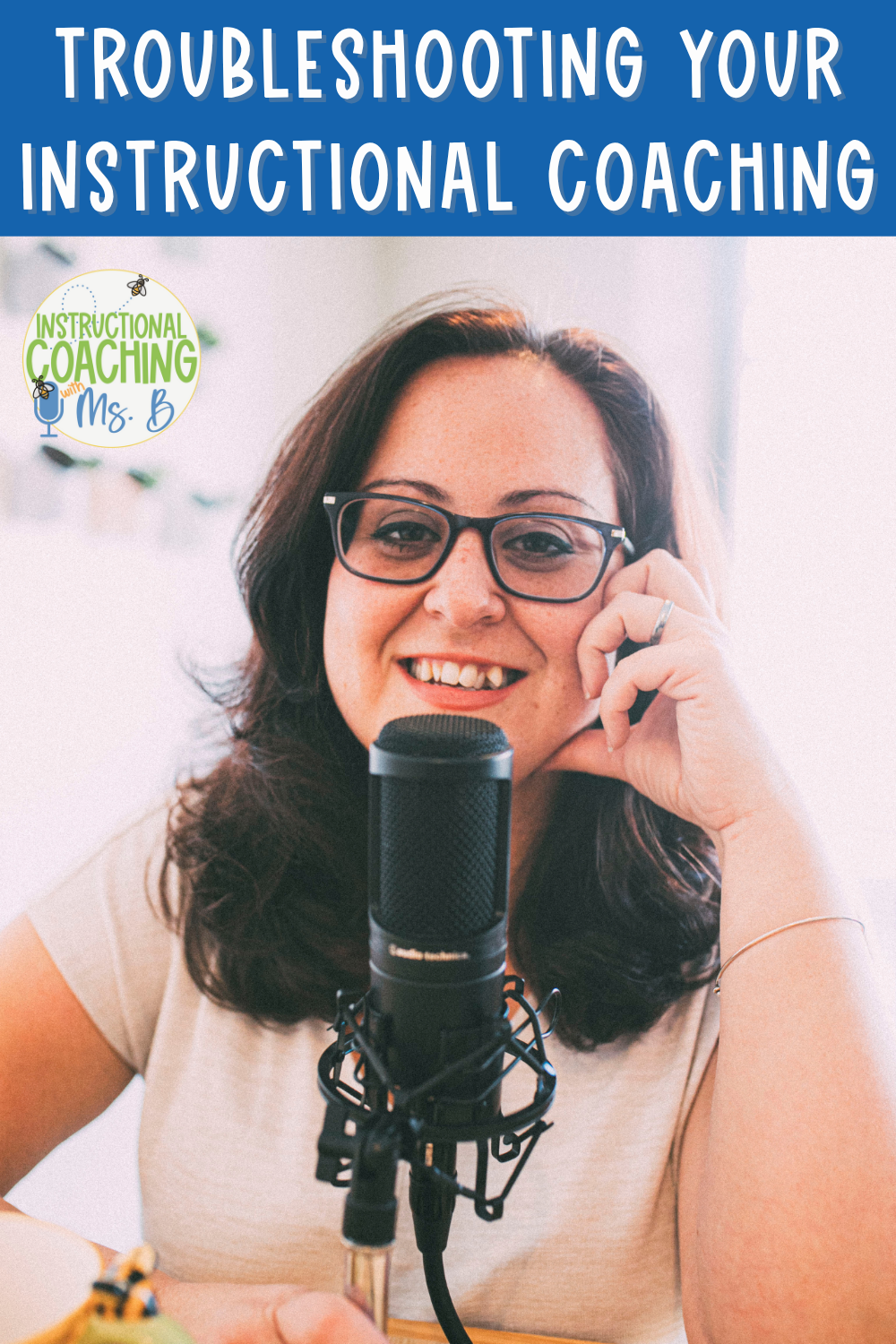
Chrissy Beltran sitting with a microphone in front of her. these words are at the top, "Troubleshooting Your Instructional Coaching".

Coaching isn’t supposed to feel like pushing a boulder uphill, but some days, it absolutely does! That’s why in the season six finale of Instructional Coaching with Ms. B, I’m offering ideas for troubleshooting your instructional coaching!

In this episode, I highlight five coaching problems and share proven steps for tackling each one. These challenges come straight from coaches I’ve been working with over the last year. Many are classic issues, but some have gotten a lot bigger over the last few years.

You’ll hear about what to do when teachers aren’t responding to coaching and ways to clarify your role with teachers or principals. I give ideas for bridging professional development (PD) so there are actual shifts in classroom practice and in the data. Plus, I highlight past podcast episodes that can support you as you work through each challenge.

Ready to make your coaching work easier? Listen to the full episode to get the complete breakdown.

Why Now Is the Perfect Time for a Mid-Year Coaching Reset

This episode is part of the mid-year coaching reset mini-series. December is the ideal time to do some deep reflection on your coaching work so far this year. You want to think about what’s working, what’s not working and then develop a plan to address these issues in the new year. With a fresh outlook, you can work on these obstacles before they get bigger and snowball into something much bigger!

5 Common Instructional Coaching Problems

Instructional coaching comes with plenty of challenges, but you don’t have to figure them out alone! I’m here to help! Here are five common coaching problems and practical strategies for handling them.

Problem 1: The Teacher Isn’t Responding to Coaching

One of the common challenges for instructional coaches is working with teachers who aren’t excited about coaching. You’ve put in the effort, kept it positive, shared strategies, and made yourself available. Yet, despite your best intentions, some teachers seem to be dodging you. Their actions say they’re not ready (or willing) to invite you into their classroom.

Don’t give up! Go back to the basics!

Here are a few steps I take when teachers seem uninterested or resistant:

  • Introduce your role clearly and repeatedly (in person and in writing). Be sure teachers really understand what you’re there to do. Just know you’ll probably need to do it more than once!
  • Examine your coaching relationships through the lens of the “Three C’s”: clarity, consistency, and connection.
  • Think about where your relationship needs work and focus there. Sometimes you need to put in the effort to establish trust or repair past misunderstandings.
  • Look for coaching opportunities by responding to teacher questions and complaints with support. These are entry points that will get your foot in the door so you can start building rapport. Offer specific, actionable help and give choices instead of leaving it open-ended.
  • Use exit tickets after PD to kick off coaching and follow up confidently.

Remember, you can’t control anyone else’s willingness to work with you. All you can do is ensure you’re not the thing getting in the way. If you’ve done all this and there’s still resistance, keep showing up, offer support, and be ready for that teacher when they’re ready for you.

To learn more listen to Episode 253 – Always Be Coaching: How to Leverage Every Interaction

Problem 2: Your Principal Uses You for Things That Aren’t Your Job

Are you being asked to do lunch duty, test administration, or paperwork? This is one of the most frustrating issues faced by coaches. I really think it’s why every coach’s contract states, “other duties as assigned”. When our days are filled with these distractions, it’s hard to show meaningful progress in the areas where we’re supposed to make an impact.

So, what can you do when you’re being pulled in a million different directions (and who isn’t these days)? The first step is to go back to basics and have a frank discussion with your principal about your coaching role. Make sure your job description and goals are defined, and everyone signs off on them.

You can also document where your time is being spent and share it with your admin. Listen to Episode 143 – How to Track Your Coaching Work with Krissy Ogletree Edwards to hear how she documents her time with simple tools like Google Calendar.

You can also connect your coaching wins to your actual work by doing this exercise with your principal. List all the tasks you’ve spent time on recently on the left and the wins you’ve had on the right. Then connect the wins to the activity they came from. You’re going to notice a lot of the tasks on the left side are not responsible for teacher and student growth.

If none of these strategies help, it might be time to bring in central office support to have a conversation with your principal about your coaching responsibilities. Alternatively, you can share a research article with the principal to clarify what instructional coaching should look like. Although I think bringing in an expert is probably best for sticky situations.

To learn more listen to Episode 193 – The Principal’s Role in Instructional Coaching with Nicole S. Turner

Problem 3: Work You Do During PLC Meetings or PD Isn’t Translating to Classroom Practice

I remember spending 90 minutes planning with each grade level when I first started coaching. Then I went to classrooms, and I didn’t see what we worked on being implemented at all. It was so disappointing!

Whenever we see that things are not transferring to the classroom, we’ve got a real bridge issue. We need to be clear about the purpose of PLC or team meetings.

Ask yourself these questions:

  • What will teachers walk away with? Do they?
  • Is there a bridge built from the meeting to the classroom?
  • Is there a clear expectation?

To build a bridge from meetings to classroom practice, you’ll need to identify if the teacher needs more support or more accountability.

If they need support:

  • Use model classrooms
  • Model using gradual release
  • Email picture examples from other classrooms with the learning in place
  • Have grade level review sessions – debrief progress and find ways to make the learning work in their classrooms
  • Book study
  • Classroom visits with feedback

If they need accountability:

  • During PLC planning, identify a specific place where the learning will be integrated into the lessons
  • Gallery walks during PD session or meeting – each teacher brings an artifact from when they tried it in their classroom
  • Classroom visits with feedback
  • Require evidence be displayed (hallway, binder, etc.)
  • Praise classrooms where you see it happening in a campus email or a campus newsletter
  • Incentives (jeans, coupons, prizes)
  • Instructional rounds focused on the initiative
  • Team decides on an accountability piece for follow-up and brings evidence to the next meeting

To learn more listen to Episode 210 – Why You’re Not Seeing Classrooms Change with PLC Meetings

Problem 4: The Teacher Isn’t Showing Change After Working with the Coach

Another big challenge for instructional coaches is when a teacher shows little or no visible change after working with you. Think about the support you’ve already provided and analyze if you’ve helped the teacher gradually gain confidence with implementation.

When offering strategies and modeling for teachers isn’t enough, try using the gradual release model. Instead of simply modeling, move through the stages just like we do with students: I do, I do with your help, you do with my help, you do. Sometimes teachers need scaffolds to gain confidence and truly take the reins.

You also want to look for systems or routines that will help the teacher sustain the new practices. This may be planning time with a team, visual reminders, or a consistent classroom routine.

To learn more listen to Episode 125 – Gradual Release with Coaching Cycles

Problem 5: Teachers’ Data Is Not Showing Growth

When the data isn’t budging, it’s time to dig into why! Ask yourself these questions to identify what you might need to do differently:

Do you look at data together?

What happens during those data meetings?

Do you know how tests are administered? Are there consistent procedures across the grade level or school?

The difference you see in the data can be pretty shocking. Visit classrooms during test time to observe and discuss procedures. These visits can be quite eye-opening.

Is the test tied to the curriculum? Do the resources teachers have actually prepare kids, or is there a gap?

Sometimes assessments don’t match what’s being taught, or teachers don’t have the materials they need to prepare students. Try to identify any gaps between instruction, resources, and assessments.

Where are students making errors?

Analyze the test together to see what errors kids are making, and then have a conversation about what can be done. Don’t only look at overall percentages. Instead, zoom in on specific items and patterns in student mistakes. This allows you to figure out why they’re having those problems and target instructional support more effectively.

Does the teacher know how to bridge to the test?

This is a skill many teachers are unsure of, and most kids need guidance to transfer their learning to paper-based assessments. We have to help students connect it, and we often have to help teachers as well.

Are teachers using formative assessments regularly?

Test results shouldn’t be a surprise. Formative assessments give you advanced insights into what students are struggling with and allow you to intervene before the big test.

By answering these questions, you and your teachers can develop an action plan to close gaps, improve instructional practices, and finally see that data move in the right direction!

To learn more listen to Episode 171 – Formative Assessment as Data with Steve Ventura

Troubleshooting Your Instructional Coaching

Instructional Coaching is demanding, and there are a lot of challenges! But you don’t have to troubleshoot them alone. Listen to the full episode to get all the strategies for troubleshooting your instructional coaching and how to reset your coaching in the new year!

Topics and Questions Discussed in Episode 259 – Troubleshooting Your Instructional Coaching

  • Troubleshooting your instructional coaching
  • Why you need a mid-year coaching reset and how to do it
  • 5 common instructional coaching problems and proven solutions
  • What to do when teachers aren’t responding to coaching
  • Best ways to introduce and clarify your role
  • Building coaching relationships with teachers using the “3 Cs”: clarity, consistency, connection
  • What to do when your principal asks you to do non-coaching tasks
  • Strategies for bridging PD and PLC work into the classroom
  • Scaffolding teacher learning through the gradual release coaching model
  • Using data to guide instructional improvements
  • Past podcast episodes to help you overcome these 5 common obstacles

The End of Season 6 of Instructional Coaching with Ms. B

Thank you all for being part of the podcast! It’s hard to believe the show has been going for six seasons already. I appreciate every listener and hope the podcast has been a helpful resource!

We’re taking a short break, but Instructional Coaching with Ms. B will be back in February 2026 for season seven. In the meantime, I’ll be sharing some of the most popular episodes, so be sure to tune in and catch up!

Got feedback, ideas for new topics, or guest suggestions for next season? Visit buzzingwithmissb.com/survey to share them and enter to win a $25 gift card!

Don’t forget to subscribe to the podcast so you don’t miss the launch of season seven. I’m excited to come back with fresh strategies, new insights, and lots of real-world coaching support!

Happy coaching and enjoy your break!

Grab the Action Plan Toolkit

Want some help with your mid-year reset?

Grab the Action Plan Toolkit! It’s filled with practical resources that build on what we talked about in this episode. You’ll get tools to help you conduct a needs assessment, set clear priorities, and create a focused plan so you’re not spinning your wheels or just crossing things off an endless to-do list. Instead, you’ll make real progress at your school!

Ready to listen?

  • Ready to listen? You can listen below with the media player, or search for Buzzing with MS. B: The Coaching Podcast anywhere you listen to podcasts!

This post contains links to products from one or more of our advertisers. This means I may receive commissions for purchases made through links in this post when you click on links to those products. Thank you for your support!

Learn more

Helpful Resources


Listen on: Apple Podcasts, Spotify, or your favorite listening app

Thank you for listening to Buzzing with Ms. B: the Coaching Podcast. Want more coaching ideas

Check me out at buzzingwithmsb.com and on Instagram @buzzingwithmsb.

If you love the show, share it with a coach who would love it too, or leave me a review on iTunes! It’s free and it helps others find this show, too. Happy coaching!

Podcast produced by Fernie Ceniceros

Troubleshooting Your Instructional Coaching, ep. 259, Instructional Coaching with Ms. B Podcast

Chrissy Beltran [00:00:03]:

Hey, coach, and welcome to instructional coaching with Ms. B. Today is the last episode of season six. Now I do plan on running some of the most popular highlight episodes for the next couple of months till the season starts again in February. But as far as new episodes, this is the last one for season six, and I can’t believe it’s been six seasons. This is 259 episodes, and actually with I think I have two bonus episodes. It’s 261 episodes, which is nuts. It’s so amazing to think about how many people have listened to this podcast, and I appreciate you all so much, and I really hope it’s helpful to you. So today, we are looking at troubleshooting your instructional coaching because this is part of our midyear reset mini series. The idea behind a mid year reset is we take this next month of December, which is why I’ve got this episode coming out at the November, to really do some thinking about where coaching is. Let’s really reflect on it, figure out what’s working, what’s not working, and make a plan for addressing these issues in January. So that’s why it’s good time to take a take stock, really, look at everything, and, come back with fresh approach. Right? Let’s let’s fix these problems before they get bigger and snowball into something worse. So today, I’m gonna talk a little bit about five common issues that coaches have and how you as a coach can troubleshoot them. We’re gonna be really specific and talk about some very specific steps that you can take if you were having one of these problems. And then I’m also gonna share some podcast episodes that could be helpful for you to dig more into that topic. These problems have come from coaches that I have been working with over this last year and hearing, you know, the kinds of challenges that they’re facing. A lot of these challenges are classic forever problems, but some of them have gotten a lot bigger in the last few years due to, you know, all these crazy circumstances. So there’s definitely been a shift in certain areas. So, the first problem that we’re gonna talk about is the classic coach problem, and we’re gonna troubleshoot this problem step at a time. Problem number one is the teacher isn’t responding to coaching. You have worked with a teacher, you have shared ideas, you have been your most positive wonderful self, and they are like, that’s lovely. I have no interest in working with you. What do you do when you have a teacher who is very unexcited about working with you, but your job is to support every teacher at your school and help them grow? And I do truly believe that is our job. It is not to support the teachers who are struggling. It is not to support just new teachers. It is to support everybody who, is a teacher and because we all need to grow. It’s it’s we’re not done learning. So let’s talk about what we can do. The first step I want you to do is kind of like whenever we would intervene with students, and we’d say, okay. They’re struggling in this level. We’re in fifth grade, and they’re struggling to read at fifth grade level. That doesn’t tell us anything about what we need to do. Right? That tells us where we see a problem, but we need to take it back to basics and figure out where does something break down. Where did our

Chrissy Beltran [00:03:13]:

understanding break down? We have to do the same thing with teachers. We need to take it back to basics and say, okay. At some point between me setting foot here as a coach and now something happened with this teacher. I don’t know what it is. We have to figure out what it is so that we can address that problem and continue to move forward in our coaching relationship. So my first question to you, if this is your problem, is have you introduced your role clearly and explicitly? And that means something in writing and something verbal in person, not an email. An email is fine to send, but if they didn’t read it, it didn’t happen. Right? So have you really, in person, told teachers what you’re there to do, your mission statement, what strategies you can provide, how you’re gonna support teachers throughout the year, what your big goals are. Have you provided a menu or a brochure, something in writing that they can review? And if the answer is yes, I still want you to do it again because teachers have too much information to take in, so everything doesn’t stick the first time. It’s just like with kids. They need multiple exposures. Right? Humans need multiple exposures to things to make them stick, especially things that they don’t think are that important in the moment. Super important to you, not as important to them. That’s not their number one priority. Oh, I would love to grow in this area with this support. Now they’re thinking about, oh my gosh. I have this kid and they need this and I don’t have this and when am I gonna do that? I have to finish this paperwork. I don’t know. I have an ARD today. Their their mind is going in a 100 different directions and not one of them is you. Right? You are the one that needs them to understand what your job is. So you just gotta explain it again. So that’s step one. Go back to basics. Make sure that it is clear what you’re there to do. Then I wanna ask you, have you explicitly worked on a coaching relationship with this teacher? And a coaching relationship, like I shared about before, is not a normal relationship. It’s not abnormal. It’s just different. It is not the same relationship you have with your colleagues. It is not the relationship you had when you were a, you know, you taught government in high school and you had a friend down the hall that also taught government and you would plan together. It’s not the same thing. It’s a unique relationship and it requires a few things. And the three things that I say it requires, clarity, consistency, and connection, the three c’s. Clarity is introducing your role and responsibilities clearly and repeatedly. We have to make sure that everybody is clear on what you’re there to do. Consistency is that you show up consistently and you do what you say you’ll do. Can you be counted on? And the third one is connection. Have you made inroads to each individual person deliberately? Some people it happens more naturally with. Some people it takes effort. And you know who I’m talking about. That was my Delilah voice. You know who I’m talking about. If you need to make a connection with a teacher, okay? So think about where the relationship might need some work and focus there on that place. Do you need to demonstrate that you can be consistent and counted

Chrissy Beltran [00:06:31]:

on? Practice showing up for that teacher. Even if they didn’t ask you to, show up. If you are unsure about clarity, deliberately with that individual teacher, have conversations about what you’re there to do. If you are lacking in connection, find a way to make a connection. Now if you feel like you’ve done these things, you’ve really made a personal effort to connect with that teacher, you’ve showed up regularly, you are there during PLC meetings and you follow-up with the things you say you’re gonna follow-up with and you know for a fact you have introduced your role multiple times to this teacher and they know what you’re there to do. Did something happen? Because sometimes something happened and that is what’s keeping everybody from moving forward. Sometimes we have to think okay was there an interaction that I felt deep down something was wrong? And if you can go back and identify what that interaction was and what happened, you can either take steps or measures to move past it, or you can address it with that teacher and say, look, I remember when this happened, it seemed like you were upset, disappointed, frustrated, whatever. I’m sorry if if that’s how I made you feel. I didn’t intend that. And then they can respond to you and say, yes, that is what happened. Or, no, that was fine, which they may say, and maybe it was fine and maybe it wasn’t, but at least you did it. When it comes to coaching, all you can do is know you’ve done what you’re supposed to do. Right? You cannot control another person. You cannot make another piece person want to work with you. You cannot make another person like you. All you can do is say, I took steps to do the thing I needed to do to make sure that I was not the thing getting in the way. And then the ball’s in their corner. Right? And you keep coming back saying, I’m here when you’re ready to toss that ball. And you give them lots of opportunities. And sometimes you say, hey. I’ll be there tomorrow, and you could toss the ball to me. But you can’t make them toss the ball. All you can do is make sure you’ve done the things to keep something from getting in the way. After you’ve done that, if you’ve identified if something happened to cause a rift, then you’re gonna look for opportunities for coaching. And this is kind of where you’re saying toss me the ball. You’re gonna listen for complaints. You’re gonna listen for teacher questions or concerns or any kind of uncertainty that they have about their coaching work. And you’re going to look at any kind of support that you provide as an opportunity. So let’s dig into what this can look like. When you listen to complaints or questions or concerns or uncertainties, even things that they’re saying next to each other when you happen to be present, those are opportunities for support. Those are problems they’re having. Those are challenges. And even if the challenge is not really what you wanted to work on with that teacher, it’s an opportunity to get into the door and say, I can be a service here. So if a teacher says, my kids don’t listen. I’m giving directions, they’re already turning pages. I’m, you know, showing them how to fold the paper, and they’re already coloring or cutting. Right? It happens. Or, you know, I’m modeling a lesson, and they’re all doing their

Chrissy Beltran [00:09:43]:

own thing. And we’re using manipulatives, and they’re rolling the manipulatives around, and they’re playing building with them. They’re doing all this stuff that is not what I’m telling them to do. All of these things are opportunities for you to say, that is so frustrating. I have been there. Right? It’s frust we’ve all seen those kids. You’re like, what are you I didn’t mean to tell you to do anything yet. What are you doing? This is an opportunity for you to say, I would love to come by and see if there’s a way I can help. Can I come by tomorrow? When do they usually not listen? When is it worse? Is it worst in the afternoon? Is it worst in the morning? Is it worst during a certain subject? I would love to come by and see maybe right after recess, everything happens at recess. You got as the world turns and days of our lives happening out there, and then they come in and they’re like, what? And they have all these problems. Everything happens at recess. So then they come in and they carry all the baggage, and then you get to deal with all the baggage because their their heads are somewhere else. If it’s worth starting a recess, I would love to show up right after recess and see what lesson you’re teaching there and what we can do. Offer and then say, when is the best time? This time or this time? Give choices. Don’t say, I’ll come back some oh, maybe I can come by sometime. Or and don’t say, when do you want me to come? Because the answer is never. They never want you to come. They never want you to come. You can say, I can come tomorrow or I can come Thursday. You could say, I can come by in the morning or the afternoon. And you give them choices, and then they’re gonna pick one most of the time. They might brush you off, but most of the time they’re gonna go with it because we’re kind of cult like, like inculcated? I don’t know. We’re we’re taught to respond positively to a choice. Right? So that is one way that you can find opportunities. Another way is whenever you provide support. This could be if you provide support to teams or PLCs, however you word it, that’s an opportunity. If you provide whole school PD, that’s another opportunity. Basically, anytime you are working on something together, you’re, of course, listening for the complaints and the questions. Those are all good. But you can also use it as an opportunity for an exit ticket or a sticky note response or whatever at the end where you ask them, what question do you have? What is something new you’re gonna try? What is something that might get in the way of you trying this out? What area would you like support in? You don’t even have to ask that fourth one because the first three are also that same exact question, but maybe they have something specific that they want support in. So, the youth they can write down their responses, you collect them, and then you go to the people. And you say, hey, I saw on your sticky note that you were gonna try out using sentence strips for revising and editing. That sounds so fun. I would love to be present when you do that. When do you think you might do that? And then you get the ball rolling, and you

Chrissy Beltran [00:12:30]:

have a conversation about something the teacher initiated and said that they were gonna try. So you follow-up with confidence. You walk into that room, and you are confidently saying, I am checking in on you because you said you wanted to do this thing. And it gives you a whole boost, and it gets the door open. So if your teachers are not responding to coaching and you have holdouts, this is for you. Okay? An episode that can help you out with this is episode two fifty three, always be coaching. And in this episode, I describe how you can take any interaction and really use it to move forward that relationship that you have with a teacher towards stronger coaching work. So that’s buzzing with missb.com/episode25three. Problem number two. This almost every I mean, this is such a common problem, and this is one of the ones that has gotten worse over the last few years. The principal uses me for things that aren’t my job. Unfortunately, we all have that other duties as a side written into our contracts. So it seems like pretty much everything is your job, but that cannot be because then we can’t do any sort of job. We’re just like a fix it, you know, mister fix it. So let’s think about if the principal’s using you for things that aren’t your job and it’s filling up your day and you don’t have time to do your work, again, back to basics. Have you had a dialogue with the principal about your role? Have you defined it clearly in black and white, and it’s written down and everybody signed it? This is probably more than your contract, although your contract is a good place to start if you have one that explicitly states what you’re there to do. If you have already had this conversation with your principal, you can revisit it. You can say, hey. I, you know, I wanna have this you should we should always have a standing meeting with our principal, by the way. So have a weekly meeting or a biweekly if if necessary. But get it on the calendar that you wanna have a meeting with a principal to check-in and see how things are going and make adjustments. Put that on the calendar every week. Follow-up with your you know, going back to your role conversation again the next time that you meet with them. K? It’s just like with the teacher. Make sure everybody knows what you’re there to do. If you do this consistently and the principal’s like, look. I know that’s what it what it says, but we have all these other needs. This is what you can do. These are some things that you can do if the principal isn’t really abiding by the agreement that you have. One of them is you can document your time. And in episode one forty three, I talked with Chrissy Ogletree Edwards. She shares how to use a Google Calendar and other Google tools to create, my graphs of your time. And this is a great way to have a dialogue and say, look, this is what I’m supposed to be doing, what my graph should look like. This is what it actually looks like. This is where my time is going. I’m subbing. I’m administering tests. I’m doing lunch duty. Right? I got GT now. Now I’m responsible for GT or I’m coordinating five zero four, whatever. You know? All of those things take from your role as a coach. So you

Chrissy Beltran [00:15:19]:

can use that to point to some evidence and say, this is what I should be doing. This is what I’m actually doing. You can use other tools for this as well, and I’ve shared a few of them on the podcast over the years, but, this one is a free one. Google Calendar and Google tools help you create your little graphs and you could check that out, in episode one forty three. She did such a good job. She was such a great guest. The next thing that you can do is really talk about, okay, this is what I’m trying to accomplish. Right? What are some coaching wins that you’ve had? And where have they come from? So this is an exercise you can do together. You take a piece of paper, you draw a line down the middle. And on the left, you write down the tasks that you have spent your time on in the last week or month, however far back you wanna go. On the right, you write down the wins that you’ve had in the last week or month. Right? Wins can be, whatever grade level analyzed data and made a plan for next steps. Whatever grade level’s data went up however many points. So and so actually tried out the strategy that we’ve been talking about for two years. You know? So you write those down on the right side. And then you look back at your list and you say, okay. I’m gonna connect the wins to the place they came from. What task did I do on the left side that brought us the win on the right side? And you draw your lines. And you’re gonna see a lot of the tasks on the left side are not getting you the wins that you are responsible for in terms of teacher growth and student growth. The tasks on the left side, a lot of them are just stuff that has to get done, but it’s not bringing you the coaching wins that you want. So you can talk about, okay. So where is my time going? How can I spend more time on the tasks that are getting us these wins? Because this is what we wanna see is what’s happening in the right column. And that can maybe help you adjust your tasks. The third one is it’s not quite the nuclear option. Right? But it is definitely moving in that direction. And so the idea is that you bring in an expert, which is somebody from your central office. Or you could also bring in an article. That is can that’s an expert who put on paper what your job is. Right? And you can share that with your administrator. Now if they’re the kind of administrator that doesn’t really wanna take the time to, you know, meet with you and make sure that you’re doing your job and that it’s really your job that you’ve been asked to do, they might not read an article. So that’s why you might have to coordinate with you know, if you have somebody from central or main office, whatever you call your, you know, the big the big house, whatever you call that, that you can ask to come to your school and have a conversation with you and your principal about what it is that you’re supposed to be doing. Because sometimes principals are using coaches in wildly different ways, and they’re doing very little coaching. So if it’s gotten to the point where you’re like not

Chrissy Beltran [00:18:03]:

doing any coaching at all, you’re concerned about how you’re gonna be held accountable for any of this, you know, because you’re not even able to spend time on your job, maybe it’s time to move into the direction of the nuclear option. If you are having trouble with your administrator, a really great episode is episode one ninety three, the principal’s role in instructional coaching with Nicole s Turner. So you can listen to that anywhere you listen to podcasts, or you can go to buzzingwith missb.com/episode193 and look at the show notes and listen on the media player. The third problem, this is a really common one, work that we do during team or PLC meetings or PD isn’t translating to classroom practice. I can remember when I first started coaching, we were planning together, You know, every other week I plan with each grade level for ninety minutes. And then I went to classrooms and I didn’t see it. I was like, why did we bother? What’s happening here? Right? So disappointing. Because teachers were investing time in that plan, and then they go to their rooms and invest more time in doing whatever preparations they needed for the lessons they were actually gonna do. They were like, those are our imaginary plans, and then these are our real plans. Well, what’s the point of making an imaginary plan? So whenever we see that things are not transferring to the classroom, we’ve got a real bridge issue there. Right? We’re not bridging. So let’s think back to the purpose of your PLC or team meetings. And I want you whenever you think about planning a PLC or team meeting, do you know what teachers are gonna walk away with before you get started planning? And do teachers know what they’re gonna walk away with from that meeting? It needs to be something pretty tangible, honestly. Thinking about things is awesome, but we we need teachers to know what they’re gonna do. About a situation, about an assessment, about a plan lesson plan, whatever it is, something they need to walk away with it. Or else they’re gonna feel like nothing came about, no decisions were made, There was no plan. There was no purpose to that meeting. And then you’re gonna think about, okay. So then once they have that, at the end of the meeting, they have this specific thing that they’re walking away with. Is there a bridge from the meeting to the classroom to help them implement that? Is there a clear expectation that it will be implemented and somebody’s gonna follow-up? So here are some things you can do to help make sure that your teachers are implementing the things that you’re talking about, whether that is a PLC meeting or some kind of a workshop or or PD. And you have to think about why is it not being implemented. Is it not being implemented because they need support and help, or is it not being implemented because they need accountability? And we’ll talk about both of those reasons. If your teachers need support, there are a few different things that you can do to make sure that they are prepared to implement the things that you’ve done together. One of those is you can visit a model classroom that has the learning in place. Whatever you’ve talked about doing, this classroom is doing it and a teacher can see it. They can visit a colleague, basically. Another thing you can do is the coach can model in a classroom and maybe

Chrissy Beltran [00:21:02]:

use that gradual release model that we talked about earlier. So, you know, the if the teacher’s like, I don’t know what this is supposed to look like. You say, okay. I will help you. I wanna show you what it looks like. Then we can, co teach. I could do in the moment coaching, and then I’ll just observe and see how it’s going. Or at any point, you can stop the process if they’ve got it. You could also email picture examples from other classrooms with the learning in place or put them in, like, a shared classroom that you have online. You could do a grade level review session. So you debrief the progress and identify ways to make the learning work. So let’s talk about how it’s going. Has anybody tried this? What was the outcome? What adjustments can we make to make this easier or better? You could do a book study on the learning if they’re still kinda shady. They’re not they’re hazy. They’re not really sure what they’re supposed to do. You can integrate it into your future PLC planning. And so you maybe you’re gonna plan opportunities to use the learning during lessons. And you can also do classroom visits with feedback. Once we are implementing a new management program, and so we visited did, like, a sweep across the school. We recorded, you know, the big ideas we were looking for. We visited every classroom to see what was in place, and then we marked out percentages. Okay. Okay. This was in place in 47% of classes. This has been placed in 90% of classes. That way we knew where to direct our future work with teachers. It was in the area where things were not being as successful. When teachers need accountability, there is a different approach. Right? Because accountability means they’re just not doing it. Doesn’t mean that they needed help with it. So a couple different things that you can do. You, again, can identify specific spots where the learning will be integrated into lessons and plug them into lesson plans. But then you’re gonna have to go check up and see how it’s going. Right? I’m gonna come by on that day and see how it’s going. I can’t wait to see it. You can also do a gallery walk during a PD session or meeting. So the idea is that each teacher brings an artifact of the learning or whatever it is that you’ve done together from when they’ve tried it out in their classroom. They bring it, put it out on display, and then everybody gets to walk around and see it and see how it’s going. You could do classroom visits with feedback or observations focused on that specific, goal that we’re that you’re working on together. You can also require evidence to be displayed. So, I mean, like, for example, for a few years, we had, teachers whenever I was a teacher who were not teaching a lot of writing in the primary grades. It was more like handwriting. It wasn’t as much like how you have an idea and I wrote a sentence or several sentences or, you know, a story. And that was a real problem. And so, the principal said, you know, what kinds of accountability can we do? And I was the leadership team of the writing cadre at that time. He put me in place so that I could grow that area. And I said, well, what if we have people post a monthly response? I don’t have

Chrissy Beltran [00:23:44]:

to go outside the window the the classroom door on their bulletin board. And he was like, yes. Let’s do it. So then everybody had a bulletin board outside their classroom where they would post their responses every month, and we could see at least that much writing was happening. They also had, their writing collection folders, and it was a good way to be like, okay. Some writing is happening in place. We can pop in and see the collections. It has to be in certain genres, etcetera. And that was a good way to make sure that at least that much was being taught. You could also do praise points in a campus email or a campus newsletter. And so you could say, hey. I was in miss Siqueiros’ classroom the other day, and she had this going on. I took a picture. I thought everybody would love to see it, and you can share it. You could do incentives depending on what it is that you’re working on, maybe like jeans, coupons, prizes. And you could also do instructional rounds focused on the initiative. And you’re basically saying, okay. We’ve been practicing different student engagement strategies and we’re gonna start having grade levels visit each other to see how, these things are going in the classroom so they can get ideas from each other. And then they will visit each other to get those ideas. Another idea is an accountability piece for PLC meetings. So if you’re having a meeting with a team maybe once a week or once every other week or once a month, at the end of some kind of learning experience, you say, okay. So what can we commit to to bring is our accountability piece for next week or next meeting. Set the date, set the accountability piece that they have chosen, and then because that way it’s, like, a realistic amount that they can actually do, and then they bring it the next time. And if somebody doesn’t bring it, it’s like, what? Okay. So let’s all share our pieces. And miss so and so oh, you didn’t you were unable to implement that? Well, maybe I can come by this week and make sure that we can get it started, and you can actually follow-up on that in the classroom. If this is an area that your teachers are struggling in, it’s really implementing things from meetings into the classroom. You can look at episode two ten, why you’re not seeing change with PLC meetings. And I talk a little bit about this issue and about what you can do to make sure that things are actually implemented and it’s not just like we go do, you know, meeting with with Chrissy and then we go back to classroom and we do whatever we want. There was, like, no point to that. Okay. Problem number four. The teacher is not showing change after working with a coach. I’ve hinted at this problem, over the last few episodes. The idea is that you wanna think about what support you have already provided, and you think sometimes I’ve modeled, but maybe I haven’t helped the teacher gradually gain confidence with implementation. So one of the things you can do is try gradual release coaching. The gradual release model is the same as it is for kids. I do, we do, I do with your help, we do, you do with my help, and then you do. But in this case, it’s with a teacher. Right? So the I do is I am

Chrissy Beltran [00:26:27]:

the model, I have the responsibility, and the teacher is observing. So I am modeling a lesson, and the, the teacher is observing me do this lesson. The next step is we do together, but it’s really I do with your assistance. So it could look like co teaching, and I’m gonna take the lead and they’re going to assist. The next one is we do, you do with my help. This again could look like co teaching, but the teacher’s gonna take the lead. And maybe it’s more like in the moment coaching or you still are providing some support as well through co teaching, but you’re starting to bridge into that direction. And then the last one is you do. Okay. The teacher has seen this several times, so now you’re ready to do this lesson and I will be observing or we can do video coaching and record it. Having those structures in place to help teachers bridge into independence can really be supportive of them if they are having trouble implementing something new. Now the other thing you wanna think about is what implementation systems does a teacher have, like tools or routines or systems that will help them implement this learning over time. If, for example, there’s a new curriculum, maybe you’re gonna make sure that they have a team opportunity to work together to plan lessons regularly. If it’s a management issue, do they have visual reminders? Or do they have a morning meeting routine that every day they’re gonna focus on a specific learning social skill or something So that that way they have an ongoing plan about how they’re going to continue to implement what learning they’ve done with you. If you need more information about this one because this is an area that you’ve had struggle with with teachers, you can check out episode one twenty five, gradual release and coaching cycles, at buzzingwithmissv.com/episode12five, or you can find that, of course, anywhere you listen to podcasts. Here’s my last one. Again, classic problem. Teachers’ data is not showing growth. So I have basically several questions to ask you to help you think a little bit about what you might do differently in this case. If you have a teacher whose data is stagnant or it’s actually starting to drop, I’m gonna wanna ask you first, do you look at data together, and what happens when you look at data together? The idea is that we look at data together, and so that should help teachers. Right? But if our meetings are not really supportive of teachers kind of, putting together a plan of what they’re going to do, if they’re not learning something during their our meetings, if they’re not I mean, if they knew how to teach it, they would have taught it that way. Right? So maybe they need a learning opportunity to respond to their data. So those are things that you wanna think about how you can support the teacher in looking at data a different way and gaining something that they didn’t have. So many times teachers get data, and it’s just like, it’s not good. Okay. We really gotta get after it. That’s what I had a principal used to say. We gotta get after it. We gotta get after it, guys. If teachers didn’t know what to do before, how did they know what to do after? We need to add something to what they know how to do so they can address it. The second question I have is, do you know how

Chrissy Beltran [00:29:29]:

the tests or whatever you’re collecting data are on are administered? Because if there are not consistent procedures across the grade level or school, it can be pretty shocking the differences you’re seeing in data. And sometimes the issue isn’t just that that teacher’s data is poor. The issue is that everybody else is inflating their data by maybe administering those assignments in a different way. So if I were you, I would visit during testing time or those assignment times to kinda get a picture because it can be pretty eye opening, and then discuss some consistent procedures. Another question I have is, is the test actually tied to curriculum? We, one year, got these tests from our central office that were common assessments that had to be given. They were like, what is this? What does that have to do with anything? Some of the questions were not correctly tied to the curriculum in the way that it would be assessed. Do teachers have the resources to actually prepare kids or is there a gap between their their program or the resources that they have and what we’re asking them to prepare kids for on a test? Because sometimes they don’t have the stuff. We’re giving them assessments on drama, but they don’t have any drama to practice on. So then how are they preparing kids? Right? Another question, another another thing you can do is you can analyze the test together and see what kinds of errors the kids are making, where are they falling, and then you could have conversation about what can be done. Sometimes we look at overall percentages of data, we don’t want to do that. We need to zoom in and really figure out which specific kinds of items are the kids having trouble with, so that we can do some thinking about their thought process and figure out why they’re having those problems. The last question that I have is, does the teacher know how to bridge to the test? So sometimes teachers are great at teaching something, a hands on amazing lesson, but then kids don’t know how to apply it on paper and in a testing situation. This is a skill that many teachers are unsure of and most kids don’t just transfer the learning. They need support, obviously, to do that. So, we need to say, okay, this is what it looked like when we taught it. Let’s bridge that to paper and pencil, now let’s bridge that to multiple choice or short answer. We have to help them connect it and we often have to help the teacher connect that as well. So if that’s a problem that your teachers are having, it’s a good idea to think about what is being done to support kids in the learning process into bridging to the test. People don’t talk about this, but it’s so true. And this is why people are like, oh, they teach to the test. No. Kids have to be taught how to take a specific kind of test. They don’t know how to do it. They’re little. They literally have no clue what multiple choice is unless we show them how to do it. Is that teaching to the test? You know? They have to be prepared, and it is it’s our responsibility to help prepare them. So that is, a recommendation that I have. Make sure that your teachers know how to bridge that learning from the learning experience all the way into the test taking situations. The last suggestion I have in

Chrissy Beltran [00:32:22]:

this situation is formative assessments. Do your teachers know how kids are doing before they take the test? Because a test shouldn’t be a surprise. The test shouldn’t be a shock in terms of, oh my gosh. I thought, you know, Billy was doing so well, but look at this. He bombed it. What happened there? How did we not know Billy wasn’t doing well? We should have some evidence pointing back, you know, weeks showing us that Billy was having a struggle in this area, and then what did we do about it? So if you need to learn more about formative assessments or if you wanna get some different ideas about how they can be used with with teachers, I did an episode a couple years ago or, yeah, a couple years ago. Wow. With Steve Ventura. It was episode one seventy seven called formative assessments as data with Steve Ventura. And he’s so great. I love Steve. And he has, some really great tips about the different kinds of assessments you can use and build, and that can help your teachers get a better handle on what kids are doing. It can even mimic the structure of the test so that you can kinda see, are they prepared to demonstrate their learning in that way and in that structure? And then the teachers can use it to respond and make those decisions like we talked about those in the moment decisions during our co teaching, episode last week. So that’s my last recommendation. Check out episode one seventy one wherever you listen to podcasts or at buzzingwithmissb.com/episode17one. This is the last episode of season six. Shocking six years I’ve been sitting here talking into this microphone. Wild. Thank you so much for being on this road with me. I appreciate you, everything that you do. Coaching is hard. Teaching is hard. Education is hard. So thanks for hanging in there with us. Now if you go to buzzingwithmissb.com/survey, tell me all your thoughts on the podcast, you will be entered to win a $25 gift card. And so you have some time to do this because I’m gonna start planning the podcast again in December. That’s, like, the December, right around Christmas time, is is whenever I start really digging in and thinking about what is this gonna be next year? How can I make this the most useful, the most practical, but but also enjoyable podcast for coaches so they really get something out of it every day? And so go to buzzingwithmissb.com/survey and tell me all of your thoughts. I wanna hear all of it, any ideas. You don’t have to answer every question. Answer the ones that you have something to say about because I wanna know who do you wanna hear from. I wanna know what topics do you wanna talk about. What questions do you have? Do you wanna be a guest? You can tell me that if you wanna be a guest on the podcast. Couple years ago, somebody suggested Ted Lasso. I obviously could not get Ted Lasso, but I did do an episode about his lessons that we can learn as coaches, and I loved doing that. So if your wildest thoughts I can’t I cannot get Ted Lasso, and I cannot even get Jason Sudeikis. But, you know, there are things that we can do to try to support you as a coach. And if you tell me what you need, I’m gonna do my best to make it happen. Head to buzzingwith missb.com/survey. Enjoy your break. If

Chrissy Beltran [00:35:16]:

you’re listening to this in real time, you’ve got, a lovely December and January that you’re going to be free from me, but then I will be back in February. And, again, if you wanna listen to those, those top episodes that have been released, I’m gonna take the ones that people have listened to the most, pull all my data, and those are the ones I’m gonna share over the next several weeks until February whenever we start season seven. So until then, happy coaching, happy holidays, enjoy your break, and I will talk to you live again in February.

Share:

Similar Posts

Leave a Reply

Your email address will not be published. Required fields are marked *