Narrative Writing: Good Beginnings for Stories
Narrative Writing:
Good Beginnings for Stories
How many times have you picked up a new book, read the first few lines, then put it back down? Ask your students this too!
The importance of a good beginning to a story cannot be understated and it’s a skill our kids need to be taught explicitly.
How do we do this? Let’s dive into some great strategies you can use in your classroom today!

Using mentor texts as examples of good beginnings
Exposing our kids to great examples of engaging beginnings is a wonderful place to start! Mentor texts give students the opportunity to analyze the ways authors introduce their stories and use these strategies in their own writing.
Some tips on using mentor texts:
- Spend time finding texts that will really captivate your students – think Charlotte’s Web or Where the Wild Things Are – or use a premade list of mentor texts like the one included in my Good Beginnings Activities Pack.
- Record what you and your students notice. A great way to do this is by creating an anchor chart! Let’s look at this in more detail…

Creating anchor charts as a visual reference
Anchor charts are a great way to record what you notice about great beginnings in mentor texts which then serve as a reference to your students when it comes time to write their own stories. One way to do this is:
- record a sentence or two from the beginning of the story on your chart
- brainstorm with your kids exactly what it is about this beginning that really draws them in and makes them want to know more!
- highlight the words in the text that are most engaging
Alternatively, anchor charts can also be created by giving your kids a list of great beginning strategies. Your chart could be built something like this:
- list the strategies, e.g. using action, setting, dialogue, or onomatopoeia to begin a story
- write a short description of each one
- use mentor texts to find examples of each and record them on an anchor chart.
This process is explained in more detail in my resource Good Beginnings Narrative Writing Mini-lessons Unit.

Model using mentor texts to write good beginnings
Model using the mentor text beginnings to write your own beginnings. Here are a few examples from lessons I’ve done with third and fourth graders!
I provided students with typed up examples of narrative beginnings from our mentor texts, similar to the ones provided in this resource. We identified the type of beginning and analyzed the parts, color-coding and observing so we would be ready to use it as a model for our own beginnings. This example is from Aunt Isabel Tells a Good One.

Here’s an example of a few lessons I did around Owl Moon. We practiced “stealing a beginning” and using it to write our own beginnings.

We analyzed the beginning from Owl Moon and identified it as a Descriptive Beginning. Then we brainstormed details that we could include in that kind of beginning for a story about a soccer field. We used the beginning of Owl Moon as our model.

Then I used that chart and the beginning from Owl Moon to write my own beginning. I underlined the details I took from my chart to help students see how to blend them into a beginning.
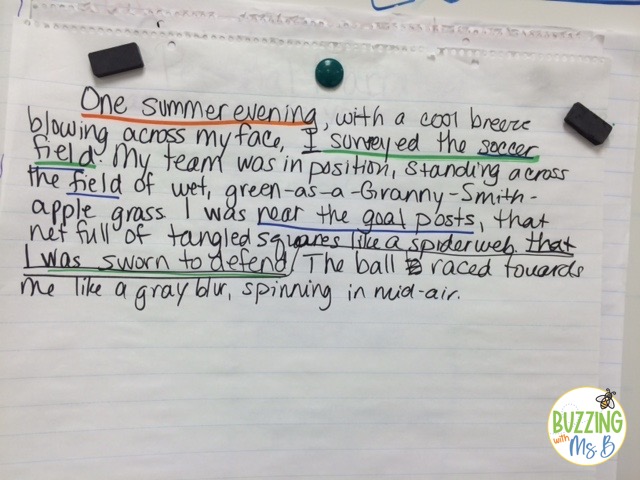
Then students tried writing their own. We analyzed Owl Moon together at the beginning of the lesson. Then they used this model to write one for their own narrative piece!

Hands on activities to reinforce strategies
Get your kids engaging further with good beginnings for stories by using hands on activities, like a cut and paste matching activity, to consolidate their understanding! Create examples of story beginnings that use dialogue, character descriptions, thought, etc. and ask students to match each example to the correct strategy.
I’ve actually included all the resources you need to do this activity with your class in my Good Beginnings Narrative Unit – available here or here on TpT!
Need more of a challenge? Ask them to write a short example of each strategy themselves to demonstrate their learning even further!
Put it into action! Write or revise
Now ask your kids to put all their learning into action! This can be done in two ways – by starting a new story or by revising a completed story and making changes. We all know how important revising and editing are as part of the writing process, so asking your students to analyze a piece of their own writing is a great way to put their new learning into action. It also takes the pressure off for those students who get stuck when trying to start a new piece of writing!
In the chart below, I modeled choosing a topic for writing and trying each type of beginning. After I tried each one, I chose which one was the best fit for the piece I wanted to write!

So give these ideas a go with your students and watch the magic happen when they kickstart their stories with a bang! Remember, crafting good beginnings isn’t just about captivating readers; it’s also about engaging classmates in the thrilling adventure of storytelling. So, let’s inspire and empower our budding writers to captivate not only their readers but also each other!
Mentor texts for good beginnings
Kitchen Dance by Maurie J. ManningSheila Rae the Brave by Kevin Henkes
Roller Coaster by Marla Frazee
Thunder Cake by Patricia Polacco
Some links are affiliate links
Looking for a whole 3-month unit to help your students improve their narrative writing?
Then look no further! I’ve created this engaging bundle which includes mini lessons on writing amazing beginnings, along with writing great endings, adding sensory details, zooming in on small moments, and more!

Narrative Writing Mini Lesson Unit Bundle | Hands On, Step by Step Lessons.
Or get it on TPT here:
Narrative Writing Mini Lesson Unit Bundle | Hands On, Step by Step Lessons