
Say Goodbye to “The End” – 6 Narrative Endings That Work
Let’s be real—beginnings get all the love when it comes to narrative writing. Hooks! Leads! Setting the scene! But narrative endings?
That’s where things start to unravel.
How many times have your students wrapped up their stories with…
🫣 “It was a great day.”
😴 “Then I went to bed.”
🙈 Or the classic: “The End.”
NOOOO! After all that work building characters, crafting problems, and zooming through action… they fizzle out like a sad balloon.
But good news! With a little direct instruction (and a lot of mentor text magic), your students can learn to write endings that surprise, satisfy, and stir emotion.

Here are six types of narrative endings to teach your students—and how to help them nail each one!
💖 1. Heartfelt Ending
A heartfelt ending tugs at the reader’s emotions. It might express joy, sorrow, love, or a big personal realization. Perfect for those touching, character-driven stories.
👉 “And as I hugged her tightly, I knew I’d never forget that moment for the rest of my life.”
📚 Mentor Text: My Rotten Redheaded Older Brother by Patricia Polacco — full of heart and sibling feels!

😄 2. Humorous Ending
These endings leave your reader laughing—or at least smiling. They often involve a twist, exaggeration, or a silly surprise.
👉 “Just as I leaned in to kiss the frog… it burped in my face. Of course.”
📚 Mentor Text: Click, Clack, Moo, Cows That Type by Doreen Cronin — cows with a typewriter? Come on. It’s gold.

🔄 3. Circular Ending
Circular endings echo something from the beginning—often the first line or a key idea. They give the reader a full-circle feeling that’s super satisfying.
👉 “I started the day chasing butterflies… and I ended it the same way, only this time with my little sister beside me.”
📚 Mentor Text: One Tiny Turtle by Nicola Davies — the ending loops beautifully back to the start.

❓ 4. Question Ending
A question leaves the reader thinking. It’s a wondering that opens the door for reflection, curiosity, or imagination.
👉 “But what if the treasure is still out there, waiting for someone else to find it?”
📚 Mentor Text: My Lucky Day by Keiko Kasza — perfect example of a story that ends with a clever little “what if?”

🔮 5. Future/Prediction Ending
A prediction gives readers a hint about what might come next. It invites them to imagine how the story might continue—even after the page ends.
👉 “And maybe, just maybe, I’ll get it right tomorrow.”
📚 Mentor Text: Ada Twist, Scientist by Andrea Beaty — a hopeful ending full of possibility!

🎓 6. Lesson Ending
This one’s all about reflection. The character learns something and shares that takeaway with the reader.
👉 “I finally understood that winning isn’t everything. Being kind felt better than any trophy.”
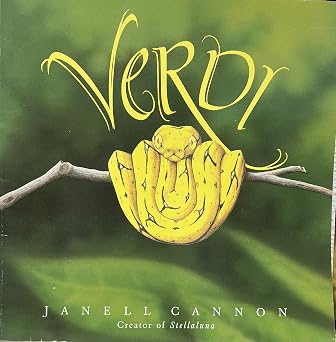
📚 Mentor Text: Verdi by Janell Cannon — a beautiful book with a powerful “lesson learned” ending.
📚 Now… How Do We Teach These?
Once you’ve introduced the six ending types, here are some of my favorite strategies to get kids practicing, experimenting, and polishing those story wrap-ups:
🖍️ Use an Anchor Chart (or Two!) to Bring Narrative Endings to Life
Anchor charts are a game-changer when it comes to teaching narrative endings—and there’s more than one way to use them effectively in your classroom!
🌀 Chart #1: Reflective Narrative Endings
This anchor chart is perfect for teaching reflective endings that go deeper. It breaks endings into types like:
- Memory – the main character recalls the event
- Feeling – expressing emotion about what happened
- Action – doing something as a result of the experience
- Decision – choosing something because of what occurred
Each section includes:
✔️ A student-friendly definition
✔️ A sentence starter
✔️ A published mentor text excerpt (hello, Patricia Polacco!)
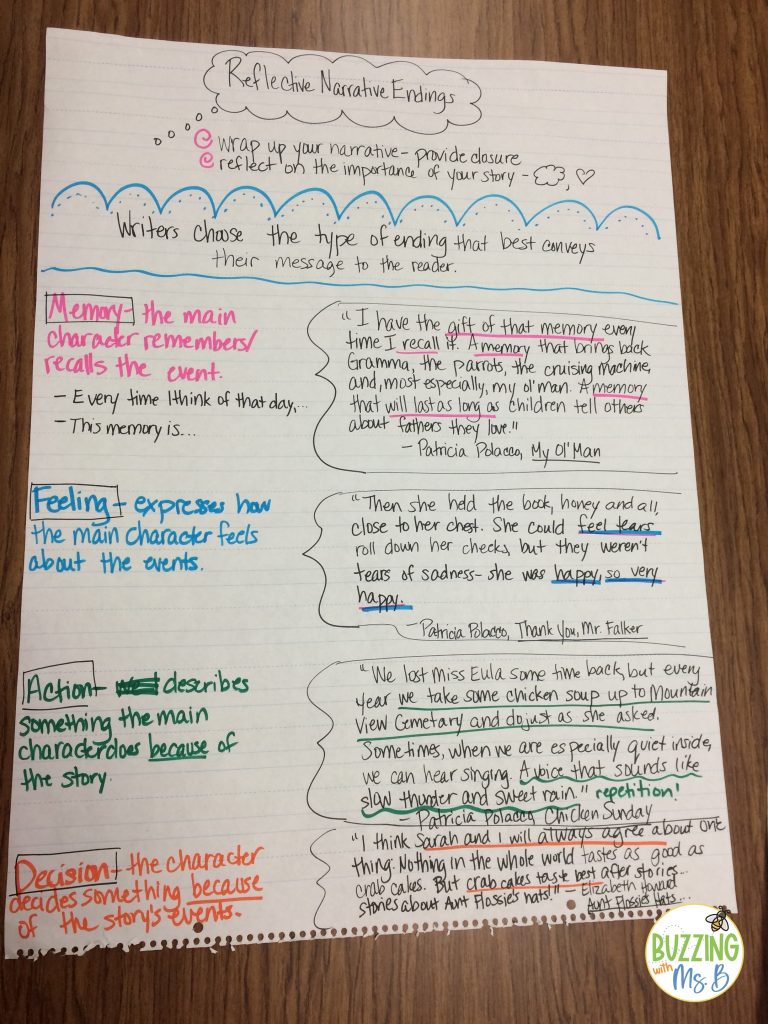
This chart helps students connect ending types with their purpose—and models how real authors do it! It’s also a wonderful anchor for helping students revise their own stories to add more depth and reflection.
📋 Chart #2: Good Endings Grid
This chart is more structured and flexible—great for modeling different narrative ending styles side by side. Set up in a table format, it includes:
- TYPE – like circular, question, humorous, heartfelt, etc.
- DESCRIPTION – a clear, concise explanation
- EXAMPLE – a short sample ending that brings it to life

What makes this style fantastic is how interactive it can be! Use sentence strips to add examples together as a class. Let students brainstorm their own and stick them on the chart. You can even make it a living resource that grows throughout your writing unit!
💡 Pro Tip:
Try using both chart styles!
- The Reflective Chart helps students connect emotionally and make deeper meaning.
- The Grid Chart introduces a broader range of ending types and invites kids to try writing more than one kind.
And if you want both of these formats (and more!) already made for you, check out my Good Endings Narrative Writing Unit — it’s packed with printable posters, anchor chart pieces, and lesson plans to support every type of narrative ending!
📖 Dive Into Mentor Texts
Choose one or two endings to focus on each week. Read the mentor text together, then highlight the final lines. What type of ending is it? How does it make the reader feel? Could they try something similar?
✍️ Rewrite the Ending Challenge
After finishing a story draft, challenge students to write two different endings using different types. It helps them see how each choice changes the tone!
🔍 Endings Detective Work
Give students a mix of sample endings (from books or peer writing) and ask them to match each one to its type. This gets them thinking like authors and readers!
🎉 Ready to Turn “Blah” into Brilliant?
Teaching narrative endings doesn’t have to be boring—and it definitely doesn’t need to end in “Then I went to bed.” 😴
With clear models, fun mentor texts, and chances to experiment, your students will soon be writing endings that make their stories shine. You’ve got this!
👉 Grab everything you need in my Good Endings Narrative Writing Unit —anchor charts, lesson plans, posters, examples, and more!
What’s included in the Good Endings resource?


Now go forth and END well, friends! 🎉


