Writing Across the Curriculum Lesson Ideas for 3rd-5th grade

One of the most effective strategies to help kids learn new information is to have them write about it. Writing across the curriculum is something we all can do!
Whether you teach reading, math, science, or social studies, having students write about your content helps them grow as writers AND in get the things you’re teaching to stick!
So what are some ideas for writing across the curriculum that you can implement in your own classroom?
Some of my favorite teachers are sharing their ideas for writing across the curriculum in this post! Read on to find the perfect writing lesson for your class!
Writing across the curriculum: structured paragraph frames
Once I started to use paragraph frames in my content area lessons, my students became better writers (seriously, the next grade level teachers commented) AND they learned more information through writing across the curriculum!
Helping kids write about their learning is so much easier when you use a paragraph frame! If your lesson involves describing, sequencing, compare contrast, cause and effect, or problem and solution, using a simple paragraph frame can help kids organize their ideas in a way that makes sense. It also helps them explain their thinking so they reinforce the content from your content lesson!
Here’s an easy one to start with to help kids write in the content areas and describe something:
__ is an interesting __ that can be discussed by looking at its characteristics. The first of these is __. It ___. The second is __. It __. Lastly, __. It __. Overall, it’s a fascinating topic!

How to use it a paragraph frame for writing across the curriculum
- Identify the topic of the paragraph. This could be a response to a lesson about the Civil War, the water cycle, polygons, polar animals, or any other content area topic!
- Start with the first sentence. In one color, write the parts of the frame that all students will have in their writing. In a different color, think aloud about the details you are going to include in your own writing. Have students write the first sentence.
- Continue using two colors: one color everyone will have and the other color that will be unique to each student, one sentence at a time.
- After you’ve modeled using frames like this, students can use a variety of frames without much assistance and eventually become more independent in their writing without frames!
Want more paragraph frames plus 17 more lessons for reading and writing in the content areas? Get Reading & Writing Across the Curriculum Guides and plan your lessons in a snap!

Teach Science through Writing with the RAFT Strategy
No matter how organized you are, there’s no denying you could always use more time in the classroom. While you can’t magically generate more hours in the work day, you can incorporate writing into your math and science blocks to make the most out of the time that you do have! Tammy at The Owl Teacher is a huge supporter of an integrated curriculum, especially when it comes to serving up science lessons with a side of writing. In fact, that’s why she created the Science Writing Prompts set!
Beyond that, however, Tammy recommends a variety of methods to add writing to science blocks, such as tickets-out-the-door, shrinking summaries of science vocabulary concepts, journals or lab reports, and her personal favorite, the R.A.F.T. strategy. For instance, during the plant unit, students can use the R.A.F.T. strategy to pretend they are one of the structures of the plant and are tasked with writing a letter requesting a vacation to another part of the plant. They will explain all the work they do, argue whether another plant part can do their job, and so on. The kiddos love the creativity, and you can determine whether they understand their plant part’s function while squeezing in some extra writing time!
You can find all of these ideas on her blog here, as well as other tips to encourage better writing in your students.

Make Writing Across the Curriculum a Routine with Journaling
Amber from TGIF, a veteran educator with 21 years of teaching experience, believes that making writing meaningful across various subjects doesn’t need to be a complex task. From her perspective, a straightforward approach involves incorporating daily journaling into the classroom routine. Amber suggests assigning a specific subject for each day of the week, such as Math on Monday, Science on Tuesday, Reading on Wednesday, Social Studies on Thursday, and Free Write Friday.
To implement this strategy, she advises setting a timer for each writing session, gradually increasing the duration over time. Amber proposes providing diverse topics, ranging from summarizing the day’s lesson to brainstorming ideas for future discussions or expressing opinions related to the ongoing curriculum. These journal writes serve as a practical tool to familiarize students with the writing process, encouraging them to articulate their thoughts on paper while gradually extending the duration of their writing.
Explain Text Evidence with Graphic Organizers
As an upper elementary teacher, Vanessa from Longwing Learning shares her go-to writing strategy for addressing challenges in explaining text evidence. Recognizing the common struggle students face when writing, she introduces a simple yet effective approach using graphic organizers. In her fourth-grade classroom, she noticed students would struggle to put their explanations into writing, even if they could verbalize the reasons for selecting specific text evidence.
To help her students with this problem, she uses a questioning technique and created a graphic organizer, “Steps to Explain My Text Evidence,” which became a valuable tool for students to gather their thoughts and articulate their evidence when writing. She breaks down the strategy into three steps in this step-by-step blog post, emphasizing the importance of giving students the necessary support and practice to master this crucial writing skill.

Descriptive Writing Activities to Inspire Your Writers
Marissa from Creative Classroom Core likes to include descriptive writing activities to help inspire the writers in her upper elementary ELA classes. Descriptive writing holds a special place in the world of education, and it’s all about unlocking the magic of words. When we teach descriptive writing, we’re giving our young learners the tools to weave enchanting tales and express themselves in a way that’s uniquely their own. Think of it as a passport to creativity!
As teachers, we’re not just helping them become better writers; we’re nurturing their ability to tell captivating stories and share their thoughts effectively. Interested in seeing some of Marissa’s favorite descriptive writing activities to use in the classroom? Check out the Creative Classroom Core blog!

Graphic Organizers for Writing All Day Long
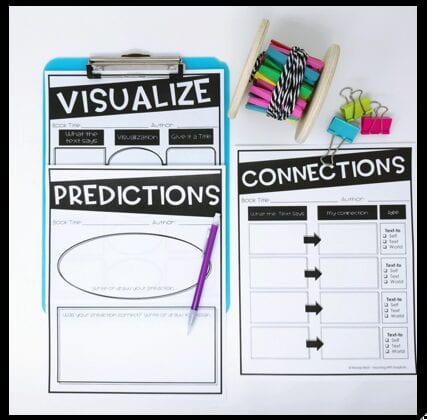
Mandy Neal from Teaching With Simplicity shares 5+ Ways to Use Graphic Organizers in Reading. She emphasizes the potential of using graphic organizers in the classroom and offers practical ways to maximize their effectiveness. Mandy suggests incorporating graphic organizers during Reading Workshop read-alouds to keep students engaged.
In addition, she suggests using them within small groups where teachers can ensure that students are using the graphic organizers correctly and provide necessary guidance. Ideas for using graphic organizers in centers, literature circles, and content reading across various subjects and encourages their use with various texts, including short passages, picture books, and chapter books. Graphic organizers are also valuable tools for students to enhance their writing skills. Mandy also provides ten ways your students can use graphic organizers with writing.
Use Mentor Texts as Writing Exemplars
Carla from Comprehension Connection loves teaching writing. She finds using mentor texts as exemplars supports students in the writing process. In this post, she uses the book, I Wanna Iguana, as mentor text for persuasive writing.
Kid LOVE animals, so the book works perfectly for connecting to this interest as well as for modeling with a persuasive letter. Another post that demonstrates using mentor texts is “Teaching Students to Expand Word Choice with My Mouth is a Volcano”. Author Julia Cook is a master of metaphor, and this book works well as an exemplar too. For other tips and ideas on mentor texts for writing, check out these posts on Comprehension Connection.