
4 Steps to Teaching Transitional Phrases with Pumpkin Jack
 Don’t you just love it when you read a student’s narrative and they use awesome transitional words like “First,” “Then,” and “Finally?”They add a touch of class and voice to their writing, and really help you experience their unique perspective.LOL! No, they don’t.
Students who use these tired transitional phrases tend to write in a simplistic manner. Authentic transition use can take a moderate piece of writing and turn it into a very strong one.
Teaching Authentic Transitions
To introduce authentic transitions using a text model (the best way to introduce writing strategies – notice them in a mentor text!), I chose Pumpkin Jack. It’s seasonal, easy to follow, and includes a ton of different transitions for different purposes. They’re each used in a natural manner that doesn’t cause the story to halt every time a transition is used.To use a mentor text as a model, this is the procedure I follow:

The lesson for teaching transitions
These four steps help students see the craft being used well by a mentor author.
Step 1: Notice It! Read aloud a great mentor book that demonstrates the craft you want to try with students. Pumpkin Jack does a great job of using transitional phrases naturally. As you read, mark the phrases with post-its, thinking about how they convey the passing of time.Step 2: Name it! Name the strategy and introduce it explicitly. When you name it, make sure to discuss with students how the craft adds something purposeful to the author’s writing.
In Pumpkin Jack, you can discuss the following points:
Step 1: Notice It! Read aloud a great mentor book that demonstrates the craft you want to try with students. Pumpkin Jack does a great job of using transitional phrases naturally. As you read, mark the phrases with post-its, thinking about how they convey the passing of time.Step 2: Name it! Name the strategy and introduce it explicitly. When you name it, make sure to discuss with students how the craft adds something purposeful to the author’s writing.
In Pumpkin Jack, you can discuss the following points:
- Transitional phrases are used to show the passing of time.
- They all sound different.
- Some show a short time has passed; some show a long time has passed.
- They are written in different places in a sentence and in a paragraph.
This would also be a good time to chart the transitional phrases by purpose, like in the anchor chart below.
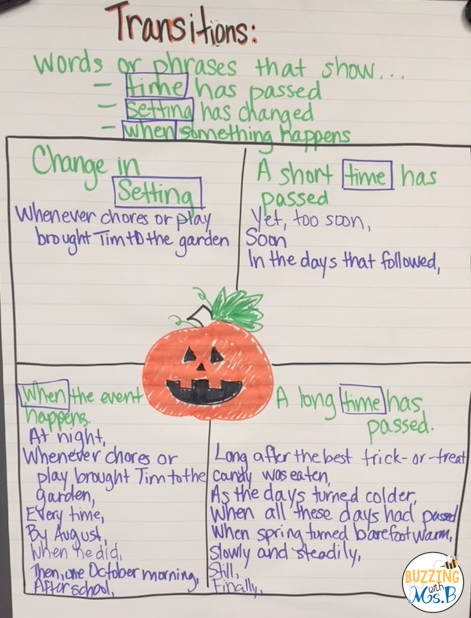
Step 3: Teacher tries it! When you model, think aloud a step at a time about how to use the craft deliberately and purposefully in your writing. Why is that craft a good idea? What is using it going to convey to your reader? How will you use it effectively? You might also revise an older piece using that craft, rather than writing a new piece.Step 4: Students try it! Have students try to use the craft in their writing. It might be easier to have them revise a piece of writing in a piece they’ve already written to use the craft.
For transitional phrases, have students read their pieces to find where time has passed. Add in a transitional phrase that moves the piece from one time to the next. Refer back to your anchor chart of the transitions from Pumpkin Jack.For a fun activity to do to help you “Notice It, Name It, and Try It,” check out my free resource below for teaching transitions with Pumpkin Jack! It includes lesson ideas and tools for teaching students to use transitional phrases appropriately in their narratives. There’s even a story for you to model revising with transitional phrases!
For transitional phrases, have students read their pieces to find where time has passed. Add in a transitional phrase that moves the piece from one time to the next. Refer back to your anchor chart of the transitions from Pumpkin Jack.For a fun activity to do to help you “Notice It, Name It, and Try It,” check out my free resource below for teaching transitions with Pumpkin Jack! It includes lesson ideas and tools for teaching students to use transitional phrases appropriately in their narratives. There’s even a story for you to model revising with transitional phrases!

Grab it free below!
The next stop is…

Selma Dawani: Teaching and Learning Resources
This post includes affiliate links.


Thank you so much! Great ideas
Excellent lesson! I love how you walked through it all. I especially love the chart with the steps. Thanks for joining in, and I appreciate the freebie!
This is great! Thanks for all the details in how you take students through this. Having taught first and second, there's a whole lot of first, then, after…but they really will go beyond that if it is modeled for them and available on anchor charts.
Jessica
Literacy Spark