| | | | |

How to Build Teacher Knowledge with Michelle Ruhe, ep. 289
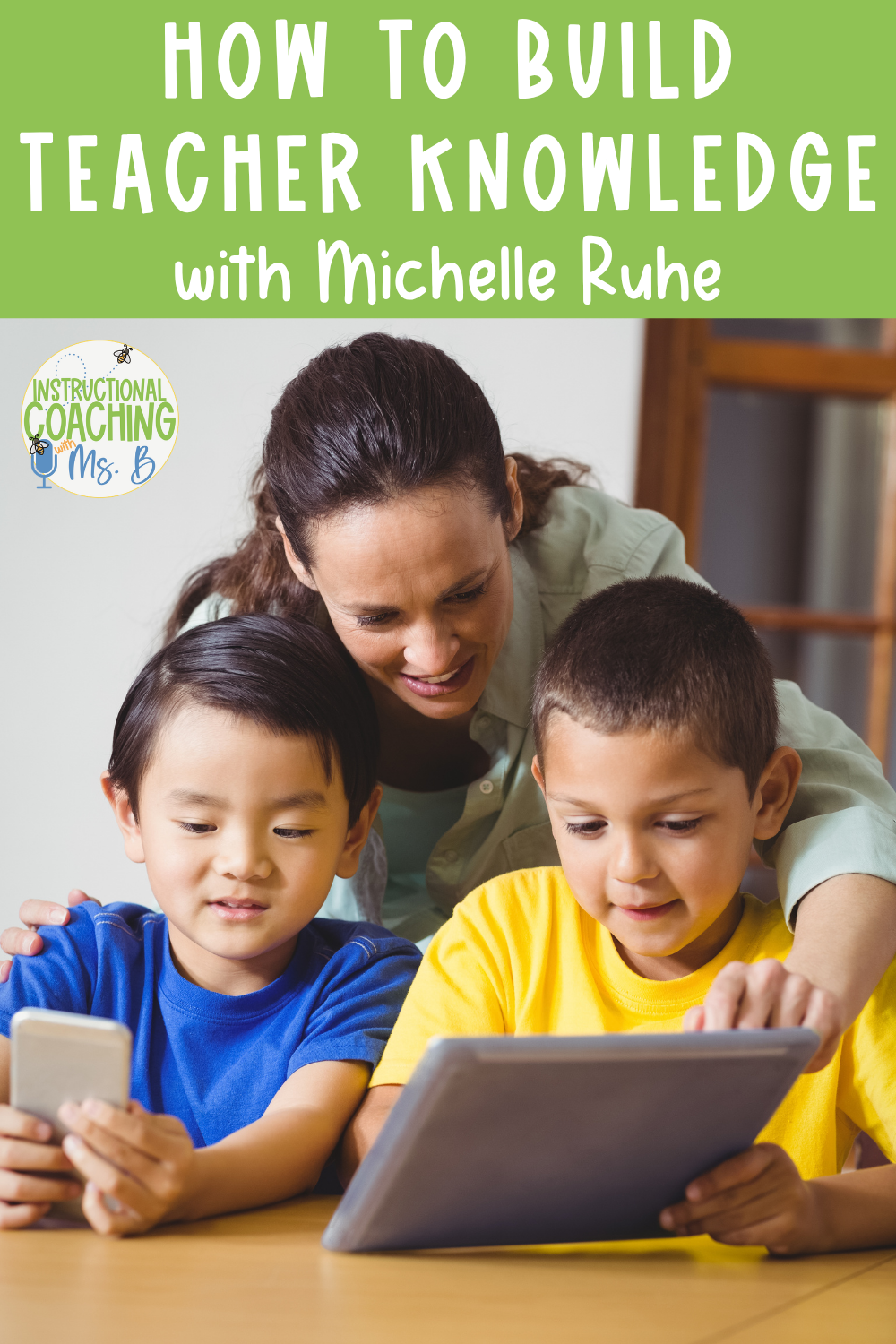
Teacher smiling while working with 2 students. These words appear at the top "How to Build Teacher Knowledge with Michelle Ruhe".

Wondering how to build teacher knowledge that supports instruction? You’ve come to the right place.

This week, I’m excited to kick off a brand-new mini-series filled with staff development ideas for coaches! We’re going to talk about PD, PLC meetings, and working one-on-one with teachers to build skills and knowledge in the classroom.

The first thing we’re going to look at is how to develop teacher knowledge because that’s really the foundation. Michelle Ruhe, of Coach from the Couch, joins me as we examine what really matters when building teacher knowledge schoolwide and in those quick moments in the copy room!

We explore the types of teacher knowledge coaches can build, ways to support individual teachers, and how to identify schoolwide PD needs. Plus, Michelle explains how she created a three-year professional learning plan for her school and how she knows when it’s time to move on to the next focus area.

Be sure to listen to the full episode to hear all the details about how to build teacher knowledge. Here are the highlights!

Starting out as an instructional coach can be so overwhelming! It can feel like there are too many things to do, and you just don’t know where to start. This resource includes a guide, printables, and fillable forms (PDFS) to build relationships, have a dialogue with your administrator, review data and make a plan, visit classrooms, and more! Get the First 20 Days of Instructional Coaching Start Up Kit and Forms today!

Essential Categories of Teacher Knowledge Coaches Can Build

To begin our discussion, I asked Michelle about the different types of teacher knowledge that coaches can build. She acknowledged that there were many. Here are a few that stand out:

Content Knowledge: Michelle says teachers must know what their content is and where it’s going across the year. This requires them to know their standards and what they mean.

Assessment Knowledge: This means understanding which assessments are available, what they can tell you, and what they can’t. It also means knowing which assessment to use at different times and how to interpret the data to make informed instructional decisions.

Instruction and Delivery: Michelle calls this “a whole ballgame in itself”. It’s about developing strategies to meet students’ needs and adjusting practices as needed.

Knowing Your Students: Effective instruction starts with knowing the whole student, not just the data points in front of you. Take time to understand their motivation, interests, and challenges. As Michelle emphasized, we need to truly know who is in front of us because that helps drive instruction and creates learning experiences that meet them where they are.

Pedagogy: Teachers are being handed a lot of programs right now and being told to implement them. Many don’t fit what teachers or students need. Michelle explains that knowing pedagogy helps teachers make decisions about what to pull from them, how to ramp it up, and how to make it stronger.

Classroom Management Practices: This is one I brought up because it’s closely connected to knowing your students and pedagogy, and I think it’s really important. So many teachers leave college without adequate training in classroom management. Many teachers need support translating the theory they learned in school into effective, practical strategies they can use in the classroom.

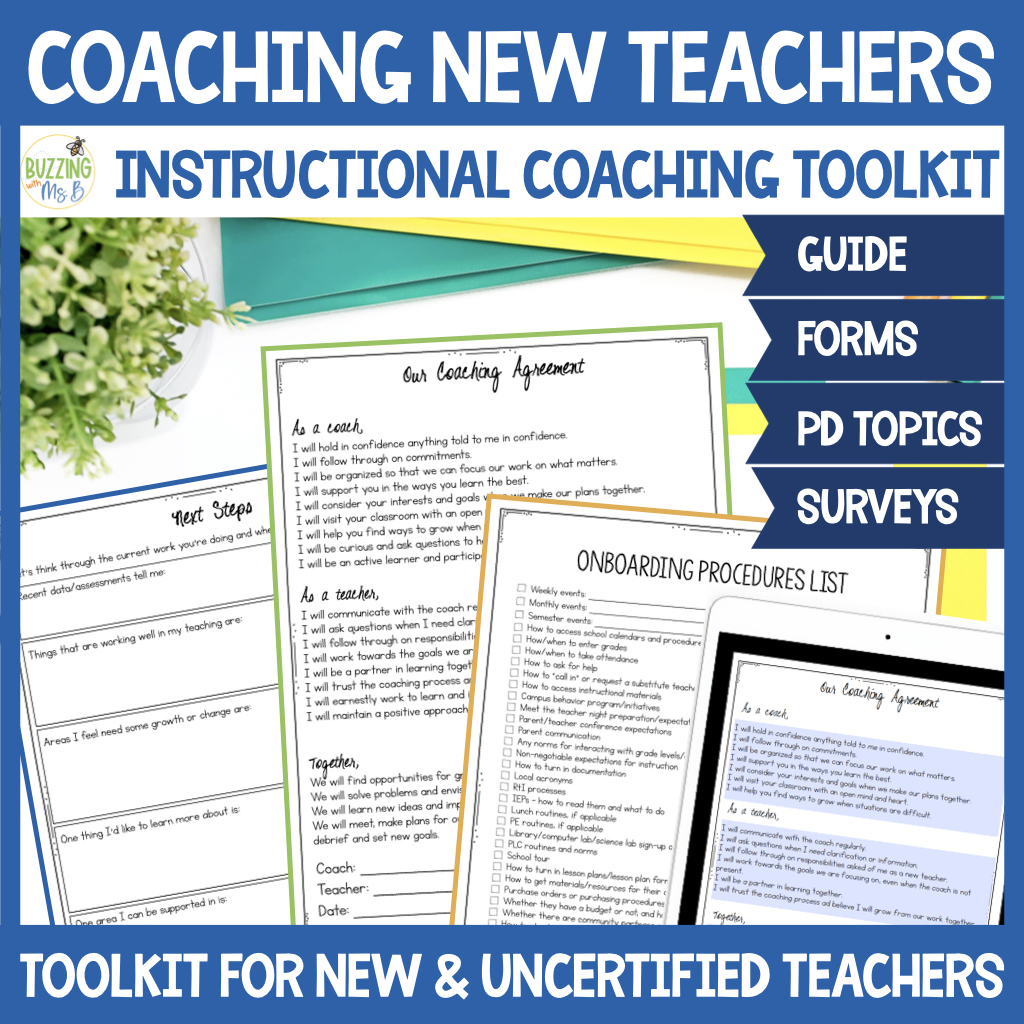
Have a plan for working with new and uncertified teachers with the Coaching New Teachers Toolkit!

It includes forms, templates, and everything you need to help your new and uncertified teachers! Figure out what support the need and provide PD and coaching with these resources. Grab the Coaching New Teachers Toolkit in my TpT Store!

⭐⭐⭐⭐⭐ “I support & coach new teachers and this resource is so valuable. I purchased it several months ago and often use tips you suggested when working with teachers. It is an essential section of my “Teacher Support Provider Binder” that I carry around with me everywhere.”
What Opportunities Exist to Build Knowledge When Coaching Individual Teachers?

Michelle and I discussed different ways instructional coaches can build teacher knowledge one-on-one. Of course, we talked about the power of coaching cycles, where so many opportunities for learning unfold naturally as students’ needs emerge and teachers see opportunities to grow.

The pre-conference is the perfect time to build knowledge, address misunderstandings, and develop a plan together. It gives coaches a chance to understand where a teacher is in the process, gauge what they already know, and identify what they may need next. This allows coaches to tailor their support and make the learning more meaningful and responsive to the teacher’s needs.

Another idea Michelle offered was seizing those little moments in the copy room or in the hallway with teachers. She tells us that being visible and having informal conversations with teachers often leads to bigger learning. It’s something I’ve talked about many times on the podcast because this is such a good one! I really hope you give it a try!

Being present in classrooms offers coaches another chance to build knowledge. Michelle explains that coaches can notice things teachers may not see themselves and name them, especially when they’re connected to a goal you’re working on together. Coaches can be that lens because it’s difficult for teachers to notice everything while they’re in the moment.

Modeling and peer visits are also powerful opportunities for building knowledge. Watching someone else teach a lesson can show teachers strategies to try and help them see what effective practice looks like in action. I think this is one of the most valuable learning tools we have, and one we don’t use nearly enough. And as Michelle points out, it’s FREE!

Be ready for anything with the Instructional Coaching Editable Binder Megapack!

It includes forms, templates, and everything you need to get organized for instructional coaching! Coach teachers and document your coaching work with these printable and editable tools. Grab the Instructional Coach Binder Megapack in my TpT Store!

Identifying Areas of Focus for PD Across the School

During the conversation, we talk about how to decide which knowledge areas to focus on for schoolwide PD. Michelle acknowledges the challenges and tells us it’s a bit like a chess game, trying to think several steps ahead.

She suggests using a deliberate, data-driven approach that draws on multiple sources of information. Rather than relying solely on students’ test scores, we should also consider anecdotal data, observations, and teacher reflections to gain a complete picture of their strengths and areas of need.

Michelle also highlights the importance of knowing what’s coming next and being prepared to have those conversations with teachers. She gives the example of hearing about the Science of Reading gaining traction in the UK and being prepared to support teachers when those ideas eventually made their way into our schools.

Developing a Three-Year PD Plan

Once we have the data, we need to examine it and identify a couple of focus areas in a stair-stepped way. For her school, she creates a three-year PD plan, so she knows her overarching goals and the direction she’s heading, while still allowing her to pivot and make adjustments as needed. She explains that having that “big picture” helps her keep her messaging cohesive and connected.

To develop the plan, Michelle looks at where the school is now, what’s missing, and what could help fill the gaps. From there, she picks a focus, honing in on one thing that can make a meaningful difference, and she stays true to it. Michelle gives teachers plenty of examples and different methods to try in the classroom. Instead of moving quickly from one topic to the next, she gives teachers time to really use the learning, refine their practice, and build confidence.

Michelle also explains that the leadership team must be aligned with the plan because it makes the work feel less confusing and more realistic for teachers. With a three-year plan, the team can regularly revisit it to reflect on where they are, where they’re going, and whether they need to make adjustments.

Her school has one overarching instructional goal and builds content knowledge alongside it. The focus is on pedagogy, helping teachers build the knowledge and skills they need to strengthen instruction, no matter what subject they teach.

I love the idea of a long-term plan because it gives the coach a roadmap while giving teachers multiple opportunities to engage with the content and deepen their understanding over time. As Michelle points out, “we can’t possibly expect to see it in action if we don’t really give teachers the time to try it and iterate on it and reflect on it.” She goes on to say it’s got to be focused and relevant. I couldn’t agree more!

Michelle says she knows it’s time to move on to the next topic when the practice is seen consistently in classrooms and becomes a natural part of the language used in planning. Only when there’s clear, widespread implementation does she shift her focus to the next instructional goal.

How to Build Teacher Knowledge

That was a really great conversation with Michelle, and I’m sure there’s something you can apply at your school today. My biggest takeaway is simple: don’t try to do everything at once. We often try to build knowledge across too many areas and then expect teachers to become proficient in everything immediately. It’s impossible! I love the idea of focusing on one thing for a while, giving teachers the time and support to really engage with it, and allowing it to make its way into classrooms in meaningful and lasting ways.

Topics and Questions Discussed in Episode 289 – How to Build Teacher Knowledge with Michelle Ruhe

  • How to build teacher knowledge
  • Types of teacher knowledge that coaches can build
  • Opportunities for building knowledge with individual teachers
  • Leveraging coaching cycles and informal interactions to build knowledge
  • Pre-conferences, modeling, and co-teaching to boost knowledge
  • Identifying PD needs across the school
  • Using multiple sources of data in decision-making
  • Developing a 3-year PD plan for your school and knowing when it’s time to move on to the next focus area
  • The power of modeling and peer classroom visits to build teacher knowledge

About Michelle Ruhe
Michelle Ruhe works alongside K-5 teachers in classrooms every day, supporting literacy instruction through coaching and collaboration. She also partners with educators beyond her school through virtual coaching, helping teachers strengthen and streamline their reading and writing instruction.

Turning Insight Into Action: Practical Steps You Can Take After Listening

Here are simple actions you can take today:

1️⃣ Join the Instructional Coaching Club!

The Instructional Coaching Club is an online membership designed to help instructional coaches improve instruction at their schools. It gives coaches the tools to go out and do it.

2️⃣ Create a 3-Year Plan!

In this episode, Michelle explains how she developed her 3-Year Plan. After listening, have a conversation with your leadership team about giving it a try. Let me know how it goes in the Instructional Coaching with Ms. B Facebook group or on Instagram @buzzingwithmsb!

Ready to listen?

  • Ready to listen? You can listen below with the media player, or search for Buzzing with MS. B: The Coaching Podcast anywhere you listen to podcasts!

This post contains links to products from one or more of our advertisers. This means I may receive commissions for purchases made through links in this post when you click on links to those products. Thank you for your support!

Learn more

Helpful Resources


Listen on: Apple Podcasts, Spotify, or your favorite listening app


Thank you for listening to Buzzing with Ms. B: the Coaching Podcast. Want more coaching ideas

Check me out at buzzingwithmsb.com and on Instagram @buzzingwithmsb.

If you love the show, share it with a coach who would love it too, or leave me a review on iTunes! It’s free and it helps others find this show, too. Happy coaching!

Podcast produced by Fernie Ceniceros

How to Build Teacher Knowledge with Michelle Ruhe, ep. 289, Instructional Coaching with Ms. B Podcast

Chrissy Beltran [00:00:01 – 00:01:35]

Hey, coach, and welcome to instructional coaching with miss b. Today, we are kicking off a new mini series for coaches all about staff development ideas for instructional coaches. We’re gonna talk about PD, PLC meetings, and also the opportunities that we have one on one with teachers to build skill and knowledge in the classroom instruction. The first thing we’re gonna talk about is how to build teacher knowledge because this is kind of the foundation for all of the things that we’re gonna move into. So before you get we we get started, I wanna share a handy dandy tool that I think you’re gonna love if you just, grab it for free. You can sorry. If you’re watching on YouTube, you can see my cat just jumped up on my chair. She is incredibly naughty. You can grab the free d free PD tools for coaches in the show notes. You’ll get the classroom sweep documents to figure out where you should start with your PD, a PD planner, step by step guide to creating powerful PD, and the PD checklist all in one download plus PD and coaching tips right in your inbox. So you can grab that in the show notes for this episode at buzzingwithmissb.com/episode280nine. I also have my lovely friend Michelle joining me today, Michelle Ruggie. She works alongside k five teachers in classrooms every day, and she supports literacy instruction through coaching and collaboration. She also partners with educators beyond her school through virtual coaching, helping teachers strengthen and streamline their reading and writing instruction. I I can’t wait to talk to Michelle. She’s actually been a guest on this podcast before. You might recognize her, and I’m really excited that she’s gonna join us today. So let’s welcome Michelle to the podcast. Thank you so much for being here, Michelle.

Michelle Ruhe [00:01:35 – 00:01:38]

Thank you so much for inviting me. I can’t wait for this conversation.

Chrissy Beltran [00:01:38 – 00:01:58]

Yeah. I think it’s gonna be a great one. We’re kicking off our little mini series about staff development ideas for teachers, and I think this is going to be foundational to all the other episodes. Mhmm. So we’re digging into the idea of teacher knowledge and how to build teacher knowledge. What are some, like, types or categories of teacher knowledge that coaches can build?

Michelle Ruhe [00:01:59 – 00:03:29]

Oh, there’s so many. I’m I’m gonna try to answer this in a way that’s not specifically literacy because I know you’ve got all kinds of instructional coaches Right. Listening. But I’m, obviously, content knowledge. Teachers must know what their content is and the where it’s going across the year, which also means they’ve gotta know their standards and what they mean Mhmm. And be on the same page with the team about what those standards mean. So I think that falls under just the umbrella of content knowledge, and that’s tricky with states always changing the standards and, you know, realigning and things like that. So that’s, like, basic. And then, of course, kind of, like, along with that, I think, is assessment knowledge in terms of this is kind of a big one. So not only understanding what assessments you have at your disposal or what your district is asking you to do, but what they mean, what they tell you, and what they do not tell you Mhmm. So that you can understand where to fill in those gaps and get the a bigger picture because often there are gaps. There’s a lot of information that they tell us, but there are gaps. And sometimes those gaps are actually the key to the puzzle. And I and then connected to that, of course, is what to do with that assessment data. So you’ve got all these numbers and these charts and these spreadsheets, but what next and how to practically do that. So that’s a big piece of the knowledge puzzle, I feel like, and the understanding that assessment doesn’t always mean formal.

Chrissy Beltran [00:03:30 – 00:03:31]

Mhmm.

Michelle Ruhe [00:03:31 – 00:05:16]

It is also informal. It is formative, and you don’t need it can be as simple as, you know, thumbs up, thumbs down, or observation. So I think the different, you know, what do you do with these assessments? What do they tell us? What do they not? And what types of assessments are appropriate at the right time for the bigger picture? That is a huge conversation, I think. Of course, instruction and delivery, that’s that’s a whole ballgame in itself. But, also, I think what goes with that is really knowing your students Mhmm. As a whole person, not just the data points in front of you, but motivation and interest and, what worries them and what, you know, if if they’ve got attention challenges and how to respond to those. We really have to know who is in front of us because that drives your instruction, of course, and that also helps paint a picture that the data is is helping to to, form. So it all goes together, I think. And then I think this is applicable to every, subject area, but literacy, especially just pedagogy. I think we’re in this time of education right now where there’s a lot of programs being handed to us and there’s a lot of push for adhering to those programs, but so many times, they don’t fit what we need or they don’t fit our students. So knowing pedagogy at the core of it is what helps make helps teachers make the decisions about what to pull from it, what to not pull from it, and how to ramp it up and make it stronger. So there’s just so many buckets, which is what makes this job of of education so challenging is there’s so much to know.

Chrissy Beltran [00:05:16 – 00:05:22]

Yeah. That’s true. I would I would say part of that, you know, knowing your students and pedagogy is also like management practices.

Michelle Ruhe [00:05:23 – 00:05:24]

Absolutely. Yeah.

Chrissy Beltran [00:05:24 – 00:05:38]

Because that’s it’s it’s an area that, you know, so many teachers come out of of school. I mean, I certainly was not trained in management. The the management tips I was given in college were so unhelpful. I was like

Michelle Ruhe [00:05:39 – 00:05:41]

If you got any at all. Right?

Chrissy Beltran [00:05:41 – 00:06:07]

Yes. Exactly. Mine just worked against me. Like, I it would have been better had nothing. Right? Might have worked against me. It was all theory. It was no practice, which I guess that’s kind of like knowledge and skill. Right? Because we start with the knowledge about, you know, what best practices are, but then we have to have the skill to actually do them effectively in the classroom. And that takes time to get good at, like, is this working? What adjustments do I need to make to reflect and to change? And that’s like a skill that is developed over time.

Michelle Ruhe [00:06:07 – 00:06:15]

Especially with every group of students being different. Mhmm. Next year’s group is not gonna be this year’s group, so you’ve gotta refine your skills definitely.

Chrissy Beltran [00:06:16 – 00:06:34]

Mhmm. Yes. Yeah. I like that. So okay. So then what opportunities do we have to build knowledge when we’re coaching individual teachers? Because sometimes I feel like we think about, okay. PD is time for building knowledge. You know? That that’s the PLC meetings, we’re gonna build knowledge. Okay. But what about one on one?

Michelle Ruhe [00:06:34 – 00:08:29]

Yeah. That’s my favorite because it’s so targeted for what kid kids teachers need. And so one thing is obvious the obvious is the coaching cycles. When you’re in a coaching cycle, there’s such opportunity for small bits of of information to kind of unfold naturally as kids need it and as teachers see that there’s a need for it. So there’s so much that can happen obviously within a coaching cycle. But also, all those little moments in the copy room, in the hallway, it’s so important for coaches and and any instructional leader to be very, very visible. I probably have more conversations with individual teachers walking down the hallways or in the copy room. There’s always a, oh, Michelle. I I’m glad you’re here. I wanted to ask you about, or what do you think about? I will purposely make copies at the time, the busy time when teachers are in the copy room in the morning because I know someone’s gonna ask a question that’s gonna lead to some bigger learning. Mhmm. I it’s the worst time for me to make copies, but it’s best time for conversations. And along with, you know, visibility, just being in the classrooms. We cannot be hidden behind an office door. We have to be in classrooms every minute that we possibly can watching the kids, seeing how they react, seeing what’s what’s going on because you’re that fly on the wall lens that teachers don’t have because they’re in the moment of it. It’s too hard to do that when you’re in the moment. But we can be that lens not only to kind of note what else to talk about in future conversations, but to notice a name for teachers. I wanna share this with you. Did you notice that this happened? This is why or what what you when you did this, this was the result, and that was amazing. Just to point out what they’re doing, especially if it’s around a goal that we’ve been working on Mhmm. Just to notice and name those things. So it’s it’s stealing all those little moments.

Chrissy Beltran [00:08:29 – 00:09:37]

Yes. I think that that I like the way you’re differentiating this coaching cycles where we’re actively growing, you know, teacher learning, and then there are those opportunities that we have to just be aware of and take advantage of, that we miss out on if we don’t really pay attention. Within a coaching cycle I mean, I I’m thinking about, like, opportunities that that, you know, we take advantage of for teacher learning where we are already there in the classroom. We’re already working together. I find that that pre conference is a really great time to build some knowledge even whether you’re gonna model a lesson or you’re gonna co teach a lesson, you’re gonna observe. It’s helpful to, like, really dig into that content at that time and make sure that everybody has, like, a firm understanding of what’s gonna happen. Because how many times as an early coach, as a baby coach, that I start working with a teacher, we were like, okay. This is what what’s gonna happen. I’m gonna observe your lesson, and then I’d watch a teacher teach, and I’d think, uh-oh. Right. Oops. Like, I now the kids think that this is the case, and that is not the case. And, it was like a huge missed opportunity that I should have, like, made sure and really clarified certain things before the lesson took place.

Michelle Ruhe [00:09:38 – 00:10:11]

Yeah. I love that conversation, that pre conversation also for really gauging where is the teacher in this step of learning or in this process. Because I think so often, you know, we know our content and this is what we do all day long. So we can tend to I can, anyway. This is a me thing maybe. We can push too hard, too quickly, or or go make it go a different direction when that’s not where the teacher needed to go. So I think that pre conversation really helps me as a coach anyway, sit and listen, really hear where are they

Chrissy Beltran [00:10:11 – 00:10:11]

Mhmm.

Michelle Ruhe [00:10:11 – 00:10:20]

So that I can best make the next steps. And it might be a step back from what I originally thought. Right. But just learning more about where they are is part of that.

Chrissy Beltran [00:10:21 – 00:10:26]

Yeah. That’s right. It helps you it can also help you decide, like, okay. What strategy are we gonna use here?

Michelle Ruhe [00:10:26 – 00:10:26]

Right.

Chrissy Beltran [00:10:26 – 00:10:47]

You know, depending on the teacher’s knowledge base and comfort level, you can say, okay. Maybe you need to see a model lesson. Like, if that’s that’s what I’m hearing is that you’re like, I do not know anything about this. I don’t even know where to start. Then I can model something for you, and you can still plan it together, but then you are, you know, actually modeling and directly you’re, like, front loading that content, not only into the kids, but into the teacher who’s present there.

Michelle Ruhe [00:10:47 – 00:10:50]

Yeah. Yeah. In a lit in a small, like, no pressure way.

Chrissy Beltran [00:10:50 – 00:11:15]

Yep. Yeah. They’re just kinda participating. Like, I can remember once working with a fifth grade teacher, and, she was pretty new to teaching. And she was after the lesson, she was like, I didn’t know any of that. That is so neat. Like, she was just like really excited about it. Oh, that’s cool. And it was just some literacy content that we were working with. And she was like, that is so I wish somebody had explained this to me, you know, whenever I was a student. But I didn’t learn any of that, you know.

Michelle Ruhe [00:11:15 – 00:11:21]

Yeah. Yeah. That can even happen, you know, inside of I know you asked about the pre conversation, but when we’re co teaching a lot

Chrissy Beltran [00:11:21 – 00:11:22]

That’s right.

Michelle Ruhe [00:11:22 – 00:11:45]

Sometimes it’s that’s a great tiny opportunity to to jump, you know, because it’s if you’ve planned what you’re gonna talk about, you can jump in and add on and sort of, correct a little bit. And then that serves as a great conversation piece later for why it went there, and then you get off and get that that realization. I didn’t realize that. I’m so glad you stepped in. That makes so much more sense. Like Yes. It’s helpful to do that too.

Chrissy Beltran [00:11:45 – 00:11:47]

Yes. It is. In real time. Yes.

Michelle Ruhe [00:11:47 – 00:11:48]

Mhmm. Okay.

Chrissy Beltran [00:11:48 – 00:12:04]

So then this is kind of like one on one. We’re talking about, you know, building knowledge with individual teachers. If we zoom out, we think about the whole school. What are some ways that you use to decide what kinds of knowledge we need to focus on across the school for PD and, like, really, opportunities that everybody’s gonna get?

Michelle Ruhe [00:12:05 – 00:14:59]

This is what makes the RoloCoach so complicated, I think. Yeah. Because it almost feels a little bit like a chess game. You gotta know what your moves are way ahead. Right? So what number one, it’s the student data. Number we have to know where where are we sitting right now, and not just scores on paper, but potential causes and and reasons, you know, deficits that you might be seeing. And also at the same time, strengths So you know what to keep and what to hang on to because those things we don’t wanna throw away. Right? We wanna just refine. So data, number one, and not just hard data. This is also anecdotal data. This is observations. This is teacher reflections. All of that is data, and we need to listen to all of it and put it together. At the same time, it’s knowing what’s coming. For example, in literacy, years ago, you know, we saw coming from your from The UK all the science of reading talk. So that was coming. We knew that was coming. So it’s important to know that and be being ready for it so that you are prepared to begin those conversations and have the materials that teachers need, things like that. And and I think picking well, the what I’ve done, and I think this and this has continues from to be my guiding light, which I’ve done since the beginning. Taking all that data, looking at what we need to do next, and picking, like, you know, a couple of focus areas, but doing it in a stair stepped way. So I always have, like, a three year plan going always so that I can connect, and I know my overarching goals. I know where I’m going. I’m not thinking all over the again, at every August where we’re going. I know exactly the direction, and that helps me pivot if I need to and, make adjustments as as needed, whether that’s acceleration or staying in one place for a little bit. But it it really helps define where where’s the first next step or first domino, and then what’s our next domino. So I think it’s a big picture thing that helps you lay out the the details of how it goes and then just being very, very cohesive in all the messaging, all of the team meetings, all of the PD that you offer. Even my newsletter is very tied to that, so it’s cohesive. Unfortunate, in my school, there’s a math coach and there’s a a a lead teacher she’s called. So she’s like the everything else coach. And we put together a newsletter, and it’s all along the same. It’s all cohesive. We’re sharing the same message so teachers aren’t trying to juggle all this information. But it’s very aligned because we are all together on our three year vision for instruction. And so, I think that’s really important to know the the end the long term end in mind to help you get short term gains.

Chrissy Beltran [00:14:59 – 00:15:35]

So I really love that you’re talking about this this plan that takes place over time because, I mean, it sounds like you’re giving people multiple exposures. You’re digging into content at different levels. You’re being thoughtful about how you’re rolling out learning just like you would in the classroom. Right? Right. We wouldn’t just dump like, whenever you teach kids, like, let’s say you’re gonna teach them division. You don’t do a day of division, go great, got that done, and then you move on to the next thing and be like, what happened? Like, I taught you division. So whenever they don’t remember any of it, and that’s what we sometimes do to teachers. We say Yeah. First day on engagement strategies in April. And then next August, we’re like, what do you mean you don’t remember any of that?

Michelle Ruhe [00:15:35 – 00:15:55]

Right. And you have we can’t possibly expect to see it in action if we don’t really give teachers the time to try it and and and iterate on it and reflect on it. And we you just can’t expect that. I think that’s I’m I mean, I’ll never forget that as a teacher that what you just explained, the, you know, flavor of the month kind of thing. Right. Yeah. Be that. It’s gotta be focused and relevant.

Chrissy Beltran [00:15:56 – 00:16:05]

Mhmm. So then can you tell me a little bit more about how you’re using this plan, like a three year plan approach to build teacher knowledge at the school level? Like, how does it build over time?

Michelle Ruhe [00:16:06 – 00:17:17]

So we start with, you know, where are we now, our current reality across instructor? Let let’s say it’s instructional practices for the sake of conversation. And what are we missing? What do we see from the data, both anecdotal and hard data? What are we seeing that’s missing? And what are the things that are gonna help fill those gaps, you know, around instructional practices? And then what is our topic of of focus? So maybe that might be, you know, engagement strategies, or maybe that is, more formative assessments or or something. But hone in on one thing, the one thing that’s gonna make a big difference, and that’s all it is. And then just staying true to that and giving lots of examples and lots of, different methods of of of trying it and doing it in the classroom and reflecting on it and really using it. I think it just comes from application. Mhmm. More than anything, staying there for a while. Once you know what your main goal is, it’s kind of easy to to fill in, I think, what your steps are. Mhmm. That’s how it’s always worked for me anyway. So that’s always I I’ll never let go of the three year plan.

Chrissy Beltran [00:17:17 – 00:17:55]

Yeah. Yeah. I love that because it gives you an opportunity to introduce something, let people try it out, and then you can kind of do some visits, work with some teachers, and see where it is. Right? What what is happening so far? Because whenever you first introduce something, generally, nobody does anything with it. Like, maybe one person has something with it. Right? And then if you keep bringing it up and you’re reiterating this and you’re giving them multiple exposures, and then over time, you can say, okay. We can come back. Let’s come back here again. Let’s learn another piece. Let’s see what it looks like. Let’s watch a video. Let’s, you know, visit somebody’s classroom. Let’s try something out together. Like, you can keep adding to their understanding over time.

Michelle Ruhe [00:17:55 – 00:18:22]

And I think what’s really key about it too is making sure that your leadership team who’s also involved with this is on the same page. Mhmm. I think when you always come back to that three year plan and look at where are you, this was our goal, where are we, and constantly reflect on that. But I recently did this. We were thinking about, you know, next year and what do we do? And I said, let’s pull out that plan. Where are we right now? And then it was a quick realization of we’re not moving on yet. We’re gonna

Chrissy Beltran [00:18:22 – 00:18:23]

stay here

Michelle Ruhe [00:18:23 – 00:18:44]

for a little bit and and, you know, really get good at this because otherwise, like you said earlier, we’re just gonna layer and layer and layer, and then you’re not gonna see any difference. So I think it helps just stay in alignment as a as a school, as a leadership team so that everybody’s on the same page, and that just makes it less confusing for teachers and and just more realistic.

Chrissy Beltran [00:18:44 – 00:18:49]

Yeah. So then how do you decide when you’re ready to move on to the next piece?

Michelle Ruhe [00:18:50 – 00:19:24]

When we see it pretty consistently in the classroom and when it becomes part of normal conversation, if it’s something like engagement strategies or formative assessments or things like that, when that becomes part of their language that they’re using as part of planning or, you know, we are a very big PLC school in my building, so like a true PLC school, not just on paper. When when it becomes what formative assessments, you know, let’s bring a formative check and and reflect on that data. When that becomes them saying it and doing it, we’ve done our job. Then we’re ready to layer the next piece.

Chrissy Beltran [00:19:24 – 00:19:27]

Yes. How many different things do you have running at the same time?

Michelle Ruhe [00:19:29 – 00:19:31]

Goals, you mean? One.

Chrissy Beltran [00:19:31 – 00:19:32]

Okay. Yes. I love that.

Michelle Ruhe [00:19:32 – 00:19:34]

Well, that’s the goal.

Chrissy Beltran [00:19:34 – 00:19:35]

Right? And then

Michelle Ruhe [00:19:35 – 00:19:53]

Yeah. So instructional, like, instructional goal is one. And that’s, like, the whole school thing. For me, because I’m literacy, we are building content knowledge at the same time, and we’re learning how to navigate a program, you know, kind of doing little things at the same time that are overarching goal, one thing.

Chrissy Beltran [00:19:53 – 00:20:00]

Mhmm. And that’s something foundational that will function in different content areas. Right? Because you said everybody’s aligned with this around the same goal.

Michelle Ruhe [00:20:00 – 00:20:13]

And that’s part of our decision making processes. This can’t be just a math thing and just or just a literacy thing. This has to be a pedagogy thing or a teacher you know, a classroom improvement thing, not not just one subject area.

Chrissy Beltran [00:20:13 – 00:20:25]

Yeah. Something foundational like you mentioned engagement or assessment or, like, academic vocabulary or, something expressive language or something that everybody can buy into and that everyone can use regardless of content.

Michelle Ruhe [00:20:25 – 00:20:51]

Yeah. Which also I know you asked this question a lot earlier, but individual teachers and how to, increase their knowledge. That also leads to peer visits, peer peer classroom visits where you that one teacher can go and how is his is my coworker adding informative assessments. I wanna see that at those engagement strategies in another classroom. That is really such powerful learning. So that’s another way to build them up, you know, knowledge wise.

Chrissy Beltran [00:20:52 – 00:21:06]

I agree. Yes. And that is, I think, one of the most valuable tools that we do not use enough. I think that for a long time, districts were, like, pushing instructional rounds, which are great for their purpose. But just go visit your neighbor. Like, what’s happening over there? So we don’t have to make it so complicated.

Michelle Ruhe [00:21:07 – 00:21:15]

I know. It just it should be just normal to go see each other because it’s such an opportunity. It’s amazing. It’s free. Yes. We should all be doing it.

Chrissy Beltran [00:21:15 – 00:21:27]

We should all be doing it. And and they are people are so much more likely to walk away with something when it’s an actual classroom down the hallway where a teacher that they know and hopefully respect is doing something.

Michelle Ruhe [00:21:27 – 00:21:29]

With your own type of students.

Chrissy Beltran [00:21:29 – 00:21:42]

Yes. Exactly. Yeah. Yes. I love that. Well, thank you so much for sharing about building teacher knowledge. I think this is so valuable. People can immediately start thinking differently about the way that they approach this. And how can people keep learning from you?

Michelle Ruhe [00:21:42 – 00:21:54]

I’m really easy to find. I have a website coach from the couch dot com. That’s where you could find my email address. I have a Facebook group. There’s a link to that Facebook group right on that website. So coach from the couch dot com is where to find me.

Chrissy Beltran [00:21:54 – 00:21:56]

Perfect. Alright. Thank you so much.

Michelle Ruhe [00:21:56 – 00:21:57]

Thank you.

Chrissy Beltran [00:22:01 – 00:22:52]

I’m sure this was something you could walk away with and apply at your school. Honestly, the biggest thing the biggest takeaway to me is don’t try to do everything at once. We try to build knowledge about everything, and then we ask teachers to get good at everything immediately, and it’s just so impossible. So I love that they focus on something with an understanding that it’s gonna take time for this to grow and actually make its way into all classrooms. But if what we’re choosing is big enough and important enough, then we can spend the time on it. So that’s beautiful. Next week, I’m actually chatting with math coach Desi Clausen about how to build teacher skill in the classroom. So today, we’re talking about knowledge. Next week, we’re talking about, like, application and what it looks like when teachers actually use the knowledge. Desi spends part of her time coaching and part of her time teaching, so you know it’s gonna be a very practical episode. I can’t wait to talk with you again. And until next week, happy coaching.

Share:

Similar Posts

Leave a Reply

Your email address will not be published. Required fields are marked *