| |

Social Justice in the Classroom with Rachael Lucille, ep. 274
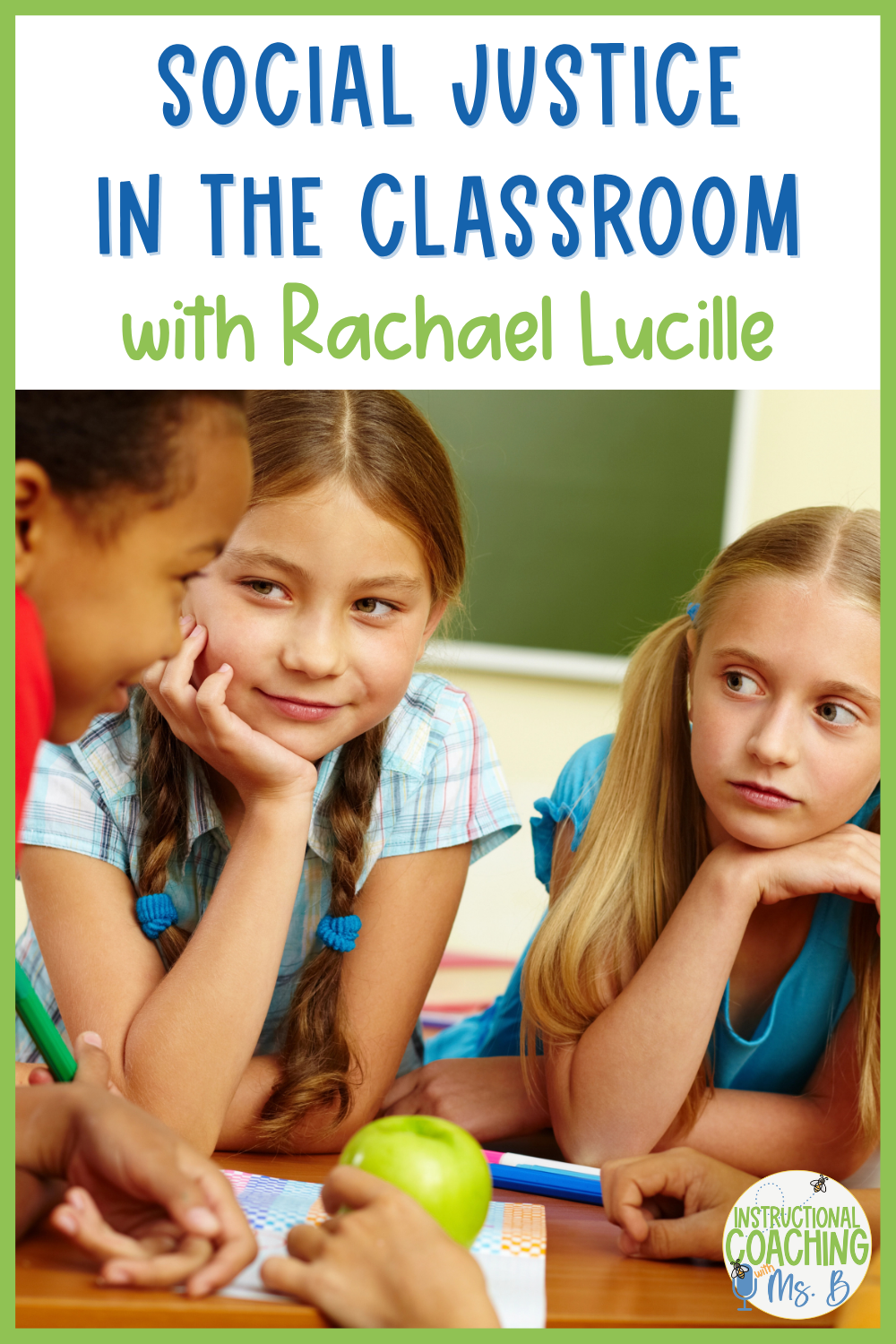
3 children in a classroom looking a each other thoughtfully. These words are at the top, "Social Justice in the Classroom with Rachael Lucille".

Social justice in the classroom can feel like a big, complicated thing to unpack. An idea that’s difficult to define and even harder to put into practice.

But what does it actually look like in real classrooms?

In Episode 274, I sit down with Rachael Lucille, School Program Specialist at Little Justice Leaders, to talk about how we can start introducing social justice work to students at every grade level, even when it feels overwhelming or scary. She shares her real-life experience as both a parent and educator, explaining what social justice really means and showing how you can embed it into daily routines, no matter what grade you teach.


Rachael offers practical examples and discusses how creating a classroom where every kid feels seen and supported is at the heart of social justice work. We talk through what conversations actually sound like with kids of different ages and include stories of discussions we’ve had with our own kids.

You’ll find out the actionable steps necessary to lay the groundwork for a more affirming school culture. We also explore how we can continue this important work even when there’s political or policy pushback. Plus, find out how instructional coaches can support social justice work, even if they don’t pick the curriculum.

Listen now for actionable ideas and inspiration!

Social Justice Work Across Grade Levels

To kick off the conversation, I ask Rachael what social justice work looks like in elementary, middle, and high school. She tells us that it doesn’t have to be a big, complicated concept reserved only for older students.

Rachael defines social justice as “the proactive pursuit of equal rights, opportunities, and treatment for all people aimed at creating a fair society by overcoming systemic inequities based on race, gender, ability, or economic status.”  During the episode, she explains what social justice work can look like across different grade levels:

Elementary School

  • Social justice work at this level is basic and teaches the foundations. It focuses on disrupting unequal systems from the very beginning.
  • For young learners, it’s about teaching inclusivity, inclusive language, and normalizing differences. Instead of addressing the classroom as “boys and girls”, try “friends”.
  • Rachael cautions teachers to be mindful and not make assumptions about students’ experiences outside school. Students don’t all have the same experiences. Not everyone goes on vacation during holidays. Instead, recognize that school might be the only place where some students feel safe or get their meals.
  • Foster an environment where kids are accepting of their peers’ differences, a place where all kids feel valued and seen.
  • In the younger years, Rachael says, “If you are teaching kids how to be kind humans, then you’re doing social justice work.”

Middle School (and Later Elementary)

  • Upper elementary and middle schoolers are ready for deeper conversations about the reasons why being inclusive and equitable matters. Educators can start breaking the barrier and explain the reasons behind inclusive practices, connecting them to historical or systemic inequities.
  • The groundwork naturally shifts from simply establishing norms to actively exploring how and why social justice principles are necessary. As Rachael notes, it’s important to help students see that “historically it hasn’t always been this way”.

High School

  • High school students have a greater capacity to handle complex, sometimes uncomfortable or controversial topics.
  • Rachael encourages waiting until this age for deeper conversations to preserve children’s innocence.

Building social justice in the classroom is a gradual process. No matter the age, the foundation starts with kindness and curiosity. You’re just going a little deeper as students mature.

Be ready for anything with the Instructional Coaching Editable Binder Megapack!

It includes forms, templates, and everything you need to get organized for instructional coaching! Coach teachers and document your coaching work with these printable and editable tools. Grab the Instructional Coach Binder Megapack in my TpT Store!

Teaching Social Justice by Meeting Students Where They Are

Another important topic we discussed is how every child is unique, and their readiness for different social justice conversations often depends on their individual interests and life experiences. During the episode, we share stories about our own kids and offer examples of how conversations arise from real moments, reminding us that the process is different for every child.

As Rachael points out, even within the same family, two children may be ready for certain topics at completely different times, influenced by what sparks their curiosity or comes up naturally in their day. The key is to be responsive and follow the student’s lead. This approach honors each child, ensuring that the conversations are relevant and meaningful to them.

Laying the Groundwork for Social Justice in Schools

If a school is trying to make moves in this direction, how can it take the first steps to lay the groundwork for social justice? Rachael shares actionable ways schools can begin building the foundation for this important work:

Implementing an Age-Appropriate Social Justice Curriculum – The Little Justice Leaders curriculum is a flexible, K–8 framework that addresses a range of topics related to social justice. It offers flexibility for when and how topics are introduced to students.

Include Diverse Books – Introduce books and reading materials that focus on inclusivity and diversity to spark important conversations in the classroom. The “A Kids Book About” series is great for conversation starters that naturally introduce social justice concepts to students.

Promote a Place of Inclusivity  – Create a school where every student feels welcomed and valued as an individual. Use inclusive language, promote acceptance, and design classrooms where students celebrate each other’s unique backgrounds and needs.

Go Beyond the Surface with Standards and Lessons – Many social studies lessons are tied to events rooted in social justice, but these stories can sometimes be glossed over. By digging deeper into these events, educators can help students make meaningful connections to the past and present.

What Can Instructional Coaches Do to Support Social Justice Work?

Instructional coaches may not choose the curriculum, but we can still play an important role in promoting social justice in schools. Here are three ways coaches can support social justice work in the classroom.

1️⃣ One of the easiest ways to make an impact is to share resources. Rachael recommends starting with the Little Justice Leaders’ website and social media.

2️⃣ Another suggestion is to curate books centered on inclusivity, equity, and diverse stories. Books can unlock a safe entry point into sensitive topics and provide key vocabulary.

3️⃣ Classroom community lessons or meetings present natural opportunities to talk about social justice. For instance, explaining the concept of equity through everyday classroom examples, like some students using glasses, helps students see that fairness means meeting individuals’ unique needs and not treating everyone the same. Small shifts like these allow coaches to foster inclusion even when the curriculum is rigid.

Be ready for anything with the Instructional Coaching Editable Binder Megapack!

It includes forms, templates, and everything you need to get organized for instructional coaching! Coach teachers and document your coaching work with these printable and editable tools. Grab the Instructional Coach Binder Megapack in my TpT Store!

Making Small Moves and Pushing Back When Policies Make This Work Difficult

We have seen significant political pushback against social justice efforts and anything perceived as related to DEI initiatives. Educators can feel caught between wanting to support all students and not wanting to face disciplinary consequences.

So, what can we do to push back or make moves in our schools?

Here are some practical ways educators can make small but significant moves, even in the face of ever-growing restrictions:

  • Choose Your Words Wisely: How you talk about the work you do matters. Instead of saying, “I’m a social justice educator”, focus on statements like “I believe in affirming and supporting kids” or “I want to make sure students have the tools they need to thrive and succeed in my classroom”.
  • Use Broad, Neutral Terms: When possible, opt for neutral or widely accepted terms. Sometimes, simply adjusting our language a little can make these important conversations possible.
  • Lead by Example: Show your commitment to social justice by meeting students’ individual needs, celebrating differences, and creating an environment where every child feels seen, valued, and supported.

Remember, you can make a difference even when there are policy barriers in place. When you walk the walk, kids notice. Your actions show students what equity and fairness look like in real life.

Supporting Social Justice in the Classroom

It’s easy to feel like we’re not doing enough, but sometimes one conversation or supportive moment for a child can be the place we start. My discussion with Rachael was an inspiring reminder that even small actions can make an impact when it comes to supporting social justice in the classroom.

Rachel’s perspective was both realistic and encouraging. I loved hearing all the actionable ideas for making social justice work part of our everyday routines and appreciated how she encouraged us to celebrate the good work we’re already doing. It left me thinking about how each of us can help create a more inclusive environment, one step at a time.

Check out the full episode for practical ways to bring more social justice into your school community.

Topics and Questions Discussed in Episode 274 – Social Justice in the Classroom with Rachael Lucille

  • A basic understanding of social justice in the classroom
  • Clear definition of social justice and its core principles
  • Understanding what social justice work looks like at different grade levels
  • Age-appropriate approaches to conversations about equity and inclusion
  • Practical steps schools can take to lay the groundwork for social justice
  • Ways instructional coaches can support social justice work, even if they don’t pick the curriculum
  • Navigating policy restrictions: What educators can do to push back or make small moves in their schools

About Rachael Lucille
Rachael Lucille (they/she) is a content creator and School Program Specialist for Little Justice Leaders. A Black parent born and raised in the Pacific Northwest, she is now raising three children near her hometown while centering social justice in both parenting and education. With a passion for storytelling and advocacy, Rachael’s work in communications challenges the status quo and amplifies community-centered narratives. Outside of work, she’s passionate about motherhood, and enjoys skateboarding, tending to plants, and collecting books.

Turning Insight Into Action: Practical Steps You Can Take After Listening

Here are simple actions you can take today:

1️⃣ Add Inclusive Books to Your Collection

Choose books that highlight inclusivity and social justice topics. Pick stories that feature diverse characters and experiences to spark classroom conversations.

2️⃣ Grab the First 20 Days Checklist

The first 20 days of school checklist is perfect for helping you narrow down the specific tasks you need to do in the first 20 days of school to set yourself up for a successful, impactful year of coaching! Grab this handy checklist at buzzingwithmsb.com/first20 and be ready to coach your teachers this school year!

Ready to listen?

  • Ready to listen? You can listen below with the media player, or search for Buzzing with MS. B: The Coaching Podcast anywhere you listen to podcasts!

This post contains links to products from one or more of our advertisers. This means I may receive commissions for purchases made through links in this post when you click on links to those products. Thank you for your support!

Learn more

Helpful Resources


Listen on: Apple Podcasts, Spotify, or your favorite listening app


Thank you for listening to Buzzing with Ms. B: the Coaching Podcast. Want more coaching ideas

Check me out at buzzingwithmsb.com and on Instagram @buzzingwithmsb.

If you love the show, share it with a coach who would love it too, or leave me a review on iTunes! It’s free and it helps others find this show, too. Happy coaching!

Podcast produced by Fernie Ceniceros

Social Justice in the Classroom with Rachael Lucille, ep. 274, Instructional Coaching with Ms. B Podcast

Chrissy Beltran [00:00:01]:

Hey, coach, and welcome to instructional coaching with miss b. Today, we are digging into social justice in the classroom with my Rachael Lucille, Rachael Lucille. Rachael Lucille, they, she, is a content creator and school program specialist for Little Justice Leaders. A black parent born and raised in the Pacific Northwest, she is now raising three children near her hometown while centering social justice in both parenting and education. With a passion for storytelling and advocacy, Rachael’s work in communications challenges the status quo and amplifies community centered narratives. Outside of work, she’s passionate about motherhood and enjoys skateboarding, tending to plants, and collecting books. And can we not all relate to collecting books at least a little bit? I have a lovely collection going right now. I have this really amazing thrift store that I go to, and I kind of refuse to buy books at regular price if I can avoid it. And they always have these the best titles, and I’m like, oh, I’ve been seeing this one going around, and I just get it and add it to my pile. So I think we all have a lovely book collection going. I actually have a free, little checklist for you. If you’re feeling a little overwhelmed with figuring out the beginning of the school year, I have a lovely resource for you. It’s the first twenty days of school checklist, and it’s perfect for helping you narrow down all of the dozens and dozens of things that you could be working on into the specific tasks that you actually need to do the first twenty days of school to set yourself up for a successful, impactful year of coaching. So you can grab that at buzzing with missb.com/first twenty, that’s first two zero, and feel ready to coach your teachers this school year. Let’s welcome Rachael to the podcast. Thank you so much for being here today with us, Rachael. I really appreciate you making the time to join us.

Rachael Lucille [00:01:32]:

Yeah. Thank you so much for having me on.

Chrissy Beltran [00:01:35]:

Yeah. Okay. I would love to get started with kind of a basic understanding of what social justice work looks like at different levels, what it can look like in elementary versus middle school versus high school.

Rachael Lucille [00:01:47]:

Yeah. So I’ve been doing social justice work for a while now, and I’ll admit that in the beginning, to me, social justice sounded so distinct. It sounded like a very distinct and like complicated thing. And even at the beginning of my parenting journey, I’m a mom of three. My oldest is 14, so I’ve also been a parent for a while. I’ve definitely been a parent for longer than I’ve been doing social justice work. And I, at the beginning, could not have imagined being the type of parent who talks about social justice. It was just not on my list of things to do. It just sounded really big, complicated and not necessarily appropriate for kids, which is what I think a lot of people assume, defined social justice is the proactive pursuit of equal rights, opportunities, and treatment for all people aimed at creating a fair society by overcoming systemic inequities based on race, gender ability, or economic status. So from that, it’s like, it’s actually pretty basic for young kids, especially. It’s really just about like disrupting unequal systems from the jump. So an elementary school that can look like teaching kids about inclusivity, inclusive language, normalizing differences, instead of addressing a classroom as boys and girls, address them as friends. And then like even something as simple as not assuming that during holiday breaks, all kids are going on vacation or having a ton of fun. For some kids school is where they’re getting their safety or their meals, or, you know, and then creating an environment where kids are accepting of peers differences. So in those younger years, it’s really just about teaching kids how to be kind humans. That’s how I have kind of reframed it to talk to folks about is, like, if you are teaching kids how to be kind to humans, then you’re doing social justice work. When you get to middle school and high school, like I would say like later elementary school, that’s when you can kind of start breaking the barrier of like, okay, the reason that we talk this way or the reason that we’re so inclusive is because historically,

Chrissy Beltran [00:04:32]:

this is how

Rachael Lucille [00:04:32]:

groups of people have been seen. Earliest conversations with my kids, letting them know that, like, I know that I’ve created this environment where we are inclusive, but I want you to know that not everyone is inclusive. And some of those conversations, they were, like, mind blown. They’re like, wait. Not everybody knows that, like, every family doesn’t just have a mom and a dad. Like, some families just have a mom and some families have two moms and, you know, and they were blown away by those conversations because we just created it a normalcy of that. So I think when they get a little older, that’s kind of when, when I have introduced, like the reason that we’re doing it this way now is because historically it hasn’t always been this this way. Yeah. And then when you get into high school, they are, you know, their capacity for being able to handle more complicated and even like, like, controversial or things that are really difficult and uncomfortable to hear.

Chrissy Beltran [00:05:46]:

Mhmm.

Rachael Lucille [00:05:47]:

I would save those. You know, we don’t wanna take away their innocence. I know that’s Yeah. A huge thing that parents worry about and educators worry about is, like, I wanna keep my kids as innocent as possible. And you totally can. You can you can save those harder conversations for when they’re a little bit older, but you’re still doing the work and, like, laying the groundwork when they’re younger.

Chrissy Beltran [00:06:07]:

Mhmm. Yeah. The other day, it was as you were talking about, you know my daughter’s in second grade. She is, eight she’s eight years old. And the other day, I was, I I’m insisting that I’m gonna take the stump out of my backyard. Like, it’s bothered me for twenty two years. It’s been on my list, and this is the year we’re gonna do it. And so I I told my husband, hey. Could you swing by my mom’s and pick up? They have, you know, like, a pickaxe and all these different tools, and I was like, I just I’m ready to get rid of that stump. Well, he didn’t want me to do it, I think, because then he thought he might have to help, and he is not a yard work guy. So he was he was very much against this. And so he came home, and he was like, honey, I picked up I went to your mom’s, and I looked, I saw the tools and I, let’s just call somebody. I don’t think you should be doing this. And my daughter looks at him and she goes, are you saying that because she’s a woman? You shouldn’t be removing that stuff because she’s a woman. And he goes, no. Isn’t this really gonna be hard to do? He goes, I’m I don’t wanna do it either. It has nothing to do with that. I just I’m we don’t need to be messing with a stump. Somebody can do this who gets paid to do this. But I was like, good job.

Rachael Lucille [00:07:13]:

Though. I love the energy from the second grader. That is

Chrissy Beltran [00:07:17]:

Yes.

Rachael Lucille [00:07:17]:

Exactly.

Chrissy Beltran [00:07:19]:

Yeah. And, I mean, I haven’t had I haven’t told her anything truly awful. I’ve just told her yes. In the past, like you mentioned, some of the things as they get a little bit older, some kids are ready for it. I felt like she was ready for certain things a little earlier. And so, yes, at certain times in history, you know, women have been considered unable to do certain things by other by men. Men have considered that this is, you know, this is what a woman’s role is, and we know that that’s not true. You know? And so she just she took it around with

Rachael Lucille [00:07:43]:

it. Absolutely. Yeah. I have a third grader, and very similar conversations. I think another thing is like certain kids are ready for, for different conversations at different times. Yeah. Even between my, so my kids are 14. My son is 14. My daughter is eight. No, she just turned nine. Oh my gosh. Just turned nine. I mean, I have a one and a half year old and my, the way that I have to explain things to my two older kids and what I thought maybe I would be ready to explain to my nine year old because of the time that I have the conversation with my 14 year old, I’m seeing is just like so different because every kid is so different. And they, they even have just like different interests, which influence the way, like what they’re ready for at different times. So.

Chrissy Beltran [00:08:36]:

And when things might naturally come up, like somebody who’s interested in sports might have different conversations than somebody who’s interested in gardening, apparently. So

Rachael Lucille [00:08:44]:

Absolutely. Yeah. Yeah. And sometimes those conversations really just come up. You know? Like Yes. They do. They they’ll come to you with questions sometimes. And suddenly you’re a social justice forward parent because your kid has asked for that.

Chrissy Beltran [00:09:01]:

And you know the context. You know the bigger picture of why this is the way that it is at this time. Yeah.

Rachael Lucille [00:09:06]:

Yeah.

Chrissy Beltran [00:09:07]:

So if a school is trying to make moves in this direction, and we know that individual teachers have done this kind of work and had these kinds of conversations with kids, but if the whole school is trying to move in this direction in general, how can they take the first steps to lay some groundwork of social justice?

Rachael Lucille [00:09:24]:

Yeah. So, Little Justice Leaders does have a curriculum for, affirming schools that want to move more in this direction. Mhmm. It is a k through eight curriculum, of lots of topics. It’s pretty flexible as far as, like, when certain teachers wanna teach certain topics. So that that would be a really great way place to start. Another thing that that I know a lot of educators do is, like, really just introducing books into, you know, like, books on inclusivity, books about book about is a great series that has a lot of really, really great education and kind of like those conversation starters for kids. Mhmm. And, yeah, really just promoting a place of inclusivity, I think, is a huge a huge way for schools to just lay that groundwork.

Chrissy Beltran [00:10:38]:

Yeah. I think I’m thinking about how many social studies standards are directly connected to events that are that were based on social justice. Right? And sometimes, I feel like those are glossed over. Like, oh, so and so did this, to fight for rights, and then that’s it. That’s the end of the conversation. But if you read more about it, if you dig into it a little bit further, then you can understand why that was necessary, and then you can have conversations around that. Well, do we see examples of that today? You know, maybe you do, maybe you don’t, but it would be interesting to see what kids are noticing, in connection to that.

Rachael Lucille [00:11:11]:

Absolutely. And and that’s something that, you know, the I was reading about it this morning, just the watered downness

Chrissy Beltran [00:11:18]:

of Yeah.

Rachael Lucille [00:11:19]:

So many of the lessons that are kind of glossed over. And I think now we’re learning as a society that kids can handle more information. It’s really just in how you present it. So exactly like what you said. It’s like digging a little deeper into those topics that we are already teaching kids. Just going a little bit deeper, asking them questions, getting them thinking about, like, getting them curious about, like, oh, yeah. How why did they do that? Or, like, what was the point or the, the power behind doing a bus boycott? Like

Chrissy Beltran [00:12:02]:

Mhmm.

Rachael Lucille [00:12:02]:

In what way would that be helpful? So, yeah, we definitely already have examples. We just need to dig a little deeper.

Chrissy Beltran [00:12:10]:

Yeah. Absolutely. So instructional coaches support teachers, and instructional coaches do not always choose curriculum. As a matter of fact, they often do not, because that usually happens, like, at the district level or sometimes even higher up than that, the state level. Things are decided. So how can a coach who doesn’t choose curriculum support social justice work in classrooms at their school whenever it’s not really built into their time frame during the day? And I think you just talked a little bit about a couple of of examples that we could use, but do you have any other thoughts on that?

Rachael Lucille [00:12:40]:

Yeah. I mean, the little justice leaders website does actually have quite a bit of resources. We have, like, a blog section to just kind of dig a little deeper. On our social media, we do a lot of, like, good questions to ask kids about certain topics. There’s a lot of really great book recommendations, which is one of the things that I mentioned earlier. I find as a parent, and as someone who works with kids really regularly, that books are such a great way to get those conversations started. Like Yeah. Books are just gold.

Chrissy Beltran [00:13:20]:

Yeah. They are. There’s so many more concepts and vocabulary and language and then illustrations or photographs there that kids can be exposed to, then it’s so much better than if we’re just trying to explain something. Right? Absolutely. Yeah. I think also another good place is how many times do we have these classroom community lessons or meetings that we do with our kids? And I think a lot of concepts would fit into that. Even just basic things about, like, equity that is a concept that translates to the entire school day and to every setting. Yes. But what would that look like? What does equity look like? Well, some kids in our classroom are gonna use glasses to see and some are not. Some kids are gonna use, you know, I had a student who had at the time, it was enormous, and now I’m sure it’s much more streamlined. But it was a gigantic, computer screen, and then they would it was, like, to enlarge their text because they needed a large print text for everything, so then they would slide it under the screen. Everybody didn’t need that. Right? You get what you need for to be equitable. But what an easy conversation to have that would actually set the stage for, like, the way your classroom functions.

Rachael Lucille [00:14:25]:

Yes. Yeah. And I think, again, the reason that it’s almost like social the words social justice or the idea of social justice was so stigmatized because it was narrowed on purpose. You know, narrowed to think about, only it being a racial issue. Mhmm. And really, exactly like what you said, it’s like you can get in a classroom of a bunch of kindergartners and well, maybe not kindergarten because I don’t know how early they start to to check on eyesight, but it’s like they It

Chrissy Beltran [00:15:01]:

depends on how bad it is, I think. I think, you know, I had a child with macular degeneration. I think she was identified as a toddler. So, you know, kids, there are differences already in learning that we can see. Yeah.

Rachael Lucille [00:15:11]:

Exactly. Exactly. And it’s like and that’s one of those things that is just so easy to to use because eyesight is something that crosses socioeconomic status. It crosses Yes. Racial divides. You know? So it it’s like the it doesn’t discriminate against how much money you have or where you

Chrissy Beltran [00:15:35]:

are born. Yeah. And maybe a colored overlay might help you, like, the film the little they were like the transparencies, but they were colorful. Maybe that might help this student because they have issues with vision. It might also help another student who has issues with focus or maybe dyslexia. Right? So the same tool can help different kids for different reasons. So everybody gets what they need, and that’s and you don’t always have to have a diagnosis to be able to get help assistance with something, some sort of tool. So I just I found that was an easy way to start talking about equity is everybody gets what they need. What do you need to be successful?

Rachael Lucille [00:16:07]:

Yeah. Yes. Absolutely.

Chrissy Beltran [00:16:09]:

So then you kind of mentioned this, actually. We have seen a huge political pushback on social justice work or anything that what people think DEI is, anything related to this topic. And in states with specific policies about this, like, I live in Texas. Right? That is getting what people are allowed to teach is getting narrower and narrower. Now they’re talking about a book list that’s gonna gonna start in a couple of years on what is approved and what’s not, and I can only I can’t it kinda makes me sick to have kids in school at this time in history. So what can educators do to push back or to make small moves in their schools without, you know, basically getting taken in front of the school board?

Rachael Lucille [00:16:53]:

Yeah. This is, this is something that I did touch on at the very beginning. It’s Mhmm. I think it’s more about what you’re saying than well, it’s more about how you’re saying it. You can say the same. You can talk about social justice, and you can say, oh, I am a social justice educator, or you can say, I believe in affirming kids and supporting kids. There’s just so many different ways of saying the same thing. So I think that in those states where there are a lot of policies blocking, it’s really just about getting creative with your vocabulary and how you talk about the work that you do. I wanna make sure that all kids are supported. I wanna make sure that all kids have the tools and the support that they need to thrive and to succeed in my classroom.

Chrissy Beltran [00:17:53]:

Mhmm. Yeah. I agree with that. I had a conversation a while ago with somebody. It took me a minute to figure out what she was trying to ask me. She said, I’m trying to have people look at the different groups of kids, the data from different groups of kids without seeming like I am she was worried about getting in trouble, basically, or or just getting shot down and saying we’re not gonna do that. I said, could you say subpopulations? And she was like, oh, I will say so I can say that. That’s a good one. And so that’s, like, a very, you know, broad it’s a term that means a lot of different things depending on who your subpopulations are, and you can use it to describe lots of different groups of kids and look at data and see how are we meeting their needs. You know? Yeah.

Rachael Lucille [00:18:34]:

Yeah. It’s and it is tricky. It’s unfortunate that it has come to this. And Yeah. I think with the rise of social media and the rise of online tools, buzzwords have just gotten really popular, and they get popular, and they get co opted, and somehow they start meaning things that don’t even that are not the original meaning. Right. Even, you know, even that definition of social justice. I think when a lot of people think, what is social justice? They think of people marching in the streets. They think of, they probably think more about race than anything else. But the definition is literally proactive pursuit of equal rights, opportunities, and treatment for all people aimed at creating a fair society by overcoming systemic inequities, which system don’t believe in. Right? Yeah. There’s some buzzwords in there too, but but when you just look at when you look at the definition, it’s like, oh, it’s just creating a fair world for everybody.

Chrissy Beltran [00:19:45]:

Mhmm. Yeah.

Rachael Lucille [00:19:47]:

Where they were born or what they look like.

Chrissy Beltran [00:19:49]:

Right. Yeah. Beautiful. So I think that this will give some people some ideas of a few things they can do and also really acknowledge maybe some of the things that they’re already doing because it’s easy to feel like I’m not doing enough and none of us is doing enough because here we still are. Right? But, but we can each do what we can do. And so, you know, acknowledge what you’re doing and think about a couple small things that you can add into your practice that could have big results because every kid, you know, deserves this. And so if there’s a kid that you can support in some way, you know, maybe we start there one at a time. Yeah. Thank you. How much could or how can coaches keep learning from you?

Rachael Lucille [00:20:25]:

Yeah. The Little Justice leaders website, like I said, we also have a lot of really great resources just on our Instagram. Follow us on Instagram or TikTok or Facebook. And we have, you know, different starting like, conversation starters. There’s book lists. You’ll probably see me on there talking about various things.

Chrissy Beltran [00:20:48]:

Great. Thank you. Thank you for being here today. I do appreciate it.

Rachael Lucille [00:20:51]:

Awesome. Thank you so much for having me.

Chrissy Beltran [00:20:54]:

Coach, I hope that gave you some things to think about in terms of directions you can go and maybe just a starting point. Have those conversations with your kids and your students and your teachers to help them be thoughtful about the way that we instruct and what opportunities we are missing and actually taking action on to have these kinds of dialogues with our students. Next week, I’m chatting with my longtime coach and friend, Denise Paisa. We’re talking about recent changes in teaching and learning and how to navigate those changes with your teachers and your leadership. So I’m really excited about this episode. I love talking with people who I actually know in real life because Denise is, like, a pro. She has been an amazing teacher since the day that I met her, when I was a new teacher and I was, you know, learning so much. I remember popping into her room and just being completely overwhelmed by all the good things, and I’m super excited to have her on the podcast next week. Until then, happy coaching!

Share:

Similar Posts

Leave a Reply

Your email address will not be published. Required fields are marked *