| | |

How Coaches Can Use Co-Teaching to Support Teachers, ep. 256
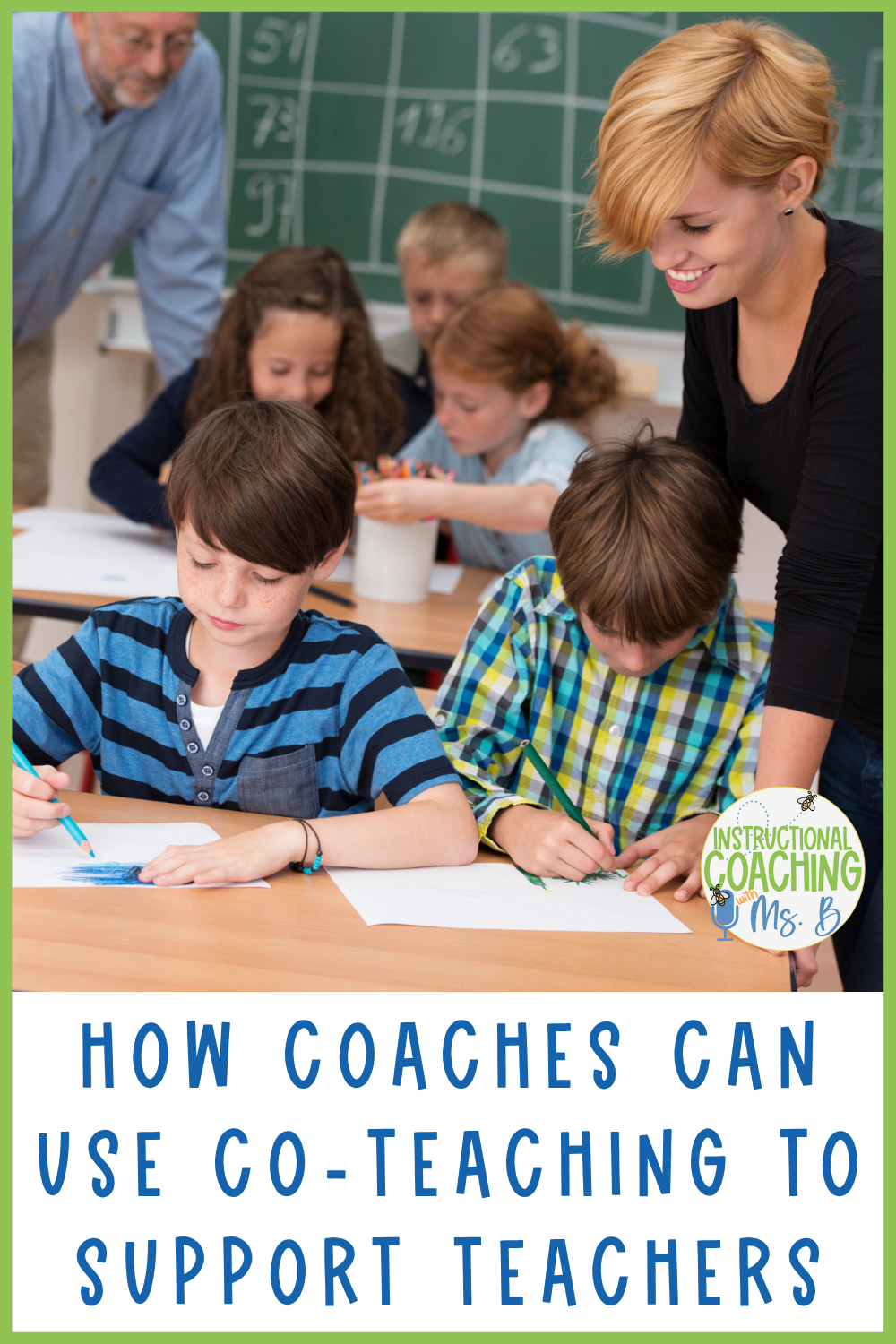
Two teachers standing around students desks while they work. These words are at the bottom, "How Coaches Can Use Co-Teaching to Support Teachers".

Wondering how coaches can use co-teaching to support teachers?

I’ve been there!

When I first started coaching, co-teaching stressed me out! I was used to running my own classroom and knowing exactly what to expect from my students. It felt daunting stepping into someone else’s space, unsure of the classroom dynamics and routines. I didn’t have rapport with the students, and it often felt like my lessons needed to fit perfectly into a single 30-minute time block.

I had experience co-teaching with a special education teacher. It was different than going into someone else’s room, but at least that experience helped me get comfortable planning collaboratively. When my principal asked me to spend a month supporting two new fourth-grade teachers, it was a good opportunity to jump in. We began with modeling, then gradually shifted to co-teaching, which allowed us to troubleshoot together and reflect in real-time.

Working together with teachers was a great experience! Co-teaching turned out to be one of the most meaningful and practical supports I could offer. It provided an opportunity for teachers to try out new things and have meaningful conversations that change teaching over time.

In Episode 256 of Instructional Coaching with Ms. B, I share my favorite tips and honest reflections on how coaches can use co-teaching. We talk about when and how to use it, plus ways to leverage it into different coaching strategies over time.

Let’s look at some of the highlights from this podcast! Be sure to listen to the full episode to get all the details!

Why Co-Teaching Is Such a Powerful Tool

Co-teaching sits between modeling and observation. It’s a collaborative bridge that builds teachers’ thinking and responsiveness. You’re still there providing support, but gradually releasing the responsibility to the teacher. Co-teaching gives teachers the chance to see how an experienced educator makes in-the-moment decisions, which is something they rarely get to observe. It also shifts the focus from delivering a lesson to responding to student learning in real time by adjusting instruction, responding to student cues, and reflecting during the lesson.

When to Use Co-Teaching

So, when should instructional coaches use co-teaching? In this episode, I walk you through the best times to try this approach:

  • When a teacher wants to try something new but needs support.
  • When a teacher has a basic lesson idea but struggles with rigor or purpose.
  • If a teacher ignores or misses student cues during instruction.
  • When a teacher struggles to assess and adjust instruction in real time.
  • As part of gradual release: model → co-teach → observe.

How Coaches Can Use Co-Teaching to Support Teachers

Co-teaching isn’t splitting the lesson in half! Instead, it’s working side-by-side to build understanding for both the teacher and students. During the episode, I explain how I plan for co-teaching. You might want to try this too!

Pre-Work

Schedule a co-planning session. You want to make sure you both understand the standard, background, and context.

Plan Together Before the Lesson

  • Define clear student learning targets and a teacher goal for the session.
  • Build a three-column lesson plan with steps and roles for co-teaching: What teacher A does, what teacher B does, and instructional moves or student actions at each stage.
  • Decide when you’ll pause for reflection and dialogue.

During the Lesson

  • Take turns teaching together with planned roles.
  • Pause for quick reflective conversations. Ask questions like:
    • “How can we tell if students are getting this?”
    • “Do we need to adjust the next step?”
  • Model your thinking out loud so teachers see how you decide what to do next.
  • Check for student understanding throughout the lesson and adjust your next steps in real time.

After the Lesson

  • Analyze students’ work together and reflect on evidence of learning.
  • Plan next steps. Some possible options are:
    • Co-teach another lesson to refine strategies.
    • Focus on one area for improvement or success to replicate.
    • Transition gradually to observation or in-the-moment coaching as the teacher gains confidence.

How Coaches Can Use Co-Teaching to Support Teachers

Co-teaching is about making thinking visible, not just sharing instruction. It builds independence by modeling how to think during a lesson, not just what to do. Co-teaching also offers a golden opportunity to have meaningful conversations that can’t happen any other time than during the lesson.

When you use co-teaching, it helps teachers become more responsive, reflective, and effective in real time. You’re there with the teacher every step of the way, providing the support they need to develop confidence and build skills in the moment.

Try co-teaching in your next coaching cycle and let me know how it goes! You can share your experience in the Instructional Coaching with Ms. B Facebook group or tag me on Instagram @buzzingwithmsb.

Listen to the episode using the player below or wherever you get your podcasts.

Topics and Questions Discussed in Episode 256 – How Coaches Can Use Co-Teaching to Support Teachers

  • How coaches can use co-teaching to support teachers
  • My experiences with co-teaching as a new coach
  • Differentiating support based on teacher needs and confidence levels
  • Benefits of co-teaching
  • How co-teaching bridges the gap between modeling and observing
  • When to use co-teaching
  • Steps for effective co-teaching: Before, during, and after the lesson
  • Tips for creating effective co-teaching plans, including a three-column lesson plan
  • The power of reflective in-the-moment conversations during the lesson
  • Ways to extend the work and guide next steps
  • How co-teaching supports teachers in learning to adapt instruction in real time
  • Using co-teaching as part of the gradual release model in coaching cycles
  • Mistakes to avoid when co-teaching
  • Making thinking visible during the lesson

Ready to listen?

  • Ready to listen? You can listen below with the media player, or search for Buzzing with MS. B: The Coaching Podcast anywhere you listen to podcasts!

This post contains links to products from one or more of our advertisers. This means I may receive commissions for purchases made through links in this post when you click on links to those products. Thank you for your support!

Learn more

Helpful Resources


Listen on: Apple Podcasts, Spotify, or your favorite listening app

Thank you for listening to Buzzing with Ms. B: the Coaching Podcast. Want more coaching ideas

Check me out at buzzingwithmsb.com and on Instagram @buzzingwithmsb.

If you love the show, share it with a coach who would love it too, or leave me a review on iTunes! It’s free and it helps others find this show, too. Happy coaching!

Podcast produced by Fernie Ceniceros

How Coaches Can Use Co-Teaching to Support Teachers, ep. 256, Instructional Coaching with Ms. B Podcast

00;00;01;27 – 00;00;21;05

Chrissy Beltran

Welcome to Instructional Coaching with Ms. B, where we believe that every teacher deserves a coach and every coach does too. I’m Chrissy Beltran, an elementary teacher who became a coach, and I had to create my own coaching program that worked. Now I teach coaches how to design their coaching programs, build a school wide action plan, and use differentiated strategies to support teachers.

00;00;21;11 – 00;00;28;28

Chrissy Beltran

Plus, I’ve got a special spot in my heart for literacy coaches. Now let’s dig into the episode.

00;00;29;01 – 00;00;54;26

Chrissy Beltran

Hey coach, and welcome to Instructional Coaching with Ms. B. Today we are talking about something that I think is very important to consider this time of year, especially if you’re struggling and working with teachers and really making change in their classrooms. Episode 256 is all about how coaches can use co-teaching to support teachers. Now, if you have been working with teachers and you feel like you’re not sure where to start, your coaching cycles are super disorganized.

00;00;54;28 – 00;01;15;26

Chrissy Beltran

I want you to grab the free coaching Cycles Crash course at buzzing with miss B.Com slash cycles. It will help you get yourself structured. It keeps everything really simple and practical, and it makes it very easy to turnaround cycles with the teachers that you’re working with and make them impactful. So grab that today. It’s a free mini course that goes straight to your inbox.

00;01;15;28 – 00;01;41;23

Chrissy Beltran

I’m going to start today by sharing a little bit about my experience with co-teaching. Whenever I first started coaching, I haven’t made a secret of this at all. Co-teaching stress me out. Co-teaching and modeling. Honestly, both stress me out because I was going to be stepping into somebody else’s classroom and handling, situations that normally in my own classroom, I had done a lot of proactive work to kind of prepare for.

00;01;41;23 – 00;02;03;09

Chrissy Beltran

So, for example, in looking at behavior, my kids knew what was expected of them in behavior situations. And so even if there were some misbehavior, they understood my response. I could get a lot across with a look or a gesture. That was, you know, nonverbal. And, whenever you go into somebody else’s classroom, you do not have that kind of rapport with the students.

00;02;03;12 – 00;02;25;16

Chrissy Beltran

I also really struggled with the idea that I didn’t teach a lesson. And then that lesson was completely encapsulated in 30 minutes or something. I approach my work as building knowledge and learning over time and developing thought processes, and my teaching was very integrated. So if we were talking about something in science, it was going to find its way into our reading work.

00;02;25;16 – 00;02;41;22

Chrissy Beltran

And if we are working on something in writing, we were going to use those writing skills later on in the day in social studies. I integrated everything over time and made connections, so it was really hard for me to isolate my teaching into one little lesson. It’s still something I struggle with to this day. Everything becomes bigger, right?

00;02;41;27 – 00;03;02;22

Chrissy Beltran

I know if you’re if you’re the same kind of teacher as I am, everything becomes bigger than you intended it to and it kind of snowballs. But that doesn’t work really well when you’re going to step into somebody else’s classroom, teach a lesson or a handful of lessons over a few days, either by yourself in modeling or working alongside the teacher as a co-teacher.

00;03;02;25 – 00;03;21;10

Chrissy Beltran

The benefit that I did have whenever I started coaching was I had worked with a co-teacher as a classroom teacher, so I was the classroom teacher, and then I had a co-teacher come in as a special education teacher, and we did a lot of co-teaching planning. And so I got really comfortable planning with another teacher about what our roles could look like.

00;03;21;15 – 00;03;42;04

Chrissy Beltran

But that was still my classroom, right? And it’s very different than whenever you go into somebody else’s room. So I was super nervous about it. So the first major experience I had with co-teaching was whenever we had two teachers who were, new to grade level and one who was brand new to our school. One of them was being promoted from kinder to fourth grade.

00;03;42;11 – 00;03;59;20

Chrissy Beltran

Oh, no, first grade. Sorry, first grade to fourth grade. I know we had a lot of this go on. And one year we had like, major, numbers change in our students. And so we really had a lot of shifting. I think I just talked about a different example of this when I shared about visiting a colleague that was a different teacher, same year, crazy year.

00;03;59;22 – 00;04;14;12

Chrissy Beltran

So we had a first grade teacher move up to fourth grade suddenly, and then we had a teacher come in from another school, and move into our fourth grade. And she had not taught fourth grade ever. And so the new to the grade level, they were new to the standards, they were new to a lot of things.

00;04;14;12 – 00;04;32;17

Chrissy Beltran

And so my principal said, why don’t we set up some really solid ongoing support in those rooms early on in the year? And so what I want you to do is I want you to teach in those classrooms. Either model co-teach, do whatever you need to do for a solid month. And that was amazing support for a teacher.

00;04;32;18 – 00;04;47;08

Chrissy Beltran

You know, I started fourth grade. I’d never taught it before either, and I got nothing. So I mean, this teachers were very well supported. We had a lot of systems in place at that time that were supportive of teachers. But, you know, they she wanted to see the support happening in the classroom. So this was a really good idea.

00;04;47;11 – 00;05;00;17

Chrissy Beltran

Granted, I couldn’t do it every day. I was in charge of PLC meetings, facilitating those meetings, you know, one day a week. And there were a lot of other things that were on my plate that made it to where I couldn’t be. There every single day. But I was there at least 3 to 4 days a week at four weeks.

00;05;00;19 – 00;05;26;02

Chrissy Beltran

And it was a great experience. I started out modeling. I kind of followed a gradual release structure, so I started out modeling. We would plan together, we would look at our curriculum, we would look at the plans that we had produced as a team, and then kind of figured out how to adjust those to their classroom. And then, over time, I integrated more co-teaching with the teachers, and working together with the teachers was a great experience.

00;05;26;05 – 00;05;47;10

Chrissy Beltran

It it gave me the opportunity to, like, let them try things out that they were comfortable with. And then we have those conversations that really are what changed teaching and support teachers over time, because you can have them in the moment and you can have them after the lesson. And that was a really good experience. Building in a planning time together was also really important because if we didn’t have that, then we walked into the lesson and it was just a hot mess.

00;05;47;17 – 00;06;09;10

Chrissy Beltran

There’s nobody who’s going to benefit from walking into a co-taught lesson called it is not a good experience and it doesn’t benefit the teacher or really the kids because you’re just kind of floundering like, what is my job here? So after I was there for a couple of weeks, one teacher still really wanted to support the one who had moved up from first grade, but the other teacher who had taught several grade levels around fourth grade, but just not fourth grade, was more comfortable.

00;06;09;10 – 00;06;16;16

Chrissy Beltran

And she turned to me and she said, can you not come tomorrow?

00;06;16;19 – 00;06;33;07

Chrissy Beltran

And I was like, yes. She goes, I don’t mean anything bad. She said. I just feel like I want to try it. I want to try it out without anybody here. And then after a few days you can come check on me. And I said, that sounds perfect. I love it that you’re taking, you know, leadership on what you’re ready to do and that you feel confident to do that.

00;06;33;07 – 00;06;54;21

Chrissy Beltran

Awesome. So that I was able to spend more time in the other classroom where the teacher was still needing more support. And that’s important. We have to differentiate for teachers wherever they are. So, that was my experience. I check back in on that other teacher after a few days. She was doing so well and she had really, felt confident and safe enough to say that she was ready to branch out on her own, and I’m so glad that she did.

00;06;54;23 – 00;07;14;10

Chrissy Beltran

So let’s talk a little bit about co-teaching today. When you want to use it, how you can use it and what it how it can like leverage into a different coaching strategy over time. Kind of like we talked about with this teacher being ready for something different. She was ready for independence. But we’ll talk about what else you can do with co-teaching.

00;07;14;10 – 00;07;34;20

Chrissy Beltran

If you feel like you need to pull back a little further. But they’re not ready completely to be on their own. So why is co-teaching such a powerful tool for for you and your teachers? Co-teaching really kind of sits in between modeling and observation. So it’s sort of like a collaborative bridge that can build teacher thinking and responsiveness.

00;07;34;27 – 00;07;58;20

Chrissy Beltran

And also have you there still providing the support, still providing a think aloud, but you’re gradually releasing that responsibility to the teacher. It can help teachers see how, how much or what’s more, experienced educators or people who are just, you know, comfortable in that area might make in the moment decisions, which is something that a lot of our teachers don’t have.

00;07;58;20 – 00;08;20;02

Chrissy Beltran

They don’t get to see each other teach. They don’t get to have conversations about why did you choose to do this in the moment? So this is the opportunity that we have to help teachers choose something in the moment to really think about why is this happening? Why did they make that decision? What information are they using? It also shifts the focus a little bit from delivering a lesson to really responding to student learning.

00;08;20;02 – 00;08;47;12

Chrissy Beltran

Because you’re having those conversations, you’re having those in the moment decision making conversations and modeling your think alouds so the teacher can see, okay, you’re not just going through the motions of a lesson plan. And if you have teachers who are doing that, this is a great way to really build their understanding of the tiny changes and reactions that we have, the way we make adjustments in the moment, so that they can see that they can do these things when you’re not around.

00;08;47;14 – 00;09;16;22

Chrissy Beltran

So this is a great strategy. And the reason that I realized that it was so important is, you know, I remember I went to a classroom once and I had modeled I was modeling a lesson on writing strong narrative beginnings. And mid lesson, I realized that the kids lacked even a basic understanding of what we’re talking about, the lessons that we had planned together, collaboratively with that teacher either hadn’t hit the mark, the kids hadn’t learned it, or they hadn’t been taught.

00;09;16;24 – 00;09;38;22

Chrissy Beltran

And so I really had to pivot in the moment to a more simple goal. And my mistake was when I was modeling the I didn’t include the teacher in that decision making process. So after the fact, she was like, well, what did you do? That’s not what you said you were going to do. She did not understand why I had made that decision to take that lesson from like, you know, step three in the process, all the way back to square one.

00;09;38;25 – 00;10;08;16

Chrissy Beltran

And I realized at that time, teachers often don’t know how to adjust their instruction in the moment. And modeling doesn’t teach that skill. So what we need to do is make sure that as we are co-teaching, we are doing a think aloud and having a conversation with teachers to really show that real time decision making. That’s how co-teaching kind of solves that problem and gives teachers insight into the way you gather data and respond to that formative data in the moment.

00;10;08;16 – 00;10;30;29

Chrissy Beltran

So then they can learn how to notice when kids aren’t getting it. They can learn how to adjust instruction without abandoning the target and like completely going off task, right? But they can use their student work or their student responses to guide their next steps and be really thoughtful. So here are some opportunities that you might use co-teaching to really address the teacher’s needs and to meet them where they are.

00;10;31;02 – 00;10;50;07

Chrissy Beltran

When a teacher wants to try something new, but they need support. Co-teaching is a great way to approach this, especially because they’re wanting to try something new, so they’re probably a little excited and motivated about it. If the teacher has a basic lesson idea, but they struggle with rigor or purpose, like they have an idea of what they want to do, but they don’t really know how to make it meaningful.

00;10;50;09 – 00;11;07;11

Chrissy Beltran

That’s a great time to do co-teaching. If a teacher ignores or misses student cues during instruction. And I know I have spoken with so many coaches who say that their teachers are still doing this, that they see teachers who don’t seem to notice that kids are lost or not listening right, that they’re not paying any attention, and the teachers just move.

00;11;07;11 – 00;11;34;25

Chrissy Beltran

Moving on. That the teacher might not notice that the kids are not grasping the content and they’re still progressing forward. So these are good opportunities for co-teaching. If if a teacher basically struggles to assess and adjust their instruction in real time. And it’s also a really great tool to use as part of a gradual release model. So we can use this and I’m going to talk about this actually have the last episode in season six is in a couple of weeks, and it’s about troubleshooting coaching.

00;11;34;27 – 00;11;52;15

Chrissy Beltran

And I’m going to share with you how the gradual release model in coaching can be a way to support teachers that are struggling to make that leap into independence. But basically, the idea is you model, then you co-teach, then you can observe the teacher teaching a lesson, or you can also bridge into, in the moment coaching.

00;11;52;15 – 00;12;14;28

Chrissy Beltran

So in the moment, coaching is like teachers teaching the lesson, but you are verbally participating in that lesson with the teacher. You have a signal. You have a moment where you share some dialog like an aside during the lesson, and then you move into observation where you are like less involved. So that’s a way to really gradually decrease the support so that the teacher can gain confidence and, structure in their lesson.

00;12;15;05 – 00;12;35;05

Chrissy Beltran

But then you are not doing all of the work, right. They are slowly gaining more of the responsibility. So let’s talk a little bit about how you can co-teach effectively. There are few pieces to this. Basically you’ve got your before, during and after, right? Just like we thought about in teaching. You think about that in coaching because this is essentially a lesson for the teacher.

00;12;35;08 – 00;12;54;26

Chrissy Beltran

You’re not going to teach all of it, but it’s a learning experience, right? So the idea is that during your pre-conference, you’re going to make sure that you have, scheduled this the session in advance of the lesson that you’re going to do together. You want to make sure that you both understand the standard, that you understand the background for.

00;12;54;26 – 00;13;28;08

Chrissy Beltran

You know what kids need to be learning and why, that you understand the context for this. And then you really want to focus and define a student goal and a learning like a student goal for learning and what the teacher wants to work on during the lesson. This is the the teacher learning, right? So you might look at that as like a learning target and a teacher goal, a learning target for students, what it is that they are going to walk away with, and the teacher goal, what it is that the student is taking away from this, the teacher is taking away from this experience because they are the ones that are like trying something

00;13;28;08 – 00;13;49;10

Chrissy Beltran

out. Then the way that you plan your lesson together, this is crucial. Build a three column lesson plan and the first column is teacher A, which doesn’t matter who that is, you are the teacher, the second one is teacher B, and the third one is like the part of the lesson. What’s happening at that point are you can put that first if you want.

00;13;49;13 – 00;14;08;29

Chrissy Beltran

So the idea is you say, okay, right now I am going to be introducing this strategy in math. So teacher A is going to model the strategy. Teacher B is going to circulate and observe students and see if they are keeping like keeping up the strategy. And, you know, making sure that they are following the lesson and participating.

00;14;09;02 – 00;14;26;23

Chrissy Beltran

And then the actual text context during that last part of the lesson is like the problem that you’re going to use, and you can put that in your box. The next piece of the lesson is maybe teacher B is going to show a non example, and teacher A is going to ask questions to help teacher B figure out where they went wrong.

00;14;26;24 – 00;14;45;10

Chrissy Beltran

They’re going to model this together. So you’re going to really focus and build your lesson one step at a time. Make sure everybody knows what is happening at that point and what teacher A and teacher B are doing during that time. The biggest problem with co-teaching is we don’t know what everybody’s doing. So one person’s teaching a lesson and the other one’s just wondering or observing.

00;14;45;10 – 00;15;02;21

Chrissy Beltran

And then we basically flip. Right. But that’s not co-teaching. That’s not working together to build your understanding and student understanding. You also want to mark any points that you might want to pause and reflect mid lesson, so that you can have a little moment to talk and really decide, you know, what do we need to move in next.

00;15;02;21 – 00;15;19;28

Chrissy Beltran

And this is a great opportunity for those think alouds. You know I’m noticing this many students struggle with that problem. I you know, we gave them a problem to try. And six out of our, you know, 22 students are like really having some trouble. Why don’t we whenever we break into small groups, why don’t we put those kids together and do some intervention with those kids?

00;15;20;01 – 00;15;35;10

Chrissy Beltran

That’s a great conversation you can have with the teacher that might not have thought about that on their own. So during the lesson you’re teaching together, you’re pausing for your quick, reflective conversations. And then you are you can ask questions like, how do we know if the kids are getting it? Do we need to adjust this next step based on what we’re seeing?

00;15;35;10 – 00;15;59;02

Chrissy Beltran

What are you seeing? And you really want to bring that to the surface so the teacher can realize you are actively reflecting throughout the lesson. After the lesson, something that’s really great to do during co-teaching opportunities is to look at student work together and really reflect on the evidence of learning, because kids have put their brains onto paper and that gives you an opportunity to say, okay, how’s it going?

00;15;59;02 – 00;16;17;12

Chrissy Beltran

Are the kids understanding what we’re doing? Do we need to make adjustments? And then let’s plan the next steps. Let’s plan the next lesson together based on the evidence that we’re seeing and what we noticed during our lesson. From there, you can decide what the next step is. Maybe you will plan another co-taught lesson to really refine the strategies.

00;16;17;14 – 00;16;39;19

Chrissy Beltran

Maybe you’ll focus on one area for improvement and say, okay, this is how it went today, but really tomorrow we want to focus on this area for our teacher goal. And what can we do to really practice that together. And Nicole also like transition to an observation or if you need a smaller transition in the moment, coaching as a teacher gains confidence.

00;16;39;21 – 00;17;00;15

Chrissy Beltran

So what’s beautiful about this strategy is it’s it’s more about sharing instruction. It’s about making teacher thinking visible. That is the golden opportunity you have when you are co-teaching is to have those beautiful conversations that can’t happen any other time than during the lesson. And it really builds independence by modeling how to think during the lesson and not just what to do.

00;17;00;16 – 00;17;23;10

Chrissy Beltran

Teachers see what we do, but they don’t know how we arrive at that idea. Basically, it helps teachers become more responsive, more reflective, and more effective in real time, and you are there with them every step of the way, providing the support that they need in order to gain confidence and to build skill in the moment. So that’s such a powerful strategy.

00;17;23;17 – 00;17;40;26

Chrissy Beltran

Co-teaching is one that you want to use if you have a teacher who is on board but is not quite figuring out how to respond in the moment to students, the lessons that you plan together, they’re not making it effectively into the classroom. Something’s off. What can you do? Try co-teaching and I would love to hear how it goes.

00;17;40;26 – 00;18;01;11

Chrissy Beltran

If you want to send me an email, or if you want to tag me on social media and let me know how your co-teaching went, it’s just oh. Also, you can join us on the Facebook group, head to, Facebook and search for instructional coaching with B. I mean, you can tell us how your co-teaching experience went because all the other coaches in there, whenever somebody shares something super detailed about how they work with, they love it because they love to get ideas from each other.

00;18;01;11 – 00;18;20;17

Chrissy Beltran

So check that out. And next week we are moving into a new little series. This is a mid-year coaching reset. And so we’re going to talk a little bit about how you know, it’s going to be it’s November. It’s going to be the end of the first semester soon. And you still got some time I know. But you know, we start thinking about these things.

00;18;20;20 – 00;18;44;04

Chrissy Beltran

And I actually have, a lovely guest that we’re going to chat with about our mid-year coaching reset. We’re going to look at how you can kind of reframe your leadership mindset, how you can structure your time differently, how you can tackle the challenges that you’re having. All of that. We’re going to dig into next week. I cannot wait to get started with our little Mid-Year reset series to give you a fresh start in January.

00;18;44;04 – 00;18;51;02

Chrissy Beltran

And until then, happy coaching!

00;18;51;04 – 00;18;59;28

Chrissy Beltran

Now that you’ve got so much to think about, head over to buzzing with Miss B.com to grab some free downloads, become a vibe and check out the podcast show notes. Happy coaching!

Share:

Similar Posts

Leave a Reply

Your email address will not be published. Required fields are marked *