| | | |

Back to School Instructional Coaching Checklist, ep. 241

Top view notebook and pens with the words back to school spelled out in tiles. These words are at the top in yellow. "Back to School Instructional Coaching Checklist".

This episode is sponsored by IRIS Connect


Want a handy dandy back to school instructional coaching checklist? Read on!

In today’s podcast, I share my favorite books and resources to get you ready for the school year. You’ll hear about the things you need to decide before school starts. Plus, discover what you should spend your time on at the beginning of the year.

This episode is part of our series – Instructional Coaching Startup: Your Coaching Identity! The series is designed to help you think about what kind of coach you want to be this year.

Whether you’re a new or veteran instructional coach, you have to decide how you are going to show up for your teachers. You need to think about what you’re going to double down on and what you want to let go of before school starts!

To help you figure it all out, I created a FREE First 20 Days of Coaching Checklist!

If you want more support, Instructional Coaching Start Up is open right now! This course tells you exactly what to do each day for the first 20 days.

Below is a list of helpful resources and important things to consider before the school year begins. To make it easier to navigate, I’ve organized everything into four categories:

  1. Instructional coaching books
  2. Resources for back to school
  3. Decisions to make before school starts
  4. Tasks to invest time in during the first few weeks of school

Listen to the full episode to get all the details!

This post contains links to products from one or more of our advertisers. This means I may receive commissions for purchases made through links in this post when you click on links to those products. Thank you for your support!

Instructional Coaching Books

Start your year off right with a few great books. These are the ones I find myself returning to again and again.

Here are my top five picks for instructional coaches:

Student-Centered Coaching: The Moves by Diane Sweeney and Leanna S. Harris

The authors lay out strategies with classroom examples and instructions on how to make them work.

Onward: Cultivating Emotional Resilience in Educators by Elena Aguilar

This book helps you think about coaching through an equity lens.

The PD Book: 7 Habits that Transform Professional Development by Elena Aguilar and Lori Cohen

If you’re going to be providing a lot of professional development (PD) or are going to facilitate PLC meetings, this book is full of useful strategies to help you design professional learning with intent.

Get Better Faster: A 90-Day Plan for Coaching New Teachers by Paul Bambrick-Santoyo

This book offers practical coaching tips for supporting teachers who are struggling with structuring their day or lessons. Plus, it includes useful advice for the start of the school year.

Coaching Conversations: Transforming Your School One Conversation at a Time by Linda M. Gross Cheliotes and Marceta Fleming Reilly

I recommend this book because it helps you communicate with teachers more intentionally, rather than falling back into whatever feels natural for you. It’s especially helpful if you have trouble giving feedback or are unsure what to say at the end of coaching cycles.

Resources for Back to School

These are my favorite resources to help you start the year strong and keep you organized all year long! Want to learn more about each one? Be sure to listen to the episode!

Digital or Paper and Pencil

If you’re a new coach unsure how to manage your schedule and materials, you’ll need to decide: digital or paper and pencil?

Going Digital: Google Drive

If you choose digital, I recommend organizing your Google Drive (or other file system) as you go. You can utilize starred folders so you can easily find what you’re looking for.

Going Paper and Pencil: 3-Inch Binder with Dividers

I prefer using paper and pencil because I need to put my finger on things and flag pages with notes.

For this, I recommend using a big 3-inch binder. I organize my teacher binder with plastic pocket dividers for grade levels or departments, and paper dividers for each teacher. Behind each teacher’s tab, I keep documentation and coaching cycle notes to track what we talked about.

At the front of the binder, I keep a classroom visits spreadsheet with teacher names and interaction dates. This helps me notice if I haven’t had an interaction with someone in a while.

Notebook and Calendar

You’ll want to carry a notebook and calendar wherever you go. When I was a school coach, I used a small Eccolo notebook and a compact calendar because I could carry them everywhere. Now, working both in schools and virtually, I prefer a Big Steel Mill & Co notebook and Big Blue Sky calendar so I can fit more stuff.

Pens

There are so many choices for pens. When I first started, I used Flair Pens and Paper Mate InkJoy Gel Pens. Now I prefer Pilot FriXion Erasable Gel Pens because I have to reschedule things often.

Sticky Notes

Who doesn’t love sticky notes? There are lots of ways to use Post-It Notes as an instructional coach! I like the tiny ones for planning my PD calendar!

Colorful Paper

To make sure what you give teachers gets noticed, use bright, colorful paper. Teachers are more likely to remember handouts when they stand out.
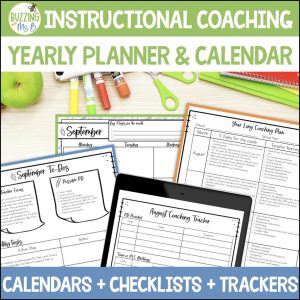
Instructional Coaching Year Planner – Calendar + Checklists + Monthly PD Topics

Are you responsible for PD or PLC meetings? Try my new Instructional Coaching Year Planner! It includes a calendar, checklists, and tools to help you choose monthly PD topics.

Want more details? Check out my blog post about the PD planner to learn everything that’s included when you purchase it!

What Instructional Coaches Need to Decide Before the School Year Starts

Now we’re going to look at what you need to decide before the school year begins. Everything we cover here is included in my FREE Jump Start mini course. When you grab it, you’ll learn exactly how to identify each one.

3 Values

Choose three values you want to embody this school year. For ideas, listen to Episode 240 – Building Your Coaching Personality with Jessica Zimmerman.

3 Coaching Goals

Pick three goals that reflect what you want to accomplish with your teachers this year.

3 Strategies

Next, identify three strategies you want to focus on during the year.

Elevator Pitch

How are you going to introduce yourself? Knowing your elevator pitch will help teachers (and admins) have a better sense of your coaching role.

Your Coaching Schedule

Take time to think through your coaching schedule and build one that works for you. For tips, check out Episode 154 – Instructional Coaching Schedules.
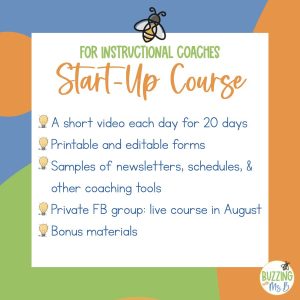
strat up course graphic

Tasks Instructional Coaches Need to Invest Time in During the First Few Weeks of School

There are tasks you’ll need to do in the first few weeks of school, or maybe even before school begins. I teach you how to do all of them in Instructional Coaching Start Up, but here’s a quick overview to get you started!

Review Your Data and Create a System

Take time to review your data and create an organizational system for your work. This could be binders, a digital tool, or something your school already uses.

Principal Dialogue

Meet with your principal early on to clarify your coaching role and expectations. This sets the tone for your work and helps build a strong partnership.

Design Your Coaching Menu

Before you start working with teachers, build a coaching menu with clear, simple options for how you can support their work. To learn more, listen to Episode 117 – Using a Coaching Menu with Raymi Royo. You can also purchase an editable coaching menu in my TpT store.

Meet Each Teacher and Build Bridges

Spend time meeting each teacher and getting to know them. Let them know what you’re there to do and start building bridges to them.

Set Up Your Coaching Space

No matter the size of your coaching space, set it up to reflect the type of work you plan to do in it. Need ideas? Check out Episode 67 – What Goes in a Coaching Office Space?

System for Organizing Documents

Create a system to organize your coaching and instructional support documents. This can be digital or in a binder.

Plan and Schedule Coffee/Cookies/Cupcakes with a Coach

Kick off the year by inviting teachers to an informal meet-and-greet with coffee, cookies, or cupcakes. It’s a great way to introduce yourself and your role.

Visit Every Classroom

At the beginning of the year, pop into each classroom to see how things are going and start building your relationship with the teacher.

Create a Survey for Teacher Support

Send a quick survey to get to know your teachers. Ask teachers what types of support they are interested in and what they want to learn more about.

Develop a PD Plan

Meet with your principal to find out who handles PD and what’s needed most. You can also create a proactive PD plan that focuses on the topics teachers frequently ask about during different times of the year.

Need help? Check out Episode 199 – Why You Need a Proactive PD Calendar as an Instructional Coach or grab my Instructional Coaching Year Planner.

Back to School Instructional Coaching Checklist

I know this is a lot of information, but I hope you found it useful! If you want extra support getting through everything on your back to school instructional coaching checklist, grab Instructional Coaching Start Up while it’s open!

Be sure to listen to the full episode using the player below or wherever you get your podcasts to discover everything you’ll need to get ready for this coming school year!

Topics and Questions Discussed in Episode 241 – Back to School Instructional Coaching Checklist

  • Your ultimate back to school instructional coaching checklist
  • Instructional coaching books I recommend
  • My favorite resources for instructional coaches
  • Inside my coaching binders: How I organize my resources and teacher documentation
  • Things to decide at the beginning of the year
  • Tasks coaches need to invest time in during the first month of school

This episode is sponsored by IRIS Connect. IRIS Connect helps you streamline teacher development with the world’s most advanced PD facilitation system.

Ready to listen?

  • Ready to listen? You can listen below with the media player, or search for Buzzing with MS. B: The Coaching Podcast anywhere you listen to podcasts!

This post contains links to products from one or more of our advertisers. This means I may receive commissions for purchases made through links in this post when you click on links to those products. Thank you for your support!

Learn more

Helpful Resources


Listen on: Apple Podcasts, Spotify, or your favorite listening app

Thank you for listening to Buzzing with Ms. B: the Coaching Podcast. Want more coaching ideas

Check me out at buzzingwithmsb.com and on Instagram @buzzingwithmsb.

If you love the show, share it with a coach who would love it too, or leave me a review on iTunes! It’s free and it helps others find this show, too. Happy coaching!

Podcast produced by Fernie Ceniceros
Back to School Instructional Coaching Checklist, ep. 241, Instructional Coaching with Ms. B Podcast

Chrissy Beltran  00:01

Are you trying to envision yourself as an instructional coach this year? Are you having trouble figuring out what the missing pieces were in your coaching work last year? Or do you have to completely start from scratch as a new coach, designing your role and figuring out what your program is going to look like? There’s not much out there that really helps you establish yourself as a coach early on in the school year, everybody says, Listen, listen, listen. And then what? Figuring out what to do to set yourself up for a successful year can feel like putting together a puzzle when you don’t know what the picture looks like. Instead, let’s start with a roadmap that tells you exactly what to do each day for the so very important first 20 days of school, the things you do the first month of school can make or break your coaching year. So let’s do the right things together. Head to buzzing with Miss b.com/startup to join instructional coaching startup. This course teaches you what to do each day for the first 20 days of school with a short video and all the resources you’ll need to set coaching goals, define your role, communicate with administrators, build relationships with teachers, understand your school’s needs and so much more. Join instructional coaching startup today, the course is open, and get your game plan for instructional coaching right now.

Chrissy Beltran  01:15

Are you ready for some back to school coaching fun and to win some great prizes, play back to school bingo with Miss B this year in my Facebook group, instructional coaching with Miss B, I’m hosting a fun game that will set you up for your first day of school and give you the chance to win. Just head to a Facebook and search for the group instructional coaching with Miss B. Once you’re in, check out the pinned post at the top of the page to join BTS bingo. Print out your board, complete the task and turn it in. It’s that easy to play, and I can’t wait to share the prizes with you. Let’s make back to school this year a little more fun.

Chrissy Beltran  01:50

Instructional Coaches, support everyone, the new teacher, the veteran teacher, and everything in between. Sometimes figuring out the best way to support each person and finding the time to do it is nearly impossible. That’s why I’m excited to share about Iris connect with this tool, you can record lessons safely and securely, summarize them with incredible AI technology, and find the exact moment you need to discuss with a teacher to support their growth instead of spending hours in a handful of classrooms. You can use Iris connect to guide teachers through the basics with a personalized PD Plan, and then meet with them when they’re ready for the next challenge. One feature I love is adaptive pathways. Pathways guide teachers through a step by step learning journey that includes expert models, classroom video, reflection, prompts and applied practice all in one place. You can use ready made templates or create your own learning journey, great for onboarding teachers who are new to your school or for a refresher course, you choose the focus for the learning and pathways documents the progress. Everything is in one integrated space, so you juggle less paperwork, and teachers do too. Iris connect pathways are an amazing way to support all of your teachers, so you can focus your one on one coaching time where it’s really needed. Head to irisconnect.com for a free trial. Plus, when you mention this ad, you’ll get 10% off your first user license. Get started with Iris, connect to make a bigger impact more efficiently.

Chrissy Beltran  03:12

Welcome to instructional coaching with Miss B where we believe that every teacher deserves a coach, and every coach does too. I’m Chrissie Beltran, an elementary teacher who became a coach, and I had to create my own coaching program that worked. Now I teach coaches how to design their coaching programs, build a school wide action plan and use differentiated strategies to support teachers. Plus, I’ve got a special spot in my heart for literacy coaches. Now let’s dig into the episode.

Chrissy Beltran  03:38

Hey coach and welcome to episode 241. Back to school. Instructional coaching checklist. This is part of my mini series on instructional coaching startup your coaching identity. Because all of these episodes in this mini series that started just a few episodes ago, they are going to help you really think about the kind of coach that you’re going to be this year, whether you’re a brand new coach and you have never coached a day in your life, and you are a little bit freaking out, totally normal, or you’re a veteran coach, you’re coming back, and every year you have to decide how you’re going to show up, what are you going to really double down on, and what are you going to discard as you start the school year? It’s important to do some thinking about that role before school starts, and so I’m going to give you my handy dandy list of back to school instructional coaching stuff. This is different kinds of things. We’re going to talk about, some books, some resources that you can invest in, some things to decide, some tasks to invest your time in. Basically, this is an investment episode on different kinds of things to invest yourself in. Before the school year starts, you’re going to be ready for school with this coaching checklist, and I’m going to organize it into different sections, so hopefully it makes a little more sense. And I’m also going to give you a handy dandy download that you can get when you go to the show notes at buzzingism b.com/episode 241, I will also. Send out in an email to anybody who is already on my email list. And if you want to do that, you can join my VIB coaches. That’s very easy to do at any basically on on my website, if you go to buzzinglithbee.com click the box that says, become a VIB coach, and that is going to give you access to the emails that I send out every week to let coaches know about the awesome things that I have going on, anything cool that they can learn from me with. You know, any new opportunities, new podcast episodes, and any resources I think they’ll love. My course is also open right now. If you go to buzzing with Miss b.com/startup you can learn how to do all the things you need to do in the first 20 days of school. Those first 20 days can make or break your coaching year, so let’s do the right things together. It’s instructional coaching startup walks you through every single day of the first 20 days, and the coaches who have taken it have really loved it. So the first thing we’re going to talk about are books you can invest in to set yourself up for success this school year. And I’ve got about five different books that I really like that I go back to over and over again, and those are the ones I’m going to recommend to you. Okay,

Chrissy Beltran  06:07

not every coaching book is for every coach, and not every coaching book is for every coach at every time, because sometimes something might be a lot, and then later it might be okay, but at first, the first time you read it, you might be a little overwhelmed, okay, and that’s the way I feel about one of these coaching books. But I’m gonna share it anyway, because I love it. Okay? Because I love it. So the first one I’m gonna share about is student centered coaching the moves, and that’s by Diane Sweeney. I love this book because it is pretty, pretty clear in what she’s trying to get you to do. She’s got it spelled out specifically with different strategy that you can use a handful of things, and then she gives you classroom examples and instructions on how you can make those strategies really effective. That’s a great one. Student Centered coaching the moves. By Diane Sweeney. I go back to that book frequently. My next book is onward, cultivating resiliency. By Elena Aguilar. I have spoken to Elena Aguilar on this podcast twice. She’s been in two different episodes that you can listen to. And the first one was about coaching with equity, which is really her entire platform, right? And the second one, she shared her kind of her update to Onward, onward is the book that helps you think about coaching through an equity lens. And if you haven’t thought about that before, there’s a lot there, right? So if you’re new to coaching, it honestly could be a little overwhelming, but it is such a good read, and I definitely would keep it in your back pocket. It’s kind of like what you’re always considering as your framework. So onward is a great way to approach that. I do recommend onward. The other Elena Aguilar book I’m going to recommend today is the PD book, so many really great specific strategies that you can use for PD, and some really great ways of thinking about the intent and the way you design PD. So definitely, the PD book is another good one. If you find you’re going to be providing a lot of PD or maybe you’re going to facilitate PLC meetings, the next book I’m going to share is get better faster, by Paul Bambrick Santoyo, I love this one because it gives you some really specific things that you can do, especially with new teachers. But really, with any teacher that is having a hard time, kind of structuring their their day, and structuring their their lessons and and really focusing on student learning, because sometimes we have those teachers that they put learning out there, but they don’t notice that the kids get it. They don’t notice all these little things that we would expect veteran teachers to notice. So if you’re having those issues, this is a really great one to check out, because it’s like really specific things you can do, like the first part of school. The last one I’m going to recommend is coaching conversations by Linda M gross. I think it is. It khalidie, I think and marceta F Riley and I love this because it helps you think about the way that we communicate with teachers in different ways. Sometimes we fall back on whatever is natural for us instead of having a really purposeful intent to each conversation. So this is a really good book if you feel like you’re having a hard time providing feedback, or if you are, maybe at the end of your coaching cycle, unsure of what to say. Check this one out. It’s a great one. Here are some resources that you can invest in. This is like, not, not like digital products or anything. Well, one of them is but most of them are like things that are helpful to have. So the first one I’m going to say is Google Drive. Get your Google Drive organized. If you are a new coach and you’re not sure how you’re going to kind of manage your schedule and your your materials, you kind of want to make a decision. Some things can be digital, some things can be paper, but you’ve got to know what is where. And if you go for like a hybrid model, where some things are in one place and some are in another, that can be a little confusing if you’re not sure about where you’re keeping things. So I really recommend trying to organize your Google Drive as you go, instead of having, like, a million files and you never know where anything is, utilize those starred folders so that you can actually find what you’re looking for. Like, I finally, this year, started starring folders. I’ve had documents. In a Google Drive for upwards of 10 years, I think probably since they like early days, and they were chaos, and so I finally started organizing them more over the last few years, and now I use starred folders. I star the ones that I need easy access to all the time, and it’s been so nice. And why didn’t I do that sooner? So definitely check out a really organized Google Drive and get yourself some basic system that’s going to help you kind of add to your resources as you go. If you like things stored in a digital format, a lot of things, I prefer having paper and pencil, and I know that’s kind of unpopular, and I also know it takes a lot of paper and a lot of stuff and a lot of space, and that’s some of the reasons why it’s a popular but I need to see things and put my finger on things and flag things with notes and leave it open on my desk. So when I sit down, I see it. I am very much the my calendar is a mess, but if I look at it, I know what’s happening. And if I look at a calendar online, it means nothing to me. I do not like virtual calendars. I don’t I prefer a paper pencil calendar, and I have some recommendations on that one, actually, but I do if you have to know who you are, and are you really going to use one or the other? Are you really going to use that digital calendar? Are you really going to use that paper calendar? Are you going to hunt in your Google Drive to find something specific, or do you need to have that in a binder? And you’re actually going to flip through your binder to find it. If you like binders, I’m a binder person. I mean, like I mentioned, some things are on Google Drive. I have a massive Google sheet where I organize all my podcast stuff, and it’s been so helpful to have everything in one spot. But if I’m looking for like reference tools, I want them on a piece of paper, and I want them in a binder organized by tab. I want a teacher binder organized by, you know, by by grade level, and then by teacher. So I recommend having a nice, big old, two or three inch binder, if that’s where you’re headed. A teacher binder is a really helpful organizational tool. Again, you can do this virtually or digitally with Google, Google Drive, or any other you know, some people use Microsoft. What is it? The Office one, office, 360, I can’t What is the one? I don’t know. The the Microsoft equivalent. Some people use that, and that’s great. But as far as teacher documentation, I liked having a nice three inch binder, and I’m putting links to all this stuff in the show notes. Okay? And you can grab it all there a nice three inch binder. And then that was my teacher documentation binder. And then on the inside, I put those big they’re like plastic pocket dividers. They’re normal dividers, but the tabs are kind of bigger, and they have, like a pocket for each one. I love those to separate groups of people, or, like, grade levels, those are great for that. So then each grade level or each department would get like, a big plastic pocket divider, and then behind the pocket divider I put normal paper dividers for each teacher, and behind each teacher I’d have my documentation for that person so I could keep track of what I had told them. You know, my coaching cycle, work with them, anything specific I put behind that tap, and that was a really easy way for me to keep my stuff organized. And then I could go back and, kind of like, get an idea of, okay, what’s happening in the front of that binder. I also put, like, not on the front, but inside the front. I put, like, a classroom visits or interactions, kind of a like a spreadsheet. Then I had the teacher’s name down the side, and then whenever I had an interaction with him in their classroom, where I visited their classroom for some time, I would put the date on the inside of the spreadsheet boxes, because I wanted to know that I was actually visiting and getting into classrooms, seeing all the good things, talking to kids, talking to teachers. And sometimes time would pass and you wouldn’t have an interaction with people because of logistics, usually. So this way, I kind of kept track of who I was visiting, and then I could say, oh my gosh, I haven’t seen Mr. So and so in like weeks, because he was out sick, and then I was out for for training. And then so then I would make a note on my calendar that I wanted to go visit that teacher my next available time, and I could check my documentation for that teacher behind his little tab to see what conversations we had already had. So that’s one recommendation. I have a binder, plastic dividers and paper dividers. I just love that system. It’s simple for me and it’s accessible. I also recommend and have four years two things that you’re going to carry with you everywhere. And I’m not talking about your coffee cup. However, I do recommend having a really nice coffee cup that you like. And there’s actually, I’m sorry this is a side. There’s actually a little handy dandy Yeti that has the Yeti coffee cup, but it’s got, like, a cup, like a mug shape, and I prefer that to the tall tumbler. Tumblers are nice for traveling, but if you’re going to be at work, I love the little Yeti mug that you can carry around. It has a lid. It keeps it hot, but it’s like a mug, and I just prefer drinking from a bug mug, so definitely check out the Yeti mug. Okay, so back to the whole point of what I was saying, which is think two things you’re going to want to carry with you every single place. And some people do these digitally. Again, I do not. Enjoy carrying an iPad with me, so I carry a notebook and a calendar, and over the years, my thinking has changed about the notebook and the calendar, and I will tell you why, and it’s just because my job has changed as a school coach that one school, I really liked having a small notebook and a small calendar, so my notebook was like a five by eight. It’s I love the echolo brand because they have, like, soft covers and lines, and the paper is really nice to write on. It doesn’t really bleed through much. So echolo is great, and I have links for that again in this post. And I also like having a small calendar, which is like a five by eight, and the blue sky brand is the one that I use the most, and you can even get those at Target, but I have a link to Amazon if you want that as well. So those two things I just found super handy, because I could carry them everywhere. It was not a big deal. I just carry them in one hand. Even Did I leave them behind? Sometimes absolutely but I never completely lost them, which is good, because I probably would have had to quit, because I never I wouldn’t never I would not have known what to do with myself if I lost those two things. And so having a small notebook and a small calendar very practical when you’re out of school all the time, if you are not out of school full time, if you are like a central office personnel person, if you are like me, where you go to work with schools sometimes and sometimes you’re at home doing virtual work or different things, I love having a big notebook and a big calendar. The big notebook is obvious. I can fit more stuff in it, and who’d have to love more stuff

Chrissy Beltran  16:32

and a big calendar. I like too, because my days are a little wacky. And I like having, you know, my to do list in place, like I have this. I bought this beautiful calendar recently that I absolutely love. It’s a big one. It’s a Simplified Planner, and what I love about it is, on each calendar date, it has on the left side of that date, you know your calendar, like, what you’re going to do each time of day, but on the right side, it has to do tasks for that day. And I love that, because I like to schedule time for certain kinds of things, like I’m going to work on this at this time, but other days I have chunks of time. And on the right side, I can make my list of things that have to get done, and I can pick the things to work on in those chunks of time. So I love the big calendar and big planner now and and the big notebook. But when I was at a school all the time, go small it. You can carry it in your hand, it’s the best. Okay, now let’s talk pens. The evolution of pens. Boy, has that changed? Okay, when I started out coaching, I used my favorite pens on Earth, which were flare pens. And I had loved flare pens ever since I was a kid. And my dad had these felt tip pens he used for work, and I would steal them, and I would write with them, and I would just like, These are so cool. I love the way that the the lines were kind of thick and the color was so bold and, like, not sketchy. I loved it. And so those are my pins, right? As a teacher, I love colorful thing. As a coach, I found I was having to do a lot of rescheduling, and you may have found this too if you’ve been coaching. So I was like these flare pens, beautiful, colorful, all over my calendar, scribbled out everything, scribbled out and rewritten next to it, because I had to change my schedule all the time based on other people, right? So I then moved to these friction, erasable pens. And they’re, they are not, to be honest, as satisfying to write with, but they are very satisfying to erase. So I recommend, if you are experiencing that kind of trouble where you have to erase half of everything that you write down, go with a friction, erasable pen. They’re great. They come in pretty colors too. Or you can use all the same color, which I kind of feel like works better on a calendar, because so many colors can be like distracting to me, but then I still keep using so many colors. I really I need to. I’m not good at being consistent with color coding. But once a teacher told me, I said, Okay, I’m gonna try to do a really good job color coding this chart we’re building together. And she goes, you start that every time, every day, every time we come work with you. You start out with your color coding, but then you get excited and you forget. And it was a very charitable way of saying, I’m a hot mess, though I appreciated that you lost. You’re out. You’re going to want some things like sticky notes, colorful paper. I do like the astral brights paper. It’s so bright. And so if you’re like trying to get people to remember things, it can be very helpful to have some colorful paper, because it stands out in the midst of all of the stacks of other things. Teachers get a lot of stuff on paper. They get a lot of emails, and we have to make them stand out. So if you really need a teacher to remember where something is, put it on a bright color of paper, and they’re more likely to recommend it. I mean, to remember that I recommend that also sticky notes, good old fashioned sticky notes. What teacher doesn’t love sticky notes? I cannot get enough. I really like the little tiny one. I use them for planning my PD calendar, and then I even cut them down further. So what I do is I cut them into like little topics that I’m going to provide PD about, and then I look at the available days, and I use those little mini sticky notes to stick them in all the right spaces so the. Totally try that. If that’s something you’d like to try out another resource that I really think will be helpful, especially if you’re starting out, but if you’re responsible for PD PLC meetings, you’re trying to plan all the things. Is my newest resource for coaches. It’s my instructional coaching year planner, and it includes a calendar checklists for each month of of coaching tasks that you should do and monthly PD topics. So if you are like at a loss for what to do in May for PD, check it out. I think you’re really going to like it, and you can get that at, I think I made you a handy dandy short link. Let me just check and see if that is absolutely true. Um, at buzzing with Miss b.com/planner will take you to the post, and then you can see what’s in it, and then you can decide if you want to check it out, that’ll take you to the store. Okay, okay, now we’re going to talk about some things you need to decide before the school year starts. And these are things that are actually in my jump start mini course. If you go to buzzing with Miss b.com/jump start, you can grab a mini course that will teach you how to do these things, but these are the really important things that coaches kind of have to have a handle on, or else, as the year is progressing, you’re kind of backtracking and undoing things that you’ve done. So you’re going to want to decide, obviously, on your your coaching role, and we’re going to talk about a principal conversation in a few minutes. But for yourself, for your own human person, you need to decide what are the three values you’re going to embody, and we just talked about those with Jessica Zimmerman, some of the values that you might consider. What are three goals for your coaching work? What are three strategies you’re going to really focus on? And what is your elevator pitch? How are you going to introduce yourself? Those? Those four things are a part of my mini course at buzzing with Miss b.com/jump start. Because if you have a handle on those things, you will be a lot happier when you actually go to introduce yourself to teachers. You’re not going to be scrambling all the time like I was as a new coach. And then I also want you to do some thinking about your schedule, your schedule, you can get ideas for in Episode 154 that is not going to be set in stone, but it’s going to help you prioritize some of the things that you do want to make sure you do every week. So you’re going to want to build a schedule as well. Now here we’re going to talk, in my last category, about some tasks to invest time in and this basically things you you’re going to have to do early on in the school year, maybe before back to school, the first few weeks of back to school. I teach you how to do all of these things in instructional coaching. Startup at buzzing with Miss b.com/startup but I did want to share them with you in case you hadn’t thought about them. Okay, so these are tasks to invest your time in, up to the first month of school. You want to review your data and create an organizational system so that data that you have,

Chrissy Beltran  22:53

maybe you have it in binders, maybe you have a system already, like we used to use aware at my school, and there’s all kinds of different digital systems for data, where they actually scan the bubble sheets and they provide you all the breakdowns. And it’s amazing spend some time reviewing and learning that digital system, if you have one for data, and if not, spend some time figuring out what are some of the ways that you can break data down by standard, by student expectation or objective by individual teacher. Think about how those different ways can help you as you move through the school year. Something else you’re going to want to do is have a principal dialog early on in the school year, ideally before the school year, to really figure out what your job is. If you are not sure of your job, you’ve got to nail it down. If you already have been a coach and you have some adjustments or things that you want to work on this year, talk to your principal, talk to them and see what do they recommend? What do they say, and that can really help you be better prepared. Excuse me for having a solid relationship with them and a solid, clear expectations about what you are there to do. Something else you’re going to want to do is design your coaching menu. Now your coaching menu is going to include those strategies that you’re focusing on that we talked about in the Jump Start course coaching. Your coaching menu is going to have different options for the kinds of coaching work that you can do for teachers. Now you don’t want it to be overwhelming. You want it to be something that teachers can look at and feel like, okay, I could easily find something here that would help me, but it’s not just for teachers. It’s also for you, right? And so the idea is that this coaching menu helps you nail down the kinds of support that you can provide to teachers, and it’ll show them exactly how you can support them in whatever areas that they are having trouble in they can choose from. It almost like a choice, choice board. So if you check out episode 117 of this podcast, I dig deep into coaching menus with my guest, Ramey royal, and I also have coaching menus in my store that you can grab. It’s just like the handy dandy page and a little guide to using your coaching menu, and you can get that at my TPT store. You also. Want to invest some time in meeting each teacher and building bridges to that teacher. So whenever you are meeting teachers, you’re going to want to have your elevator pitch. You’re going to want to communicate with them about what you’re there to do, and really start building bridges by getting to know who they are, so you can figure out what bridge you’re building to them. Like sometimes we have to be very purposeful in saying, Okay, I am going to reach out to this teacher in this way, because I know this about them, right? Those little pieces of information help us reach them. So we’ve got to build bridges purposefully, and to do that, we really need to know who they are. You also want to set up your coaching space. Your coaching space might be very different. Some of us have a closet, some of us have a whole classroom, a large space. It just depends on the school. Depends on the school and what space you got, but the coaching space that you set up should reflect the kinds of things that you plan to do in the space. Right? If you don’t have any ideas of what that can look like, I do have a podcast episode for you from a while back, and we can link that in the show notes, because I am not seeing what the episode number is right now. But yeah, the idea is that if you are really focusing on PLC meetings with teachers that you’re going to plan collaboratively, let’s say, then maybe you can take a look at your space and figure out, do you have some sort of area that will be conducive to that? Are you prepared to create those meetings with teachers in your coaching space, or do you have to have them in classrooms? You have to do some thinking about that. Actually, I found that you can check that out in Episode 67 of instructional coaching with Miss B so that you can learn about what can go in your coaching space. And I share a little bit about my spaces. You also want to have a system for organizing your documents and for coaching as well as instructional support. So as a coach, depending on what grades or contents you work with, you may have to know a lot about the content. I certainly did as a literacy coach in an elementary school, so I had to have a lot of familiarity with state standards, with test samples, release test questions, the curriculum guides, all of that stuff. And so I organize those in the binders, as I mentioned before. And some people do that digitally. I prefer to have it so I can highlight and mark things up and make notes. So however you’re going to do that, you want to create a system for those kinds of of documents. You also want to plan and schedule a coffee or cook cookies or cupcakes or whatever with the coach. And so that can look differently depending on what kind what your school is, or what your structure is, what your schedule is. If you can invite teachers before the school day, if you have to wait for them after school, if you have to talk to them during their instruction, like maybe their planning times, it kind of depends on on your school day, but cookie coffees, cupcakes with a coach, it’s a fun way to get to know your teachers and to introduce the role that you’re going to serve. And so making a plan for that is is a great way to spend your time early in the school year. You also want to visit each classroom, just pop in, see how things are going. And you want to create a survey for teacher support. This survey is a helpful way to get to know your teachers and see what kinds of support they would be interested in, for me and what they’re interested in learning in. So definitely send something out to them that will help them tell you what it is that they want from you. And the last thing I’m going to mention is a PD Plan. I mentioned a little bit a while ago how I use my sticky notes for doing my PD Plan. If you’re unsure about what how to approach PD or what topics would be helpful, the yearly planner is a great way to go that you can grab on my TBT store. But talking to your administrator about PD and who’s responsible for it, what kinds of things need to be provided. Working towards the goals that you’ve set. Through providing PD to teachers is a great focus for professional learning. So keep that in mind as you’re thinking about your PD Plan for the school year. And you can also do a proactive PD Plan and just think about, well, what are things that teachers always have questions about at different times of the year, and make sure that you provide resources for them in those times so they are already prepared to kind of learn about them. So for example, if you know that every year, teachers struggle to get into the access the digital curriculum at the beginning of the year, create a little video for them and release it in August and let them know. Hey, this is just a reminder about how to access your your digital curriculum. You can learn more about the proactive PD Plan in Episode 199, of this podcast. I hope, I know there’s a lot, but I hope it was helpful. You can grab this checklist at the in the show notes, like I mentioned in buzzing limits be com slash episode 241, and I do recommend grabbing that jump start mini course, or the startup course itself. It’s open. You can join me today, and I think you’ll learn to love it if you do next week, it’s a clip show. And whenever I say clip show, I feel like one of those cheesy shows whenever I was a kid, where they were like the two, a couple of. The characters would come in because somebody was out on maternity leave or something like that, and they’d be like, do you remember that time whenever so and so was so upset that we blah, blah, blah, and then they would show a clip from that episode, and then they jump into other clips and other clips. And this is not that kind of a clip show. This is the best kind of clip show where I have a few different coaches who are going to share with us how they introduce themselves as instructional coaches. I’ll get into the coffee with a coach at the beginning. I’ll share a little bit about that, and then we’re going to hear from our different coach, guest coaches, about how they introduce themselves, whether they use menus or brochures or coffee with a coach or whatever. And I can’t wait to hear from all of them. So until next week, happy coaching. The now that you’ve got so much to think about, head over to buzzing with missbee.com to grab some free downloads, become a VIBee and check out the podcast show notes. Happy coaching!

Share:

Similar Posts

Leave a Reply

Your email address will not be published. Required fields are marked *