How Leaders Can Create a Culture of Growth and Learning with Jon Saphier, ep. 192

There are schools where the teachers are responsive to learning and trying out innovative ideas. In other schools, teachers are not as open to trying new things. The difference is the culture!
In this episode of Instructional Coaching with Ms. B, we’re continuing our series on school leadership and culture! Many coaches have asked me how leaders can create a culture of growth and learning so everybody gets better. That’s why I’ve invited Jon Saphier, founder of Research for Better Teaching to join us today on the podcast!
How Leaders Can Create a Culture of Growth and Learning
During the show, Jon discusses his work with schools and what led him to become interested in adult professional culture. He tells us the things you see in successful schools and explains the characteristics of leaders who build a strong school culture. You’ll hear about everyday habits that make a big difference and the systems that schools need to have in place to support a culture where everyone is learning. We also talk about what coaches can do to foster a culture of coaching that encourages teachers to work with us.
Creating a culture of learning and growth on campus is so important! It allows teachers to develop their practice and ultimately improves student achievement! This episode will get you thinking about the culture of your school currently and how you can help make it better.
Listen to this episode to learn about what successful schools do to build a culture that increases student learning. I know you’re going to get a bunch of valuable ideas you can start implementing right away!
Topics and Questions Discussed in Episode 192 – How Leaders Can Create a Culture of Growth and Learning with Jon Saphier
- What led Jon to become interested in Adult Professional Culture
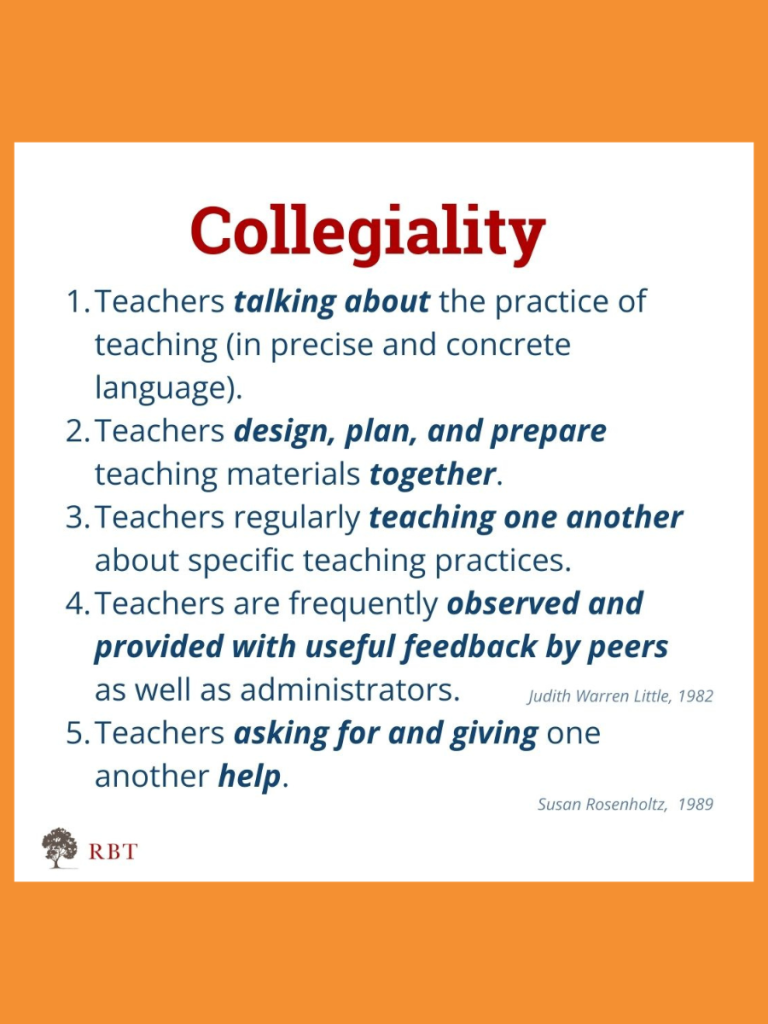
- Judith Warren Little’s study of successful schools and how they showed true collegiality
- Characteristics of leaders who build a positive school culture
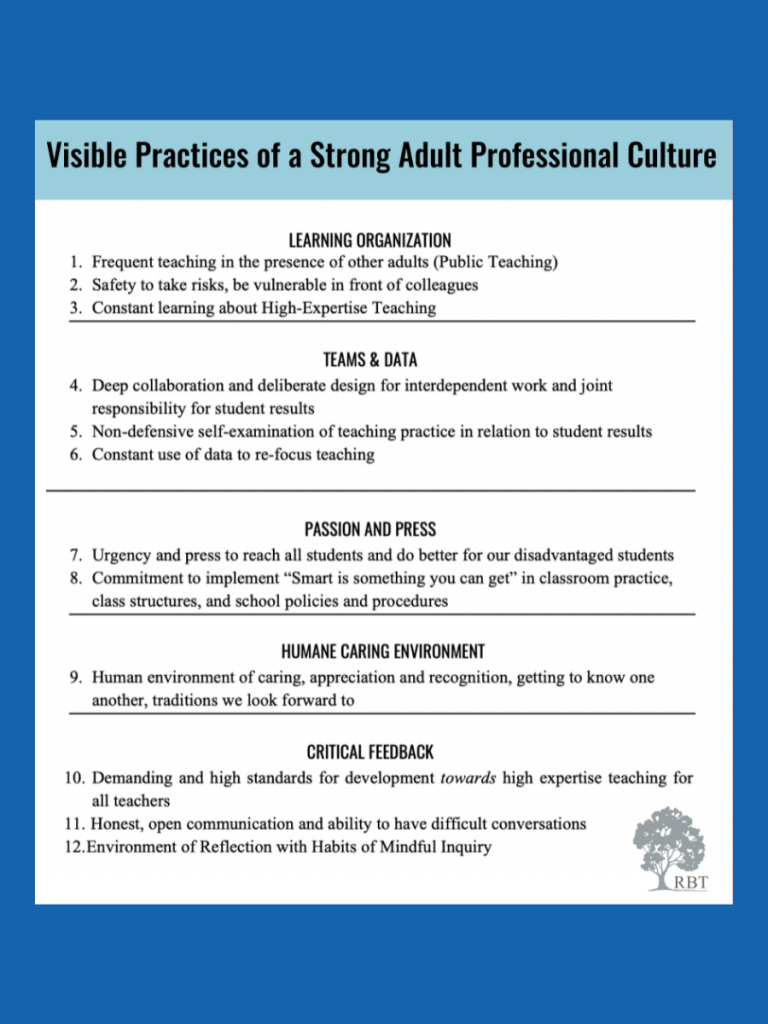
- The visible practices of a strong adult professional culture
- What instructional coaches can do to foster a culture of growth and learning
- Why school leaders need to learn alongside teachers.
- Everyday habits that have a big impact on school culture
- Systems that schools need to have in place to support growth and create change over time
- Why it’s important to define your coaching role
- Having positive experiences with strong teachers and how it can help you coach more people
In this episode, Jon references the three images below.

Ready to listen?
- Ready to listen? You can listen below with the media player, or search for Buzzing with MS. B: The Coaching Podcast anywhere you listen to podcasts!
Join the Waitlist for the Instructional Coaching Start-Up Course
The Instructional Coaching Start-Up Course is opening soon! The course walks you through the first 20 days of coaching and helps you prepare for the year with a really strong foundation. It includes 20 videos that tell you exactly what to do each day. You can also join the live Facebook group where we walk through the course one day at a time. Check out the Instructional Coaching Start-Up Course here and join the waitlist for a coupon.
This post contains links to products from one or more of our advertisers. This means I may receive commissions for purchases made through links in this post when you click on links to those products. Thank you for your support!
Learn more
- Episode 191 – Qualities Strong School Leaders Possess with Dwight Carter
- Instructional Coaching Jump Start Course
- Join My Facebook Group: Instructional Coaching with Ms. B
- Research For Better Teaching
- Email Jon Saphier – Saphier@rbteach.com
- Research for Better Teaching Overview 2024
- Book Excerpt: The Skillful Culture Builder
Helpful Resources
- Instructional Coaching 20-Day Start-Up Waitlist
- Instructional Coach Binder Megapack – Editable Forms, Calendars, Planning Tools
- Buzzing with Ms. B TpT Store
- Disrupting the Teacher Opportunity Gap by Jon Saphier on Amazon
- Disrupting the Teacher Opportunity Gap by Jon Saphier on RBT website
Thank you for listening to Buzzing with Ms. B: the Coaching Podcast. Want more coaching ideas
Check me out at buzzingwithmsb.com and on Instagram @buzzingwithmsb.
If you love the show, share it with a coach who would love it too, or leave me a review on iTunes! It’s free and it helps others find this show, too. Happy coaching!
Podcast produced by Fernie Ceniceros
How Leaders Can Create a Culture of Growth and Learning with Jon Saphier, ep. 192, Instructional Coaching with Ms. B Podcast
Chrissy Beltran 00:00
Coach, I know you’re trying to figure this all out on your own. You’re investing in your own learning on your own time because you want to show up for your teachers in the best way possible. Building your coaching program is a huge challenge. And it’s even more difficult when you’re asked to know about literacy practices and how to support them. That’s why I created the confident literacy coach. This self paced course gives you the knowledge strategies, processes, and downloadable tools that you need to be confident in your coaching work every single day. The new update to the reading and writing modules includes information about literacy that will help you grow your skills practices, and grow your students into skilled readers and writers. Check it out at confident literacy coach.com and stop reinventing the wheel.
Chrissy Beltran 00:40
Have you felt like you’ve provided all the PD, you facilitated all the PLCs and you’ve had all the conversations, but your teachers are still stuck. If your teachers are resistant to instructional change or having trouble implementing new things, it might look something like this. They’re still using outdated practices that we know don’t work. They fight every PLC to claim to their favorite lessons or strategies. You see evidence of for instructional methods everywhere despite having provided tons of PD and better practices. And kids aren’t learning and the same kids are at the bottom of the data chart every single time. Does this sound familiar? To literacy coaches who are committed to helping students grow as readers and writers This is especially frustrating. That’s why I created a free webinar for literacy coaches, but really any coach can value from it. It’s all about helping teachers embrace new practices and try out something new even when they’re not excited about it. We’ll learn why teachers resist change, how to help teachers feel secure and ready to try something new. And my favorite strategies and methods to encourage choice while expecting and holding them accountable for trying new things. I’m so excited to share this information with you that I created a free download that you’ll get when you grab the free pre recorded webinar at buzzing with Miss b.com slash shift. Grab it today. It’s totally free and it will make such a difference in your coaching.
Chrissy Beltran 02:03
Welcome to instructional coaching with Miss B where we believe that every teacher deserves a coach and every coach does too. I’m Chrissy Beltran, an elementary teacher who became a coach, and I had to create my own coaching program that worked. Now I teach coaches how to design their coaching programs, build a school wide action plan and use differentiated strategies to support teachers. Plus, I’ve got a special spot in my heart for literacy coaches. Now let’s dig into the episode.
Chrissy Beltran 02:38
Hey, coach, and welcome to Episode 192, of instructional coaching with myth b how school leaders can create a culture of learning and growth. This is part of our theme about school leadership. And I am so interested in this topic. And I know so many of you are, are I’ve heard from many coaches who asked about how school leadership can support learning and growth and really create a school culture that continues to build learning for teachers and kids and create the right kind of environment where these things happen.
Chrissy Beltran 03:06
I want to remind you, before we jump into the episodes that I do have my instructional coaching startup mini course for free, you can grab that at buzzing with Miss b.com slash Jumpstart. And we’ll get you set up with your three by three vision and helping you make a plan for your instructional coaching.
Chrissy Beltran 03:22
I also have instructional coaching startup, which is my course for instructional coaches that teaches you exactly what to do in the first 20 days of school, I want you to grab that at buzzing with miss b.com/startup. If the waitlist is still there in place, that means you put your email address in there, you will be on the waitlist and whenever it opens up, you will get a coupon for the course. And that is going to save you some money and it’s already at a really good price. So definitely check out buzzing with ms b.com/startup because that’s going to open up soon. And you’re going to want to be in it, because it’ll tell you exactly what to do to set yourself up for success this year.
Chrissy Beltran 03:56
So my guest today is Jon Saphier. And he is from research for better teaching. And I’m so excited to share this episode with you because he is so knowledgeable in this area of school leadership and can really speak to the great work that he has done. So we’re going to welcome John. So let’s welcome Jon Saphier to the podcast. Thank you so much for being here today. John.
Jon Saphier 04:16
It’s my pleasure, Chrissy.
Chrissy Beltran 04:19
Well, I would love to get to know you a little bit better. And so what our listeners so it’s kind of a quick way to introduce yourself. Could you share about who do you help? And how do you spend most of your time and energy at work?
Jon Saphier 04:30
Well, that certainly has evolved over the years. You know, when like most of your viewers and listeners. I was a classroom teacher for 10 years and the primary people I tried to help were my kids and then I became an instructional coach in an urban district, Cambridge, Massachusetts for four years and an interesting thing about that was I I viewed the teachers as my clients and in a way they always were in It will be. But I had a little shift as the years rolled on towards realizing that the really the students were still primarily the people that I was interested in helping. And I had to do that through teachers. So that made me occasionally more, more directive or more, more clearer and bringing issues to people’s attention rather than having every conversation from their agenda. And the organization that I founded in 1979, called research for better teaching. We started with our focus, again on PD for teachers. But it evolved into really coaching principles about how to be good at observing and giving feedback to teachers. And that has shifted as the decades went by now, my personal focus is really more on the supervisors of principals than anybody in central office staff, in order to create an environment in a school where everybody is constantly learning about high expertise teaching. So I guess, supervisors or principals are my main personal context right now, what I hope to do in the district, we’re currently working on a big project. Baltimore County is leave them with a teaching and leading Academy so that everything we’re studying together becomes a permanent part of their own institutional capacity. So there’s the long answer who’s short.
Chrissy Beltran 06:35
Well, thank you. And then the other question that gets to know you a little bit more is what is your favorite TV show of all time?
Jon Saphier 06:40
Oh, boy. Well, here’s where I’m gonna date myself. No, I don’t think anybody I, if anybody recognizes what I’m about to say you call up pretty in and tell it’s called the Show of Shows. It was since Caesars variety show in the 50s. It went on and under different names for seven years. He it started it was a comedy mainly comedy variety show with Carl Reiner Howard Maurice imaging coca and, and Sid Caesar himself. So you know, I, I still crave those variety shows where you would have music and dancing but comedy, too.
Chrissy Beltran 07:22
I love that. Yeah, no, I know that that Caesar is and Carl Reiner as well. And I was a huge fan of Carl Reiner and Rob Reiner. Grew up on Dick Van Dyke and
Jon Saphier 07:34
your show New York. That’s where I was born. Oh, really? Yeah. That show was
Chrissy Beltran 07:41
neat. All right. Well, thank you so much. So I would love to know a little bit about what led you to become interested in adult professional culture?
Jon Saphier 07:51
Well, it came from kind of a, a, it came from an experience I had teaching the same workshop in the same city to two different middle schools. And in in one school, the one great, you know, and I’m patting myself on the back about water, good workshop, John, and people are coming up to me afterwards. And when I went back to two weeks later, they were trying out a whole lot of things on formative assessment that I chaired to them. And then the next week, I did the same workshop and another school, and it’s like, I’m talking to the living dead, you know, nobody’s responding, nobody’s doing anything. When I went home, I, I was beating myself up. And I do wrong. She I, I showed the same videos, I got out of bed on the same side. And and what I realized is that had very little, if anything to do with me, it had to do with a culture of those two different schools. One was a place where they were receptive to new ideas, we’ll evaluate them try out the things that worked and discard the others. And the other was a place where people didn’t talk much to each other. And so that was 30 years ago, but it was at that point that I really got interested in. How did that first place get to be like a was what did the leaders do? And so that that was a real turnaround point for me that there was another one by the way that I guess it was 40 years ago, it was 1982. I remembered like it’s just seared in my memory, one of those humiliating experience which is good for one’s own learning, right, learn from learn from things that are not comfortable. I was in a magazine club at the time with three buddies, one of them was Roland Barth and Roland brought a study by Judith Warren little to our group to share you know, we shared articles, and she had just done her study on successful schools and how they showed true collegiality. She actually rented that term. At that time, I’ll put up, put up a video to show you. If I can, oh, I gotta open, I have to open it first. Here we go. Now I will share that. There we go, that Judy had studied schools that were successful, and increasing student achievement. But she took a different approach to how she did the study. She would, she was like an anthropologist, in a way, she hung out in a teacher’s room, she gets a school early, see who was there and what they were doing and stay late. And what she found was these, the first of these five things on the board here, people talked about practical things in their teaching in increasingly precise language quite a lot. And they were always observing one another, the second bullet, and they plan make materials together, and teach each other direct techniques in an informal way, like, you know, when they’re having lunch together. And the fifth one at the bottom was added by Susan Rosen holds in 86. She wanted to continue Judas research tradition, and she found in schools that did well against the odds, because these were places with high poverty. Teachers who are willing to ask for help and give it and you know, sometimes giving help can be is more risky than asking for it. You know, what if I give you my help, and it doesn’t work and use last time, I’m asking him. So this coincided with my own experience and gotten me and some my colleagues really interested in studying how it was that these places came to be. It isn’t just enough to say collegiality is important. But what are you going to do if you’re going to actually get more of it for more kids more of the time? So let me oh, this is an interesting little one, you know, I went to a conference with Michael Fullan. In in California once and he said something that also really emblazoned itself on my memory, he said, What if every day when you get up to go to work, you know, you’re going to learn something new. That’s going to make people get out of bed in the morning and want to go to work even more than they might have otherwise. So. So that was another little piece of fuel to the fire and Michael Fullan. And Andy Hargreaves and a bunch of other people have been very consistent at showing that schools that have these strong adult professional cultures are schools that get better results for children.
Chrissy Beltran 12:56
But I love love those principles of collegiality. I agree, I think that we don’t spend enough time and each other’s classroom, teachers need to see each other teaching, because we can’t have real conversations about teaching. If we don’t know what we’re, we have no frame of reference for what we’re talking about. And I think that’s one of the biggest challenges, the increasingly precise language is so good, because whenever teachers are not speaking the same language, they’re not talking about the same thing. And they think that they’re sharing, but we’re not really understanding what the other is trying to share. It’s the same thing is whenever you plan a lesson together, ego and three years from classroom, and it looks completely different, because everybody had a completely different frame of reference. And we’re not using that precise language. And we don’t have a frame of reference for what it looks like in action. Right. That’s, that’s so helpful. Those Those, those points that you shared about collegiality were great.
Jon Saphier 13:46
You know, the question that I often use to start workshops about this topic is, why is it true? If it’s true that and we certainly have the research that schools with strong cultures do better for kids? Why is that so? And my own conclusion about that is everybody’s learning how to be better all the time. In such a school, they’re increasing their teaching expertise, and that in turn, leads to better student achievement. Here’s a little here’s a little slide that illustrates that the one with the big red arrows. So what are these places like and that is what I’m going to try and put up in a way that fills the screen.
14:42
John, hit the Share Screen button again at the bottom stop, you got it. And start share again. Nope, stop. Well, unless you want to share something you just I do. I do.
Jon Saphier 14:56
I want to share this when they just had up So at least I can hit just that PowerPoint, you won’t be looking at a whole bunch of other stuff on my screen, Chrissy
Chrissy Beltran 15:06
bago.
Jon Saphier 15:08
What we got up here is the characteristics you see in a strong school culture. And what’s going to be really interesting is what we have all figured out about how leaders make this happen. But first of all, it’s useful to get an image of what you’d see if you hung out in such a place. So this is kind of like an expansion, of Judith’s definition of collegiality. You know, this term learning organization, as far as I know, first came in Peter Sankeys, early work. And he means a place where everybody’s always learning how to get better. So those four things you see on screen are characteristic of such an environment. But another thing that’s present in these places, learning organization is characterized by safety. And people are constantly learning about better teaching this, this is a school that’s really focused on data. We’re not afraid to look at the data. And we deeply collaborate with one another such that at a PLC meeting, which a lot of the coaches watching and listening to your podcasts do, you’ll see people who are willing to say, hey, hey, Chrissy, you, your kids can write with voice, I can’t get my kids to do it. Look, look, look at how it shows up in the work that we have on the table here. So you know, what are you doing? Now, that’s people asking for help. But it also means I’m not afraid to be vulnerable and put my students work on a table and have people talk about me in the parking lot afterwards.
Chrissy Beltran 16:52
So then, let’s go ahead and lift these aloud. So these are the visible practices of strong adult professional culture, specifically focused around team than data right are the ones you’re referring to now, some deep collaboration and deliberate design for interdependent work and joint responsibility for student results. Non defensive self examination of teaching practice, in relation to student results, like you’re referring to, we’re not being defensive about our practice, whenever we ask for input from other people, and then constant use of data to refocus teaching, which is the goal of our PLC meeting. But we aren’t always achieving those if we don’t have these, all of these different characteristics in place.
Jon Saphier 17:27
Now, one of the things that drives us to act this way is we feeling that we have a feeling of urgency, you know, we we, we can’t let kids through slip through the cracks. And we can be efficacious in preventing that from happening. So one of the beliefs is urgency. And the other belief is the belief that smart is something you can get not something you are ability can be improved, the bell curve is wrong. It is a false view of the intellectual capacity of the kids, and especially that enter, intersects and interacts with ideas about racism, and the limited view we take of children of color when in fact that they have as able brains as anybody else they may be behind, they may have missed out on some early literacy. But it doesn’t mean there’s anything wrong with their brains, and they can’t learn as much as everybody else. There are two more sort of buckets for the strong school culture. One is it’s a caring place. You know, if one of the teachers gets sick, the casserole start flowing home, people, people take care of each other, they are appreciative of each other, they get to know one another. And that’s one of the things the leaders do you make sure people from opposite ends of the corridor, don’t work in silos, they actually know something about each other. And the final characteristic of a strong CEU culture is honesty, and how we talk to one another, demanding high standards for development towards high expertise teaching, I don’t expect everybody to come in with a bachelor’s degree being at the high expert level, but I have the standards as a leader that says we’re all trying to get better and we can get better. And the second thing is honest, open communication, and ability to have difficult conversations. So there we are. Now, that leads us to this critical question of what do people do in order to make such a culture grow? And I want to play a brief clip for you of Tara Gagnon, terrorists, the principal of one of the schools where we have worked extensively over the years. And I think she’s a real model in her leadership and it’s kind of embedded In what you’re going to hear her say in this in this little clip, so let me get it up without all the screen interference I created before. And have her speak in her own words to you, sharing screen. And here you go, Tara, folks listen to this,
20:24
you wouldn’t ask anybody to do something that you wouldn’t do yourself. So in attending all of the workshops that I attended side by side with all of my teachers in coming here, and sitting in a teacher table, while they weren’t a teacher table, I was at a teacher table trying to implement what we saw, that makes a huge difference, a huge difference when they see, oh, I’m not just top down making demands, I want to be part of this, because I can’t wait to see where this takes us.
20:50
So for the principals in our courses, hopefully, your message would be to be part of instruction,
21:05
my message for principals always still running because I want to make sure I’m not wasting your time. My message for principals is that you definitely need to be hands on, you need to roll up your sleeves. Um, you need to show what’s important to you, if you want data to improve if you want your instruction to prove if you want to see student achievement, reach its highest level, then you have to be part of that solution. And that means you have to be in there, working with the teachers attending the professional development, making sure that as you evaluate teachers, you’re using the common language around these implementation strategies, making sure that you’re using the instructional language that everybody knows, but that you actually know what it means. And you know how to implement it, you know, what they’re what they’re doing and how they’re doing it. That’s how you’re going to find success, I wouldn’t do a thing differently, I go to every workshop, even though I spent a lot of hours outside of my building and work piled up, I wouldn’t change a thing, what you pay attention to will grow negative and positive.
Jon Saphier 22:06
Does that echo with some of the things you’ve experienced as a coach Chrissy, you
Chrissy Beltran 22:12
know, whenever I think about administrators that I’ve worked with, and you know, sometimes we would have even professional development on campus. And so many times admin sits on their laptop, they do the work that they have all the tasks that they’re having to get done. And then whenever it comes to actually implementing the learning, they don’t always even really know what we’ve learned. And they’re supposed to be the instructional leader, you know, of the campus. But then you don’t actually see that because they don’t always have the knowledge or the experience in that area, they might be really good at other parts of their job. But that is a very lacking piece. So then sometimes, you know, they’re going into classrooms, they’re observing teachers are providing feedback, and then they don’t even always know what they’re looking at. And I think it’s really hard to hold teachers accountable for learning new things and throwing them out whenever their boss doesn’t know what they’re looking at
Jon Saphier 23:04
that. So this, this was Tara’s fourth year in the school, they had made dramatic improvements from level one to level four in the Massachusetts grading system. And and, you know, you would see, let me let me start to sense again, being a builder of school culture doesn’t add something to your list of to dues. It comes from carrying out certain beliefs and attitudes, when you do your everyday rounds of the things you normally do. Visiting glasses, going to PLC meetings, running faculty meetings, it doesn’t add things to do, it just makes one as a leader, very reflective about how you do what you do. And so this, this business of modeling, being a learner, and risking not being terrific at the new strategy on say, accountable talk, or reciprocal teaching that we all just studied, but being a co learner with the teacher and whose room I go to try it out. The word gets around when when you’re doing that. And so it makes everybody else feel that it’s safe for them to take risks and try things even if they don’t work out the first time. Right.
Chrissy Beltran 24:21
And we want to model that we do we need like we need to, they set the tone. They set the tone for the school and teaching whenever we are all isolated in different classrooms. People are not talking about their work sharing about the challenges that they’re having. We don’t get better at what we do. And the culture is bad because everybody feels completely responsible for their own learning. Like they’re, they’re in their silo, they’re an island, you know, and we’re missing out on we have to work together because there’s too much for any one person to do and be good at. For in any classroom. There’s too much for any one person to be amazing at all. All of those things, we have to share the workload and the learning load as well. So, the habit Oh, so I was curious about you mentioned earlier about, like these everyday thing that we need to embody. And you mentioned being a learner, you know, what are some of those habits that school leaders can possess? That they might look like small things, you know, every day, but they may have really big effects on culture. What does that look like? Well,
Jon Saphier 25:26
one is being visible and present all the time. One of our one of our senior consultants called it Hall wall availability. And what she meant is you’re hanging out in the halls leaning against the wall, when kids are changing classes in secondary school, or when people are going taking their kids to lunch. So that you have these little conversations with people, some of which will be substantive arounds, what you noticed when you were in their class for three minutes, and some of which will be more social. But being in classes themselves, frequently, and being a somebody who talks to the kids and gathers data about how the kids are doing with various assignments and tasks. And, you know, I become a provider of information to the teacher when I do a classroom visit, because I’ve spent a whole lot of time looking at what the kids are doing, and talking to them about whether they understand what the purpose of it is. Another another habit is attending PLC meetings or grade level meetings in elementary school, and being a problem solver with them. When I do now, what what happens in any school is that there’s a continuum of how successful the PLCs are, and using their time well. So I do want to have a shared vision of what a good PLC meeting is. And, you know, in the last decade or so, we put a lot of videos on our website, so that principals could use them or coaches could use them for developing that shared vision, you know, people can watch these videos and say, What’s going on there that’s useful? What’s different that’s going on here that’s useful. How does that compare with the way we spend our time? There’s, there’s a whole chapter in a book we just published called the teacher opportunity gap, disrupting the teacher opportunity gap. And the point of that book is that we systematically cut off people who under our profession from the constant learning that everybody wants, and that could be available to them. So there’s one chapter about effective time use by PLCs. But anybody can watch these videos I just referred to for free RB teach.com, we have a video library. So going to PLC meetings and being a useful contributor to the topics forming a common image of what a good PLC would do. The the act of visiting a class is what we’re working on in our organization, with the whole with all the principals in in, in Baltimore County 176 schools there. And they haven’t decided before they approached us for anything, that they want to create this adult culture of constant learning and everybody can get better. Now that means from the very top you have the model, you don’t know everything. I here’s a here’s a connection to that idea. There’s a high school in our state called Brockton High School. It’s the largest high school in Massachusetts, at the time that we weren’t there with the principal for seven years. They went from in the tank on their statewide scores to making the front page of The New York Times. Now, if you read the studies of what they did, external observers say, well, they decided they were going to have a literacy initiative that every teacher in every department would join. And so everybody would think of themselves as a teacher of literacy. Great. They did, in fact, do that. But what you don’t read in this reports is that the principle was vulnerable and strong at the same time. She was strong in that. We’re in the tank. We can’t tolerate this. We have to do something. Su Sacco it’s is her name. And at the on the other hand, I don’t know exactly how to solve this. We got to come together and figure it out. Vulnerable I don’t know how to do this. I need your help strong. We need to get better and over the first two years of that project, she formed a committee of teachers that eventually would meet on Saturday mornings, no pay on their own time to plan the next PD thing for the school. And it was the third year that they decided to do this literacy initiative. So I have kind of adopted that as a mantra. Since about culture, the leaders are willing to be vulnerable and strong at the same time. And that pertains to coaches, system principals, you know, the leadership team of the school. So that’s another characteristic of the leaders asking for help, as well as the teachers who are having such conversations and requests of each other.
Chrissy Beltran 30:48
Yeah, I like that. It’s about characteristics that we can adopt. And it’s what the instructional coaches as well can model these characteristics in the leadership position, and we can see change in the way that people interact not only with us, but with each other, because we’re struggling this is how our school functions and how we work together. So what are these are some really great habits that that leaders can have, what are some systems that schools need to have in place in order to support growth and really create change over time?
Jon Saphier 31:19
Well, the first system you need to have in place is eliminating a bad one. teacher evaluation systems are often toxic contaminants of annatto culture, because they are tied to the presence or absence. So the 48 items on the rubric, and I’m looking for them every time I come into your class. So you are naturally defensive. Because when I walk through the door, I’m the judge, right? Rather than somebody who’s there to help you. Now, as as I heard Jim Knight, say, on one of the previous podcasts with you, and I know Elena Aguilar would go along with this too. Administrators can be effective coaches, just because they are carrying out evaluation doesn’t mean their actions can’t make them. Be providers have useful feedback, and conversations about problem solving. So if your evaluation system minimizes the number of times I’m in there as a principal and gives me 45 people to evaluate, that’s a big problem to start with. In in Montgomery County, Maryland, where we were hired to develop a new evaluation system, we insisted on calling it a professional growth cycle. So that was really supported by the president of the Union and two subsequent presidents of the Union. And we formed a steering committee, which had as many teachers and union people on it as administrators. So get rid of an evaluation system, which creates a culture in itself of judgment rather than constant growth. Another one is pay attention to the professional development of your principles. One of the things you talked about with me before we got together for this conference was what? How many schools are missing the boat when it comes to creating a culture of learning and growth? And what occurs to me it isn’t so much the schools, it’s the principal preparation programs, the things on which principals are evaluated, and the supervision of principals and assistant principals and coaches. District Two in New York City is a kind of an optimal case study in how to make that supervision be growth oriented and culture building. There’s an article that the administrators journal as a journalist is going to publish in August, in which I review what happened there between 1990 and 2000. They went from below the middle to the number one performing district in the entire city of New York. And they did it by having a revolutionary coaching structure that built slowly and created good experiences for the strongest teachers who would then bring in their colleagues for more and more planning conferences together. So that’s another, you know, to whom do the coaches report that’s another part of the structure in in New York, the coaches reported to the curriculum directors, not the principal’s now, that’s not easy to sell. But they had a superintendent who had already devoted the first three years of his tenure there, to strengthening and supporting principals. And the reason they had this structure was so that the director of curriculum could bring all the coaches together from around that the 42 schools in that district was not a small district. But the the coaches were very carefully selected for their, their own skills at being with people, but they’re also their their content, knowledge, specialty, and their ability to plan lessons with teachers, where the act of planning would improve the actual lesson. And I’ve often shared that model with principals because you don’t have to be an expert in the content to be inquire about it and get the teacher to keep explaining it to you. So those are those are all structures that may make it easier for us to develop a culture in montgomery county, we were asked to develop the evaluation system of principles after we’d been there for six years. And we made being a culture builder, one of the evaluation things. Now in order for that, to have some effect, the people that evaluate, you have to know what it is to be a culture builder. So you put it in the institutional frameworks that are used for considering teaching. And if you if you can get to it, you you put this in the induction system for new leaders and coaches as well. Adult professional culture becomes a parallel road down which all coaches are expected to go. You’re not just helping a person, learn the content and teach it better. You’re helping them do that in an environment where everybody is more open and honest and willing to share and learn with one another.
Chrissy Beltran 36:57
Yeah, something you said that really stood out to me, it’s about this program in New York, where they focused on strong teachers having good, good experiences with coaching. And one of the concerns that I have, like a systemic issue that schools can actually change at a school level often is that coaches are assigned to work with only new teachers, or only struggling teachers, or only whatever category of teacher has been deemed by administration as meeting coaching, instead of saying coaching is something that we all do, because we all need to get, we’re going to keep learning and we’re going to keep growing. And this is an opportunity that we have, this is our support system for doing that at the school level. And so whenever coaches are defined in that way, it is so hard to create positive change and growth because they’re already if you work with a coach, you’re identified as needing help, or as not doing a good job or whatever, you know, whatever system they’ve used to identify these teachers. So the way that we define that coaching role is so important, as well. And it’s really it can be done in a really harmful way and actually impair the coach’s ability to support and grow teachers. Great
Jon Saphier 38:02
point. I hope people play that last minute over again, Chrissy when they listen to this podcast, if you do that, if you if you make the coach, the person who works with the teachers in trouble, that’s the kiss of death.
Chrissy Beltran 38:14
It is oh model, it’s absolutely as yet. And so many coaches have told me that that’s kind of what their job is. And yeah, that’s gonna be, you’re gonna have you’re gonna struggle to see growth across your school because no one is gonna want to work with you. You’re the bad guy now. You know,it’s strange
Jon Saphier 38:30
In district to Lucy Westwood i She was that director of math, hired three years into the whole Alvarado period there. And she was the third director of mass. But she had a different approach. She would identify the strongest teachers in this school and say, let me co plan a lesson with you. And they had a good experience. And then she would say, hey, next time we do this, invite somebody else from the grade level to come with you. And so it’s spread like, you know, I think that’s the magnet approach or, you know, like bears are attracted to honey, the magnet will suck in the other teachers, because the word is out. It’s good. And those first teachers that she would do that with she made them lead teachers in the school. And that enabled coaches to cover more than one school because your two year three to lead teachers would start doing internal PD, for the people in their building.
Chrissy Beltran 39:30
Yeah, I love that approach. Thank you so much for sharing all this information with us. I’m sure it’s given people a lot to think about as they think about the culture of their school currently, and how they can support and grow it as leaders so I want people to be able to learn more from you. Where can they go? Are you already mentioned your website, but if you want to show that again, where can they go to learn more from you?
Jon Saphier 39:53
If people want to contact me directly, they can email me at SAFFiR sa p h, i e, r are at RB teach calm and RB teach.com is also the by itself you just put that and you get the website where we have lots of free materials there downloading articles case studies, the videos. So that’s our BTAC h.com. Chrissy.
Chrissy Beltran 40:21
All right, I love it. Thank
Jon Saphier 40:22
you so much. been my pleasure. All right, Coach, I
Chrissy Beltran 40:26
know there was a ton of information. But I’m so thankful to John for coming on this podcast because he shared so much of his experience and working with schools and figuring out how to become better a better place for learning a better place for growth. And leaders have so much to do with that because we set the tone. So I know you took a lot away from that episode. Next week, we’re going to continue our study on school leadership. But in the meantime, I don’t want you to forget checkout buzzing with msp.com/jumpstart for that free email course. It’s going to help you get in the right frame of mind for your coaching and if you’re a new coach that’s really going to be great for you. It’s going to walk you through some things you really want to know. Also go to startup get grab instructional coaching startup that’s buzzing with Miss b.com slash startup and you can get that really soon. Right now you’re going to join the waitlist you whenever it opens up, you get a coupon at buzzing with Ms. b.com. Flash startup next week we are looking at how to work with administrators who don’t understand the role of a coach. We’re continuing that School Leadership and Culture series and I cannot wait to welcome my guest Nicole because she’s going to share about the the administrators role in instructional coaching. Until next week, happy coaching
Chrissy Beltran 41:39
now that you’ve got so much to think about, head over to buzzing with Ms. b.com to grab some free downloads, become a VIBee, and check out the podcast show notes. Happy coaching!